McClellan Re-evaluating George McClellan

McCown epi 1.png
 

Attachments

  • McCown epi 2.png
    McCown epi 2.png
    44.6 KB · Views: 226
  • McCown epi 3.png
    McCown epi 3.png
    46.1 KB · Views: 202
  • McCown epi 4.png
    McCown epi 4.png
    42 KB · Views: 208
  • McCown epi 5.png
    McCown epi 5.png
    44.3 KB · Views: 190
I have a book of writings here of Robert E. Lee - a collection of his letters to friends and family over the years. In one he writes that "McClellan was the greatest union general" when he was asked who was the greatest Union general?
As so many others and much of history's judgment have found McClellan to Not be the greatest Union general - why did Lee think so? Or what does that say about Lee's ability as a general if he judged McClellan to be the best??
 
I have a book of writings here of Robert E. Lee - a collection of his letters to friends and family over the years. In one he writes that "McClellan was the greatest union general" when he was asked who was the greatest Union general?
As so many others and much of history's judgment have found McClellan to Not be the greatest Union general - why did Lee think so? Or what does that say about Lee's ability as a general if he judged McClellan to be the best??

I believe you have Robert E. Lee Jr.'s book about his father, with a collection of letters in it. If you read it carefully, you'll see that wasn't R. E. Lee writing, but rather someone writing to Lee's son about what he claimed Lee said.

Edit to add: http://studycivilwar.wordpress.com/2014/08/23/did-lee-say-this/
 
Last edited:
I believe you have Robert E. Lee Jr.'s book about his father, with a collection of letters in it. If you read it carefully, you'll see that wasn't R. E. Lee writing, but rather someone writing to Lee's son about what he claimed Lee said.

Edit to add: http://studycivilwar.wordpress.com/2014/08/23/did-lee-say-this/

There are three Lee quotes, I know of, and I'll throw in one that is almost certainly Longstreet (name another high ranking general in Lee's army that joined the Republicans):

"McClellan, by all odds! I think he is the only man on the Federal side who could have organized the army as it was. Grant had, of course, more successes in the field in the latter part of the war, but Grant only came in to reap the benefits of McClellan's previous efforts. At the same time, I do not wish to disparage General Grant, for he has many abilities, but if Grant had commanded during the first years of the war, we would have gained our independence. Grant's policy of attacking would have been a blessing to us, for we lost more by inaction than we would have lost in battle. After the first Manassas the army took a sort of 'dry rot', and we lost more men by camp diseases than we would have by fighting."

- either Lee or Mosby (Mosby may have said this quoting Lee, and is on record as being much, much more critical)

"General McClellan was the only General Father dreaded"

- R.E. Lee's daughter

"As regards General McClellan, I have always entertained a high opinion of his capacity, and have no reason to think he omitted anything that was in his power"

- R.E Lee to B.H. Wright

and Longstreet's opinion:

"There was no Union general whom we so much dreaded as much as McClellan. We would always tell when he was in command by the way the Union troops were handled, and the number of our dead and wounded. We received the blows, and we knew who dealt the heaviest ones. We were sorry when we heard he had been restored to command, after we had defeated Pope, and were glad when we was retired.... [McClellan] had, as we thought, no equal."

- unattributed Republican Confederate General (almost certainly James Longstreet) to Hugh McCulloch, 1874
 
Longstreet's estimation is, of course, incorrect. After Antietam, as after the 'Seven Days, little mac gave Lee(and Longstreet) all the time needed to rest, regroup and resupply and plan further campaigns for the ANV against the AoP.

In fact the two armies remained in close contact facing each other off over the Potomac, making feints, probes, raids etc. for another 5 weeks after Antietam which prevented Lee dispersing his army into camps. Then McClellan moved south and around Lee leading to a series of rapid movements that culminated (after McClellan was replaced with Burnside) in Fredericksburg. Lee's army didn't get to go into encampment until January '63.
 
There are three Lee quotes, I know of, and I'll throw in one that is almost certainly Longstreet (name another high ranking general in Lee's army that joined the Republicans):

"McClellan, by all odds! I think he is the only man on the Federal side who could have organized the army as it was. Grant had, of course, more successes in the field in the latter part of the war, but Grant only came in to reap the benefits of McClellan's previous efforts. At the same time, I do not wish to disparage General Grant, for he has many abilities, but if Grant had commanded during the first years of the war, we would have gained our independence. Grant's policy of attacking would have been a blessing to us, for we lost more by inaction than we would have lost in battle. After the first Manassas the army took a sort of 'dry rot', and we lost more men by camp diseases than we would have by fighting."

- either Lee or Mosby (Mosby may have said this quoting Lee, and is on record as being much, much more critical)

That was Mosby in an interview he gave to the Philadelphia Post in either 1867 or 1868. He wasn't quoting anyone but himself.


"General McClellan was the only General Father dreaded"

- R.E. Lee's daughter

There is no primary source for this that I have found. Thus far I have seen nothing where any of Lee's daughters actually reported this. I've been able to trace it to Warren Hassler's General George B. McClellan: Shield of the Union from 1957, but I need to get a copy of that book to see where he got it.

"As regards General McClellan, I have always entertained a high opinion of his capacity, and have no reason to think he omitted anything that was in his power"

- R.E Lee to B.H. Wright

This comes from a letter that Lee's son identified as to "a distinguished Federal general" who was unnamed. Freeman later identified the recipient as B. H. Wright by referring to Lee's manuscript letter book.

and Longstreet's opinion:

"There was no Union general whom we so much dreaded as much as McClellan. We would always tell when he was in command by the way the Union troops were handled, and the number of our dead and wounded. We received the blows, and we knew who dealt the heaviest ones. We were sorry when we heard he had been restored to command, after we had defeated Pope, and were glad when we was retired.... [McClellan] had, as we thought, no equal."

- unattributed Republican Confederate General (almost certainly James Longstreet) to Hugh McCulloch, 1874

Longstreet is a prime candidate, but I don't see why it's almost certainly him. Were there no other generals who served under both Johnston and Lee?
 
That was Mosby in an interview he gave to the Philadelphia Post in either 1867 or 1868. He wasn't quoting anyone but himself.

However the first part exists separately and is definitely Lee's words to his son on the matter. Either Mosby is quoting Lee, or it's an extraordinary coincidence both used the same turn of phrase.

There is no primary source for this that I have found. Thus far I have seen nothing where any of Lee's daughters actually reported this. I've been able to trace it to Warren Hassler's General George B. McClellan: Shield of the Union from 1957, but I need to get a copy of that book to see where he got it.

If memory serves he references James Randall who got it "from the horses mouth". Don't take my word for it, but you probably want to look that way.

Longstreet is a prime candidate, but I don't see why it's almost certainly him. Were there no other generals who served under both Johnston and Lee?

This was, if memory serves, at the 1874 Republican convention. Care to name another senior CS general who'd be there?
 
The time it took Lee to get his army across the Potomac after Antietam, compared with McClellan's to do the same with his army, says all that really needs to be said about MCClellan and his concepts of speed.
 
The time it took Lee to get his army across the Potomac after Antietam, compared with McClellan's to do the same with his army, says all that really needs to be said about MCClellan and his concepts of speed.

How is this remotely comparable? Lee crossed the Potomac with no opposition from the far shore (twice!). McClellan was faced with a totally different situation. An opposed assault against an entrenched enemy behind a river, or a turning movement which would allow Lee to fall on his rear.

His solution was to hold Lee in place until the Potomac raised enough that the fords were unusable then make the turning movement with his flank and rear secured by a geographic feature. Actually a good plan.
 
How is this remotely comparable? Lee crossed the Potomac with no opposition from the far shore (twice!). McClellan was faced with a totally different situation. An opposed assault against an entrenched enemy behind a river, or a turning movement which would allow Lee to fall on his rear.
His solution was to hold Lee in place until the Potomac raised enough that the fords were unusable then make the turning movement with his flank and rear secured by a geographic feature. Actually a good plan.


In all wars, time is a priceless commodity, always in short supply and not to be wasted. Does 67th Tigers, really believe McClellan ever understood that?
Just the thought of Lee being in the neiborhood, was always enough to bring McClellan to a halt.
 
In all wars, time is a priceless commodity, always in short supply and not to be wasted. Does 67th Tigers, really believe McClellan ever understood that?
Just the thought of Lee being in the neiborhood, was always enough to bring McClellan to a halt.

Rubbish. Of course time has a price.

McClellan is facing a difficult tactical situation, and is looking for a solution. The enemy is behind a river, well entrenched, and it would be nearly suicidal to cross it. His only realistic option is a turning movement and that requires one of two things:

1. A force so large that it could leave a massive detachment along the porous curtain of maneuver capable of handling the entire enemy force on its own. The turning force also needs to be capable of taking on the whole force of the enemy.

or

2. The curtain of maneuver to solidify (i.e. the river rises to the point it is unfordable).

Condition 1 was not met, since 3rd and 11th Corps were being held along the Rappahanock line to prevent a phantom Confederate army from attacking Wahsington. Thus McClellan waited until option 2 was satisfied, then moved very quickly.
 
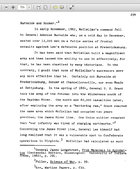
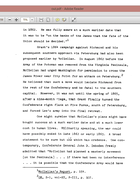
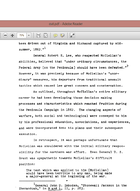
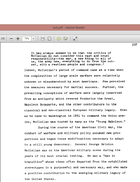
While reading Hartwig's book about Antietam, I have come to the conclusion that he did a marvelous job
moving the army but not so good in attacking Lee.

However, the tactics of the individual attacks were down to the Corps commanders. One can say that neither Hooker nor Burnside nor Sumner covered themselves in glory that day.
 
However the first part exists separately and is definitely Lee's words to his son on the matter. Either Mosby is quoting Lee, or it's an extraordinary coincidence both used the same turn of phrase.

It's not Lee's words to his son. It's what Cazenov Lee claimed Lee said to Cassius Lee. There's really no way Mosby could have known about the claim.

If memory serves he references James Randall who got it "from the horses mouth". Don't take my word for it, but you probably want to look that way.

I'll try to find it, but thus far I haven't seen any primary source yet.

This was, if memory serves, at the 1874 Republican convention. Care to name another senior CS general who'd be there?

Early, Munford, Kemper, and Kershaw to name four. In his book, McCullough only says it was "a Confederate general who served with distinction in the Army of Virginia under Johnston and Lee." He doesn't say it was at the convention, merely that it was in 1874. He also doesn't say it was a senior confederate general.

http://books.google.com/books?id=s-4MAAAAIAAJ&pg=PA317&lpg=PA317&dq=There was no Union general whom we so much dreaded as much as McClellan Hugh McCulloch&source=bl&ots=U9U4MT4wkr&sig=vyiQyAEqKvqwqkglF6GgA2Nf_NY&hl=en&sa=X&ei=f3gTVPiaCo6pogSngoIY&ved=0CB4Q6AEwAA#v=onepage&q=There was no Union general whom we so much dreaded as much as McClellan Hugh McCulloch&f=false
 
The time it took Lee to get his army across the Potomac after Antietam, compared with McClellan's to do the same with his army, says all that really needs to be said about MCClellan and his concepts of speed.
For some aspects of this topic, I am much more in agreement with 67th Tigers than with others.

McClellan had a force crossing the Potomac at Botelers ford the day after Lee crossed, leading to the battle at Sherpardstown on the 20th.

Also on the day after Lee withdrew from Antietam, McClellan sent two Corps of his army to retake Harpers Ferry. They had crossed the Potomac to do this by the 22nd.
 
However, the tactics of the individual attacks were down to the Corps commanders. One can say that neither Hooker nor Burnside nor Sumner covered themselves in glory that day.

But I am not so sure McCellan was completely in control. I don't know exactly what it was but something wasn't jiving.
Maybe with Hartwig's II edition will clarify a little more.
 
But I am not so sure McCellan was completely in control. I don't know exactly what it was but something wasn't jiving.
Maybe with Hartwig's II edition will clarify a little more.

McClellan was as in control as any army commander ever is. Remember the ACs tools for controlling the battle are fairly limited and largely come down to giving general orders to corps or division commanders and committing resources (i.e. reserves) to the actions they're undertaking.

The big question is whether McClellan intended to have Burnside attack his bridge on the 16th or early on the 17th. The data would seem to indicate McClellan gave a verbal order to Burnside to attack the southern bridge and seize the heights somewhen between 1100 and 1200 hrs on the 16th, or maybe to simply have his forces in their start positions for an assault immediately the word was given. Whichever it was, Burnside failed in his mission that day.

McClellan of course commits 1st Corps early afternoon on the 16th to strike on his right, and Hartwig's book covers this quite well. McClellan commits 12th Corps as reinforcements, and has 2 divisions of 2nd Corps stood to ready to cross the creek - an order given before 0720 (the written copy is timestamped 0720, but orders were usually delivered twice - an initial verbal order followed by a written confirmatory order).

The order to Burnside to assault the southern brigade is muddied by Burnside trying to shift it. The timings however are that at ca. 0700 Burnside gave Cox an order to bring the Corps in position. At 0800 Lt Wilson (later regular BG and superintendent of the USMA) carried the order to Burnside to commence the attack, and a confirmatory order was sent 0910.

Thus at 0800 when he shift his command post to near the middle bridge every single division bar the one held back as a final reserve (Morell's) every single division on the field has been committed to something. When Franklin arrives McClellan modified his original plan to mass them in the centre and sent them to Sumner on the right, who is representing the situation as so dire that McClellan orders the main body of his final reserve (Morell) to Sumner.

The attacks of course are disjointed, but that's the nature of the field. The attacks in the northern sector had to pass through a defile, and hence the choice is between speed and mass - you can't have both. McClellan chose speed and aggression that day, probably because he thought he'd cornered a fraction Lee's army. When it was clear Lee had his whole force up McClellan reverted to more deliberate operations.
 
McClellan was as in control as any army commander ever is. Remember the ACs tools for controlling the battle are fairly limited and largely come down to giving general orders to corps or division commanders and committing resources (i.e. reserves) to the actions they're undertaking.

The big question is whether McClellan intended to have Burnside attack his bridge on the 16th or early on the 17th. The data would seem to indicate McClellan gave a verbal order to Burnside to attack the southern bridge and seize the heights somewhen between 1100 and 1200 hrs on the 16th, or maybe to simply have his forces in their start positions for an assault immediately the word was given. Whichever it was, Burnside failed in his mission that day.

McClellan of course commits 1st Corps early afternoon on the 16th to strike on his right, and Hartwig's book covers this quite well. McClellan commits 12th Corps as reinforcements, and has 2 divisions of 2nd Corps stood to ready to cross the creek - an order given before 0720 (the written copy is timestamped 0720, but orders were usually delivered twice - an initial verbal order followed by a written confirmatory order).

The order to Burnside to assault the southern brigade is muddied by Burnside trying to shift it. The timings however are that at ca. 0700 Burnside gave Cox an order to bring the Corps in position. At 0800 Lt Wilson (later regular BG and superintendent of the USMA) carried the order to Burnside to commence the attack, and a confirmatory order was sent 0910.

Thus at 0800 when he shift his command post to near the middle bridge every single division bar the one held back as a final reserve (Morell's) every single division on the field has been committed to something. When Franklin arrives McClellan modified his original plan to mass them in the centre and sent them to Sumner on the right, who is representing the situation as so dire that McClellan orders the main body of his final reserve (Morell) to Sumner.

The attacks of course are disjointed, but that's the nature of the field. The attacks in the northern sector had to pass through a defile, and hence the choice is between speed and mass - you can't have both. McClellan chose speed and aggression that day, probably because he thought he'd cornered a fraction Lee's army. When it was clear Lee had his whole force up McClellan reverted to more deliberate operations.
You make sense. Thanks.
 

Learn About Us
About CivilWarTalk
Contact the Webmaster
Meet the Staff
Link to CivilWarTalk
Join Our Community
Register
Browse Forums
View Today's Discussions
Search the Forum
Get Help
FAQ
Student Guide
Forum Rules & Etiquette
Copyright / DMCA

     Contact Us CivilwarTalk on Facebook CivilWarTalk on YouTube CivilWarTalk on Twitter RSS Feed

Bringing the American Civil War and More to Life.
© 1999 - , CIVILWARTALK, LLC - Site Version 10.0

SlaveryTalk.com - SecessionTalk.com - CivilWarTalk.com - ReconstructionTalk.com
Back
Top