
And as I've repeatedly said, I have looked at all the evidence presented and I disagree with your conclusions.You need to look at all of the evidence, not just the pieces which you have selected.
-
Welcome to CivilWarTalk, a forum about the American Civil War! - Join today! It's fast, simple, and FREE!
- Home
- Forums
- The War of the Rebellion Forums
- Battles & Events of 1861 to 1865
- South & Western Theaters
You are using an out of date browser. It may not display this or other websites correctly.
You should upgrade or use an alternative browser.
You should upgrade or use an alternative browser.
Random Thoughts on Iuka
- Thread starter tony_gunter
- Start date
Do you think that Rosecrans should have stuck with the original plan of covering the Fulton Road, even if it meant not getting into position before dark and having to delay the battle until the next morning?As seen on this map leaving the second road (Fulton) was left uncovered when the plan was altered by time and distance. Price used it for his escape. Had it been sealed as the original plan called for Price would have been in serious trouble even without Ord's attack.

Nathan Towne
2nd Lieutenant
- Joined
- Jan 14, 2023
As you know, if they deliberately held back on the 19th, per the formulation of the plan, the Army of the West would pull back to the east via Bear Creek. We know that the plan was to catch the Army of the West before they could pull out of Iuka either to the south, to the east, or to the north. Such was explicitly stated, numerous times, in the contemporary correspondence. It isn't really subject to being questioned that way. It just is. One need only read the relevant correspondence. That is what was explicitly stated.Do you think that Rosecrans should have stuck with the original plan of covering the Fulton Road, even if it meant not getting into position before dark and having to delay the battle until the next morning?
Nathan Towne
2nd Lieutenant
- Joined
- Jan 14, 2023
You came out of the woodwork with your newfound theory that the Army of the Mississippi was trying to hold back on the 19th and stumbled into the Confederate Army based on a later source which is repudiated by the contemporary record as your most recent epiphany. That tells us what we need to know on that.And as I've repeatedly said, I have looked at all the evidence presented and I disagree with your conclusions.
Look, the record is just the record. It says what it says. That the threat of the Army of the West pulling back to the east was fundamental to the conception of the plan is not really something which can be controverted that way as far as I can see. It just was. One only need to read the relevant contemporary correspondence. That conclusion is essentially inevitable.
Nathan Towne
2nd Lieutenant
- Joined
- Jan 14, 2023
We have to do this again, as you are dishonestly misleading new users who could come on the thread. Absolutely nothing in the contemporary record in terms of what was communicated between the relevant participants contradicts the following correspondence. Quoted from an earlier post. One has to begin there.
As noted previously, Grant sent the following message to Halleck at 8:00 A.M. on September 16th:
"For ten days or more the enemy have been hovering in our front in reported large force. I have watched their moves closely until I could concentrate my forces. All are now in good shape. Hurlbut's division has come from Memphis to Bolivar and about 6,000 troops from Bolivar brought here. General Orice is southeast from us, near Bay Springs, moving northeast. It is reported that Van Dorn and Breckinridge are to join and attack. Form the best information they cannot reach here under four days. My view is they are covering a move to get General Price into East Tennessee. If I can I will attack Price before he crosses Bear Creek. If he can be beaten there, it will prevent either the design to go north or to unite forces and attack here."
-17 OR 2:220
Of course, the results of Mower's reconnaissance were not known to Grant yet at the time in which this message was sent.
Rosecrans to Grant on the 17th (not timestamped):
"Hamilton has sent out Mizner with a regiment of infantry and all our cavalry, under Mizner, toward Barnett's, on the Jacinto and Iuka road. The only thing we can do to prevent Price passing through the defiles of Bear Creek east is to push that division on him and follow it with all of Stanley's force while Ross makes a strong demonstration on his front. This is safe for a day or two if we can keep spies from running to Breckinridge and Van Dorn and Price and you can hold your hand against them. I can pursue with my entire force, which, including Du Bois and Danville, will be about 13,000 men of all arms."
-17 OR 2: 222
Also on September 17th Rosecrans, concerned that they may have already missed their opportunity, wrote the following to Grant:
"Mizner's dispatch just in reports that the cannonading of our reconnoitering party ceased at 4.40 last evening, and that about 8 o'clock last evening a very large fire was seen in the direction of Iuka; the distance is 20 miles. Mizner has gone to feel of them since 4 a.m. My suspicions are that some houses and stores have been burned in Iuka, the place abandoned, and that Price has crossed the defiles of Bear Creek, and will pass the Tennessee before it rises- at the Shoals, if possible; if not, will proceed at once to above Decatur, near Whitesburg."
-17 OR 2: 222-223
After this message had been sent, Rosecrans messaged from Jacinto later on the 17th (not timestamped) stating that Hamilton was sure that Price was still at Iuka.
17 OR 2: 223
He then forwarded the message from Hamilton to Grant at 9:30 P.M.
-17 OR 2: 224
In yet another message, sent on the 17th, Rosecrans expressed his concern regarding a move from Price, stating that had he not been pursued via their reconnoitering force, he would have probably left Iuka destined for the Tennessee Valley.
-17 OR 2: 223-224
In another message to Grant on the 17th (also not timestamped), probably sent after the above message, but certainly after hearing from Hamilton, returned to the concern expressed above, albeit expressing his hope that Grant was covering against a move directly towards Eastport on his front, stating:
"As Price is an old woodpecker it would be well to have a watch set to see if he might not take a course down the Tennessee, toward Eastport, in hopes to find the means of crossing. Have you any lookout toward Hamburg Landing?
-17 OR 2: 224
Of course, as noted above, it was imperative to prevent a move across Bear Creek to the east for the same reason.
Finally, from the Reports section of the Official Records, as it was reprinted in Grant's first report of the operation dated September 20th. The original copy is not contained in the correspondence, as is the case with many messages and orders, of course.
It was also not timestamped and is dated September 18th from Rosecrans to Grant. It read:
"One of my spies, in from Reardon's, on the Bay Springs Road, tells of a continuous movement since last Friday of forces eastward. They say Van Dorn is to defend Vicksburg, Breckinridge to make his way to Kentucky, and Price to attack Iuka or to go to Tennessee. If Price's forces are at Iuka the plan I propose is to move up as close as we can to-night and conceal our movements; Ord to advance from Burnsville, commence the attack, and draw their attention that way, while I move in on the Jacinto and Fulton roads, massing heavily on the Fulton road, and crushing in their left and cutting off their retreat eastward. I propose to leave in ten minutes for Jacinto, from whence I will dispatch you, by line of vedettes, to Burnsville. Will await a few minutes to hear from you before I start. What news from Burnsville?"
-17 OR 1: 66
As can be seen, the Fulton road was just one way out. It was just one way out. Rosecrans and Grant has been in communication regarding the situation quite steadily and continuously, to that point.
Additionally, all of this makes perfect logical sense from the perspective that one has to account for the purpose of the movement to Iuka in the first place.
So, as far as the notion that the High Command were cognizant of the Army of the West being able to fall back to the east across Bear Creek and that such recognition was fundamental to the conception of the plan, it is really all but incontrovertible as far as that is concerned. One only need to read the relevant correspondence.
That was really my principal point that way and one only need look at the record that way. Whether that assessment was accurate, or not, is really something of a separate discussion, although I do believe that there is evidence to indicate that it probably was. That is a serious potential discussion though.
As noted previously, Grant sent the following message to Halleck at 8:00 A.M. on September 16th:
"For ten days or more the enemy have been hovering in our front in reported large force. I have watched their moves closely until I could concentrate my forces. All are now in good shape. Hurlbut's division has come from Memphis to Bolivar and about 6,000 troops from Bolivar brought here. General Orice is southeast from us, near Bay Springs, moving northeast. It is reported that Van Dorn and Breckinridge are to join and attack. Form the best information they cannot reach here under four days. My view is they are covering a move to get General Price into East Tennessee. If I can I will attack Price before he crosses Bear Creek. If he can be beaten there, it will prevent either the design to go north or to unite forces and attack here."
-17 OR 2:220
Of course, the results of Mower's reconnaissance were not known to Grant yet at the time in which this message was sent.
Rosecrans to Grant on the 17th (not timestamped):
"Hamilton has sent out Mizner with a regiment of infantry and all our cavalry, under Mizner, toward Barnett's, on the Jacinto and Iuka road. The only thing we can do to prevent Price passing through the defiles of Bear Creek east is to push that division on him and follow it with all of Stanley's force while Ross makes a strong demonstration on his front. This is safe for a day or two if we can keep spies from running to Breckinridge and Van Dorn and Price and you can hold your hand against them. I can pursue with my entire force, which, including Du Bois and Danville, will be about 13,000 men of all arms."
-17 OR 2: 222
Also on September 17th Rosecrans, concerned that they may have already missed their opportunity, wrote the following to Grant:
"Mizner's dispatch just in reports that the cannonading of our reconnoitering party ceased at 4.40 last evening, and that about 8 o'clock last evening a very large fire was seen in the direction of Iuka; the distance is 20 miles. Mizner has gone to feel of them since 4 a.m. My suspicions are that some houses and stores have been burned in Iuka, the place abandoned, and that Price has crossed the defiles of Bear Creek, and will pass the Tennessee before it rises- at the Shoals, if possible; if not, will proceed at once to above Decatur, near Whitesburg."
-17 OR 2: 222-223
After this message had been sent, Rosecrans messaged from Jacinto later on the 17th (not timestamped) stating that Hamilton was sure that Price was still at Iuka.
17 OR 2: 223
He then forwarded the message from Hamilton to Grant at 9:30 P.M.
-17 OR 2: 224
In yet another message, sent on the 17th, Rosecrans expressed his concern regarding a move from Price, stating that had he not been pursued via their reconnoitering force, he would have probably left Iuka destined for the Tennessee Valley.
-17 OR 2: 223-224
In another message to Grant on the 17th (also not timestamped), probably sent after the above message, but certainly after hearing from Hamilton, returned to the concern expressed above, albeit expressing his hope that Grant was covering against a move directly towards Eastport on his front, stating:
"As Price is an old woodpecker it would be well to have a watch set to see if he might not take a course down the Tennessee, toward Eastport, in hopes to find the means of crossing. Have you any lookout toward Hamburg Landing?
-17 OR 2: 224
Of course, as noted above, it was imperative to prevent a move across Bear Creek to the east for the same reason.
Finally, from the Reports section of the Official Records, as it was reprinted in Grant's first report of the operation dated September 20th. The original copy is not contained in the correspondence, as is the case with many messages and orders, of course.
It was also not timestamped and is dated September 18th from Rosecrans to Grant. It read:
"One of my spies, in from Reardon's, on the Bay Springs Road, tells of a continuous movement since last Friday of forces eastward. They say Van Dorn is to defend Vicksburg, Breckinridge to make his way to Kentucky, and Price to attack Iuka or to go to Tennessee. If Price's forces are at Iuka the plan I propose is to move up as close as we can to-night and conceal our movements; Ord to advance from Burnsville, commence the attack, and draw their attention that way, while I move in on the Jacinto and Fulton roads, massing heavily on the Fulton road, and crushing in their left and cutting off their retreat eastward. I propose to leave in ten minutes for Jacinto, from whence I will dispatch you, by line of vedettes, to Burnsville. Will await a few minutes to hear from you before I start. What news from Burnsville?"
-17 OR 1: 66
As can be seen, the Fulton road was just one way out. It was just one way out. Rosecrans and Grant has been in communication regarding the situation quite steadily and continuously, to that point.
Additionally, all of this makes perfect logical sense from the perspective that one has to account for the purpose of the movement to Iuka in the first place.
So, as far as the notion that the High Command were cognizant of the Army of the West being able to fall back to the east across Bear Creek and that such recognition was fundamental to the conception of the plan, it is really all but incontrovertible as far as that is concerned. One only need to read the relevant correspondence.
That was really my principal point that way and one only need look at the record that way. Whether that assessment was accurate, or not, is really something of a separate discussion, although I do believe that there is evidence to indicate that it probably was. That is a serious potential discussion though.
Obviously I disagree.As you know, if they deliberately held back on the 19th, per the formulation of the plan, the Army of the West would pull back to the east via Bear Creek. We know that the plan was to catch the Army of the West before they could pull out of Iuka either to the south, to the east, or to the north. Such was explicitly stated, numerous times, in the contemporary correspondence. It isn't really subject to being questioned that way. It just is. One need only read the relevant correspondence. That is what was explicitly stated.
Yes, the record is the record. But your interpretation of the record is very subjective and I don't agree with the conclusions that you've reached.You came out of the woodwork with your newfound theory that the Army of the Mississippi was trying to hold back on the 19th and stumbled into the Confederate Army based on a later source which is repudiated by the contemporary record as your most recent epiphany. That tells us what we need to know on that.
Look, the record is just the record. It says what it says. That the threat of the Army of the West pulling back to the east was fundamental to the conception of the plan is not really something which can be controverted that way as far as I can see. It just was. One only need to read the relevant contemporary correspondence. That conclusion is essentially inevitable.
Yes, there absolutely was a concern on the part of Grant and Rosecrans in the days leading up to the battle that Price might want to cross Bear Creek into Alabama, and then go on to join Bragg.We have to do this again, as you are dishonestly misleading new users who could come on the thread. Absolutely nothing in the contemporary record in terms of what was communicated between the relevant participants contradicts the following correspondence. Quoted from an earlier post. One has to begin there.
As noted previously, Grant sent the following message to Halleck at 8:00 A.M. on September 16th:
"For ten days or more the enemy have been hovering in our front in reported large force. I have watched their moves closely until I could concentrate my forces. All are now in good shape. Hurlbut's division has come from Memphis to Bolivar and about 6,000 troops from Bolivar brought here. General Orice is southeast from us, near Bay Springs, moving northeast. It is reported that Van Dorn and Breckinridge are to join and attack. Form the best information they cannot reach here under four days. My view is they are covering a move to get General Price into East Tennessee. If I can I will attack Price before he crosses Bear Creek. If he can be beaten there, it will prevent either the design to go north or to unite forces and attack here."
-17 OR 2:220
Of course, the results of Mower's reconnaissance were not known to Grant yet at the time in which this message was sent.
Rosecrans to Grant on the 17th (not timestamped):
"Hamilton has sent out Mizner with a regiment of infantry and all our cavalry, under Mizner, toward Barnett's, on the Jacinto and Iuka road. The only thing we can do to prevent Price passing through the defiles of Bear Creek east is to push that division on him and follow it with all of Stanley's force while Ross makes a strong demonstration on his front. This is safe for a day or two if we can keep spies from running to Breckinridge and Van Dorn and Price and you can hold your hand against them. I can pursue with my entire force, which, including Du Bois and Danville, will be about 13,000 men of all arms."
-17 OR 2: 222
Also on September 17th Rosecrans, concerned that they may have already missed their opportunity, wrote the following to Grant:
"Mizner's dispatch just in reports that the cannonading of our reconnoitering party ceased at 4.40 last evening, and that about 8 o'clock last evening a very large fire was seen in the direction of Iuka; the distance is 20 miles. Mizner has gone to feel of them since 4 a.m. My suspicions are that some houses and stores have been burned in Iuka, the place abandoned, and that Price has crossed the defiles of Bear Creek, and will pass the Tennessee before it rises- at the Shoals, if possible; if not, will proceed at once to above Decatur, near Whitesburg."
-17 OR 2: 222-223
After this message had been sent, Rosecrans messaged from Jacinto later on the 17th (not timestamped) stating that Hamilton was sure that Price was still at Iuka.
17 OR 2: 223
He then forwarded the message from Hamilton to Grant at 9:30 P.M.
-17 OR 2: 224
In yet another message, sent on the 17th, Rosecrans expressed his concern regarding a move from Price, stating that had he not been pursued via their reconnoitering force, he would have probably left Iuka destined for the Tennessee Valley.
-17 OR 2: 223-224
In another message to Grant on the 17th (also not timestamped), probably sent after the above message, but certainly after hearing from Hamilton, returned to the concern expressed above, albeit expressing his hope that Grant was covering against a move directly towards Eastport on his front, stating:
"As Price is an old woodpecker it would be well to have a watch set to see if he might not take a course down the Tennessee, toward Eastport, in hopes to find the means of crossing. Have you any lookout toward Hamburg Landing?
-17 OR 2: 224
Of course, as noted above, it was imperative to prevent a move across Bear Creek to the east for the same reason.
Finally, from the Reports section of the Official Records, as it was reprinted in Grant's first report of the operation dated September 20th. The original copy is not contained in the correspondence, as is the case with many messages and orders, of course.
It was also not timestamped and is dated September 18th from Rosecrans to Grant. It read:
"One of my spies, in from Reardon's, on the Bay Springs Road, tells of a continuous movement since last Friday of forces eastward. They say Van Dorn is to defend Vicksburg, Breckinridge to make his way to Kentucky, and Price to attack Iuka or to go to Tennessee. If Price's forces are at Iuka the plan I propose is to move up as close as we can to-night and conceal our movements; Ord to advance from Burnsville, commence the attack, and draw their attention that way, while I move in on the Jacinto and Fulton roads, massing heavily on the Fulton road, and crushing in their left and cutting off their retreat eastward. I propose to leave in ten minutes for Jacinto, from whence I will dispatch you, by line of vedettes, to Burnsville. Will await a few minutes to hear from you before I start. What news from Burnsville?"
-17 OR 1: 66
As can be seen, the Fulton road was just one way out. It was just one way out. Rosecrans and Grant has been in communication regarding the situation quite steadily and continuously, to that point.
Additionally, all of this makes perfect logical sense from the perspective that one has to account for the purpose of the movement to Iuka in the first place.
So, as far as the notion that the High Command were cognizant of the Army of the West being able to fall back to the east across Bear Creek and that such recognition was fundamental to the conception of the plan, it is really all but incontrovertible as far as that is concerned. One only need to read the relevant correspondence.
That was really my principal point that way and one only need look at the record that way. Whether that assessment was accurate, or not, is really something of a separate discussion, although I do believe that there is evidence to indicate that it probably was. That is a serious potential discussion though.
But not one of these sources explicitly includes a route that the confederates would follow to cross Bear Creek. Would they be moving northeast from Bay Springs as Grant indicated on the 16th? Would they move to Cartersville and then east? There simply was not one single solitary way to cross Bear Creek into Alabama. So this false implication that every mention of Bear Creek must have to mean moving directly east from Iuka is just simply wrong. It's a faulty interpretation of the evidence.

1SGDan
Major
- Joined
- Dec 13, 2009
- Location
- New Hampshire
As it turned out Ord was not going forward with his attack, but that doesn't mean a more aggressive push to cover both exit roads could not be effective towards negating Price's orders for unification.Do you think that Rosecrans should have stuck with the original plan of covering the Fulton Road, even if it meant not getting into position before dark and having to delay the battle until the next morning?
1SGDan
Major
- Joined
- Dec 13, 2009
- Location
- New Hampshire
Please feel better.I have not been feeling well of late, but I am going to print out your piece today and read it and offer my feedback.
Nathan Towne
2nd Lieutenant
- Joined
- Jan 14, 2023
Yeah. The only thing which the U.S. command knew though was that the Confederate force could pull back. They don't know about the orders which had been received on the morning of the 19th to move to unite with Van Dorn's forces. Furthermore, regardless, as long as the threat existed of the Army of the West pulling back directly to the east existed, as it was explicitly stated in the conception and discussion of the plan that such was understood to be the case, the attack would have to go forward if possible on the 19th because the Confederates knew that they were coming. Grant didn't ask for Rosecrans to hold the attack back until the 20th per what we have and is instead simply on record as having possibly discussed with Ord that it was unlikely that they would be able to make it by the end of the day of the 19th. The reality was that the Confederates knew that they were coming by mid-day on the 19th, so there really doesn't seem to have been any viable option other than to press on.As it turned out Ord was not going forward with his attack, but that doesn't mean a more aggressive push to cover both exit roads could not be effective towards negating Price's orders for unification.
The way I see it, once this is recognized, it wasn't the lack of blocking the Fulton road from the outset which derailed the plan. The Confederates could have fallen on either force individually or pulled back to the east that night. The Army of the Mississippi had to get to the connecting road and launch the attack in order to prevent that, anyways. Failure to do so would probably mean failure of the plan regardless, so it was imperative that the Army of the Mississippi get to the connecting road (in which the Jacinto and Fulton roads would be mutually supporting and hence could far more safely be covered) anyways, from where the attack could be launched.
Nathan Towne
2nd Lieutenant
- Joined
- Jan 14, 2023
Thank you brother.Please feel better.
I think that if Rosecrans covered both exit roads as planned, but he didn't get into position on both roads until after sundown, it would have left Price with some hard decisions.As it turned out Ord was not going forward with his attack, but that doesn't mean a more aggressive push to cover both exit roads could not be effective towards negating Price's orders for unification.
I don't see Price trying to navigate the difficult terrain to the east as an escape route, especially at night. Perhaps he would have tried to fight his way out on the Fulton Road at dawn on the 20th.
At any rate, once the battle was brought on with the Fulton Road left uncovered, there doesn't seem to be any way of salvaging the plan. It was pretty much a complete failure at that point.

SSVilla
First Sergeant
- Joined
- Mar 25, 2024
- Location
- Virginia, USA
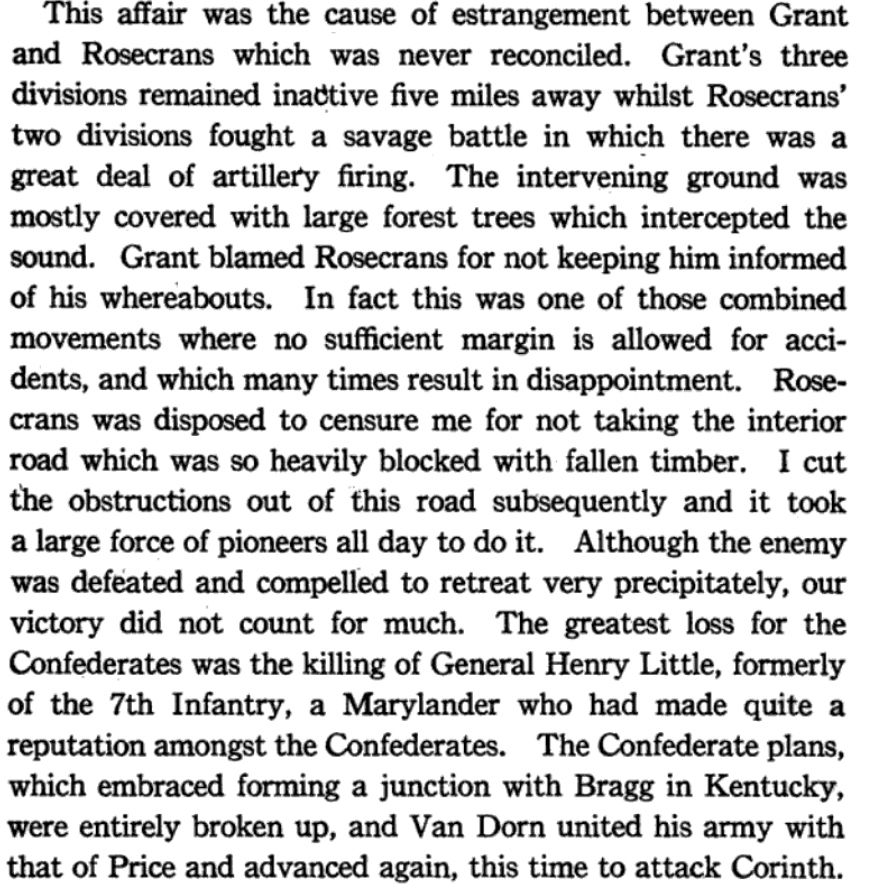
I found this statement in Gen.D.S. Stanley's memoirs, which I just discovered as a reference in something else. This statement came in 1902, much after the events, and is just Stanley's opinion, with no objectivity behind it. Anyways, Stanley basically agrees that the battle plan was one of those that generally requires such precision, leaving no margin for error that it invariably leads to disappointment.
He was of the opinion that Iuka is where the antagonism between Grant and Rosecrans started. I am not convinced that was the case Grant, but I am for Rosecrans, although even with Rosecrans I also wonder if it wouldn't have subsided had nothing else happened to embitter him further. However because of his experience with McClellan in Rich Mountain and his temper, I don't think he ever let this go. No one seems to be making that argument on his behalf either.
I find Cozzens unsatisfying on this point tbh, which is why I am reading the book in the first place…
He was of the opinion that Iuka is where the antagonism between Grant and Rosecrans started. I am not convinced that was the case Grant, but I am for Rosecrans, although even with Rosecrans I also wonder if it wouldn't have subsided had nothing else happened to embitter him further. However because of his experience with McClellan in Rich Mountain and his temper, I don't think he ever let this go. No one seems to be making that argument on his behalf either.
I find Cozzens unsatisfying on this point tbh, which is why I am reading the book in the first place…
SSVilla
First Sergeant
- Joined
- Mar 25, 2024
- Location
- Virginia, USA
Thanks for sharing this. I am really behind on this thread and still reading Cozzens but I'll check this up. I have read your write ups before and learned a lot. Thank you.
Iuka - Victory as Failure | South & Western Theaters
Introduction In a recent thread another poster posed the question of why the battle of Iuka was considered a Union victory. Before responding I decided to review the battle in an effort to justify or dispel the outcome as a Union victory. What I discovered was actually a surprising mix of...civilwartalk.com
I did a lot of research on this battle and feel quite confident in my knowledge of it. Pleas see the above.
"Rosecrans was disposed to censure me for not taking the interior road which was so heavily blocked with fallen timber."I found this statement in Gen.D.S. Stanley's memoirs, which I just discovered as a reference in something else. This statement came in 1902, much after the events, and is just Stanley's opinion, with no objectivity behind it. Anyways, Stanley basically agrees that the battle plan was one of those that generally requires such precision, leaving no margin for error that it invariably leads to disappointment.
He was of the opinion that Iuka is where the antagonism between Grant and Rosecrans started. I am not convinced that was the case Grant, but I am for Rosecrans, although even with Rosecrans I also wonder if it wouldn't have subsided had nothing else happened to embitter him further. However because of his experience with McClellan in Rich Mountain and his temper, I don't think he ever let this go. No one seems to be making that argument on his behalf either.
I find Cozzens unsatisfying on this point tbh, which is why I am reading the book in the first place…
View attachment 521989
Interior road?
Nathan Towne
2nd Lieutenant
- Joined
- Jan 14, 2023
One can make that argument, but they have to do so in the face of the conception of the plan and how the situation was understood at the time, as was expressed in the contemporary correspondence between Rosecrans and Grant.I think that if Rosecrans covered both exit roads as planned, but he didn't get into position on both roads until after sundown, it would have left Price with some hard decisions.
I don't see Price trying to navigate the difficult terrain to the east as an escape route, especially at night. Perhaps he would have tried to fight his way out on the Fulton Road at dawn on the 20th.
At any rate, once the battle was brought on with the Fulton Road left uncovered, there doesn't seem to be any way of salvaging the plan. It was pretty much a complete failure at that point.
Whether than conception was an accurate reflection of the situation as it actually existed is a debatable point, but you have to recognize such in order to understand the course of events. Beyond this, while debatable, I think that the evidence supports the notion that the reality of the situation was accurately reflected in the planning and articulation of the plan, but as to the nature of the operation as it was actually conceived, that has been wholly established.
SSVilla
First Sergeant
- Joined
- Mar 25, 2024
- Location
- Virginia, USA
I have to double check, because I am not sharp on what specific divisions were doing and he's not clear about what road he's talking about here. We'd have to figure out what he was doing."Rosecrans was disposed to censure me for not taking the interior road which was so heavily blocked with fallen timber."
Interior road?
By the way, Stanley comes across as a highly jealous General, green with envy, which is kind of surprising because he had a long military career attaining the rank of brigadier general in the regular army and no one wronged him. However, he is very jealous of the reputations attained during the war by Grant, Sherman, and Sheridan and has that Army of the Cumberland envy that is almost a trademark. It's really very evident. I almost can't emphasize it enough. He's not bonkers crazy, full of conspiracy theories like Piatt, or as argumentative and fictitious as Boynton, but he's definitely jealous.
For example, one would think he'd say more about this Iuka battle of which he was a part, than he would write about the first day of the battle of Shiloh in which he wasn't present. But he must insist, and narrate a version of Shiloh in which Grant's entire army was completely "defeated" and Buell saved him. And he has to narrate how Sheridan placed his little cavalry in a completely desperate situation at Booneville, out of range of infantry support from which he extricated them with the help of Captain Alger, in a little battle of a few hours with little losses on either side, and then milked that to be promoted to Brigadier, eventually to become a General of the Army on his deathbed while Alger eventually became a member of the cabinet and a governor of his state. He writes nothing about anything these two men did afterwards to eventually get to the level they got in life. He was full of envy.
Anyways, no word from him on what road he's talking about, but this is all that Stanley wrote about that interior road:
"The enemy being located at Iuka, Rosecrans was ordered to make a detour and place his two divisions, Hamilton and Stanley, south of Price's army and cut off his retreat to the south. On the 20th of September these divisions marched all day,-an excessively hot day-and fought the battle of Iuka at sundown. The inner and shorter road, assigned to me, was effectually blocked by fallen trees. I was therefore compelled to march along a longer road."
Excerpt From Personal Memoirs of Major-General D. S. Stanley, U. S. A.
David Sloane Stanley
I disagree. It's obvious that we have different understandings of the plan, and by no means has anything been "wholly established."One can make that argument, but they have to do so in the face of the conception of the plan and how the situation was understood at the time, as was expressed in the contemporary correspondence between Rosecrans and Grant.
Whether than conception was an accurate reflection of the situation as it actually existed is a debatable point, but you have to recognize such in order to understand the course of events. Beyond this, while debatable, I think that the evidence supports the notion that the reality of the situation was accurately reflected in the planning and articulation of the plan, but as to the nature of the operation as it was actually conceived, that has been wholly established.
SSVilla
First Sergeant
- Joined
- Mar 25, 2024
- Location
- Virginia, USA
Some quick info on Stanley. Cozzens described him as capable but petulant (pg 34).
————
Stanley's division was the cause of delay twice. It had been raining heavily on September 17, 1862 which delayed his rendezvous with Hamilton. Rosecrans reassured Grant that he'd still push past the original point set for the following day. (Cozzens pg 68). On September 18, Stanley again was the cause for delay. "Whether from treachery or by accident" Stanley's guide led him down a wrong road. This should have raised the alarm because Stanley reached Jacinto at 9:00 pm. Instead Rosecrans sent another reassuring message to Grant indicating he'd still get to Iuka on September 19 by 2:00 pm and would endeavor to do it strongly… That started a cascade of failures which he have recounted here.
I could not find anything about this specifically on a quick search of Cozzens book, but I looked at maps of the battle shared in this thread and there are several minor roads unnamed. I assume Rosecrans was looking for a way to flank Price and didn't find it because the latter had ordered trees felled to cover his flanks and funnel Rosecrans exactly to where he wanted him. Credit and points to Price.
I include this map taken from the official atlas, which I had already shared, because there is an "inside road," — not the Fulton road, or even the perpendicular road that connects the Fulton and Jacinto roads — nor is it the Mill road. It's drawn with a pattern of connected dots and unnamed. It may be incorrectly drawn, but there was an additional road. This map would lead one to believe that road would have led to flanking Price.
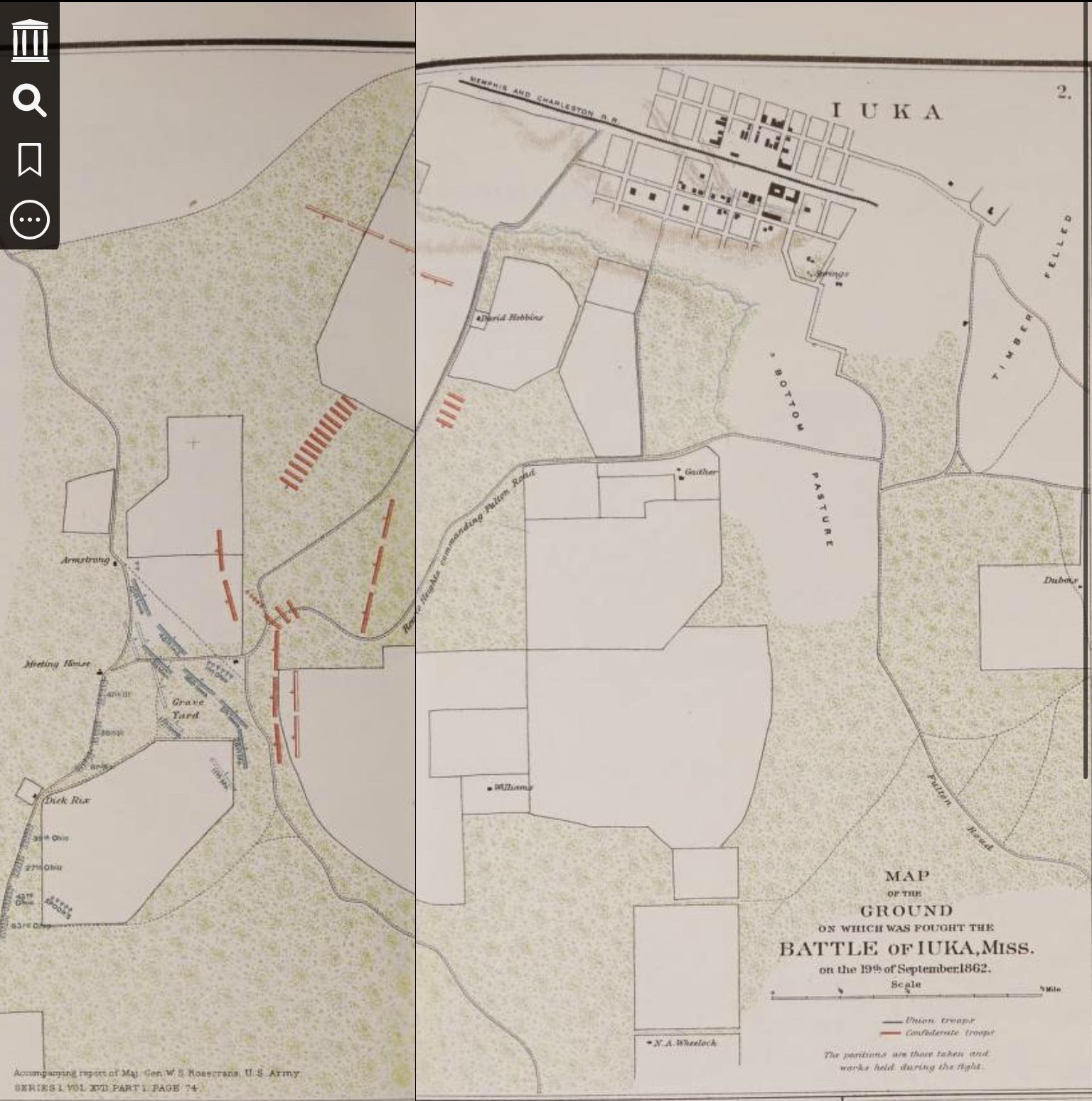
Here's a different map, shared by @DanSBHawk, much earlier in this thread from the Comte de Paris. It shows some unnamed "interior roads" in the shape of a trident.

There's this other map provided by @Nathan Towne. I don't know anything about its origin. This one doesn't show any interior roads, but marks Stanley with an arrow directed to the Mill Road.

————
Stanley's division was the cause of delay twice. It had been raining heavily on September 17, 1862 which delayed his rendezvous with Hamilton. Rosecrans reassured Grant that he'd still push past the original point set for the following day. (Cozzens pg 68). On September 18, Stanley again was the cause for delay. "Whether from treachery or by accident" Stanley's guide led him down a wrong road. This should have raised the alarm because Stanley reached Jacinto at 9:00 pm. Instead Rosecrans sent another reassuring message to Grant indicating he'd still get to Iuka on September 19 by 2:00 pm and would endeavor to do it strongly… That started a cascade of failures which he have recounted here.
I could not find anything about this specifically on a quick search of Cozzens book, but I looked at maps of the battle shared in this thread and there are several minor roads unnamed. I assume Rosecrans was looking for a way to flank Price and didn't find it because the latter had ordered trees felled to cover his flanks and funnel Rosecrans exactly to where he wanted him. Credit and points to Price.
I include this map taken from the official atlas, which I had already shared, because there is an "inside road," — not the Fulton road, or even the perpendicular road that connects the Fulton and Jacinto roads — nor is it the Mill road. It's drawn with a pattern of connected dots and unnamed. It may be incorrectly drawn, but there was an additional road. This map would lead one to believe that road would have led to flanking Price.
Here's a different map, shared by @DanSBHawk, much earlier in this thread from the Comte de Paris. It shows some unnamed "interior roads" in the shape of a trident.
There's this other map provided by @Nathan Towne. I don't know anything about its origin. This one doesn't show any interior roads, but marks Stanley with an arrow directed to the Mill Road.
Similar threads

- Question
- Replies
- 57
- Views
- 563
- Replies
- 86
- Views
- 891

- Replies
- 1
- Views
- 207
- Replies
- 6
- Views
- 126
Similar threads

- Replies
- 4
- Views
- 5

- Learn About Us
- ►About CivilWarTalk
- ►Contact the Webmaster
- ►Meet the Staff
- ►Link to CivilWarTalk
- Join Our Community
- ►Register
- ►Browse Forums
- ►View Today's Discussions
- ►Search the Forum
- Get Help
- ►FAQ
- ►Student Guide
- ►Forum Rules & Etiquette
- ►Copyright / DMCA
 Bringing the