McClellan at Antietam

Since the issue of McClellan's move on Frederick came up, I thought I'd point a few things out.

The first is that Lee historically decided to leave Frederick on the 9th of September (which is when SO 191 was issued, for march beginning on the 10th), and that he could quite conceivably have left earlier. But the first that McClellan can know that Lee is moving is the 10th, and it would be quite realistic that he wouldn't be sure until his cavalry can penetrate the Confederate cavalry screen.

The second is that if Lee decided to stay and defend the line of the Monocacy then McClellan's ability to force that line is directly related to how broad an attack he's conducting. If he's coming in on a narrow front then his superior numbers mean basically nothing, and if you're going to set up for a move around the flank it's best to do so at enough of a distance that the enemy can't strike you in the middle of the manoeuvre.


So here's the positions at dusk on the 8th, 9th, 10th, 11th and 12th. The key is that:
Red is Confederate infantry formations.
Orange is Confederate cavalry.
Green is Union cavalry.
Blue is Union infantry formations.

Base maps are from the GCACW maps. Data is largely from Carman's campaign positions map with some data from an article by Gene Thorp.

8th September:
Night_of_8th.jpg

At this point McClellan's three main wings have formed - those being Franklin's wing (6th Corps plus Couch's division), Sumner's wing (2nd and 12th Corps) and Burnside's wing (9th and 1st Corps). Sykes is effectively attached to Sumner's wing, because Porter has not yet been released to McClellan's OpCon.
If Sumner marched straight down the pike road, he'd hit the Monocacy on the 10th or so, but he'd do it in a situation where he was at a great disadvantage - attacking with one column down a single road against a strong enemy on the far side of a river. It's a recipe for disaster.
Meanwhile, McClellan's cavalry screen is pushed out to engage the enemy cavalry screen.

Lee is in a posture around Frederick which is good for defence. All the approach routes are well screened and he's behind a water feature.


9th September.
Night_of_9th.jpg

Sumner's wing largely holds position, and the main thing that happens for Franklin's wing is that Couch pulls into line, but Burnside's wing moves north and spreads out. This is widening the fighting front which the army can present when it makes contact, and the manoeuvre is taking place outside the range of an opportunistic strike by Lee.
The cavalry screen is now in close contact, except for the section which has diverted north to cover the National Road.

This is the day Lee decides to leave Frederick. Notably though Walker's position is good to block 6th Corps.


10th September.
Night_of_10th.jpg


Lee's army actually doesn't move all that far as the result of the first day of marching - or, rather, it's comparable with the move made by McClellan's leading corps to South Mountain a few days later.
The Confederate cavalry screen remains in place, screening the movement. Franklin and Sumner move up to the same positions as the Union cavalry screen, but Burnside's wing doesn't move much.
My suspicion (and it is only a suspicion) is that this is so that the lateral movement Burnside's wing is going to make is delayed until it's got a strong screen on the flank. It could simply be that the wing is resting for the movement it's about to make, though.


11th September.
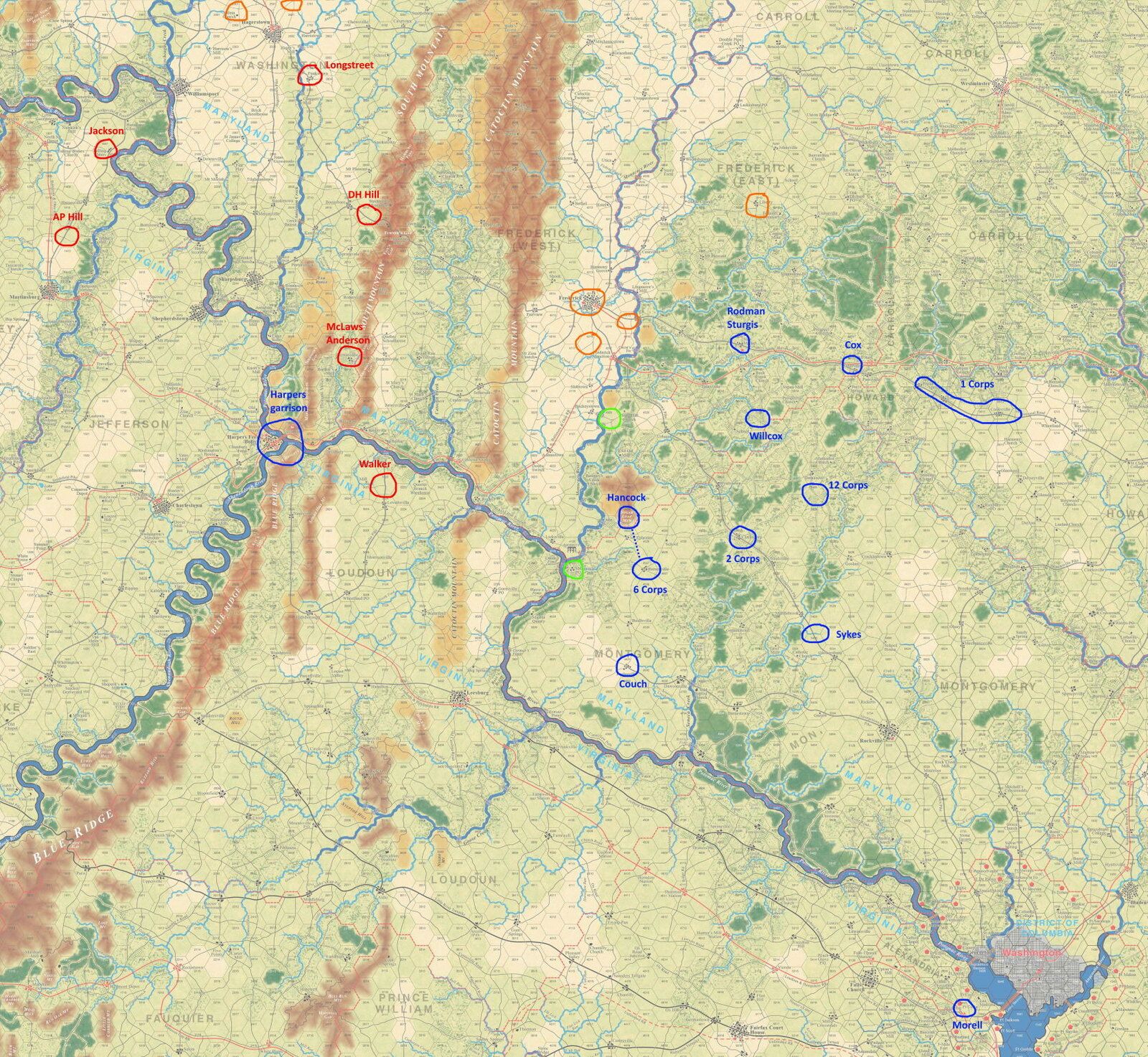
Night_of_11th.jpg

This is when the last of the Confederate army moves out of Frederick. It's taken the bulk of their army two days to leave Frederick and get to the far side of South Mountain, not counting Walker's brigades and the cavalry (which is still in control of Frederick, though it's being pushed back and I believe that by this point it would be quite possible for Union cavalry to confirm that the Confederate army is moving west through a process of elimination)

The 12th will be when Morell is able to start moving to join McClellan's army.

9th Corps surges forwards (Rodman and Sturgis appear to move 16+ miles), and with 1st Corps they establish themselves on the National Road. This means McClellan now has two pike roads to advance down towards Frederick.


12th September:

Night_of_12th.jpg
Which is what he does on the 12th.
9th and 6th Corps cross the river at widely separated points, and the rest of the Union army closes up to the Monocacy; the Union cavalry drives Stuart out of Frederick, though the mountain passes remain in Confederate hands.


The interesting questions to me that this raises basically revolve around what could have happened if McClellan had pushed towards Frederick more directly (and on a narrower front). The first thing is that Lee could have stepped up his own timetable and marched out earlier, but the second thing is that it's quite possible Lee could instead have defended the line of the Monocacy - especially if there's a single Union column pushing up the Rockville turnpike. This would be Lee's army with no straggling and would be a fearsome thing to attack...
 
Lincoln's orders a few days before Antietam were that the following were appointed to Corps command:

1st Corps - Reno vice McDowell
2nd Corps - Sumner
5th Corps - Hooker vice Porter
6th Corps - Franklin relieved, corps ordered to be attached to 3rd Corps
9th Corps - Burnside
12th Corps - Banks
I've been looking at this a bit, and something that caught my eye was that if 6th Corps was to be attached to 3rd Corps - does that mean McClellan was only going to be allowed to take 1st, 2nd, 5th, 9th and 12th?

Depending on what "5th Corps" actually means in this context that could be an army considerably weaker than the one McClellan actually fought with in Maryland.
 
For my part, I don't think McClellan was amazing - I think he was more capable than he is usually considered, and the reason for this is that the challenges he faced are not sufficiently examined which means his achievements are not considered in the proper context.

What I suspect was the case for McClellan was that he had:

1) At least some natural command talent, and by that I mean that certain aspects of tactics and operations came easily to him relative to others.
2) Practical experience with logistics and rail lines.
3) Officer training.
4) Combat experience.
Although often overlooked because of what McClellan "didn't do", #3 is extremely important for military success. And McClellan was superb at preparing troops for combat. It can also be said that once property led, the Unions troops performed very well, which stemmed from that training they received while McClellan was in command.
 
Although often overlooked because of what McClellan "didn't do", #3 is extremely important for military success. And McClellan was superb at preparing troops for combat. It can also be said that once property led, the Unions troops performed very well, which stemmed from that training they received while McClellan was in command.
I think to be honest it's worth looking again at an important detail about Antietam, with that in mind.


Look at the units in McClellan's army.

1st Corps - mostly composed of what used to be the Department of the Rappahanock, which was formed of the core of McClellan's old 1st Corps but had significant injections of troops McClellan never had the chance to train.
2nd Corps - mostly troops McClellan trained, but with three regiments of raw recruits.
5th Corps - Sykes was mostly troops McClellan trained, Morell had a numerically significant injection of new troops.
6th Corps - mostly troops McClellan trained, with some new troops.
9th Corps - none of these troops were McClellan trained.
12th Corps - most of these troops did not have any significant time training under McClellan (they were originally the Dept. of the Shenandoah which had been McClellan's 5th Corps back in March, but they were not intended for an offensive role)


Then from the end of Antietam to the start of Loudoun, McClellan was training these troops about as hard as possible. It's perhaps not a coincidence that the most fragile corps in the Army of the Potomac going forwards was 11th Corps - the one which never had a significant amount of time under the drum as part of McClellan's army.


With that being said, though, I'd contest the "once properly led" point, unless it's about the divisional- and corps-level commanders who still needed some time to shake out. Certainly it can't have helped that McClellan basically didn't get to pick most of his own commanders, and indeed had a hell of a fight to get rid of his worst division commander back on the Peninsula.


The top level commander bears responsibility for the level of leadership in his command, and "there are no bad troops, only bad officers", but it is important to realize that McClellan actually has very little ability to affect the command arrangements at the corps or division level. Normally we give the top level commander responsibility because he has the ability to change things (up to and including getting rid of an incompetent commander) but if there's an incompetent commander in McClellan's army at the divisional or corps command level he often does not have the ability to get rid of them - explicitly he does not at corps level, and at divisional level sacking even a single commander was a lot of effort and a decision Lincoln told him off for.
 
I've been looking at this a bit, and something that caught my eye was that if 6th Corps was to be attached to 3rd Corps - does that mean McClellan was only going to be allowed to take 1st, 2nd, 5th, 9th and 12th?

Depending on what "5th Corps" actually means in this context that could be an army considerably weaker than the one McClellan actually fought with in Maryland.
Dan Vermilya showed that Halleck thought 5th Corps was over 20,000 strong without Humphreys. This was because it took over it's old position on the Arlington Heights immediately after 2nd Bull Run, and for a few days "Defences, South of the Potomac" was suborned to the corps.

Before the rout at Bull Run, the 5th Corps had 8,994 PFD on the August monthly return, but a field return of the 1st September showed:

Morell: 3,620 infantry and 247 gunners in 2 btys
Sykes: 3,202 infantry and 287 gunners in 3 small (4 gun) btys

or 6,822 infantry PFD, far less than a division a few months before.

Morell's division was "fattened up" with two new raw regiments, and the new division was formed for Humphreys
 
Dan Vermilya showed that Halleck thought 5th Corps was over 20,000 strong without Humphreys. This was because it took over it's old position on the Arlington Heights immediately after 2nd Bull Run, and for a few days "Defences, South of the Potomac" was suborned to the corps.
Right, but if McClellan actually gets to take only 1st, 2nd, 9th, 12th and "5th Corps" proper (without Humphreys, but with the extra bulk from the two new regiments) and doesn't get 6th Corps, then McClellan's total maneouvre strength in Maryland when he marches out of Washington is actually on par with - if not slightly weaker than - Lee's total manoeuvre strength.
 
I thought Welker's analysis was interesting. Specifically, he placed a lot of blame on Hooker for McClellan's plan unraveling on September 17.

I think there is a certain amount of truth in Welker's analysis. I believe it might be overstated a bit, but I would have to really study his arguments more than I have to this point. McClellan would be far from the only general who didn't adapt real well when his initial plan unraveled.

I have to agree with you here. Certainly MacClellan's meticulousness slowed him down, but his corps commanders definitely executed and communicated poorly on the 17th.
 
I have to agree with you here. Certainly MacClellan's meticulousness slowed him down, but his corps commanders definitely executed and communicated poorly on the 17th.
This is the thing, though, I'm not sure where the meticulousness actually slows McClellan down - certainly during the post-Frederick section of the campaign.
If McClellan was being meticulous, he'd be waiting until his whole attacking force was deployed and ready (and certainly until all his divisions had arrived on the field) before going for the attack, but that's not what happens; he pushes his troops forwards even at the expense of breaking up wings (Burnside's wing ends up split by the whole battlefield) and indeed corps (Richardson gets march order priority and is separated from 2nd Corps for two days).

Meanwhile, the entire 75,000 man main body is squeezed through South Mountain in just over two days, which is an achievement by itself.
 
Something I think it's worth pointing out in keeping with a point made by Rafuse is that one possible reason McClellan doesn't issue his full plan of attack for the day to all his commanders is that he doesn't have a full plan; that is, he has an attack on the left (1 corps) and an attack on the right (2 corps, with the option to commit a third), and he has a central reserve which he will use wherever the needs of the day dictate (starts out as 6 divisions from 3 corps, gets whittled down to 1 division).

McClellan doesn't know how Lee will respond, and Lee's decisions fundamentally change what he does. If he's got a situation going on where the attack in the north results in stalemate but Burnside easily gets over the bridge in the south (and is looking to be finished getting over the bridge by 11AM-noon) then diverting a second corps over to the bridge might be the best option; if Lee keeps lots of troops to the south covering the bridge but the attack in the north makes headway and Lee has to peel back from the middle bridge, then sending his reserve over the middle bridge to help roll up the Confederate lines might be the best option.

That is, it's flexibility.
 
I think some of things being considered here are seen through the prism of hindsight. McClellan's first priority was to turn an Army that had suffered a terrible heavy defeat at Second Bull Run into a fighting force that would be sufficient to resist any possible invasion of Northern territory by the triumphant Confederate Army. When the Confederates advanced, thereby threatening Northern states his primary role was to resist the invasion and ultimately prevent further lose of territory and under all circumstances not to suffer a further heavy defeat that could result in a Confederate victory sufficient to perhaps even end the war with considerable advantage to the South. My point is that to achieve these primary aims he did not have to totally destroy the AoNV.
So on the first point, did he revive the AotP the answer must be a resounding yes. Was he able to resist what was then the largest incursion into the Northern states? Again the answer is yes. Considering the state of the AotP when McClellan took over I think he achieved something that many other generals would have shied away from (apart from perhaps Hooker) as the word was that the war could be lost in a single day and many could not or would not have accepted that responsibility. Lincoln really had no choice but to ask McClellan back asking him to pitch being several runs down at the bottom of the ninth!
The finding of the 'lost order' did not really change the tactical situation that McClellan was in, it merely confirmed what he had suspected or had information on. Therefore the expectation on McClellan is now that as he seemingly has been given the full run down on Confederate dispositions and intentions he is now in a position to destroy Lee's Army. This ups the ante on what McClellan is expected to do which quite frankly makes many think that his original objectives are now somehow redundant. He must eliminate the AoNV having been somehow given all the cards in the deck!
McClellan did achieve all of his original objectives and he also went a considerable way to cripple the South's war effort by inflicting loses on the AoNV that it could not sustain in the long run. Finally McClellan had considerable empathy with the soldiers he was commanding, one might say a rather modern-day attitude to the suffering of his men. The fact that he does not send thousands more men to their deaths in a somewhat vain hope of destroying the AoNV is somehow now seen as a negative knowing now that the experience of Antietam must have had a considerable impact of those involved with the likes of PTSD obviously impacting on the actions of men on both sides.
Finally McClellan was a political animal and having been called on by the opposition to 'pull their bag out of the fire' would be one thing but then not being given sufficient credit by them for saving the Union must have had a considerable impact on the way in which he saw things in the future. Let us not forget that it was to the benefit of Lincoln to downplay anything achieved by McClellan as he would be a possible adversary in any future election.
McClellan was no saint with many flaws in his personality yet many of the things that are expected of him in this campaign are completely unfair and often heavily influenced with the benefit of hindsight. Should he not be credited with what he was actually able to achieve despite the many problems that he faced and should he be more celebrated as the man who 'saved the Union'? How does Lincoln get excused for the many errors he made (including the appointment of Pope) yet McClellan is constantly and persistently crucified for what he did not do? As Hermann Goring said 'History is written by the winners', and although McClellan won the battle he lost the election!
 
I think some of things being considered here are seen through the prism of hindsight. McClellan's first priority was to turn an Army that had suffered a terrible heavy defeat at Second Bull Run into a fighting force that would be sufficient to resist any possible invasion of Northern territory by the triumphant Confederate Army. When the Confederates advanced, thereby threatening Northern states his primary role was to resist the invasion and ultimately prevent further lose of territory and under all circumstances not to suffer a further heavy defeat that could result in a Confederate victory sufficient to perhaps even end the war with considerable advantage to the South. My point is that to achieve these primary aims he did not have to totally destroy the AoNV.
So on the first point, did he revive the AotP the answer must be a resounding yes. Was he able to resist what was then the largest incursion into the Northern states? Again the answer is yes. Considering the state of the AotP when McClellan took over I think he achieved something that many other generals would have shied away from (apart from perhaps Hooker) as the word was that the war could be lost in a single day and many could not or would not have accepted that responsibility. Lincoln really had no choice but to ask McClellan back asking him to pitch being several runs down at the bottom of the ninth!
The finding of the 'lost order' did not really change the tactical situation that McClellan was in, it merely confirmed what he had suspected or had information on. Therefore the expectation on McClellan is now that as he seemingly has been given the full run down on Confederate dispositions and intentions he is now in a position to destroy Lee's Army. This ups the ante on what McClellan is expected to do which quite frankly makes many think that his original objectives are now somehow redundant. He must eliminate the AoNV having been somehow given all the cards in the deck!
McClellan did achieve all of his original objectives and he also went a considerable way to cripple the South's war effort by inflicting loses on the AoNV that it could not sustain in the long run. Finally McClellan had considerable empathy with the soldiers he was commanding, one might say a rather modern-day attitude to the suffering of his men. The fact that he does not send thousands more men to their deaths in a somewhat vain hope of destroying the AoNV is somehow now seen as a negative knowing now that the experience of Antietam must have had a considerable impact of those involved with the likes of PTSD obviously impacting on the actions of men on both sides.
Finally McClellan was a political animal and having been called on by the opposition to 'pull their bag out of the fire' would be one thing but then not being given sufficient credit by them for saving the Union must have had a considerable impact on the way in which he saw things in the future. Let us not forget that it was to the benefit of Lincoln to downplay anything achieved by McClellan as he would be a possible adversary in any future election.
McClellan was no saint with many flaws in his personality yet many of the things that are expected of him in this campaign are completely unfair and often heavily influenced with the benefit of hindsight. Should he not be credited with what he was actually able to achieve despite the many problems that he faced and should he be more celebrated as the man who 'saved the Union'? How does Lincoln get excused for the many errors he made (including the appointment of Pope) yet McClellan is constantly and persistently crucified for what he did not do? As Hermann Goring said 'History is written by the winners', and although McClellan won the battle he lost the election!
I agree with a lot of this. McClellan was flawed (so were Grant and Sherman for that matter) but I don't think he was as big a disaster as many of his detractors present it. He was certainly a much better army commander in September 1862 than he had been in March. He was growing in the job, and he did a pretty good job forcing Lee back into Virginia. With the army he had at his disposal at the time -- which wasn't even an army but a conglomorate of different armies -- it was pretty impressive. Could he have won a greater victory at Antietam? Possibly, but I don't think definately.

The main issue for McClellan was by this time he and the administration were so far apart politically that they could not have worked together effectively. For that reason McClellan had to go.
 
I think the point about a modern attitude is actually very correct, because a lot of McClellan's methods of warfare are surprisingly modern. One of these is that he basically employs something a lot closer to mission-command tactics than many other generals of the time, in that he gives his subordinates wide latitude.
This sometimes has disadvantages...


The main issue for McClellan was by this time he and the administration were so far apart politically that they could not have worked together effectively. For that reason McClellan had to go.
I'm actually wondering about this, because I'm not sure what was driving them apart. Certainly if you define "the Administration" to include people like Stanton and the Radicals then it can work, but only because the unacceptable political distance is "McClellan is a Democrat and the Radicals hate Democrats".

McClellan is certainly not a Republican, but he's also a professional soldier and appears to largely remain professional (at least, in public; private letters are private after all).
That said, there's certainly all sorts of unpleasant rumours about him going around at the time, partly owing to sabotage from people like Halleck, and possibly these got taken as true.
 
He was certainly a much better army commander in September 1862 than he had been in March. He was growing in the job, and he did a pretty good job forcing Lee back into Virginia.
I agree totally with you Andy, McClellan was growing into the job and his decision making was improving with time. I suppose the big question is had he been properly supported by the administration could he have further improved his overall performance or would the flaws in his character have ultimately prevented him from becoming the general who won the war? Would he have been prepared to do what ultimately had to be done and sacrifice many lives to end the rebellion? You could also perhaps argue that McClellan's outlook had two contrasting and conflicting elements, the need to look after and take care of his men yet a realisation that some would need to be sacrificed to achieve the outcome of ending the rebellion. I think this dichotomy of choice was not always apparent in many of the other army commanders of the time. This could help explain his popularity with the rank and file which was certainly on a par with that of Lee. In fact many of his distractors have difficulty in explaining away this very point. His popularity at the time I think goes beyond anything he could have done by way of manipulation of the media and he was genuinely well-liked with many soldiers believing that he would look after them and take care not to expose them unnecessarily to the dangers of the battlefield.
 
I think the question about whether McClellan would "have been prepared to do what ultimately had to be done" has a simple answer, and that answer is "launched all the Union attacks on the bloodiest day of combat in US history".

McClellan is quite willing to launch attacks, he's just not willing to launch attacks which don't have at least a reasonable chance of achieving their goal. This factor of husbanding his strength over unimportant things and committing to strike when there was a good chance is a common trait of his, and it shows up repeatedly - it's quite hard to find a time when you can honestly argue there was a good opportunity and he didn't go for it, at least once you consider what he actually had available to use to make the attempt in question.
 
It's actually interesting to look at McClellan's original plans for the invasion of the South. Put simply, what he wanted in the main force moving on Richmond was about 250 regiments of infantry, plus cavalry and artillery in proportion.

This figure was achievable (in fact Grant took more than 250 regiments of infantry to operate against Richmond) but existing Union priorities in 1862 (by which I mean, decisions about where to launch offensives) didn't allow for it in that year. His goal was to use overwhelming force to defeat the Rebellion as quickly and easily as possible, to minimize bloodshed and effectively enact a version of "shock and awe" (i.e. destroy the enemy so completely that future rebellion is untenable) combined with "hearts and minds" (i.e. reconcile the citizens of the south).
This combination was intended to erode both pillars of the Rebellion ("we can win" and "we can't tolerate staying") simultaneously. It's quite a modern mindset.
 
I think the point about a modern attitude is actually very correct, because a lot of McClellan's methods of warfare are surprisingly modern. One of these is that he basically employs something a lot closer to mission-command tactics than many other generals of the time, in that he gives his subordinates wide latitude.
This sometimes has disadvantages...


I'm actually wondering about this, because I'm not sure what was driving them apart. Certainly if you define "the Administration" to include people like Stanton and the Radicals then it can work, but only because the unacceptable political distance is "McClellan is a Democrat and the Radicals hate Democrats".

McClellan is certainly not a Republican, but he's also a professional soldier and appears to largely remain professional (at least, in public; private letters are private after all).
That said, there's certainly all sorts of unpleasant rumours about him going around at the time, partly owing to sabotage from people like Halleck, and possibly these got taken as true.
For me, the administration includes cabinet as well as president. Congressional pressure, particularly from the "Radical Republicans" was also a factor.

McClellan described himself as a "Douglas Democrat," but after reading Rafuse I realize he was actually a Whig without a party. He believed the Republicans were too extreme. McClellan saw himself as a moderate and held on to moderation. Once the administration moved beyond moderation and conciliation, McClellan and the administration were no longer compatible.

There were stories that McClellan was being talked about as a replacement for Halleck as general-in-chief in the fall of 1i62. Onciouy tjat never happened, but it is interesting to speculate what the war might jave looked like if McClellan was general-in-chief in 1863.
 
There were stories that McClellan was being talked about as a replacement for Halleck as general-in-chief in the fall of 1i62. Onciouy tjat never happened, but it is interesting to speculate what the war might jave looked like if McClellan was general-in-chief in 1863.
Well, it was originally his job! He got removed from it based on pretty specious reasoning, which kind of boiled down to "he's not in the office", though that was only a "temporary suspension".


I also suspect that McClellan could have operated under the existing (1863) administration, if they'd been okay with a professional military officer who didn't get very involved in politics. McClellan has private opinions about the Emancipation Proclamation, but he squelches dissent in the army (he says the proper means of restitution is at the ballot box, which is correct).


Oddly enough there's evidence to suggest that, of the two people who could have prevented McClellan's removal:

Lincoln - did not protect McClellan (historically he gave Halleck the authority to remove McClellan, but left it up to Halleck), possibly because the midterms were over and possibly because of a conspiracy theory he'd heard from somewhere about McClellan trying to let the South go; this conspiracy theory was totally groundless, and we know this because he tried to get more details for 1864 election propoganda and was basically told "no, no such thing".

Halleck - issued the order for McClellan's removal, which appears to have been because he was being blackmailed by Pope. Pope had amassed enough evidence against Halleck to take him down and wanted to avoid taking the blame for Second Bull Run.

Neither of these things is a fundamental incompatibility of philosophy. Indeed, if a fundamental incompatibility of philosophy with members of the Administration was enough to get someone canned then McClellan would have been fired in early 1862 - at least one cabinet official IIRC was saying it'd be better to lose (either the campaign, the war, or Washington) than have McClellan win it. I can't track down the quotation, but I do know the Republicans intrigued to get his army stripped of more than 40,000 men and foist on him a set of Republican senior commanders (who all turned out to be poor at best).


I think if McClellan is GiC what you see is a focus on the amphibious route to Richmond, as that was his strategic conception; operations in the West would be intended to avoid requiring too many troops, with the threat to Richmond as the primary strategic focus.
 
Halleck - issued the order for McClellan's removal, which appears to have been because he was being blackmailed by Pope. Pope had amassed enough evidence against Halleck to take him down and wanted to avoid taking the blame for Second Bull Run.
This is interesting. Would like to see more about this
 
This is interesting. Would like to see more about this
It's discussed in Heysinger:


In 1865 Pope's letters include the actual charge - that he had evidence that Halleck falsified reports from the Corinth period. This is what he would have been using on Halleck.

Obviously we shouldn't necessarily expect Pope's letters of the time to be too obvious with the blackmail, but as we have the 1865 letter we know Pope had evidence to use to bring down Halleck; Halleck writes to Pope on November 7 about how there was a newspaper effort to blame Halleck for Second Bull Run. Pope's letter of November 20th in reply is suddenly much more patient about things.

This matters - his October 30 letter had been saying things like "no man in the country regrets more than I do that you occupy such a position or would more gladly see you out of it" and
1612481922350.png

1612481899202.png


So on October 30, Pope is arguing that McClellan should be fired immediately and saying "I was hoping you'd make official steps unnecessary" and "half of Congress knows the circumstances under which the campaign took place"...


Based on this and how rigged the court-martial was, I suspect that Pope's argument was basically going to be "you agreed with everything I was doing at the time at 2BR" plus the release of the evidence about the fabricated communications, OR Porter at least gets the blame for 2BR (and ideally McClellan fired), OR Pope gets given a high ranking post.
 
Last edited:

Learn About Us
About CivilWarTalk
Contact the Webmaster
Meet the Staff
Link to CivilWarTalk
Join Our Community
Register
Browse Forums
View Today's Discussions
Search the Forum
Get Help
FAQ
Student Guide
Forum Rules & Etiquette
Copyright / DMCA

     Contact Us CivilwarTalk on Facebook CivilWarTalk on YouTube CivilWarTalk on Twitter RSS Feed

Bringing the American Civil War and More to Life.
© 1999 - , CIVILWARTALK, LLC - Site Version 10.0

SlaveryTalk.com - SecessionTalk.com - CivilWarTalk.com - ReconstructionTalk.com
Back
Top