Saphroneth
Colonel
- Joined
- Feb 18, 2017
Since the issue of McClellan's move on Frederick came up, I thought I'd point a few things out.
The first is that Lee historically decided to leave Frederick on the 9th of September (which is when SO 191 was issued, for march beginning on the 10th), and that he could quite conceivably have left earlier. But the first that McClellan can know that Lee is moving is the 10th, and it would be quite realistic that he wouldn't be sure until his cavalry can penetrate the Confederate cavalry screen.
The second is that if Lee decided to stay and defend the line of the Monocacy then McClellan's ability to force that line is directly related to how broad an attack he's conducting. If he's coming in on a narrow front then his superior numbers mean basically nothing, and if you're going to set up for a move around the flank it's best to do so at enough of a distance that the enemy can't strike you in the middle of the manoeuvre.
So here's the positions at dusk on the 8th, 9th, 10th, 11th and 12th. The key is that:
Red is Confederate infantry formations.
Orange is Confederate cavalry.
Green is Union cavalry.
Blue is Union infantry formations.
Base maps are from the GCACW maps. Data is largely from Carman's campaign positions map with some data from an article by Gene Thorp.
8th September:

At this point McClellan's three main wings have formed - those being Franklin's wing (6th Corps plus Couch's division), Sumner's wing (2nd and 12th Corps) and Burnside's wing (9th and 1st Corps). Sykes is effectively attached to Sumner's wing, because Porter has not yet been released to McClellan's OpCon.
If Sumner marched straight down the pike road, he'd hit the Monocacy on the 10th or so, but he'd do it in a situation where he was at a great disadvantage - attacking with one column down a single road against a strong enemy on the far side of a river. It's a recipe for disaster.
Meanwhile, McClellan's cavalry screen is pushed out to engage the enemy cavalry screen.
Lee is in a posture around Frederick which is good for defence. All the approach routes are well screened and he's behind a water feature.
9th September.

Sumner's wing largely holds position, and the main thing that happens for Franklin's wing is that Couch pulls into line, but Burnside's wing moves north and spreads out. This is widening the fighting front which the army can present when it makes contact, and the manoeuvre is taking place outside the range of an opportunistic strike by Lee.
The cavalry screen is now in close contact, except for the section which has diverted north to cover the National Road.
This is the day Lee decides to leave Frederick. Notably though Walker's position is good to block 6th Corps.
10th September.

Lee's army actually doesn't move all that far as the result of the first day of marching - or, rather, it's comparable with the move made by McClellan's leading corps to South Mountain a few days later.
The Confederate cavalry screen remains in place, screening the movement. Franklin and Sumner move up to the same positions as the Union cavalry screen, but Burnside's wing doesn't move much.
My suspicion (and it is only a suspicion) is that this is so that the lateral movement Burnside's wing is going to make is delayed until it's got a strong screen on the flank. It could simply be that the wing is resting for the movement it's about to make, though.
11th September.
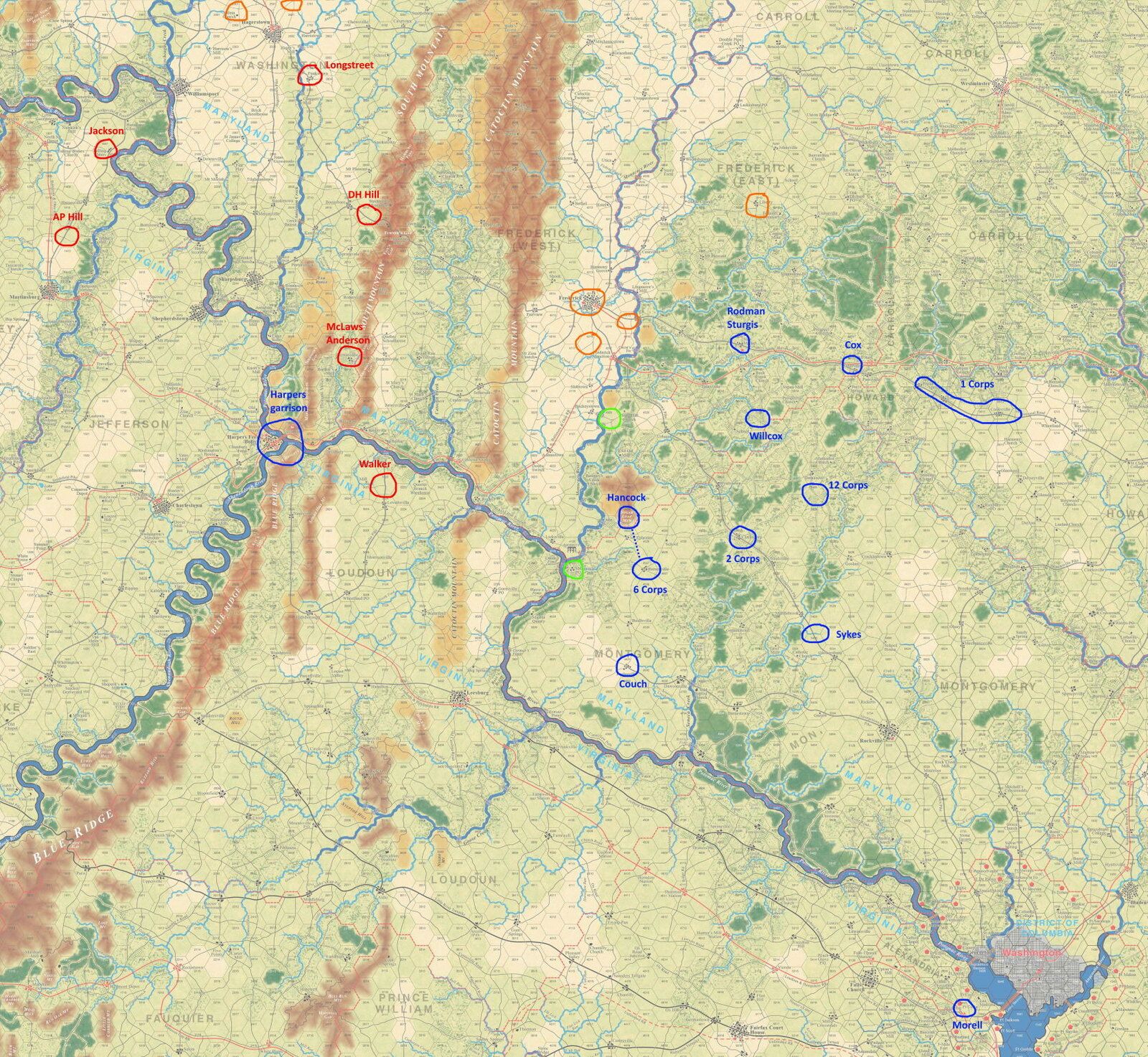
This is when the last of the Confederate army moves out of Frederick. It's taken the bulk of their army two days to leave Frederick and get to the far side of South Mountain, not counting Walker's brigades and the cavalry (which is still in control of Frederick, though it's being pushed back and I believe that by this point it would be quite possible for Union cavalry to confirm that the Confederate army is moving west through a process of elimination)
The 12th will be when Morell is able to start moving to join McClellan's army.
9th Corps surges forwards (Rodman and Sturgis appear to move 16+ miles), and with 1st Corps they establish themselves on the National Road. This means McClellan now has two pike roads to advance down towards Frederick.
12th September:
 Which is what he does on the 12th.
9th and 6th Corps cross the river at widely separated points, and the rest of the Union army closes up to the Monocacy; the Union cavalry drives Stuart out of Frederick, though the mountain passes remain in Confederate hands.
The interesting questions to me that this raises basically revolve around what could have happened if McClellan had pushed towards Frederick more directly (and on a narrower front). The first thing is that Lee could have stepped up his own timetable and marched out earlier, but the second thing is that it's quite possible Lee could instead have defended the line of the Monocacy - especially if there's a single Union column pushing up the Rockville turnpike. This would be Lee's army with no straggling and would be a fearsome thing to attack...
The first is that Lee historically decided to leave Frederick on the 9th of September (which is when SO 191 was issued, for march beginning on the 10th), and that he could quite conceivably have left earlier. But the first that McClellan can know that Lee is moving is the 10th, and it would be quite realistic that he wouldn't be sure until his cavalry can penetrate the Confederate cavalry screen.
The second is that if Lee decided to stay and defend the line of the Monocacy then McClellan's ability to force that line is directly related to how broad an attack he's conducting. If he's coming in on a narrow front then his superior numbers mean basically nothing, and if you're going to set up for a move around the flank it's best to do so at enough of a distance that the enemy can't strike you in the middle of the manoeuvre.
So here's the positions at dusk on the 8th, 9th, 10th, 11th and 12th. The key is that:
Red is Confederate infantry formations.
Orange is Confederate cavalry.
Green is Union cavalry.
Blue is Union infantry formations.
Base maps are from the GCACW maps. Data is largely from Carman's campaign positions map with some data from an article by Gene Thorp.
8th September:
At this point McClellan's three main wings have formed - those being Franklin's wing (6th Corps plus Couch's division), Sumner's wing (2nd and 12th Corps) and Burnside's wing (9th and 1st Corps). Sykes is effectively attached to Sumner's wing, because Porter has not yet been released to McClellan's OpCon.
If Sumner marched straight down the pike road, he'd hit the Monocacy on the 10th or so, but he'd do it in a situation where he was at a great disadvantage - attacking with one column down a single road against a strong enemy on the far side of a river. It's a recipe for disaster.
Meanwhile, McClellan's cavalry screen is pushed out to engage the enemy cavalry screen.
Lee is in a posture around Frederick which is good for defence. All the approach routes are well screened and he's behind a water feature.
9th September.
Sumner's wing largely holds position, and the main thing that happens for Franklin's wing is that Couch pulls into line, but Burnside's wing moves north and spreads out. This is widening the fighting front which the army can present when it makes contact, and the manoeuvre is taking place outside the range of an opportunistic strike by Lee.
The cavalry screen is now in close contact, except for the section which has diverted north to cover the National Road.
This is the day Lee decides to leave Frederick. Notably though Walker's position is good to block 6th Corps.
10th September.
Lee's army actually doesn't move all that far as the result of the first day of marching - or, rather, it's comparable with the move made by McClellan's leading corps to South Mountain a few days later.
The Confederate cavalry screen remains in place, screening the movement. Franklin and Sumner move up to the same positions as the Union cavalry screen, but Burnside's wing doesn't move much.
My suspicion (and it is only a suspicion) is that this is so that the lateral movement Burnside's wing is going to make is delayed until it's got a strong screen on the flank. It could simply be that the wing is resting for the movement it's about to make, though.
11th September.
This is when the last of the Confederate army moves out of Frederick. It's taken the bulk of their army two days to leave Frederick and get to the far side of South Mountain, not counting Walker's brigades and the cavalry (which is still in control of Frederick, though it's being pushed back and I believe that by this point it would be quite possible for Union cavalry to confirm that the Confederate army is moving west through a process of elimination)
The 12th will be when Morell is able to start moving to join McClellan's army.
9th Corps surges forwards (Rodman and Sturgis appear to move 16+ miles), and with 1st Corps they establish themselves on the National Road. This means McClellan now has two pike roads to advance down towards Frederick.
12th September:
9th and 6th Corps cross the river at widely separated points, and the rest of the Union army closes up to the Monocacy; the Union cavalry drives Stuart out of Frederick, though the mountain passes remain in Confederate hands.
The interesting questions to me that this raises basically revolve around what could have happened if McClellan had pushed towards Frederick more directly (and on a narrower front). The first thing is that Lee could have stepped up his own timetable and marched out earlier, but the second thing is that it's quite possible Lee could instead have defended the line of the Monocacy - especially if there's a single Union column pushing up the Rockville turnpike. This would be Lee's army with no straggling and would be a fearsome thing to attack...

 Forum Host


 Bringing the