When would you say the tactics evolved to where they were placing distance markers and riflemen were actively adjusting sights (what I saw in Zulu Dawn anyway)? Were they already doing that in professional armies in Europe or was this still a decade or two away?
That is already the case in the 1850s in the British Army and certainly during all years of the American Civil War.
EDIT -- To be very clear, this is even more
the case for the British than even what you describe; what you are talking about is how typical armies, i.e. Russian, Norwegian or Austrian fought in the late 1850s through mid-1860s; British trained so that rather than having distance markers, every soldier individually is rifle-trained to the level of judging distances themselves. I have given myself the impression reading this post back to myself, that I have not emphasized that judging distance was as critical to British drill as it is for Union infantrymen to form ranks or to learn drill arms positions.
From the 10th page of the Regulations for Conducting the Musketry of the Army, 1859 Manual used in various minor revisions until 1889 - PART II (Part I is just some general instructor's notes for organization and absences while III ahead of it is dedicated to cleaning and understanding each individual component of the rifle, disassembly, storage etc.):
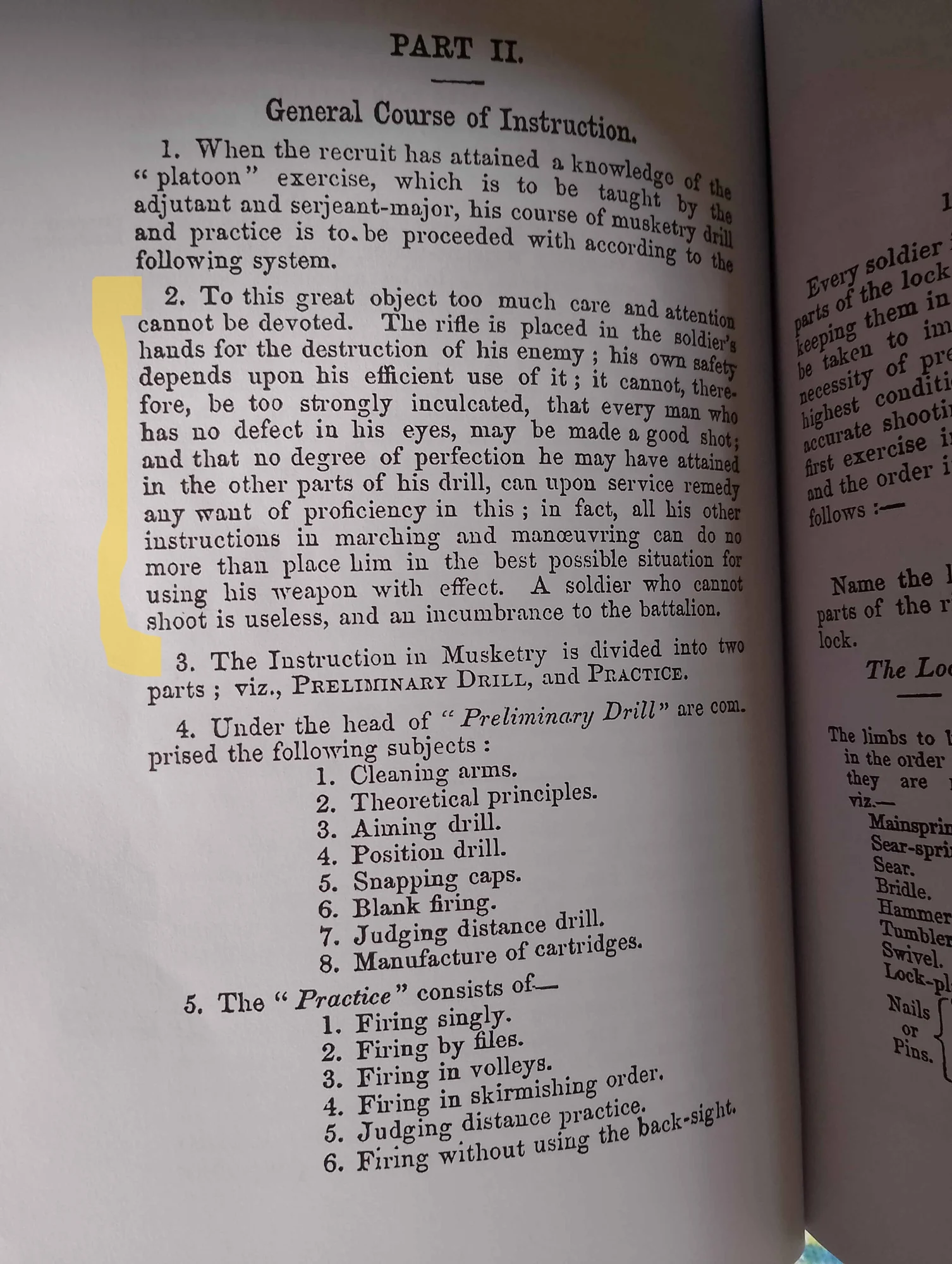
This is the first page of any relevance to the common infantryman. The details of the "volley fire" in practice, battle lines etc., the basics of the two drills and so on I describe later in the post if you read it - the focus here is on that 2nd paragraph. This is important - if the Field Exercise & Evolutions, 1859 give me the main imprinted, reiterated idea of maneuvering from close order to extended order, which is a major focus of that manual, then this book, the Regulations for Musketry Instruction, 1859, rifle-training counterpart to it, gives the one, lasting imprint of the idea that nothing - nothing - is as important, nor will make up for, a lack of proficiency in the ability of the infantryman to judge distances and set sights accordingly. That is the single most important skill of the individual infantryman, and is said here way at the start of the manual.
In other words., as of 1859 through 1889, the British were actively doing what is described in the quotation - at a far more sophisticated, autonomous, individual level.
Far contrary to certain posts both on this thread and far too common on others, literally describing European tactics as emphasizing volume of concentrated fire in volleys no different to in the Napoleonic period, i.e.
"I've always been under the impression that the tactics of the day, imported from Europe, placed more emphasis on getting the soldiers to move in unison in large groups rather than on individual marksmanship. Hence, lots of time was spent in drilling, not shooting."
or
"Exactly. Military dogma of that time was based on close order formations that were able to deliver a high, concentrated, volume of volley fire. Individual marksmanship would come into play among sharpshooters in a skirmish line."
Which are in their entirety false,
The manual in its first pages makes clear that any man who cannot shoot is so far as an "incumbrance to the battalion"; the British Army, as you will read further into this post, emphasizes skirmish tactics, open-order and individual marksmanship above all else, and this statement alone deletes the concept that a good or useful soldier can simply shoot quickly or in ranks well - it directly says much the opposite. And you can read on as to why; the British Army does not shoot blankets of volleys in unison and does little in line or close order; what it does is best read about or visualized, for it is very different to any fighting of the armies of the Civil War taking place
after the manuals are already in use for years.
Heck, even basic commands you would imagine standard and definitely unchanged in this period have evolved into something very different, as will be seen.
SO, to begin:
The British Army at the time of the Civil War actively drills every single infantryman at 300, 600 and 1,000 yards (900 until the 61/63 revisions of their 1859 manual). In increasing distance, that is Class C, B, & A - C would be expected minimum, B, preferable, A, ideal. British infantrymen fire 90 rounds annually in rifle practice at the aforementioned distances from March 1859 onwards, while in comparison as of 2023 in the US Army, in Standard in Training Commission (STRAC) details 58 rounds annually per individual. To my understanding the average, universal US Infantryman today does not typically train beyond 300 yards. Point;
the British Army of the year 1860 is one comprised of an infantry of individual marksmen.
You (And anyone else particularly interested in the Civil War; assumptively, virtually everyone here) are encouraged to read in any great detail about the drill and infantry instruction of the British Army at this time, and most other European militaries, for I very often see complete neglect of anything outside of the United States when discussing tactics; it would be good for comparison, rather than the assumptions many seem to have that European infantry was either behind or was using the old 1830s manuals certain US manuals are themselves derivative of. I say this because, while this is in general constructive in answering your question, greater knowledge of various European tactics directly contemporary to the Civil War would cure of many myths, i.e. that narrative of the Europeans needing to "learn" from the Civil War; everyone knows (at least very superficially) about the Prussians, but realistically virtually all Western infantries are far ahead of the Americans. That aside:
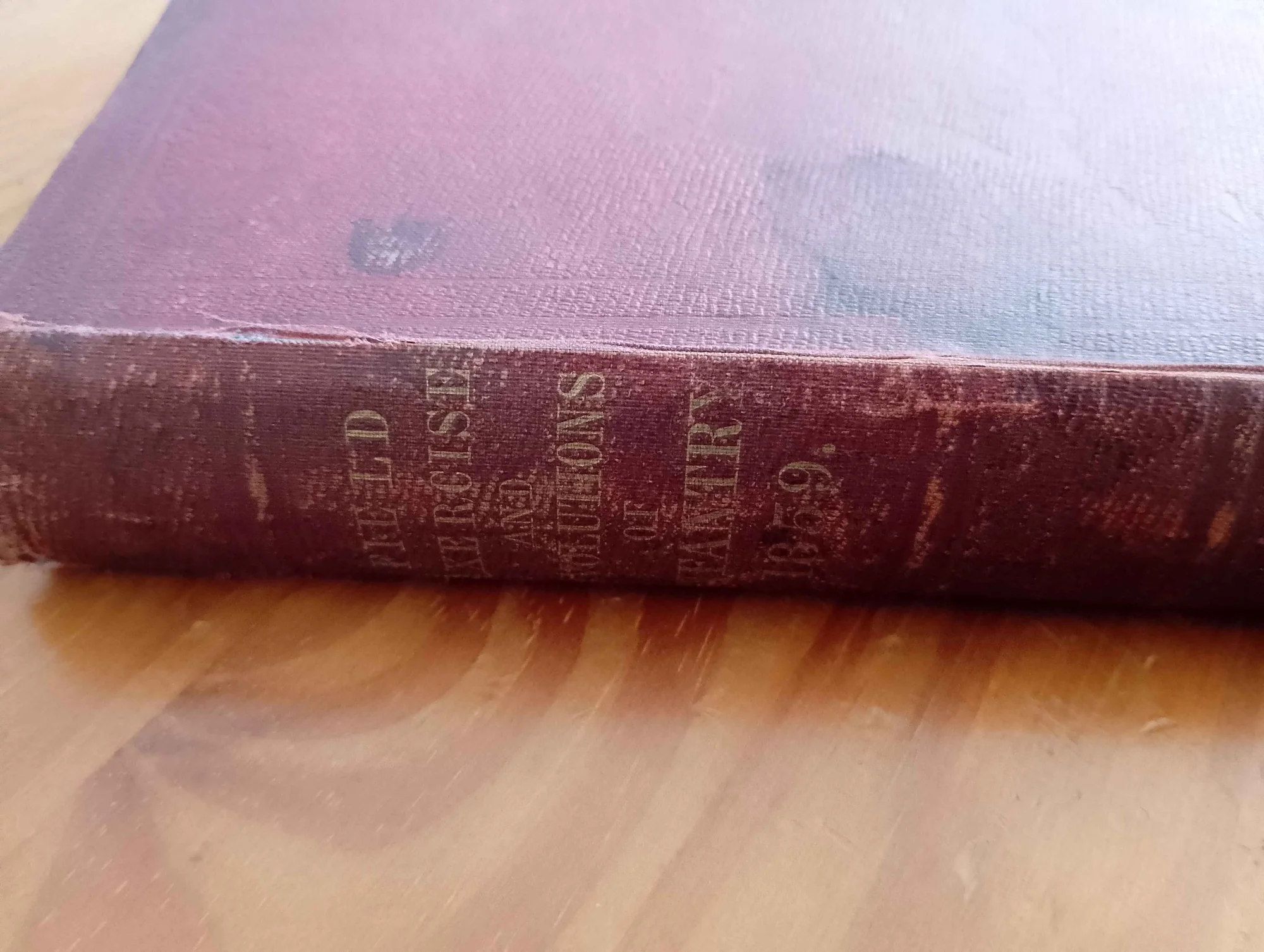
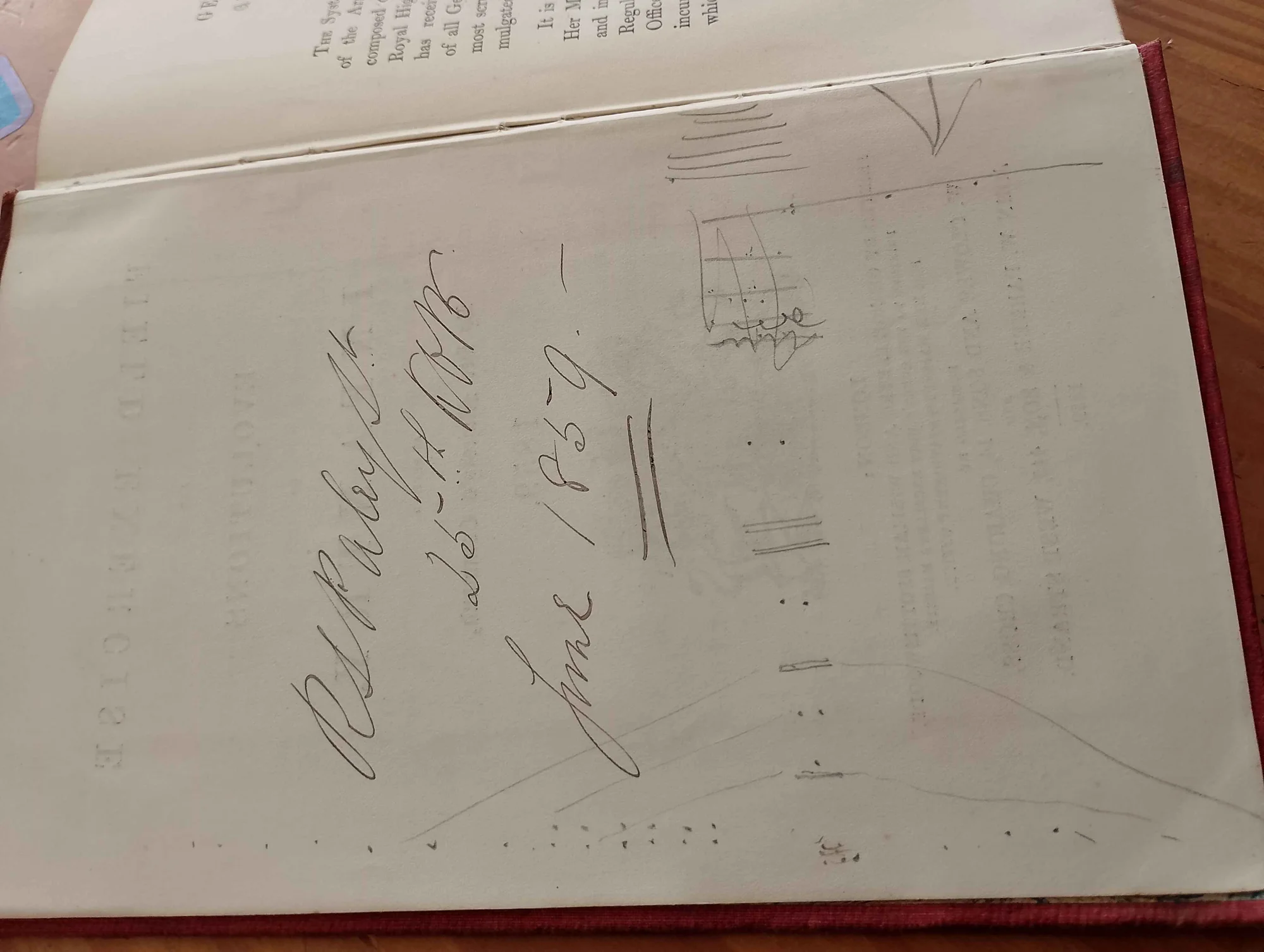
This is an original copy I have of the
Field Exercise & Evolutions of the Infantry (of the British Army),
March 1859. There is a whole separate other manual entirely for rifle training, the Regulations For Conducting The Musketry Instruction of the Army of the same year. I have a recent reprint of that manual (Which I have used in the EDIT at the start of this post.)
This would be in use with various, themselves, evolutionary revisions until 1889, ('61, '63, '67, '70 & '77, the '63, '67 & '70 dates being coincidental in their release dates, not made in reaction to developments of the Civil War, Austro-Prussian War, or Franco-Prussian War having each been produced prior to the actual fighting of each..) where it would be replaced by the
New Drill in use until the 1890s. My copy appears to be owned by a Mr. "R.S. Paley(?) of the 25th something - I've read the manual, but hardly paid attention to the original sketches and writing! This copy is from June of 1859, a mere 3 months after the 1859 manual was adopted.
There are these little sketches of the symbols for movement and changing formation, specifically of the changing from close-order to extended/skirmish order:
This is a very important movement - generalizing the entire doctrine laid out in the
Exercises of Infantry's described tactics, the British Infantry generally travel and deploy initially in close order - as with most infantries then using the new rifle-muskets as of 1859, where
infantry is universally light infantry and a combination of all previous forms of infantry, they are all expected to perform easily in extended order, and that is the preferred line of actual battle and combat. (In the British Army.) On that note, be it Edward Dyne Fenton's photographs in 1861 or the various J. Paul Getty Museum's photographs between 1857-59 of mock battles and displayed formations, or the mock positions in the aftermath of the battle of Eccle's Hill - I don't think I've actually seen anything like a linear formation pretending to fire or even just in close order in an obvious front-line of fighting. There is a good reason for that - the British Army does not even have "volley firing" in the sense most people would imagine it by 1860.
There is not a single "Fire!" or "Reload!" command in the entire of the two manuals. That is because, as said before, the British Army functions as an entire army dedicated to individual marksmanship (The British National Rifle Association, founded in 1860 predates that of the American, built for the same purpose of nationalizing the promotion of rifle marksmanship, and the Rifle Volunteer Corps boasts ~134,000 men (1862 figures) in addition to the ~220,000 some strong British Army (1861) to make a total of at least 354,000 total.).
To facilitate all of this the British Army has the first real modern military institution for rifle training set-up, the Hythe School of Musketry as an entire army corps for rigorous instruction of the whole army in marksmanship. Even every Cavalryman and Artillerist is still required to be able to shoot at 300 yards - compare that to American armies where most men fire their first shot in battle, and 90-100 yards would be typical for most Civil War battles.
Officers, for the most part, as described in the manuals, direct fire, pick targets and decide when to begin and cease firing - every soldier is expected to, in most situations, to always be loaded, and has the autonomy to reload entirely on their own accord, while firing, even in "close order" or line, consists of either individual aimed fire (that is, fire-at-will) or a weird form of, what can best be described as ripple-firing, except that it is still very "individual" in nature, simply that an order is called out that involves a general firing from one end of a rank to the other. As to the actual firing itself, as said before,
there is no "Fire!" command, and in the closest form of "volley firing" that is recognizable, after being ordered to "Ready" & "Present", the men are given a personal count of ~3 seconds to fire entirely on their own time: firing together is not the idea, but this is still of course a form of massed fire, and the hail of bullets inevitably coming the way of the enemy will not care about exact unison - marksmanship, instead of volleying in blankets of fire. Pairs in skirmish line was the preferred way of formation, and as in all armies, involves even more individual autonomy - this example though, I am using to illustrate that even the most "conservative" form of infantry firing formation had changed substantially - however
evolutionary, of course.
Should be noted that in many situations what I have described, i.e. command for "Make Ready!" is only detailed at various points at the start of firing, once firing has commenced in close order it is almost always firing at will or, if "volleys", the individual also has the autonomy to ready when reloading, such that there is only really even the command of "Present!", firing is done in the individual infantryman's personal count of ~3 seconds, they reload on their own accord and ready (cock) for the next "controlled volley" on their own accord in the readied position.
In the preferred extended order, the officer's job really is for directing at the general target or front, when to retire etc. - the individual infantryman, regardless of the exact skirmish tactic, i.e. in pairs, files or so forth has entire control of their own aiming, firing, reloading and advancing unless situationally, strictly not to advance/retire. If this sounds like Civil War sharpshooters, or like Riflemen/dedicated skirmishers of old, this is because that is essentially what every British infantryman is being drilled to be; the green riflemen still have their unique uniforms, but much like "Grenadiers", "Fusiliers" etc. have no practical distinction any more except for esprit de corps, there is no actual tactical difference at all between them and the regular British redcoat; they are drilled the exact same way and carry the exact same arms, the Enfield, and use these same manuals.
There's advertisements for a whole bunch of complementary army-made and army-sponsored other books in the very front of both my original
Evolutions and reprint
Musketry manuals,
even a little book for learning Turkish vocabulary! And yet, not one book dedicated to some kind of specialized sharpshooters detached from regular infantry; there is none because they drill the exact same way with the exact same arms.
All manner of things on this and the proceeding pages, various books just for cavalry exercise, and indeed a book wholly for learning basic Turkish - but no green sharpshooters book, for good reason. If the British Army had given the Union Army a single battalion of infantry, the Americans would have given them green uniforms and sent them off as sharpshooters.
There is a lot more I want to add, but there is little (or
no) structure at all to this response, and I only really intended to give a far shorter answer.
I am mostly just blurting random bits and pieces at this point, I might return back to this another time but the basics I think I have brought them across at least in introduction. There is plenty more to it, i.e. the 21st-25th pages of the
Musketry Instruction of the Army, (The book which can be considered the "rifle training" to the counterpart "drill" manual) that covers the first 3 lessons of "
Theoretical Principles" that are taught before new Infantrymen even learn how to judge distances and set sights, directly says that basic fluid mechanics and ballistics are taught to troops, i.e. the concept of influences of the "line of fire" & "axis of the piece", such as decreasing velocity of the projectile with distance from the muzzle, atmospheric influence and the force of gravity in Lesson 1, in Lesson 2 the concept of air as an elastic fluid and the application of Newtonian principles of motion, action/reaction and the force of gravity of the projectile. That is how seriously the British Army took rifle training for the average Infantryman, remembering that these two are the standard, basic infantry manuals of the day.
Since I began discussing how autonomous the British rifleman from 1859 onward was, I might as well continue to describe the reload drill, Enfield cartridge construction etc. but I will not in too great of detail, but on the topic - the drill describes perhaps the fastest reload drill I have ever seen for any muzzle-loaded standard military rifle I have ever seen, intentionally designed for very fast firing - something all the more able to be trusted in Infantry that are well-drilled and understand their standard arms inside and out. It includes, among other things, the motions of removing, ramming and replacing of the ramrod in single swipes - and the accoutrements of the army are designed to facilitate this faster loading, too - it helps that the percussion cap pouch, beginning in 1857 and universally standard from 1863, was placed on the chest, for much faster reloading of the primer:
Also being done by the Swedish and various other European militaries of the time.
This drill and these functional adaptations of equipment to facilitate it can verifiably achieve, if you so tried, a rate of 5 rounds per minute as given by this video by Paper Cartridges (if loaded at the beginning, would be 5):
Paper Cartridges, firing 4 aimed shots in 1 minute from an unloaded position
The benefits and advantages seen clearly when directly contrasted to American drill; you will notice there is no biting of the cartridge:
Paper Cartridges again, (and some other guy I am familiar with but cannon remember the name of for the life of me on a different channel I know) contrasting American 9-times drill vs. British drill under the 1859 Manual
Notice no biting of the cartridge.
I hardly even want to get into uniforms - a rabbit hole of their own, the post-Crimea worldwide changes to uniform dress are highly overlooked in how transformative they are; British (or most) go from coatees as standard dress uniform coats, frock coats/shells in fatigue uniforms, and shift to making frock coats, or "Dress tunics" as have been globally worn since, into dress uniforms, with fatigue wear being left to sack coats and shells, the former of which the British Army introduces in various regulation and non-regulatory forms between 1857 and the 1870s. There is simply too much to add to that, so I will leave that for a future, or entirely different conversation.
British Gurkha regiment a couple years back - all of these uniforms are directly familiar if they were shown to a British infantryman time-traveling from 1860.
You may even question, with all this supposed change, why retain the redcoat? To which there is the fact that in most actual practice post-1856 in combat, the British Army regularly wears khaki or blues - the US Civil War takes place in the midst of an era where the British Army repeatedly ditches the redcoat when actual combat is involved; it should be remembered there are only 19 years left to the actual extent of any combat use of the redcoat by 1865. Virtually every two years between Crimea and 1870 the British Army also seems to reduce the number of decorative elements on coat and headwear.
i.e.:
68th (Durham) regiment of foot during their New Zealand postings c.1863-64, likely during the Tauranga (or "Te Ranga) campaign from April 1864. The Mauri Wars are yet another can of worms in the case of directly contemporary British combat to the Civil War, various wars in New Zealand that are characterized by trench warfare, earthworks, rifle-pits and bush fighting, a very unique and oddly symmetrical conflict in which the Mauri themselves are primarily armed with percussion firearms, namely double-barrel shotguns and old British muskets and routinely repulse and beat the British Army in the field. A topic for another time.
Two paintings by Henry Nelson O'Neill both of 1859, titled Home Again, oil on canvas. Iconic paintings of their time. You will notice the British battle tunic in khaki - these are returning soldiers from the Sepoy Mutiny.
Storming the Batteries at Badle-Serai, June 1857 during the Indian Sepoy Mutiny, as sketched by Captain George Franklin Atkinson (and built upon clearly and painted).
Aside from Khaki, you also notice the Greek-style pith helmets that also have their first use with the army from the Mutiny era.
This was all alive and well when the British embarked on the Abyssinian Expedition of 1867-68 to liberate several hostages of the Ethiopian Empire:
4th King's Own Royal Regiment at the Battle of Magdala on 13th April 1868, painted by Richard Simkin. By the time of the expedition, armed with the stopgap Snider conversion of the Enfield.
The 4th again.
The Mauri Wars are for the most part, comparable except in various blues:
I.e. the famous 57th (West Middlesex) Regiment of Foot as they were between 1862-66; Representative of how virtually all British troops fighting the Mauri Wars looked contemporary to the American and Confederate armies of 1861-65.
To end off, some of my favorite photographs of the 1860s:
British cadets in mock-battle c.1857
British soldiers in skirmish and regimental line formations posing during drilling, 1861. By Captain Edward Dyne Fenton. Royal Collection Trust.
It's all in the manuals, but rather than only skirmishers deploying ahead of line infantry, more often than not this would be the reserve:
While what the manuals consider the line of battle, as said before, is the line ahead in extended order:
The image greatly reduces the distances that all of this would happen at, and seems to attempt to show various stages of deployment from closed to extended order; the
one illustrated formation maneuver I have stuck in my head, for being drilled into it if nothing else, is the all
important deployment from close to extended order.
Definitely an image where context helps a lot in understanding what this really is - looks seem to deceive here.
A
third, and much better image to me personally is this:
Same source, collection, photographer and medium as before, 1861:
The manuals make very clear that this is the line of battle, and this image for the most part depicts how this looks, at least, in a condensed fashion - trying to fit everything into the image while keeping up close details and a bit of romanticism sprinkled in; these are images made for the Prince of Wales, not realistic.
We've not even touched upon artillery - during every single year of the Civil War the British Army's standard naval, field and siege pieces are all Armstrong Rifled Breechloaders (RBL):
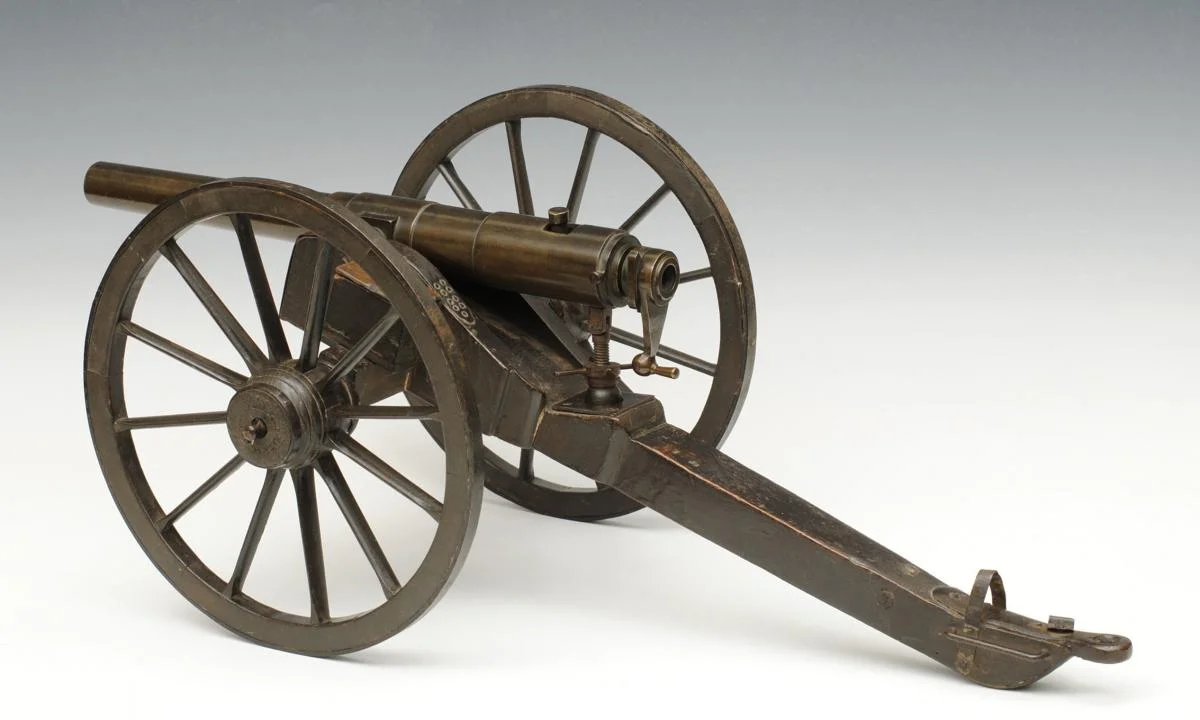
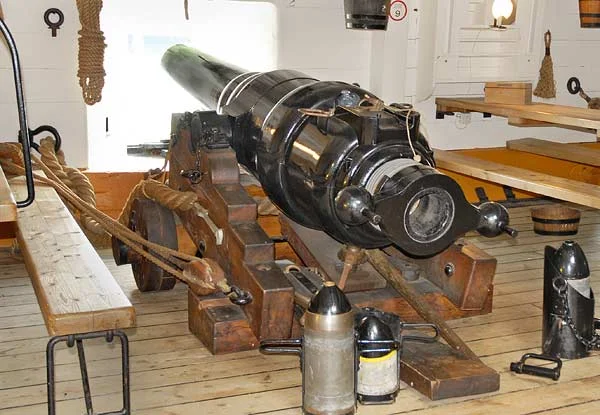
Top is a model of a 6lb Armstrong field gun, bottom is one of many 110lb/7" Armstrongs aboard the HMS Warrior - been various times, definitely suggest a visit.
Unequivocally, while Gettysburg raged in July 1863, the Overland Campaign went on in early 1864 and bogged down into the many, many miles of elaborate earthworks of Petersburg.. the British were using built-up, rifled guns of far higher quality than any Parrott or even the beloved Ordinance, breechloaded, to shoot hundreds of shells at Mauri fortifications... a theater that was their own testing ground for extensive use of breechloaders - i.e. in this case, the Terry & Callisher of J.E.B. Stuart fame... used by certain cavalry, by the Forest Rangers and by the New Zealand Police. Without elaboration, the British Army had nothing to "learn" from the Americans in infantry tactics - they were already far ahead. That goes for artillery too, really.
EDIT - comparing Petersburg or the Overland Campaign with the Mauri Wars gave me a random thought; I will not go into great detail, as I might as well publish this post at that rate, but just
consider this... on top of the previous paragraph, where British soldiers are busy experiencing extensive unique forms of elaborate entrenchments, making assaults with bloody costs and heavy bombardment from rifled breechloading cannon
at the same time as, and years before Petersburg, the Prussians are bombarding the entrenched town of
Dybbøl in April 1864,
before the Overland Campaign even begins, pounding the works with their
Krupp breechloaders they have developed also since the 1850s, assaulting primarily armed with the bolt-action
Dreyse... let that sink in. Even in the most "modern" side of the war supposedly with the most to teach the world about "
How it's done", from the
Overland Campaign, to
Petersburg and the
Franklin-Nashville Campaign, March to the Sea across various theaters of war, there are major fronts on two other continents being fought by the eminent European powers that not only mirror but feature much more "modern" aspects, including widespread not-merely-rifled but breechloading artillery of better designs than any American make, and fielding notable numbers of breechloaders in doing so... at the very least both the Americans and Europeans are "learning" the same "lessons" simultaneously, and realistically the Americans are the ones with catching up to do. Both
Gate Pā and
Dybbøl are far better candidates as indicators of progress in warfare and both are finished by the battles of the Overland Campaigns.
The Armstrong RMLs, i.e. the 150lb at Fort Fisher with its brilliant Armstrong segment shell I have repeatedly read from Civil War artillery veterans (i.e. in 1911's
Photographic History of the Civil War) as having a reputation as the very best of ordinance, being known to explode into over 200 pieces - and if you know shell designs, it is not an overexaggeration.
While I very often have seen such things as excerpts from Sherman's Memoirs debated over, i.e. the whole "heavy skirmish line" thing and discussion of the taking of cover, extended order etc., it is much clearer in the British Army - the literal Infantry manual, which has a much, much larger section of it dedicated to skirmish order than Hardee's "Rifle and Light Infantry Tactics" directly says, on this page among many others, repeatedly encouraging and instructing cover (and initiative for concealment) to be taken regularly, leaving no room for confusion or debate:
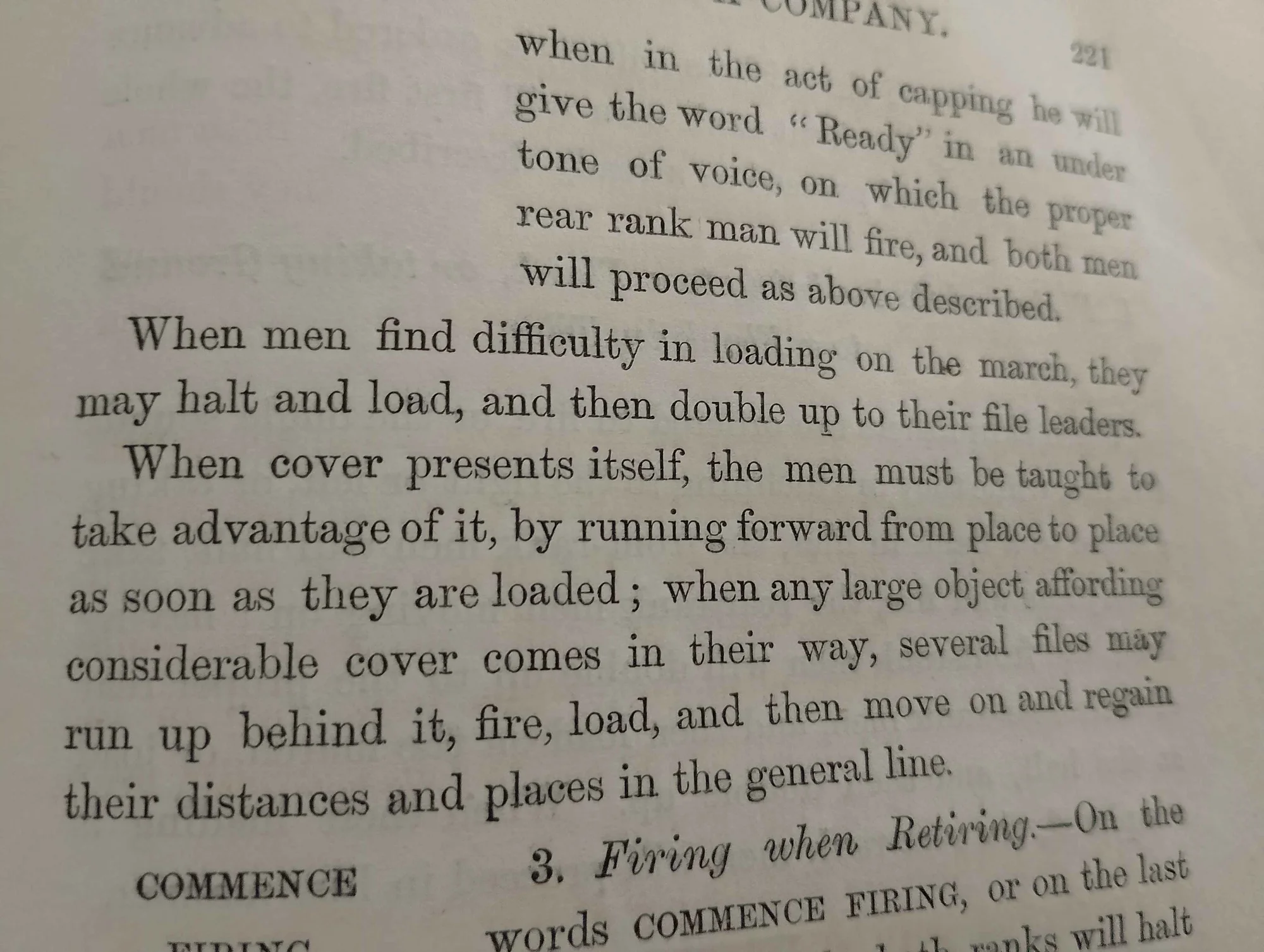
I won't even touch the 2nd Opium War, any further on artillery etc, I think I've got my point across. I hope this is not too far a deviation for a CivilWarTalks thread, but even among some scholars I see the Civil War, especially in infantry tactics discussed as though either it is up to the Americans to figure out how to really develop tactics for the rifle-musket, as if European tactics are hardly changed from 1813 (or 1832 for that matter), or even, especially in mainstream discussion as if no other armies but the American exists. the most advanced and pioneering armies of the 1860s are not the US or Confederate; they are rather archaic in structure and doctrine. I hope this may have encouraged some interest. The sheer difference in basic infantry practice should be shocking to anyone familiar with Civil War tactics and may be assuming this or the rare, highly specialized actions of Wilder or Willich is as far as pioneering tactics go in the era prior to the Prussians at Sedan. Rather than divert attention and try to turn this into some kind of "British Army Talks" I merely think that having considerable knowledge of contemporary armies to the US and Confederate should greatly change perspective, and allow us all to much better understand the Civil War - and not believe many of the self-praising myths that seem to surround the war. Too often I see something simply treated as "non-existent" if America does not yet have it.
If you are someone who benefits from video content more than most other mediums,
British Muzzleloaders on YouTube definitely played a part in my branched interest into what the British are up to in the 1860s, and directly confirms and displays visually, live what I only describe.
Paper Cartridges to a lesser extent. Both are great. New Zealand Museum's archives and plenty of other collections and archives are great sources for images, writing and information in general.
Hope this was interesting. I would love to see a single actual film depict any of this, most Zulu War films do not have accurate tactics really, and I have seen little to nothing that depicts the tactics of the British Army as it was during this period. Again, should be an eye-opener to any Civil War buff only really familiar with the Civil War; it was when I first learned of it. Hope this is a good read, however convoluted. Take care.
EDIT - On a re-read I have noticed plenty of minor spelling mistakes and oddities, some repeated phrases in quick succession, etc.

even repeating certain images (i.e. look right above this). I made this (and directly subsequent posts) while having been awake almost 20 hours straight, I took a nap and recently took a look at this only now. If the grammarians among us can let it rest, literarily, literally and figuratively, forgiving these mistakes I still think it's quite readable. I am not fixing any of them in fact, letting this post sit as it was when I wrote it. Not too sure how I mustered the mental clarity to line up some sources from my files and make a half-dozen posts, but I saw some
hideously inaccurate statements made about the other armies of the 1860s relative to the Civil War and I guess the nerd inside me could not skip past this one. Again, I hope everything here, sleep-deprived as certain paragraphs or sentences may read, is still comprehensible and you, whoever reading may get something good from it. Take care, everyone.


 Bringing the