Whitworth sniper round or post war?

Wraith_3

Private
Joined
Mar 24, 2021
I have this bullet from my dad's collection and the original auction page for it says it's a Whitworth sniper round. I listed it on ebay months ago and had someone tell me that it was actually a post war round because of the nipple in the base cavity. So I canceled the auction. Recently a friend of his said he thinks it actually might be CW. So I wanted to get your opinion.
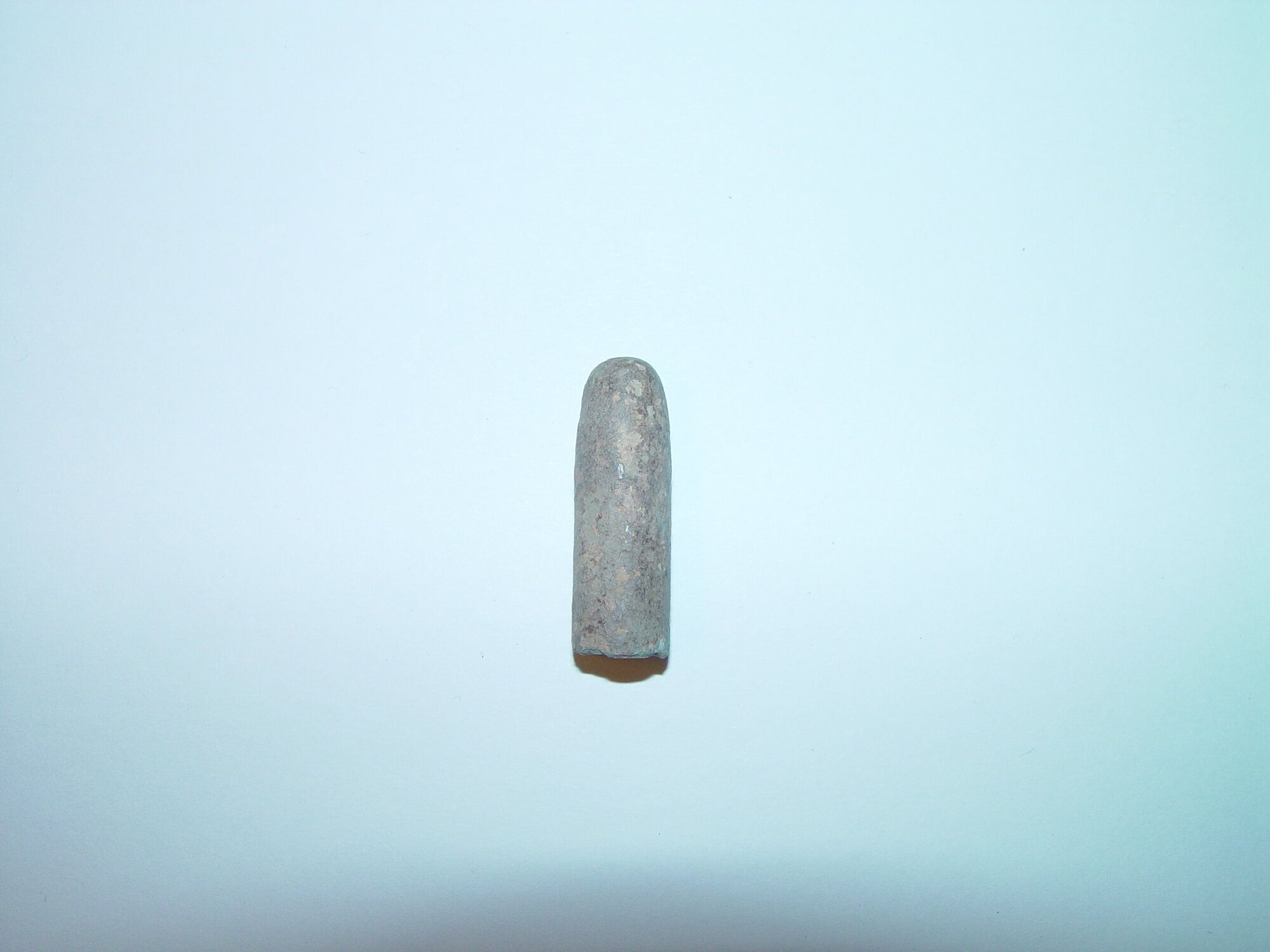
DSC04887.JPG

whitworth.jpg
 
It's not a Whitworth bullet as it is round. The Whitworth's used hexagonal rifling.
At the risk of appearing pedantic, fired Whitworth bullets are hexagonal in section. The rifle could however be loaded with mechanically fitting hexagonal bullets, or cylindrical bullets - the latter expand to fit the hex. bore on firing.

I can't see any rifling marks on the bullet pictured.

David
 
At the risk of appearing pedantic, fired Whitworth bullets are hexagonal in section. The rifle could however be loaded with mechanically fitting hexagonal bullets, or cylindrical bullets - the latter expand to fit the hex. bore on firing.

I can't see any rifling marks on the bullet pictured.

David
But it still isn't a 'sniper's bullet' - it was never fired. They seem to have dropped a lot of these on the battlefield too! There are hundreds of them!

The standard Whitworth bullet was hexagonal. The 530 grain, .451 caliber hexagonal bullet did not depend upon unreliable expansion of a hollow base in order to engage the rifling of the bore, but instead replied upon the tight mechanical fit of his bullet to the .451 polygonal bore. If it was meant to expand, it would not be as long as this one - nor as accurate. This may be a Confederate replacement for the hexagonal bullet, since they would have been hard to come by, but it would not have been as accurate. Here is a real one from the period:
45-cal-confederate-whitworth.jpg
45 whitworth.jpg

Check out: http://www.americancivilwarstory.com/whitworth-rifle.html
 
What is the diameter and length of the bullet?

.45 cal 1 7/16" long +/- 1/32".

When I've searched "Confederate Whitworth sniper bullet" quite a few that look like this show up like this one: https://shilohrelics.com/cgi-bin/display_Item.asp?128151 . They don't look like they have the nipple in the cavity though. The little bit I've read in his books it says the Whitworth rifle used both hex and cylindrical bullets.
 
.45 cal 1 7/16" long +/- 1/32".

..... The little bit I've read in his books it says the Whitworth rifle used both hex and cylindrical bullets.
And that's my understanding too, that the bullets could be cylindrical or hexagonal sided.

Thanks for the bullet dimensions.

That the bullet's diameter is of .45 cal. is in your favor that the bullet could be a Whitworth (.451 caliber). In a couple of books I have on CW projectiles, one of the pictures looks very close to your bullet, with the exception of that teat in the base.

If it's a post-war Sharps type bullet, since it's smooth-sided, it would be for a paper-patched bullet. The paper patching was used to prevent the bullet from leading the barrel and the patch would fall off the bullet once the bullet left the barrel. The paper patched bullet also had a cupped base as did the Whitworth, so no help there. Give me a day to look through a couple of books I have on black powder cartage rifles and paper patched bullets. Maybe we can narrow the possibilities down a bit. Since your bullet is 1 7/16," it's too long for a .45/70 paper patched bullet, so that narrows it down to the real big cartridge calibers, like the .45-110.

The other possibility is that perhaps this bullet is for a different type of long-range rifle used in the war. .45 Caliber was not an unusual caliber for a target rifle. The Kerr was of .442 caliber and fired a cylindrical bullet.
 
The other possibility is that perhaps this bullet is for a different type of long-range rifle used in the war. .45 Caliber was not an unusual caliber for a target rifle. The Kerr was of .442 caliber and fired a cylindrical bullet.
The Whitworth rifle was trialled by the British army at Hythe using a patched cylindrical bullet, .442" (54-bore), for rifles with a .451" bore, mainly because it eased and quickened loading. It was rejected in the long run because the caliber was considered as 'too small' for a military round, although it was more accurate at distance. Whether it would have been as accurate as the original hexagonal round is debateable, since it did not conform to Whitworth's original idea. It was never patented, so variations were many and varied.
The patch, not the bullet, must have gripped the rifling since the only expansion for such a long bullet would be at the base. The better modern cylindrical rounds are over-bore and with multiple grooves.
45 Whitworth Fired multi-groove.png


The other alternative bore - the Lancaster oval bore - was accepted for theSappers and Miners carbine, but that used the same cartridge as the enfield P1853.
 
Last edited:
The Whitworth rifle was trialled by the British army at Hythe using a patched cylindrical bullet, .442" (54-bore), for rifles with a .451" bore, mainly because it eased and quickened loading. It was rejected in the long run because the caliber was considered as 'too small' for a military round, although it was more accurate at distance. Whether it would have been as accurate as the original hexagonal round is debateable, since it did not conform to Whitworth's original idea. It was never patented, so variations were many and varied.

Actually as I understand it the issue was that Whitworth had patented the "small bore rifle" concept. As soon as that patent expired the British Army adopted the Westley-Richards carbine as the regulation arm for cavalry in 0.45" calibre. Now it was superseded before it was issued by the Snider-Enfield which perforce meant a return to 0.57" but with a metallic cartridge and the Army immediate embarked on a trials process for 0.45" calibre metallic cartridge rifle leading the famous Martini-Henry being adopted.
 
I was using the 1858 report from Hythe. The only patent Whitworth brought out was for 'polygonal' rifling for cannon and was not specific as to the term 'polygonal'. There was no 'small bore rifle patent'. Even the first French Minies trialed in 1850 were of .702 calibre and used for the Enfield M1851 because of that same 'heavy bullet' stance. The recoil was so bad on the '51, that it was reduced to .577 for the '53. The Whitworth bullet was classed as 'smallbore', even though it was of a similar weight! Another objection was to the length of cartridge for the Whitworth as well as the smaller width which would increase the likelyhood of damage in the field. It also explains the rather 'dumpy' Martini 45/577 cartridge too.
 
But it still isn't a 'sniper's bullet' - it was never fired. They seem to have dropped a lot of these on the battlefield too! There are hundreds of them!

The standard Whitworth bullet was hexagonal. . . . .
I never said it was a 'sniper's bullet'.

Whitworth's system used both cylindrical bullets and those of hexagonal section. In their own loading instructions they wrote - "The cylindrical form of projectile is the best for general use. It is 530 grains in weight and is wrapped with paper."

David
 
The patch, not the bullet, must have gripped the rifling since the only expansion for such a long bullet would be at the base. The better modern cylindrical rounds are over-bore and with multiple grooves.
That multi-groove bullet doesn't feature much in long range competition today. Paper patched cylindrical or hexagonal bullets are used. The best (match winning) shooting I have seen with the Whitworth is with the cylindrical form of bullet with hollow base as per original use. Even when the grease groove cylindrical bullets are used, I've never seen over-bore size bullets used - they are a snug slip fit and don't take any great effort to load.

David
 
Actually as I understand it the issue was that Whitworth had patented the "small bore rifle" concept. As soon as that patent expired the British Army adopted the Westley-Richards carbine as the regulation arm for cavalry in 0.45" calibre. Now it was superseded before it was issued by the Snider-Enfield which perforce meant a return to 0.57" but with a metallic cartridge and the Army immediate embarked on a trials process for 0.45" calibre metallic cartridge rifle leading the famous Martini-Henry being adopted.
Whitworth patents covered cannon and firearms, and insofar as I am aware did not address bore size. He ended up with the .45 bore most commonly encountered for his rifle after experimenting with a variety of bore sizes and rifling twists. The 530 grain bullet weight was a Government requirement. By Whitworth's own request, Westley Richards had helped him with his experiments - Richards had a licence under Whitworth's system for his octagonal bore rifles.

David
 
If you read up on the supply of Whitworths to the Confederates, you will find that they were the shorter 2-band variety - not the three band type, so not as accurate, described as just a 'small number' and 'limited use'. So where are all these Whitworth bullets coming from? What other rifle used them? Most have an expansion recess in the base, but do not bear rifling marks so they were either discarded or fired from smoothbores.
 
Whitworth patents covered cannon and firearms, and insofar as I am aware did not address bore size. He ended up with the .45 bore most commonly encountered for his rifle after experimenting with a variety of bore sizes and rifling twists. The 530 grain bullet weight was a Government requirement. By Whitworth's own request, Westley Richards had helped him with his experiments - Richards had a licence under Whitworth's system for his octagonal bore rifles.

David
Do you have any documentation of the 530 grain specification? Not that I doubt you, it seems to fit events. Just that it is always useful have written evidence to add to the knowledge base.
 
You can read it in Whitworth's own words in his 'Guns and Steel' (1873) - linked to my web site.

David
Thanks for that. Though I rather get the feeling that among Whitworth's many talents arguing his case in a manner not calculated to get up the listener's nose was not among them. I wanted to agree with him, history and engineering do in fact agree with him on many points and he still comes across poorly, like he does not believe in himself and is masking it with arrogance. Which may be behind much of the resistance to his ideas even as he liked to remind folks he was often right.
 

Learn About Us
About CivilWarTalk
Contact the Webmaster
Meet the Staff
Link to CivilWarTalk
Join Our Community
Register
Browse Forums
View Today's Discussions
Search the Forum
Get Help
FAQ
Student Guide
Forum Rules & Etiquette
Copyright / DMCA

     Contact Us CivilwarTalk on Facebook CivilWarTalk on YouTube CivilWarTalk on Twitter RSS Feed

Bringing the American Civil War and More to Life.
© 1999 - , CIVILWARTALK, LLC - Site Version 10.0

SlaveryTalk.com - SecessionTalk.com - CivilWarTalk.com - ReconstructionTalk.com
Back
Top