Stonewall Was Jackson ever without Little Sorrel?

J. Horace

Corporal
Joined
Sep 29, 2015
Location
North Carolina
I came across this letter asking Smith if Jackson had the sorrel with him "when he rode to the relief of Richmond during McClellan's campaign of 1862." I think the answer is pretty simple and at first I thought the question to be rather stupid.

However, after researching Robert U. Johnson I find his work to be referenced in many Civil War books. He also is credited with having persuaded Ulysses S. Grant to write his Memoirs. Johnson was supposedly a driving force behind the creation of Yosemite National Park and Johnson and his wife were "close friends of Nikola Tesla."

So he does not sound like someone who would ask stupid questions.

Anyone have any reason to believe that Jackson was ever without Little Sorrel?


johnson1.jpg
johnson2.jpg
johnson3.jpg
 
I don't offhand remember when it was Jackson got Old Sorrel (as he was sometimes also called), but it was during the war, so there had to have been at least one predecessor, and likely others as well. Generals and other mounted officers usually kept more than one available (like Custer during the Little Big Horn Campaign with his Vic and Dandy) in case of necessity. Lee certainly had more than Traveler and I know Grant had at least Little Jeff and Cincinnati.
 
I don't offhand remember when it was Jackson got Old Sorrel (as he was sometimes also called), but it was during the war, so there had to have been at least one predecessor, and likely others as well. Generals and other mounted officers usually kept more than one available (like Custer during the Little Big Horn Campaign with his Vic and Dandy) in case of necessity. Lee certainly had more than Traveler and I know Grant had at least Little Jeff and Cincinnati.

He bought both horses at the same time and intended to keep Big Sorrel for himself and the smaller one, then still by the name of Fancy for his wife. But after a few days he discovered that Big Sorrel was frightened all too easily, so he renamed Fancy, calling him Little Sorrel from now on and riding him for the remainder of his life.
http://connecticuthistory.org/little-sorrel-connecticuts-confederate-war-horse/
 
Last edited:
Little Sorrel was a Morgan, a tough smart little horse. Morgans are one of the first original American breeds, too, and favored for cavalry use. Jackson was 6 ft and usually rode with the stirrups high, which gave the impression his knees were up under his chin and also that he wasn't a good horseman! He was - he'd been a child jockey in his uncle's races, so he tended to ride like a jockey. He didn't have style and form but he actually was a good rider. Little and Big Sorrel were part of his string of horses and one almost killed him. People around Winchester gave him a beautiful grey stallion but this critter proved to be very temperamental. The first time Jackson mounted him he reared back and fell on the general - he was still stunned a week or so later when Lee went into Maryland!
 
There are several interesting articles about Little Sorrel.

http://www.historyreplaystoday.com/2013/03/little-sorrels-travels.html


Monday, March 25, 2013

IMG_2105.jpg

Stonewall Jackson on Monument Ave, photo by Jeff Majer

Monument Ave's Thomas "Stonewall" Jackson monument was unveiled on Oct 11, 1919 with a huge to do including a parade with The National Guard, cadets from John Marshall High School, cadets from VMI, and new fangled motor vehicles carrying Governor Westmoreland and members of Jacksons family.1 After the main speaker, Colonel Robert E Lee, the grandson of THE Robert E Lee finished, Anna Jackson Preston, Jackson's granddaughter and William Siever, the son of the sculptor, pulled two cords to reveal the new statue…and…uh…um…nothing happened. The cords were tangled so workman scaled the statue to remove the covering while the anxious crowds waited below.1


Old_Sorrel_Foto.jpg

Little Sorrel

That wasn't the only surprise. Onlookers were shocked to see Jackson sitting on a tall, scrawny horse that most said wouldn't have survived the war.1 Jackson's horse, Little Sorrel or Old Sorrel, was well know, and pretty important to his fame. The horse was described by a staff officer as "Stocky, well made, round barreled, close coupled, good shouldered, excellent legs and feet, not fourteen hands high, (less then 56 inches). The horse was known as a natural pacer but was lacking in style. Sorrel had vast endurance and would eat what ever was offered him, whether hay or corncobs."2 Jackson was given other horses including a "magnificent stallion", but he let his black servant Jim ride him.2

Thomas became a legend and earned his famous nickname "Stonewall" at the Battle of Manassas. It was said he sat on his horse like a stonewall with bullets zinging just past him. The key is he was on his horse, which also stood there in the same situation with no allegiance to either side or notion of honor. As a horse, he should have turned tail and ran but he stood there like the base of a stonewall. Little Sorrel was with Jackson through out the war only missing two of Jackson's significant Civil War events. During the Sharpsburg campaign, Little Sorrel had been stolen, but returned a few days later.2Little Sorrel did finally run off and got captured by a Union soldier when Jackson was mortally shot by his own men and fell from the saddle after the Battle of Chancellorsville so the horse missed Jackson's funeral. A few weeks later the Confederates recaptured him.2

After Jackson's death, Little Sorrel went to live with Jackson's wife on her father's land in Lincoln County, NC2and became a celebrity and symbol of southern pride3yet he was pulling a buggy and was a saddle horse.2 Jackson's wife hit some financial troubles, so in 1883, while in his 30's (pretty old for a horse) Little Sorrel was sent to VMI where Jackson had served as Professor of Natural and Experimental Philosophy & Instructor of Artillery for about a decade before the Civil War.4 The VMI cadets looked after him.3 After the aging horse was controversially sent to New Orleans for the Worlds Fair, Mrs. Jackson suggested he be transferred to the RE Lee Camp Number 1, also known as The Home for Confederate Veterans in Richmond in 1885.2

The Virginia Historical Society, The United Daughters of the Confederacy, and the VMFA now stand where The Home for Confederate Veteran's once stood. It was 36 acres and was confined by Boulevard, Grove, Shepard, and Kensington from 1885 (two years after LS went to VMI) until 19415where he was a hit attraction. Southern women would cut bits of his mane to make bracelets and rings.3


Old_Sorrel_Foto_1.jpg

Little Sorrel

By this point he was too old and crippled to stand on his own so veterans made a makeshift sling to hoist to him to his feet to greet visitors.3 In 1886, only a year after moving to RVA the sling slipped, dropping Little Sorrel, breaking his back.3 But this injury, which ended Little Sorrel's life, did not end his work living in Confederate memory. CSA vets had him stuffed so he could continue standing at attention at the Confederate Veterans Home, a few blocks from where the statue stands on Monument. He stayed there until the 1940's.3 The sculptor could have used the actual horse as his model or at least the part of Little Sorrel anyone would see. His hide was standing at attention. You would be hard pressed to find a better model. The horse the sculpture did use was moving and alive and named Superior, an area race horse loaned to the sculptor.1

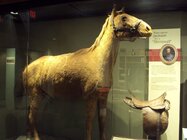
If you want to see Little Sorrel today, he still stand in the basement of The VMI Museum, along with Jackson's raincoat showing the bullet hole he received the last time he saw Little Sorrel.6 It was moved there when the Confederate Veterans Home closed.

That's not the only postmortem travels for Little Sorrel. The taxidermist who mounted him, took the bones as partial payment.6 He sent Little Sorrel back into Yankee hands at The Carnegie Museum in Pittsburg irritating many southerners.6 The bones stayed there until July 20, 1997, 136 years after the Battle of Manassas.2 They were then cremated and buried at the base of the life sized statue of Jackson on the parade grounds at VMI.6
 
http://www.civilwarprofiles.com/traveller-and-little-sorrel-the-war-horses-of-lee-and-jackson/


Little Sorrel

Little-Sorrel-1-510x300.jpg

Post-war photograph of Little Sorrel

"Little Sorrel" was a Morgan horse, fifteen hands tall, captured in Harper's Ferry, (West) Virginia by Stonewall Jackson's army in 1861. Originally intending to give the horse to his wife, Jackson paid the quartermaster $150 for the gelding, naming him "Fancy." But after riding the horse, Jackson found the animal's gait so pleasing he remarked, "A seat on him was like being rocked in a cradle." Deciding to keep the horse for himself, it quickly became known as "Little Sorrel" once Jackson began using it as his regular mount.

Although not looking the part of the classic "war-horse," Little Sorrel had the reputation of remaining calm in battle while also possessing remarkable stamina on long marches. "The endurance of the little animal was marvelous," Henry Kyd Douglas wrote, "and the General was apt to forget it was exceptional."

Jackson was riding Little Sorrel when wounded on May 2, 1863 at the battle of Chancellorsville. The horse remained on the battlefield after Jackson was removed to receive medical attention and was later found by two artillery soldiers, neither of whom recognized it as Jackson's horse. One of the soldiers rode the horse for several days until it was discovered to be Little Sorrel, at which point the horse was turned over the Gen. J.E.B Stuart. He in turn gave the animal to Anna Jackson, who took Little Sorrel with her to North Carolina to live at her father's farm.

Little-Sorrel.jpg

Little Sorrel on the parade grounds of the Virginia Military Institute

In 1883, Anna donated Little Sorrel to the Virginia Military Institute (VMI), where the animal was permitted to leisurely graze the parade grounds for the next two years. The horse was then relocated to the Confederate Soldiers' Home in Richmond, Virginia, where he subsequently died at the age of 36 in 1886.

Little-Sorrel-VMI-300x224.jpg

Little Sorrel's preserved hide in the VMI Museum

Little-Sorrel-Grave-Marker-300x224.jpg

Stone over Little Sorrel's grave on the VMI parade grounds

Following the animal's death, the Soldiers' Home contracted a taxidermist named Frederic Webster to preserve Little Sorrel's remains. Webster mounted the hide on a framework of plaster, keeping the animal's skeleton for himself "as part payment for my service." In 1949, the hide was returned to VMI where it remains on display to this day. That same year, the horse's skeletal remains were also donated to VMI, but stayed in storage until 1997, at which time they were cremated and interred on the school's parade grounds at the foot of the Stonewall Jackson statue.
 
dsc03394-jpg.jpg


As my more recent photo from this spring shows, Old Sorrel's looking quite the worse for wear these days!
 

Attachments

  • dsc03394-jpg.jpg
    dsc03394-jpg.jpg
    195.1 KB · Views: 179
The mount at VMI has been spruced up and looks pretty good these days. Little Sorrel was Jackson's go-to warhorse, but hardly his only one. As far as I was able to determine in several years' research, he always had at least two and sometimes three or four. He was aboard Little Sorrel for all or part of every battle except for First Manassas, where he borrowed a horse from James Thomson. Of all the equestrian statues of a mounted Jackson, only one--the statue in Charlottesville (copied in Clarksburg WV)-- shows a horse even vaguely similar to Little Sorrel, and the gait of that horse is wrong. Book coming out in October.
 
The mount at VMI has been spruced up and looks pretty good these days. Little Sorrel was Jackson's go-to warhorse, but hardly his only one. As far as I was able to determine in several years' research, he always had at least two and sometimes three or four. He was aboard Little Sorrel for all or part of every battle except for First Manassas, where he borrowed a horse from James Thomson. Of all the equestrian statues of a mounted Jackson, only one--the statue in Charlottesville (copied in Clarksburg WV)-- shows a horse even vaguely similar to Little Sorrel, and the gait of that horse is wrong. Book coming out in October.

Thanks for the input Sharon; welcome to the forums!
 

Learn About Us
About CivilWarTalk
Contact the Webmaster
Meet the Staff
Link to CivilWarTalk
Join Our Community
Register
Browse Forums
View Today's Discussions
Search the Forum
Get Help
FAQ
Student Guide
Forum Rules & Etiquette
Copyright / DMCA

     Contact Us CivilwarTalk on Facebook CivilWarTalk on YouTube CivilWarTalk on Twitter RSS Feed

Bringing the American Civil War and More to Life.
© 1999 - , CIVILWARTALK, LLC - Site Version 10.0

SlaveryTalk.com - SecessionTalk.com - CivilWarTalk.com - ReconstructionTalk.com
Back
Top