Fort Jackson 1862 / 2019

tony_gunter

2nd Lieutenant
Joined
Feb 19, 2011
Location
Mississippi
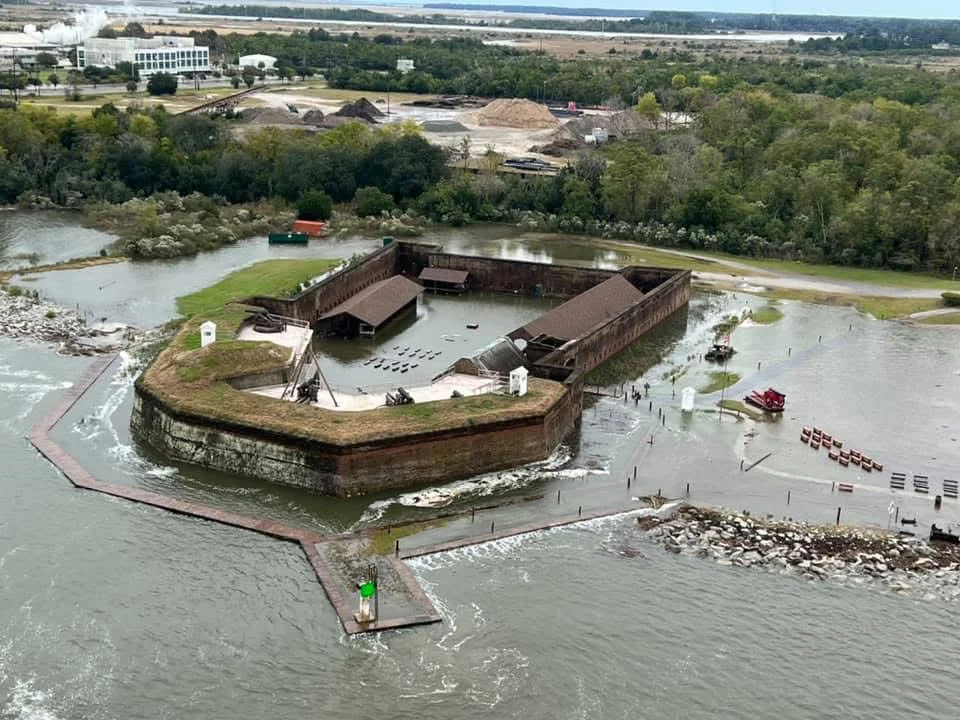
1862 was a major flood year on the Mississippi River when Farragut ran past the forts and captured New Orleans. Kason Fritts captured a photo of Fort Jackson during the last major flood in 2019.
1782055883381.webp
 
Last edited:
I used to stop by Fort Jackson after fishing trips in Venice, Louisiana. The last time I was there was back in August of 2005.
(literally one week before Hurricane Katrina). Unfortunately I never took any photos.

From what I remember, it was completely submerged for over a month after Katrina.
Another hurricane buried the fort in mud. I forget that storm's "name".

It's my understanding Fort Jackson has been cleaned up, repaired and is currently open to visitors.
But I'm not 100% sure that is accurate.

Perhaps some of our Louisiana members will let us know the current status of this fort.
 
I would imagine a lot of work needs to be done just to maintain a coastal fort. Fort Point in San Francisco sits high enough that it's not threatened; absent a major tsunami. In that case, most of the landfill in San Francisco and other cities around the Bay Area belongs temporarily to Davy Jones Locker.
 
Yep. Does anyone have a picture of the other Fort Jackson at major flood stage?
Here is a website with a few before and after pictures of Fort Jackson after Hurricane Katrina:

I'm pretty sure the grounds around the fort are walkable, but I do believe the fort itself has not been opened to the public for regular visits since Hurricane Ida in 2021 because of all of the damage it sustained.

The museum which used to be located in one of the casemates has been moved about a mile down the road. I am certain that is still open.

Unfortunately, a lot of these forts along Louisiana's waterways have been closed in recent years. The upkeep is enormously expensive. I know Fort Pike--which is a substantially smaller fort located along one of the approaches into Lake Pontchartrain--had an upkeep cost of like $400,000 a year before they closed it to the public. The ground in this area has no natural bedrock and the alluvial soil that dominates the geography of the area is in a continual cycle of shifting and subsiding. The weight of a masonry fort doesn't help in the least.

I do know that the storm surge of Hurricane Betsy and Hurricane Katrina brought somewhere around twenty feet of water into the area surrounding the fort although that is an entire different animal than the typical Spring flooding associated with the mouth of the Mississippi.

I don't know if any modern picture could accurately capture how the yearly Spring floods impacted Fort Jackson and Fort St Philip in the 1860s because of the modern levee/ locks and dams/ diversions that have been built to keep the river from doing exactly that.

I'll keep looking.
 
Last edited:
I wonder what is left with Fort St. Phillips? I know that in the 1960s, during the Civil Rights scuffles, Leander Perez turned Fort St. Philips into a makeshift prison camp. Not sure if anything is left of it today.
I visited Fort St Philip in 2003 or 2004, and there wasn't much left of it then--or at least what was left of it was buried and only two or three feet of the parapet walls were still visible in most places. It is my understanding that the pre-civil war fort was back-filled when it was updated during the Span-Am era. The parish dump was located in the vicinity as well. I'm not quite sure how much that impacted the fort's preservation. I could imagine the past twenty odd years of hurricanes has done a number on it as well.
 
I wonder what is left with Fort St. Phillip
I'm not sure, but I think there's more intact remains than most folks think.
Fort St. Phillip is on private property and not open to the public. Seems the swamp has reclaimed most of it.

Over the years, I've watched many of those youtube "urban explorer" types sneek into what's left.

Here's a relatively recent example:

 
I'm not sure, but I think there's more intact remains than most folks think.
Fort St. Phillip is on private property and not open to the public. Seems the swamp has reclaimed most of it.

Over the years, I've watched many of those youtube "urban explorer" types sneek into what's left.

Here's a relatively recent example:


That's a splendid video. Thanks for posting! A lot more there than I expected!
 
Although I believe a lot of the original bricks are still there, I think most of what this guy filmed is from the Spanish-American War era, circa 1896-1903.
Correct, a majority of what is left at Fort St Philip are the Endicott period batteries. Little of the site's previous fortifications are left.
 
I know Fort Pike--which is a substantially smaller fort located along one of the approaches into Lake Pontchartrain--had an upkeep cost of like $400,000 a year before they closed it to the public. The ground in this area has no natural bedrock and the alluvial soil that dominates the geography of the area is in a continual cycle of shifting and subsiding. The weight of a masonry fort doesn't help in the least.
Yes indeed !

Fort Pike is another very interesting abandoned site.
Almost 100 miles upriver from Fort Jackson & Fort St. Philip ... Fort Pike was not involved in any actions during the Civil War.
But one can still see what's left .. (if taking a boat on Lake Pontchartrain) north shore of New Orleans.

For anyone interested in Fort Pike :

 
I wonder what is left with Fort St. Phillips? I know that in the 1960s, during the Civil Rights scuffles, Leander Perez turned Fort St. Philips into a makeshift prison camp. Not sure if anything is left of it today.
Not much. The CW era walls are gone, and the Spanish American War era batteries are falling apart. I saw a guy who got permission to go out there. Said he didn't want to go in one of the batteries. It was filled with water, abd he wasn't entirely sure what wss down there.

Weirdest thing about it was a cult took the fort over, lured there, but things started falling apart within the group and the cult leader did what cult learners oft do to themselves with firearms.

The American Heritage book, one of the first I got when I was 8 years old had some cool photos of the fort with the water risen. Lilly pads and the like. Pretty cool.
 
Unfortunately, a lot of these forts along Louisiana's waterways have been closed in recent years. The upkeep is enormously expensive. I know Fort Pike--which is a substantially smaller fort located along one of the approaches into Lake Pontchartrain--had an upkeep cost of like $400,000 a year before they closed it to the public. The ground in this area has no natural bedrock and the alluvial soil that dominates the geography of the area is in a continual cycle of shifting and subsiding. The weight of a masonry fort doesn't help in the least.
Pike and it's sister fort, Fort Macomb, have cypress incorporated into their foundations. The engineers knew subsidence would be an issue. But eventually, time catches up.
 

Learn About Us
About CivilWarTalk
Contact the Webmaster
Meet the Staff
Link to CivilWarTalk
Join Our Community
Register
Browse Forums
View Today's Discussions
Search the Forum
Get Help
FAQ
Student Guide
Forum Rules & Etiquette
Copyright / DMCA

     Contact Us CivilwarTalk on Facebook CivilWarTalk on YouTube CivilWarTalk on Twitter RSS Feed

Bringing the American Civil War and More to Life.
© 1999 - , CIVILWARTALK, LLC - Site Version 10.0

SlaveryTalk.com - SecessionTalk.com - CivilWarTalk.com - ReconstructionTalk.com
Back
Top