The Peninsula The Peninsula

Interested in finding a good book about the Peninsula campaigns and battles. Which are considered best, especially from the Confederate side ?
Steve Sears wrote one but I am not at home right now. Something like the "Road to Richmond". Any good biography of Lee, Longstreet, A.P. Hill or McCellen would have information about the Peninsula Campaign. General Porter Alexander's biography " Fighting for the Confederacy" I have it at home also has a lot on the Peninsula Campaign.
We have had many debates about McCellen over the years. Our two biggest defenders of McCellen @Saphroneth and at @67th Tigers have posted about McCellen for years. Lots of posts and lots of arguments about McCellen and his conduct of the Peninsula Campaign. Some new books which are now more sympathetic to McCellen have been published.
Leftyhunter
 
Sears has the "slight" problem that he in cases fabricates or disregards evidence crucial to his argument. For example in his To The Gates Of Richmond:


After seeing off his reconnaissance, Smith rode to Keyes's headquarters to let his superior know "in a conversational way" what he had done. As they talked, a messenger arrived from McClellan's headquarters. Keyes read the dispatch and without a word handed it to Smith. No action was to be initiated against the enemy, it read, until the engineers had thoroughly studied the Rebel line and determined the best approach. Smith, "very much chagrined," rushed back to the front to recall Hancock. Hancock said that he had already discovered the weak spot they were looking for, and that it could be taken easily. No matter now, Smith told him: it was out of their hands. Baldy Smith always believed that had McClellan's order arrived an hour or two later, he would have broken the enemy's line

Sears, Stephen W.. To the Gates of Richmond: The Peninsula Campaign (Kindle Locations 802-807). Houghton Mifflin Harcourt. Kindle Edition.

This section of the book is written as being on the 6th of April.


The reference for the bolded sentence is Hancock's report. Here is the text of Hancock's report:


This creek here is about 1,200 yards distant from the Yorktown road. The Fourteenth Alabama was stationed there, and according to the statement of four soldiers of that regiment, taken by the Sixth Maine Volunteers, it numbered 1,070 men when it left Richmond, a few days ago. During the afternoon other movements of troops were observed marching down the stream behind the works, while this regiment was holding the crest of the creek. The dam there, by the statement of the colonel, is from 15 to 20 rods in length and about 12 feet broad. It is believed that yesterday that point could have been easily taken. The colonel of the regiment sent me a message by his major, asking permission to take it, which, however, I did not receive, being at the time with the other regiment, overlooking the two lower works. I merely mention this to show his idea of the practicability of it at that time, for I imagine the difficulty would have been in crossing the creek and in maintaining possession after we had taken it, for we had no artillery or intrenching tools with us. Major Harris, who took the message, with an escort of two men, meeting a scouting party of seven of the enemy, was prevented from communicating. He, however, by a ruse (commanding a deployment of men) and the fire of the two men, killing one of the enemy, causing them to fall back, escaped.

The circumstances were entirely changed afterwards, for the movement of several regiments of troops beyond the forts was observed by our line of skirmishers, who, notwithstanding, held the crest for about three hours, and until withdrawn to return. The next work below that appeared to be a rifle pit, and showed no guns. Our skirmishers, of the Fifth Wisconsin Volunteers, Captain Bean, drove the enemy from this crest down the bank, across the bridge there, and into their works. This appears to be flanked by the work in rear of the one-gun battery. Below this three other works were seen, each mounting artillery, each containing several guns. We drove the enemy to the crest of the high ground overlooking the flat in front of these forts. From the one (of those two) highest up the stream the enemy threw a number of shells at our skirmishers. It appears to have a direct control of the next one or two lower down the stream. We had a fair view of the lower work from this crest at about not more than 1,000 paces, and probably not so far. This crest commands it, and looks down upon the mill and road directly under it.


The report is dated the 6th, and what it claims is that "it is believed that yesterday the point could be easily taken" and it notes further that the belief is by the colonel of the 6th Maine - not by Hancock - while Hancock himself notes that later the same day it was discovered that several regiments stood-to on the crestline.


Sears here is essentially fabricating evidence and directly contradicting his own source. This renders all his work suspect, since this is not a minor matter of interpretation - it's getting the source wrong in every particular. (Sears states that Hancock claimed a weakness on the 6th; Hancock actually reported someone else believed mistakenly in a weakness on the 5th.)
 
Clifford Dowdy's "The Seven Days: The Emergence of Lee" (Boston: Little Brown & Co., 1964) is written from a southern perspective and very admiring of Lee.

Dowdy has been criticized as too admiring of Lee, but I found the book a good read nevertheless.
 
Sears has the "slight" problem that he in cases fabricates or disregards evidence crucial to his argument. For example in his To The Gates Of Richmond:


After seeing off his reconnaissance, Smith rode to Keyes's headquarters to let his superior know "in a conversational way" what he had done. As they talked, a messenger arrived from McClellan's headquarters. Keyes read the dispatch and without a word handed it to Smith. No action was to be initiated against the enemy, it read, until the engineers had thoroughly studied the Rebel line and determined the best approach. Smith, "very much chagrined," rushed back to the front to recall Hancock. Hancock said that he had already discovered the weak spot they were looking for, and that it could be taken easily. No matter now, Smith told him: it was out of their hands. Baldy Smith always believed that had McClellan's order arrived an hour or two later, he would have broken the enemy's line

Sears, Stephen W.. To the Gates of Richmond: The Peninsula Campaign (Kindle Locations 802-807). Houghton Mifflin Harcourt. Kindle Edition.

This section of the book is written as being on the 6th of April.


The reference for the bolded sentence is Hancock's report. Here is the text of Hancock's report:


This creek here is about 1,200 yards distant from the Yorktown road. The Fourteenth Alabama was stationed there, and according to the statement of four soldiers of that regiment, taken by the Sixth Maine Volunteers, it numbered 1,070 men when it left Richmond, a few days ago. During the afternoon other movements of troops were observed marching down the stream behind the works, while this regiment was holding the crest of the creek. The dam there, by the statement of the colonel, is from 15 to 20 rods in length and about 12 feet broad. It is believed that yesterday that point could have been easily taken. The colonel of the regiment sent me a message by his major, asking permission to take it, which, however, I did not receive, being at the time with the other regiment, overlooking the two lower works. I merely mention this to show his idea of the practicability of it at that time, for I imagine the difficulty would have been in crossing the creek and in maintaining possession after we had taken it, for we had no artillery or intrenching tools with us. Major Harris, who took the message, with an escort of two men, meeting a scouting party of seven of the enemy, was prevented from communicating. He, however, by a ruse (commanding a deployment of men) and the fire of the two men, killing one of the enemy, causing them to fall back, escaped.

The circumstances were entirely changed afterwards, for the movement of several regiments of troops beyond the forts was observed by our line of skirmishers, who, notwithstanding, held the crest for about three hours, and until withdrawn to return. The next work below that appeared to be a rifle pit, and showed no guns. Our skirmishers, of the Fifth Wisconsin Volunteers, Captain Bean, drove the enemy from this crest down the bank, across the bridge there, and into their works. This appears to be flanked by the work in rear of the one-gun battery. Below this three other works were seen, each mounting artillery, each containing several guns. We drove the enemy to the crest of the high ground overlooking the flat in front of these forts. From the one (of those two) highest up the stream the enemy threw a number of shells at our skirmishers. It appears to have a direct control of the next one or two lower down the stream. We had a fair view of the lower work from this crest at about not more than 1,000 paces, and probably not so far. This crest commands it, and looks down upon the mill and road directly under it.


The report is dated the 6th, and what it claims is that "it is believed that yesterday the point could be easily taken" and it notes further that the belief is by the colonel of the 6th Maine - not by Hancock - while Hancock himself notes that later the same day it was discovered that several regiments stood-to on the crestline.


Sears here is essentially fabricating evidence and directly contradicting his own source. This renders all his work suspect, since this is not a minor matter of interpretation - it's getting the source wrong in every particular. (Sears states that Hancock claimed a weakness on the 6th; Hancock actually reported someone else believed mistakenly in a weakness on the 5th.)

The OR I'm looking at has Hancock's report dated April 7.

Ryan
 
Interested in finding a good book about the Peninsula campaigns and battles.

I like Stephen Sears' To The Gates of Richmond, especially because it covers the entire campaign. Sears is an excellent writer, although as other posts show some people criticize some of his accuracy and his clear disdain of McClellan.

Brian Burton's Extraordinary Circumstances: The Seven Days Battles is very in-depth, but also difficult read. He's like a poor man's Peter Cozzens. The book also doesn't cover the Peninsula Campaign through Seven Pines; it only addresses the Seven Days.

Burton's book is from 2001 and Sears from 1992. Somebody really needs to give the Peninsular Campaign proper treatment as a modern trilogy (Part 1 up through Seven Pines; Part 2 from immediately after that battle through the end of Gaines Mill; Part 3 McClellan's order to withdraw to Harrison's landing until the last troops are removed).

Which are considered best, especially from the Confederate side?

What does that even mean?

All the criticism I've heard about Sears regards perceived mistreatment of the Union side, not bias against Confederates. Yet he is by no means a Lost Causer or pro-Confederate.

Clifford Dowdy's "The Seven Days: The Emergence of Lee" (Boston: Little Brown & Co., 1964) is written from a southern perspective and very admiring of Lee.

Dowdy has been criticized as too admiring of Lee, but I found the book a good read nevertheless.

I thought it was terrible, but if you're looking for the Lost Cause version of the Peninsular Campaign it's perfect.
 
I like Stephen Sears' To The Gates of Richmond, especially because it covers the entire campaign. Sears is an excellent writer, although as other posts show some people criticize some of his accuracy and his clear disdain of McClellan.

Brian Burton's Extraordinary Circumstances: The Seven Days Battles is very in-depth, but also difficult read. He's like a poor man's Peter Cozzens. The book also doesn't cover the Peninsula Campaign through Seven Pines; it only addresses the Seven Days.

Burton's book is from 2001 and Sears from 1992. Somebody really needs to give the Peninsular Campaign proper treatment as a modern trilogy (Part 1 up through Seven Pines; Part 2 from immediately after that battle through the end of Gaines Mill; Part 3 McClellan's order to withdraw to Harrison's landing until the last troops are removed).
Also @Rebe


What does that even mean?

All the criticism I've heard about Sears regards perceived mistreatment of the Union side, not bias against Confederates. Yet he is by no means a Lost Causer or pro-Confederate.


I thought it was terrible, but if you're looking for the Lost Cause version of the Peninsular Campaign it's perfect.
Also @Rebelsoul @Mike Griffith shared a presentation of an author who had a new book about McCellen. This book should cover the Peninsula Campaign. I forgot the thread.
A strong argument has been made by @Saphroneth and @67th Tigers that McCellen could of won the Peninsula Campaign but Lincoln pulled the rug under him.
That is a controversial point of view but it has merit. That is not to argue Lincoln was not a great president but presidents do make terrible military decisions.
Leftyhunter
 
Interested in finding a good book about the Peninsula campaigns and battles. Which are considered best, especially from the Confederate side ?
The author Kevin Dougherty of the book "Strangling the Confederacy" makes a good argument that instead of sending General Burnside and his men from New Berne, North Carolina to Ft.Monroe , Virginia to reinforce McCellen ; Burnside should of been allowed to mount an offensive to Goldsboro,North Carolina. Doing so would of crippled vital rail lines to Richmond and divert Confederate troops away from Virginia.
Leftyhunter
 
Clifford Dowdy's "The Seven Days: The Emergence of Lee" (Boston: Little Brown & Co., 1964) is written from a southern perspective and very admiring of Lee.

Dowdy has been criticized as too admiring of Lee, but I found the book a good read nevertheless.


Correct but it doesn't cover the entire campaign. But Dowdey ranks somewhere near Freeman in his Lee adulation
 
Sears' To The Gates of Richmond is not from the Confederate side, despite all its other qualities.

The charge by Saphroneth that Sears is guilty of fabricating evidence is overwrought. Sears is very good, even if he is not perfect.
 
I liked this too:


The Richmond Campaign of 1862: The Peninsula and the Seven Days (Military Campaigns of the Civil War)
by Gary W. (ed.) Gallagher (Author)

The Richmond campaign of April-July 1862 ranks as one of the most important military operations of the first years of the American Civil War. Key political, diplomatic, social, and military issues were at stake as Robert E. Lee and George B. McClellan faced off on the peninsula between the York and James Rivers. The climactic clash came on June 26-July 1 in what became known as the Seven Days battles, when Lee, newly appointed as commander of the Confederate forces, aggressively attacked the Union army. Casualties for the entire campaign exceeded 50,000, more than 35,000 of whom fell during the Seven Days.

This book offers nine essays in which well-known Civil War historians explore questions regarding high command, strategy and tactics, the effects of the fighting upon politics and society both North and South, and the ways in which emancipation figured in the campaign. The authors have consulted previously untapped manuscript sources and reinterpreted more familiar evidence, sometimes focusing closely on the fighting around Richmond and sometimes looking more broadly at the background and consequences of the campaign.

Contributors:
William A. Blair
Keith S. Bohannon
Peter S. Carmichael
Gary W. Gallagher
John T. Hubbell
R. E. L. Krick
Robert K. Krick
James Marten
William J. Miller
 
The OR I'm looking at has Hancock's report dated April 7.

Ryan

Yes, and he probably started writing it on the 7th. It is a portmanteau of the actions of the 6th and 9th, which is why the engineer officer present changes from Merill and Comstock halfway through. The report was handed in on the 10th.

The order of events is roughly:

1. Evening of 5th April.

McClellan orders out three recces-in-force. One from Hancock's brigade accompanied by Lt Merrill of the engineers was ordered to march across the Warwick line "left to right" and provoke responses. Another from Burns' brigade accompanied by Lt Comstock went right to left. These two patrols actually crossed each other in from of Wynn's Mill and kept going. The third patrol was Barnard and Lt McAlester who went forward under cover to recce the ravines in front of Yorktown proper.

2. 6th April

The patrols set out. Hancock's patrol encounters the skirmish line of the 14th Alabama on the near side of the river along Garrow's Ridge. The Garrow Ridge, Hancock notes was the only place they found where the ground was higher on the near side than the far.

The storm starts in the evening.

3. 7th April

As per orders from McClellan, that evening Smith moves his 1st and 2nd Bdes from the vicinity of Warwick Court House to the Four Corners with artillery and assumes command of the Lee's Mill sector.

4. 8th April

Lt Comstock begins a series of recces to find a potential attack point. He can't observe the dam because of the rebel skirmishers.

5. 9th April

Comstock makes another recce of the Dam, this time covered by Hancock. The 6th Maine advance on the 14th Alabama on the Garrow Ridge and suffer a KIA in the firefight with the skirmishers. The 14th Alabama fell back into the "one gun battery". The colonel of the 6th Maine sent his major back to ask permission to go further, but he was ambushed by a rebel patrol and the message never arrived. Comstock gets to observe the dam.

(The 14th Alabama's history confirms that this happened on 9th April. A history of the 6th Maine says much the same.)

6. 10th April

Smith sends a copy of Hancock's report to Keyes, and then takes another in person to McClellan. McClellan tells Smith
"Had you moved and won, it would have made you a major-general.", indicating his disappointment that Smith had not attacked.

Comstock recces the Wynn's Mill position.

7. 11th April

The storm ends. Comstock has finished his recces.

8. 12th April

Comstock starts writing his report.

9. 13th April

Merrill starts writing his.

10. 14th April

McClellan has read the reports and meets with the engineers and senior commanders. They conclude that an attack at Lee's Mill is the only viable one. Smith is ordered to seize the Garrow Ridge and permanently occupy it as a Line of Departure for a future assault. Smith conducts his own recce that evening.

11. 15th April

McClellan approves Smith's plan and sends Marcy to gather the reserve divisions in the rear (Casey's, Hooker's and the brigade of Richardson's that has landed) for an assault after Smith has secured the LD.

12. 16th April

Smith seizes the Garrow Ridge exactly as per the plan, but then McClellan left to bring up the main attacking force. Smith sent a weak attack over and as the Vermonters retreated they cut the dam, destroying the crossing point. The plan for an assault was cancelled.
 
The OR I'm looking at has Hancock's report dated April 7.
The top line of the place I got it from says "April 6, with indorsements". If that's referring to the date of the action rather than the report my apologies, though it doesn't change the other two points and certainly doesn't change that Hancock's report was not "I have found a weakness now" but was written the day after the action.
 

Attachments

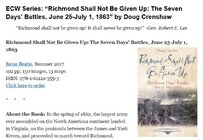
  • ECW.jpg
    ECW.jpg
    81.9 KB · Views: 107

Learn About Us
About CivilWarTalk
Contact the Webmaster
Meet the Staff
Link to CivilWarTalk
Join Our Community
Register
Browse Forums
View Today's Discussions
Search the Forum
Get Help
FAQ
Student Guide
Forum Rules & Etiquette
Copyright / DMCA

     Contact Us CivilwarTalk on Facebook CivilWarTalk on YouTube CivilWarTalk on Twitter RSS Feed

Bringing the American Civil War and More to Life.
© 1999 - , CIVILWARTALK, LLC - Site Version 10.0

SlaveryTalk.com - SecessionTalk.com - CivilWarTalk.com - ReconstructionTalk.com
Back
Top