★ ★  Hunt, Henry Jackson

Henry Jackson Hunt
:us34stars:
Hunt 1.jpg


Born: September 14, 1819

Birthplace: Detroit, Michigan

Father: Samuel Wellington Hunt 1799 – 1829

Mother: Julia Ann Herrick 1799 – 1827

1st Wife: Emily Caroline DeRussy 1831 – 1857
(Buried: Saint Johns Church Cemetery, Hampton, Virginia)​

2nd Wife: Mary Bethune Craig 1836 – 1911
(Buried: U.S. Soldiers and Airmen's Home National Cemetery, Washington, D.C.)​

Children:

Emily De Russy Hunt 1852 – 1873​
(Buried: Jefferson Barracks National Cemetery, Lemay, Missouri)​
Lt. Henry Jackson Hunt Jr. 1855 – 1886​
(Buried: U.S. Soldiers and Airmen's Home National Cemetery, Washington, D.C.)​
Conway Bethune Hunt 1861 – 1947​
(Buried: Oak Hill Cemetery, Washington, D.C.)​
Maria Bethune Hunt 1862 – 1938​
(Buried: U.S. Soldiers and Airmen's Home National Cemetery, Washington, D.C.)​
Dr. Presley Craig Hunt 1871 – 1910​
(Buried: U.S. Soldiers and Airmen's Home National Cemetery, Washington, D.C.)​
Colonel John Elliott Hunt 1874 – 1951​
(Buried: Arlington National Cemetery, Arlington, Virginia)​

Education:

1839: Graduated West Point Military Academy – (19th in class)​

Occupation before War:

1839 – 1846: 2nd Lt. United States Army 2nd Artillery​
1846 – 1852: 1st Lt. United States Army 2nd Artillery​
1847: Brevetted Captain for Gallant Service at Contreras & Churchbusco​
1847: Wounded twice during the Mexican War​
1847: Brevetted Major for Gallantry at Battle of Chapultepec​
1852 – 1861: Captain United States Army, 2nd Artillery​

Civil War Career:
Hunt.jpg


1861 – 1863: Major United States Army, 5th Artillery​
1861: Chief of Artillery Washington, D.C. Defenses​
1861 – 1862: Colonel in the Union Army​
1861 – 1862: Organizer of Artillery Reserve, Army of the Potomac​
1861 – 1862: Member of the Board for Arming Fortifications​
1862 – 1866: Brigadier General of Union Army Artillery​
1862: Commander Artillery Reserve, Army of the Potomac​
1862 – 1864: Chief of Artillery, Army of the Potomac​
1863: Brevetted Colonel United Army, Artillery​
1863 – 1869: Lt. Colonel United States Army, 3rd Artillery​
1864: Brevetted Major General United States Army Artillery​

1865: Brevetted Brigadier General, United States Army Artillery​
1865: Commander of Camp of Instruction near Blandensburg, Maryland
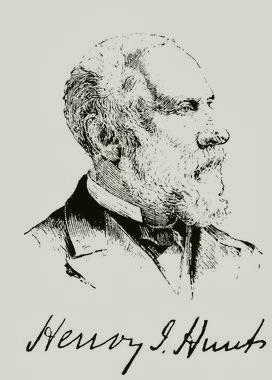
After War.jpg
1866: President of Permanent Artillery Board​
1866: Mustered out of Union Army on April 30, 1866​

Occupation after War:

1866 – 1869: Lt. Colonel United States Army, 3rd Artillery​
1869 – 1883: Colonel United States Army, 5th Artillery​
1883: Retired from United States Army on September 14th​
1885 – 1889: Governor of Soldier's Home Washington, D.C.​

Died: February 11, 1889
IMG_9893.JPG


Place of Death: Washington, D.C.

Cause of Death: Pneumonia

Age at time of Death: 69 years old

Burial Place: U.S. Soldiers and Airmen's Home National Cemetery, Washington, D.C.
 
Last edited by a moderator:
Odd I would have thought the wasting of artillery ammunition would have been one of the main concerns of The Confederate Army at Gettysburg. And it probably was. Especially being as how they were "farther from home"and only had what brought with them. But from reading about this man, He too was concerned about the Unions supply. Maybe it was a concern of both armies?
 
His rank of command during the war looks mixed up to me. He is a Colonel in 1862 and soon becomes a Brigadier General, so I assume it is a rank that took affect by being backdated. In 1863 he is Lt. Colonel and brevetted a Colonel, but it seems that rank was already attained in 1861-1862. Then his brevet rank for Major General is a year before his brevet for brigadier general, but that appears to be when his rank was backdated. But he is given the rank of Lt. Colonel after the war in 1866 without the brevet. It sounds like the army headquarters bounced his rank up and down to meet the challenge of command and seniority among the Divisional and Corps commanders. Is my assumption accurate?
Thanks,
Lubliner.
 
His rank of command during the war looks mixed up to me. He is a Colonel in 1862 and soon becomes a Brigadier General, so I assume it is a rank that took affect by being backdated. In 1863 he is Lt. Colonel and brevetted a Colonel, but it seems that rank was already attained in 1861-1862. Then his brevet rank for Major General is a year before his brevet for brigadier general, but that appears to be when his rank was backdated. But he is given the rank of Lt. Colonel after the war in 1866 without the brevet. It sounds like the army headquarters bounced his rank up and down to meet the challenge of command and seniority among the Divisional and Corps commanders. Is my assumption accurate?
Thanks,
Lubliner.

Well he was in the Union Army and United States Army so the ranking is confusing
 
He was one of 3 officers who,as a board, revised field artillery.This 1856 board consisted of Henry J.Hunt, William H, French, and William F. Barry. Together they wrote the manual, "The Instructions for Field Artillery". It was published in 1861 by the War Department and became the"bible" of Northetn field artillerists.
 
Anniversary Bump

Birthday

14 Sept 1819

Hunt's most famous service in the war was at the Battle of Gettysburg in July 1863. His new commander, Maj. Gen. George Meade, greatly respected Hunt's expertise and not only gave him great latitude in directing the artillery, but also used him on occasion as his personal representative. For example, on July 2, Meade sent Hunt to 3rd Corps commander Maj. Gen. Dan Sickles in an attempt to get Sickle's defensive lines to conform to orders. (Sickles' insubordinate movement from Cemetery Ridge, where he had been ordered to defend, to the Peach Orchard, broke the continuity of the Union defensive line.) Hunt was unable to influence Sickles's deployment, but Hunt's masterful analysis of terrain and placement of batteries on the ridge were important factors in the Union's eventual success on the second day.

Full article here - https://uniongenerals.org/meet-the-members/brigadier-general-henry-hunt/

Papers of the 2017 Gettysburg National Military Park Seminar
Artillery "When Properly Managed" Henry Hunt vs. William N. Pendleton
Bert Barnett

In company with other officers, Hunt had for some time been pressing for changes within the artillery command structure of the Army of the Potomac. Unfortunately, sometimes it took much more than the choir of a few voices to force the heavy head of tradition. Chancellorsville would be such a circumstance; paving the way for a corps – level restructuring of Union field artillery. The need for this change is nowhere better described than in the writings of Colonel Charles S. Wainwright's private diary. A meticulous, precise, opinionated man, Wainwright served as the Chief of Artillery for the First Corps. This trusted associate of General Hunt accurately recorded the meltdown of the Federal artillery command on that occasion.


Cheers,
USS ALASKA
 

Attachments


Learn About Us
About CivilWarTalk
Contact the Webmaster
Meet the Staff
Link to CivilWarTalk
Join Our Community
Register
Browse Forums
View Today's Discussions
Search the Forum
Get Help
FAQ
Student Guide
Forum Rules & Etiquette
Copyright / DMCA

     Contact Us CivilwarTalk on Facebook CivilWarTalk on YouTube CivilWarTalk on Twitter RSS Feed

Bringing the American Civil War and More to Life.
© 1999 - , CIVILWARTALK, LLC - Site Version 10.0

SlaveryTalk.com - SecessionTalk.com - CivilWarTalk.com - ReconstructionTalk.com
Back
Top