Desperate Measures: Self-Mutiliation to Avoid Service

lelliott19

Brigadier General
Moderator
* OFFICIAL *
CWT PRESENTER
Forum Host
Silver Patron
Regtl. Staff Chickamauga 2018
Joined
Mar 15, 2013
Desperate Measures
When we study the common soldier of the Civil War, we often focus on stories of bravery, hardship, endurance, and such. Incidents of self-mutilation to avoid duty are rarely documented. I've seen notes suggesting that a soldier shot himself in the foot or hand before. But none as well-documented as well as this one.

Before we start, I want to be clear. The purpose of this thread isn't to sit in judgment of a long-dead soldier. Instead, it is to demonstrate a reality. Something that happened more often than people may realize.

Background
In 1861, 21-year-old James Robert Holcombe married Ellen Dura Sophia Clements in Georgia. On March 1, 1862, leaving his pregnant wife behind, James enlisted at Cedartown, Georgia. He joined the "Cedartown Guards" which became Company D of the 21st Georgia Infantry. He was described as 5 feet 11 inches tall, with a light complexion, blue eyes, and blond hair.

Once in Virginia, like many newly enlisted volunteers, James contracted some disease or camp illness. By April 21 he was admitted to Chimborazo Hospital in Richmond, where he languished sick for over three weeks before being returned to duty on May 14.

Baptism by Fire in the Valley
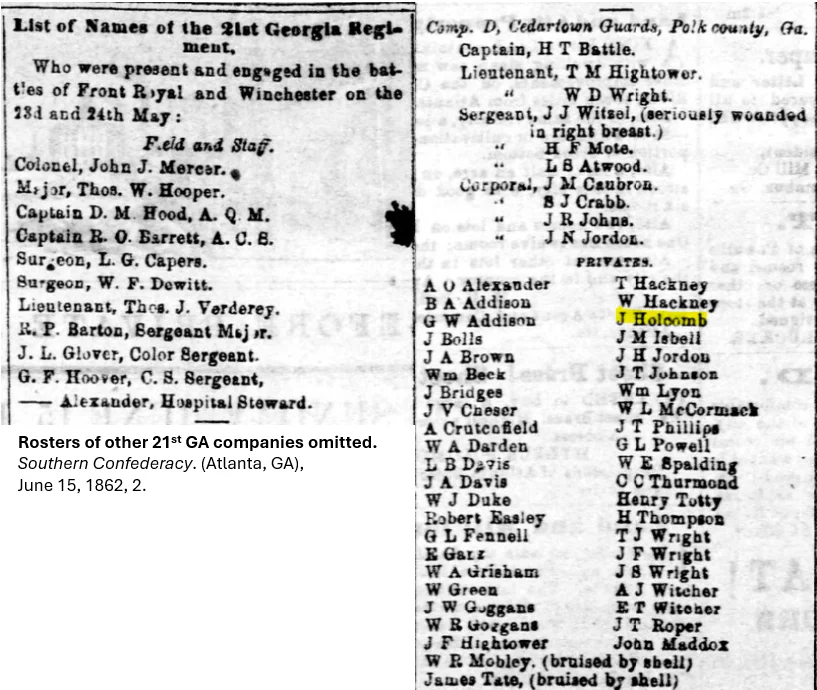
You might assume a soldier who resorted to "desperate measures" was a coward who never faced enemy fire but James Holcombe experienced combat. After recovering from his illness, he was rushed back to his unit just in time to join Stonewall Jackson's Shenandoah Valley Campaign. A roster of 21st Georgia combatants incudes the name "J Holcomb." There was only one man with the last name Holcomb in the regiment. Private James R. Holcomb was "present and engaged" at Front Royal and Winchester on May 23 and 24th, 1862. On May 27, just 48 hours after the victory at Winchester, he was admitted to the Winchester CSA General Hospital. He is not listed as wounded on the roster and there is no notation of the cause on the carded record.
1788736086649.webp


As this clipping shows, James was right there on the front lines. He watched his hometown buddies get torn apart, including his sergeant who was shot through the chest, and others bruised by exploding artillery shells. Maybe James didn't want to be next. Or perhaps something happened with his wife or the baby? And he felt he must go home? Whatever his motivation, James reached the breaking point in early July.

Self-Maiming: A Shot to the Right Hand
He placed the muzzle of his own musket against his right hand and pulled the trigger. He was sent to the 21st Georgia's regimental hospital. His middle finger and one of the bones in his hand were either carried away by the blast or surgeons had to operate to remove that part of his hand.
1788736338019.webp


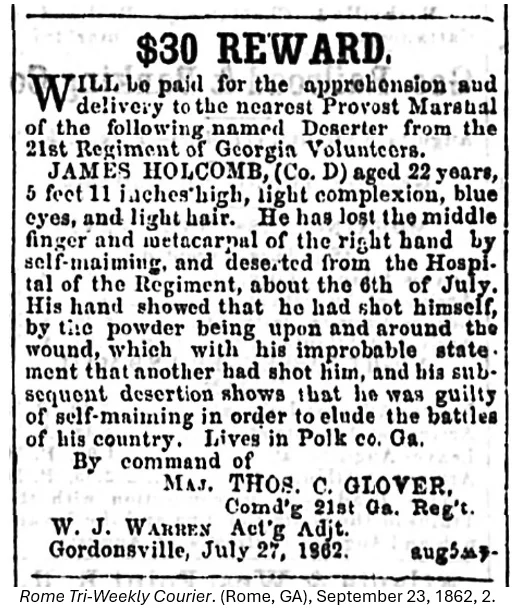
Major Glover notes the evidence that sealed James's fate:
"He has lost the middle finger and metacarpal of the right hand by self-maiming, and deserted from the Hospital of the Regiment, about the 6th of July. His hand showed that he had shot himself, by the powder being upon and around the wound, which with his improbable statement that another had shot him, and his subsequent desertion shows that he was guilty of self-maiming in order to elude the battles of his country. Lives in Polk co Ga."

Heavy black powder burns and carbon tattooing on the skin only occurs at point-blank range. This was the exact forensic evidence Civil War surgeons used to catch members of what frustrated commanders sometimes termed "the foot-and-hand brigade."

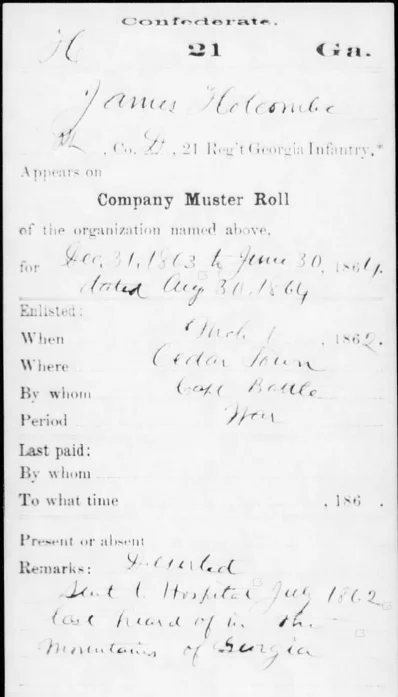
Later Company Muster Rolls recorded the following: "Deserted. Sent to Hospital July 1862 last heard of in the mountains of Georgia."
1788737583407.webp


PostScript
James evidently managed to avoid authorities and vanished in to the mountains. Sometime prior to 1870, he took his family and migrated west to Warren, Bradley County, Arkansas where he lived a quiet, well-respected life as an Arkansas farmer. James outlived two wives and raised a large family before passing away March 8, 1927, at the age of 87.

For 65 years, he lived as a quiet neighbor, carrying a desperate secret that only a Georgia newspaper and his NARA compiled service record would remember.
 
The case of Pvte. James Robert Holcomb(e) demonstrates what differences can occur in the psychological profiles of soldiers in stressful combat conditions and that every individual has varying breaking points.

Interestingly, according to Maj. Thomas Glover's published order, it seems this officer was quick to deduce from the type of Holcombe's hand wounding, that it was a self-inflicted injury, despite the private claiming that another person shot him. (It's also noted in the official roster that this soldier was listed as 'wounded at Richmond' and 'sent to hospital in Jul. '62' before 'deserting in the mountains of Georgia'- see https://babel.hathitrust.org/cgi/pt?id=hvd.32044090078676&seq=888 @ p. 872). As Holcomb stated, could another soldier, friend or foe, have shot him at point-blank range?

It certainly appears that Pvte. Holcomb deserted for reasons unknown, but from the information seen, thought it is less than certain (based on the evidence viewed) that he self-maimed.

Holcomb also appears to have been deeply religious, judging by the inscription displayed on his grave marker. (See https://babel.hathitrust.org/cgi/pt?id=hvd.32044090078676&seq=888 ). He may have been a conscientious objector, even though he was present during Jackson's Valley Campaign, he might not have engaged in actual combat. If he held and followed deeply religious convictions at the time, is it possible that he prima facie told the truth in his statement 'that another soldier shot him' ?

Just putting this perspective out there, as a possibility to consider.
 
Last edited:
Honor is something which most Americans today don't understand and this is particularly true as to how it relates to past generations. My grandfather told me similar stories from his experiences in Vietnam. Thank you @lelliott19 for sharing this story.
I turned 15 as Vietnam ended but later I had to work with a retired Cop (he was a jerk and corrupt) that admitted he only became a Cop to avoid the draft because being in Law Enforcement apparently you were exempt from the draft. Retired now I work with an older retired guy that avoid the draft by claiming hearing problems during the physical. He had no problem with it since all his friends got drafted and never came back!
 
I turned 15 as Vietnam ended but later I had to work with a retired Cop (he was a jerk and corrupt) that admitted he only became a Cop to avoid the draft because being in Law Enforcement apparently you were exempt from the draft. Retired now I work with an older retired guy that avoid the draft by claiming hearing problems during the physical. He had no problem with it since all his friends got drafted and never came back!
Too bad. After all, someone had to take their place. Wonder if either of them ever thought about that.
 
Last edited:
I don't know if you could positivity avoid the draft as a police officer, probably need draft board to ok it, but more than likely they would. Necessary jobs. I actually have a certain group of relatives who's ancestors served with the 11th GA Infantry CSA during the War. These family members have never served in the military since then..At least they hadn't since I was a kid. They were all state or local police or firemen. They would not take a federal job under any circumstance. They didn't mutilate themselves and were not corrupt...put their life on the line all the time. They just put the Die in Die Hard.
 
The case of Pvte. James Robert Holcomb(e) demonstrates what differences can occur in the psychological profiles of soldiers in stressful combat conditions and that every individual has varying breaking points.

Interestingly, according to Maj. Thomas Glover's published order, it seems this officer was quick to deduce from the type of Holcombe's hand wounding, that it was a self-inflicted injury, despite the private claiming that another person shot him. (It's also noted in the official roster that this soldier was listed as 'wounded at Richmond' and 'sent to hospital in Jul. '62' before 'deserting in the mountains of Georgia'- see https://babel.hathitrust.org/cgi/pt?id=hvd.32044090078676&seq=888 @ p. 872). As Holcomb stated, could another soldier, friend or foe, have shot him at point-blank range?

It certainly appears that Pvte. Holcomb deserted for reasons unknown, but from the information seen, thought it is less than certain (based on the evidence viewed) that he self-maimed.

Holcomb also appears to have been deeply religious, judging by the inscription displayed on his grave marker. (See https://babel.hathitrust.org/cgi/pt?id=hvd.32044090078676&seq=888 ). He may have been a conscientious objector, even though he was present during Jackson's Valley Campaign, he might not have engaged in actual combat. If he held and followed deeply religious convictions at the time, is it possible that he prima facie told the truth in his statement 'that another soldier shot him' ?

Just putting this perspective out there, as a possibility to consider.
Thank you for bringing this thoughtful perspective to the thread! You hit on some excellent points that encourage us to look past the language of the "$30 Reward" bounty and consider alternative theories. The entry you pulled from Lillian Henderson's roster - where Holcomb was recorded as "wounded at Richmond" prior to the notation that he deserted. Perhaps at some point his wound was treated as a legitimate combat injury?

When you look at the mechanics, Holcomb would have probably been carrying a Springfield or Enfield rifle-musket. The length of these makes it physically impossible for a soldier to hold that weapon and pull the trigger with their own finger to shoot themselves in the hand. To do it would have required a workaround. Possibly using the ramrod or a long stick.

What if Holcomb was telling the truth when he claimed "another had shot him." Looking at the sequence of events.... On June 27, 1862 at Gaines' Mill, Holcomb's regiment (21st Georgia) assaulted the Union right. They were funneled in a piecemeal charge through swampy, tangled creek bed under artiillery fire and musketry. Holcomb's commanding officer, Lt. Col. Hooper, was shot through the arm and the 21st GA lost heavily. The fighting July 1 at Malvern Hill was chaotic. If there was overlap and tangled lines, it's possible that a comrade standing next to him (or in front or behind) accidentally discharged his gun into Holcomb's right hand.

That would match the catastrophic damage (losing the middle finger and metacarpal) and the heavy black powder burns and "tattooing" that Major Glover used as evidence. If it was a friendly fire incident, your theory about Holcomb's religious character brings up another possibility: What if Holcomb chose to take the blame, rather than name the man who accidentlaly shot him? Faced with the accusations and the evidence, maybe Holcomb realized a court-martial would never believe him anyway? So he escaped the hospital and took his chances in the mountains.

We will probably never know exactly what happened, but it's why I love discussing these micro-histories here. Thanks again for digging up the roster.
 
Desperate Measures
When we study the common soldier of the Civil War, we often focus on stories of bravery, hardship, endurance, and such. Incidents of self-mutilation to avoid duty are rarely documented. I've seen notes suggesting that a soldier shot himself in the foot or hand before. But none as well-documented as well as this one.

Before we start, I want to be clear. The purpose of this thread isn't to sit in judgment of a long-dead soldier. Instead, it is to demonstrate a reality. Something that happened more often than people may realize.

Background
In 1861, 21-year-old James Robert Holcombe married Ellen Dura Sophia Clements in Georgia. On March 1, 1862, leaving his pregnant wife behind, James enlisted at Cedartown, Georgia. He joined the "Cedartown Guards" which became Company D of the 21st Georgia Infantry. He was described as 5 feet 11 inches tall, with a light complexion, blue eyes, and blond hair.

Once in Virginia, like many newly enlisted volunteers, James contracted some disease or camp illness. By April 21 he was admitted to Chimborazo Hospital in Richmond, where he languished sick for over three weeks before being returned to duty on May 14.

Baptism by Fire in the Valley
You might assume a soldier who resorted to "desperate measures" was a coward who never faced enemy fire but James Holcombe experienced combat. After recovering from his illness, he was rushed back to his unit just in time to join Stonewall Jackson's Shenandoah Valley Campaign. A roster of 21st Georgia combatants incudes the name "J Holcomb." There was only one man with the last name Holcomb in the regiment. Private James R. Holcomb was "present and engaged" at Front Royal and Winchester on May 23 and 24th, 1862. On May 27, just 48 hours after the victory at Winchester, he was admitted to the Winchester CSA General Hospital. He is not listed as wounded on the roster and there is no notation of the cause on the carded record.

View attachment 589313

As this clipping shows, James was right there on the front lines. He watched his hometown buddies get torn apart, including his sergeant who was shot through the chest, and others bruised by exploding artillery shells. Maybe James didn't want to be next. Or perhaps something happened with his wife or the baby? And he felt he must go home? Whatever his motivation, James reached the breaking point in early July.

Self-Maiming: A Shot to the Right Hand
He placed the muzzle of his own musket against his right hand and pulled the trigger. He was sent to the 21st Georgia's regimental hospital. His middle finger and one of the bones in his hand were either carried away by the blast or surgeons had to operate to remove that part of his hand.
View attachment 589314

Major Glover notes the evidence that sealed James's fate:
"He has lost the middle finger and metacarpal of the right hand by self-maiming, and deserted from the Hospital of the Regiment, about the 6th of July. His hand showed that he had shot himself, by the powder being upon and around the wound, which with his improbable statement that another had shot him, and his subsequent desertion shows that he was guilty of self-maiming in order to elude the battles of his country. Lives in Polk co Ga."

Heavy black powder burns and carbon tattooing on the skin only occurs at point-blank range. This was the exact forensic evidence Civil War surgeons used to catch members of what frustrated commanders sometimes termed "the foot-and-hand brigade."

Later Company Muster Rolls recorded the following: "Deserted. Sent to Hospital July 1862 last heard of in the mountains of Georgia."
View attachment 589318

PostScript
James evidently managed to avoid authorities and vanished in to the mountains. Sometime prior to 1870, he took his family and migrated west to Warren, Bradley County, Arkansas where he lived a quiet, well-respected life as an Arkansas farmer. James outlived two wives and raised a large family before passing away March 8, 1927, at the age of 87.

For 65 years, he lived as a quiet neighbor, carrying a desperate secret that only a Georgia newspaper and his NARA compiled service record would remember.
 
Honor is something which most Americans today don't understand and this is particularly true as to how it relates to past generations. My grandfather told me similar stories from his experiences in Vietnam. Thank you @lelliott19 for sharing this story.
When I was in Vietnam, we had a guy shoot himself in the foot with a .45 Automatic. I don't know if he was punished or not.
I often wonder what he thinks of himself today?
 
The case of Pvte. James Robert Holcomb(e) demonstrates what differences can occur in the psychological profiles of soldiers in stressful combat conditions and that every individual has varying breaking points.

Interestingly, according to Maj. Thomas Glover's published order, it seems this officer was quick to deduce from the type of Holcombe's hand wounding, that it was a self-inflicted injury, despite the private claiming that another person shot him. (It's also noted in the official roster that this soldier was listed as 'wounded at Richmond' and 'sent to hospital in Jul. '62' before 'deserting in the mountains of Georgia'- see https://babel.hathitrust.org/cgi/pt?id=hvd.32044090078676&seq=888 @ p. 872). As Holcomb stated, could another soldier, friend or foe, have shot him at point-blank range?

It certainly appears that Pvte. Holcomb deserted for reasons unknown, but from the information seen, thought it is less than certain (based on the evidence viewed) that he self-maimed.

Holcomb also appears to have been deeply religious, judging by the inscription displayed on his grave marker. (See https://babel.hathitrust.org/cgi/pt?id=hvd.32044090078676&seq=888 ). He may have been a conscientious objector, even though he was present during Jackson's Valley Campaign, he might not have engaged in actual combat. If he held and followed deeply religious convictions at the time, is it possible that he prima facie told the truth in his statement 'that another soldier shot him' ?

Just putting this perspective out there, as a possibility to consider.
I believe that the record of self-mutilation is the truth.
 
It would also be technically true that "another person shot him" if he asked that person to do so and he complied (for whatever reason - on both their parts).

It's also difficult to commit suicide by shooting yourself in the head with a rifle, but I've seen autopsy photos where the person was successful and photos that showed how it was done. That's when I found out that the big manilla envelope in the case folder didn't have any words in it, just pictures. The pathologist didn't have any objections to me looking at them, though.
 
 
He may have been a conscientious objector, even though he was present during Jackson's Valley Campaign, he might not have engaged in actual combat. If he held and followed deeply religious convictions at the time, is it possible that he prima facie told the truth in his statement 'that another soldier shot him' ?
Interesting question. I don't think there was much recourse for a CO during the Civil War, especially on the Confederate side.
AR
 
When you look at the mechanics, Holcomb would have probably been carrying a Springfield or Enfield rifle-musket. The length of these makes it physically impossible for a soldier to hold that weapon and pull the trigger with their own finger to shoot themselves in the hand. To do it would have required a workaround. Possibly using the ramrod or a long stick.
My instant thoughts too, upon reading the report.
Unless he was ambidextrous, can imagine it would have been made extra difficult to exercise the action, if he were indeed right-handed (and used his uncustomary left-hand to discharge the weapon in such circumstances). Raises the question of whether he was right or left handed.
 
It's also difficult to commit suicide by shooting yourself in the head with a rifle
Not so. The Japanese did it with ease during WW2. To prevent being captured they committed suicide by putting the Rifle barrel between their eyes and pulling the trigger with their big toe. I've seen a few pics of this in history books of them dead in their bunkers with the rifle on top of them, big toe in trigger, & hole in their head!
 
 
Here's a case of self-mutilation after enlistment, but before muster-in.

Joseph Albert Perry was a 33-year-old farmer with a wife (married 1852) and seven-year-old daughter. He lived in the western New York town in which he was born, Clarkson, on the west side of Monroe County. Among President Lincoln's calls for troops in the summer of 1862, on August 13, he enlisted in the Erie Canal village of Brockport, which sat on the border between Clarkson and its neighbor to the north, Sweden, parts of the village in both towns.

The company in which he enlisted would become Company A of the 140th New York. It was made up, said one officer in the regiment, of "farmers and sons of farmers." A modern-day descendent of one of the men noted the vast connections among the company; cousins, in-laws and the like, listing some 10 different familial connections between his ancestor and other men in the company, including Perry. It was the most cohesive and self-contained company in the regiment.

Enlistees were housed in Camp Fitz John Porter in nearby Rochester, the seat of Monroe County, once their respective company filled up. As the camp grew in population, men were liberally issued furloughs, both to make whatever arrangements necessary prior to departing for war, as well as to ease crowding in the camp. Perry was on furlough in early September when he suffered an accident so notable as to warrant attention in one of Rochester newspapers:

SAD ACCIDENT — We regret to learn that Mr. Albert Joseph Perry, a resident of Brockport, and a member of Capt. Starks' company, who was home on furlough a week or two, accidentally cut off one of his large toes, while chopping wood! The toe was entirely amputated, and strange to say, none of the other toes were injured.

Col. Smith has ordered Capt. Starks to send for Mr. Perry, and have him placed in the hospital where he can have the best of medical attendance which the magnitude of his injury would seem to demand.

Mr. Perry was very anxious to go with Capt. Starks, so much so that his horse was put up to be sold and drawn by lottery. The company paid $100 for the horse, and the former owner bought it back from the lucky winner at $40, making $60 by the operation — rather a shrewd financial transaction.

Some people are uncharitable enough to think the wound was self-inflicted, to avoid going with the regiment. We impute no such motives to Mr. Albert Joseph Perry.


This story ran in the Rochester Democrat & American on September 12, and that same date would also go on the record as the day Perry deserted from Camp Porter. The following day, September 13, the entire regiment was mustered into United States service and he would be listed on the company roll as "absent without leave." Some two weeks later his hometown newspaper, the Brockport Republic, published a roster of Company A, with an asterisk attached to Perry's name noting that he was "Reported to have cut off one of his toes for the purpose of escaping military duty, and finally fled to Canada. He got his bounty."

The National Museum of Civil War Medicine has an online article published in 2002 about the medical exam required of recruits ( https://www.civilwarmed.org/surgeons-call/exams/ ). While the article draws its information from two 1863 published manuals, it wouldn't be out-of-line to conclude that these publications just codified what had been standards for the first two years of war.
It was noted that "numerous diseases and conditions" were not consider disqualifying, including the loss of fingers or toes, "except [emphasis minie] for either a thumb, great toe, index finger on the right hand, or any two fingers or toes." The sarcastic tone of the news article strongly infers that it was well known that the loss of a toe could disqualify a recruit.

Perry was not the only member of the 140th who would desert, as 48 men on its roster were not on hand when the regiment departed Rochester on September 19. He was, however, the only one from Company A.

The excellent original post notes the potential reasons that particular soldier would have resorted to "desperate measures." The most notable news that came to Rochester prior to Perry's "accident" were the sizeable losses suffered by the 13th N.Y., an area regiment which included men from the Brockport region, at Second Bull Run during the last days of August. Over 100 men were killed, wounded or missing, including six from around Brockport.

It's unknown as to if Perry every returned to his hometown, but considering the notoriety of his case and the vast number of comrades and neighbors who would have known of it, it would seem unlikely. At some point Perry and his family moved to Michigan, where he died in 1909, in Elk Rapids.
 
When I was in Vietnam, we had a guy shoot himself in the foot with a .45 Automatic. I don't know if he was punished or not.
I often wonder what he thinks of himself today?
My brother in law got drafted for Vietnam and chose not to fight. He spent his time at ft. Leavenworth in prison. Now he has health problems and the V.A. takes care of him, go figure…..
 

Learn About Us
About CivilWarTalk
Contact the Webmaster
Meet the Staff
Link to CivilWarTalk
Join Our Community
Register
Browse Forums
View Today's Discussions
Search the Forum
Get Help
FAQ
Student Guide
Forum Rules & Etiquette
Copyright / DMCA

     Contact Us CivilwarTalk on Facebook CivilWarTalk on YouTube CivilWarTalk on Twitter RSS Feed

Bringing the American Civil War and More to Life.
© 1999 - , CIVILWARTALK, LLC - Site Version 10.0

SlaveryTalk.com - SecessionTalk.com - CivilWarTalk.com - ReconstructionTalk.com
Back
Top