
lelliott19
Brigadier General
★ Moderator
* OFFICIAL *
CWT PRESENTER
CWT PRESENTER
 Forum Host
Silver Patron
Regtl. Staff Chickamauga 2018
- Joined
- Mar 15, 2013
Desperate Measures
When we study the common soldier of the Civil War, we often focus on stories of bravery, hardship, endurance, and such. Incidents of self-mutilation to avoid duty are rarely documented. I've seen notes suggesting that a soldier shot himself in the foot or hand before. But none as well-documented as well as this one.
Before we start, I want to be clear. The purpose of this thread isn't to sit in judgment of a long-dead soldier. Instead, it is to demonstrate a reality. Something that happened more often than people may realize.
Background
In 1861, 21-year-old James Robert Holcombe married Ellen Dura Sophia Clements in Georgia. On March 1, 1862, leaving his pregnant wife behind, James enlisted at Cedartown, Georgia. He joined the "Cedartown Guards" which became Company D of the 21st Georgia Infantry. He was described as 5 feet 11 inches tall, with a light complexion, blue eyes, and blond hair.
Once in Virginia, like many newly enlisted volunteers, James contracted some disease or camp illness. By April 21 he was admitted to Chimborazo Hospital in Richmond, where he languished sick for over three weeks before being returned to duty on May 14.
Baptism by Fire in the Valley
You might assume a soldier who resorted to "desperate measures" was a coward who never faced enemy fire but James Holcombe experienced combat. After recovering from his illness, he was rushed back to his unit just in time to join Stonewall Jackson's Shenandoah Valley Campaign. A roster of 21st Georgia combatants incudes the name "J Holcomb." There was only one man with the last name Holcomb in the regiment. Private James R. Holcomb was "present and engaged" at Front Royal and Winchester on May 23 and 24th, 1862. On May 27, just 48 hours after the victory at Winchester, he was admitted to the Winchester CSA General Hospital. He is not listed as wounded on the roster and there is no notation of the cause on the carded record.
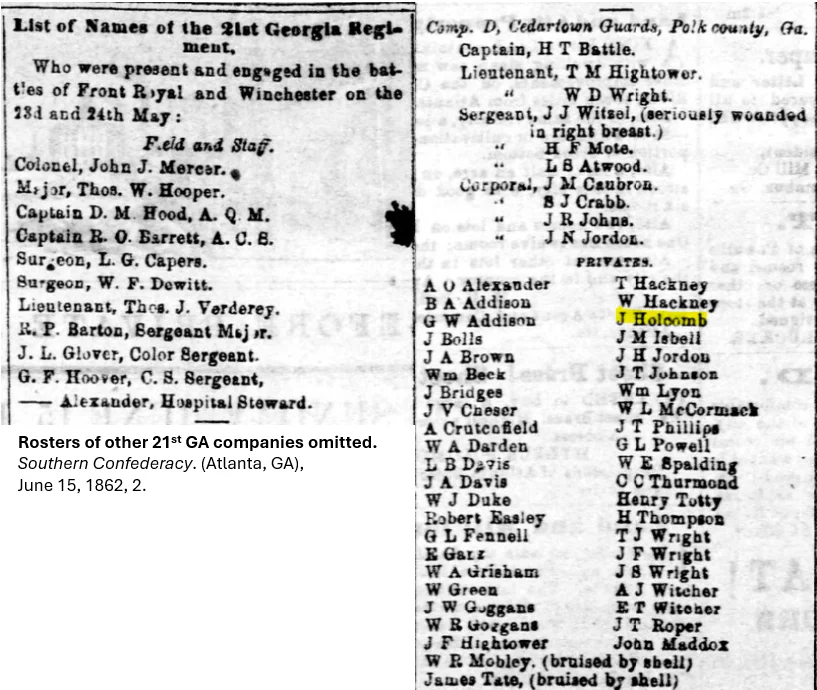
As this clipping shows, James was right there on the front lines. He watched his hometown buddies get torn apart, including his sergeant who was shot through the chest, and others bruised by exploding artillery shells. Maybe James didn't want to be next. Or perhaps something happened with his wife or the baby? And he felt he must go home? Whatever his motivation, James reached the breaking point in early July.
Self-Maiming: A Shot to the Right Hand
He placed the muzzle of his own musket against his right hand and pulled the trigger. He was sent to the 21st Georgia's regimental hospital. His middle finger and one of the bones in his hand were either carried away by the blast or surgeons had to operate to remove that part of his hand.
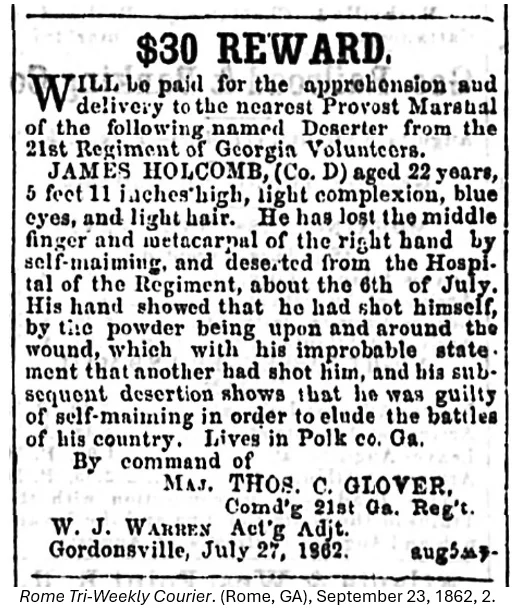
Major Glover notes the evidence that sealed James's fate:
"He has lost the middle finger and metacarpal of the right hand by self-maiming, and deserted from the Hospital of the Regiment, about the 6th of July. His hand showed that he had shot himself, by the powder being upon and around the wound, which with his improbable statement that another had shot him, and his subsequent desertion shows that he was guilty of self-maiming in order to elude the battles of his country. Lives in Polk co Ga."
Heavy black powder burns and carbon tattooing on the skin only occurs at point-blank range. This was the exact forensic evidence Civil War surgeons used to catch members of what frustrated commanders sometimes termed "the foot-and-hand brigade."
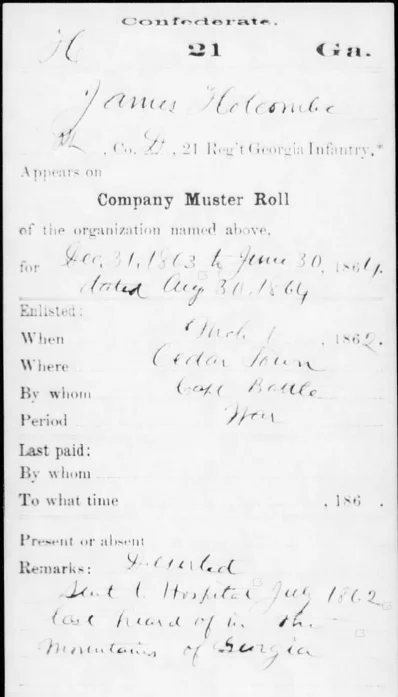
Later Company Muster Rolls recorded the following: "Deserted. Sent to Hospital July 1862 last heard of in the mountains of Georgia."
PostScript
James evidently managed to avoid authorities and vanished in to the mountains. Sometime prior to 1870, he took his family and migrated west to Warren, Bradley County, Arkansas where he lived a quiet, well-respected life as an Arkansas farmer. James outlived two wives and raised a large family before passing away March 8, 1927, at the age of 87.
For 65 years, he lived as a quiet neighbor, carrying a desperate secret that only a Georgia newspaper and his NARA compiled service record would remember.
When we study the common soldier of the Civil War, we often focus on stories of bravery, hardship, endurance, and such. Incidents of self-mutilation to avoid duty are rarely documented. I've seen notes suggesting that a soldier shot himself in the foot or hand before. But none as well-documented as well as this one.
Before we start, I want to be clear. The purpose of this thread isn't to sit in judgment of a long-dead soldier. Instead, it is to demonstrate a reality. Something that happened more often than people may realize.
Background
In 1861, 21-year-old James Robert Holcombe married Ellen Dura Sophia Clements in Georgia. On March 1, 1862, leaving his pregnant wife behind, James enlisted at Cedartown, Georgia. He joined the "Cedartown Guards" which became Company D of the 21st Georgia Infantry. He was described as 5 feet 11 inches tall, with a light complexion, blue eyes, and blond hair.
Once in Virginia, like many newly enlisted volunteers, James contracted some disease or camp illness. By April 21 he was admitted to Chimborazo Hospital in Richmond, where he languished sick for over three weeks before being returned to duty on May 14.
Baptism by Fire in the Valley
You might assume a soldier who resorted to "desperate measures" was a coward who never faced enemy fire but James Holcombe experienced combat. After recovering from his illness, he was rushed back to his unit just in time to join Stonewall Jackson's Shenandoah Valley Campaign. A roster of 21st Georgia combatants incudes the name "J Holcomb." There was only one man with the last name Holcomb in the regiment. Private James R. Holcomb was "present and engaged" at Front Royal and Winchester on May 23 and 24th, 1862. On May 27, just 48 hours after the victory at Winchester, he was admitted to the Winchester CSA General Hospital. He is not listed as wounded on the roster and there is no notation of the cause on the carded record.
As this clipping shows, James was right there on the front lines. He watched his hometown buddies get torn apart, including his sergeant who was shot through the chest, and others bruised by exploding artillery shells. Maybe James didn't want to be next. Or perhaps something happened with his wife or the baby? And he felt he must go home? Whatever his motivation, James reached the breaking point in early July.
Self-Maiming: A Shot to the Right Hand
He placed the muzzle of his own musket against his right hand and pulled the trigger. He was sent to the 21st Georgia's regimental hospital. His middle finger and one of the bones in his hand were either carried away by the blast or surgeons had to operate to remove that part of his hand.
Major Glover notes the evidence that sealed James's fate:
"He has lost the middle finger and metacarpal of the right hand by self-maiming, and deserted from the Hospital of the Regiment, about the 6th of July. His hand showed that he had shot himself, by the powder being upon and around the wound, which with his improbable statement that another had shot him, and his subsequent desertion shows that he was guilty of self-maiming in order to elude the battles of his country. Lives in Polk co Ga."
Heavy black powder burns and carbon tattooing on the skin only occurs at point-blank range. This was the exact forensic evidence Civil War surgeons used to catch members of what frustrated commanders sometimes termed "the foot-and-hand brigade."
Later Company Muster Rolls recorded the following: "Deserted. Sent to Hospital July 1862 last heard of in the mountains of Georgia."
PostScript
James evidently managed to avoid authorities and vanished in to the mountains. Sometime prior to 1870, he took his family and migrated west to Warren, Bradley County, Arkansas where he lived a quiet, well-respected life as an Arkansas farmer. James outlived two wives and raised a large family before passing away March 8, 1927, at the age of 87.
For 65 years, he lived as a quiet neighbor, carrying a desperate secret that only a Georgia newspaper and his NARA compiled service record would remember.


 Bringing the