My criticism of Rosecrans is with his personality. The timing of the campaign is actually a good example of how his personality gets in his own way. He creates a problem with perception all by himself.
I have often wondered what was delaying him, but not because of anything anywhere that anyone has written about this, but because of Rosecrans himself and what he wrote, the reasons he gave, and what was on his mind.
Of course I am going to wonder what's delaying him, upon reading a dispatch where he states that he took a survey of his senior subordinates and they all agreed (except one) to wait to advance. That says nothing about what the holdup is, or when he's expecting it to be resolved. Moreover as Halleck points out, that's not a valid military reason by itself. The responsibility lies with the commander and not a committee.
Another time, Rosecrans stated that he could better hold Bragg in place by staying static than by advancing. Bragg would in fact detach forces to reinforce Johnston, but that's beside the point that he also doesn't explain why he thinks advancing is going to push the enemy towards Grant. His reasoning was off and the President knows it.
Then he wrote that it was against some military precept to fight two different decisive battles at the same time. That made no sense and instead prompted me to think that what was on his mind was the publicity for his victory in the papers when it came. He didn't want to be eclipsed, he was playing the press and public opinion there.
Overall, he created an impression of being dilatory for no honest military reason by citing all these extraneous excuses. He could have been straightforward. There were times he had crowded the telegraphs with so much detail with no urgency that he was reprimanded for doing this. Yet when the administration was pressuring him to prevent reinforcements from being sent to raise the Vicksburg siege, he was raising objections that did not make military sense.
He eventually was threatened by Halleck (who wouldn't have done this without Lincoln approval) that if he didn't advance, he was going to have part of his forces sent to reinforce Grant, and only after that does he finally move.
————
In all this, Rosecrans just created a negative impression all by himself. Then, he had written to the President demanding that his commission be backdated to supersede Grant, to which Lincoln responded, in essence, you presume too much, setting him straight as to who held the power in that relationship. That's actually an incident that revealed how Rosecrans would push boundaries when it came to authority.
Then all these remarks were made in the context of Rosecrans' stubborn antagonism with Grant, which the President knew because Rosecrans wrote about this to Halleck, plus he then made all those efforts to outrank Grant explicit. Therefore one is left with a lot of questions about what was really motivating Rosecrans, and the problem is that all these questions and nebulous reasons derive just from Rosecrans own writing.
Again, he might have had a justifiable reason, several possibly. But he could have stuck to that and avoided all this extraneous stuff that just comes across as power hungry plays. And the thing is that this negative inference will always be there because it started with him, it comes across from his dispatches and letters.
As to criticisms that others may have about one thing or another, before or afterward I don't have any formed opinions, but I do know what (or rather, who) made me suspicious about the issue of his timing.
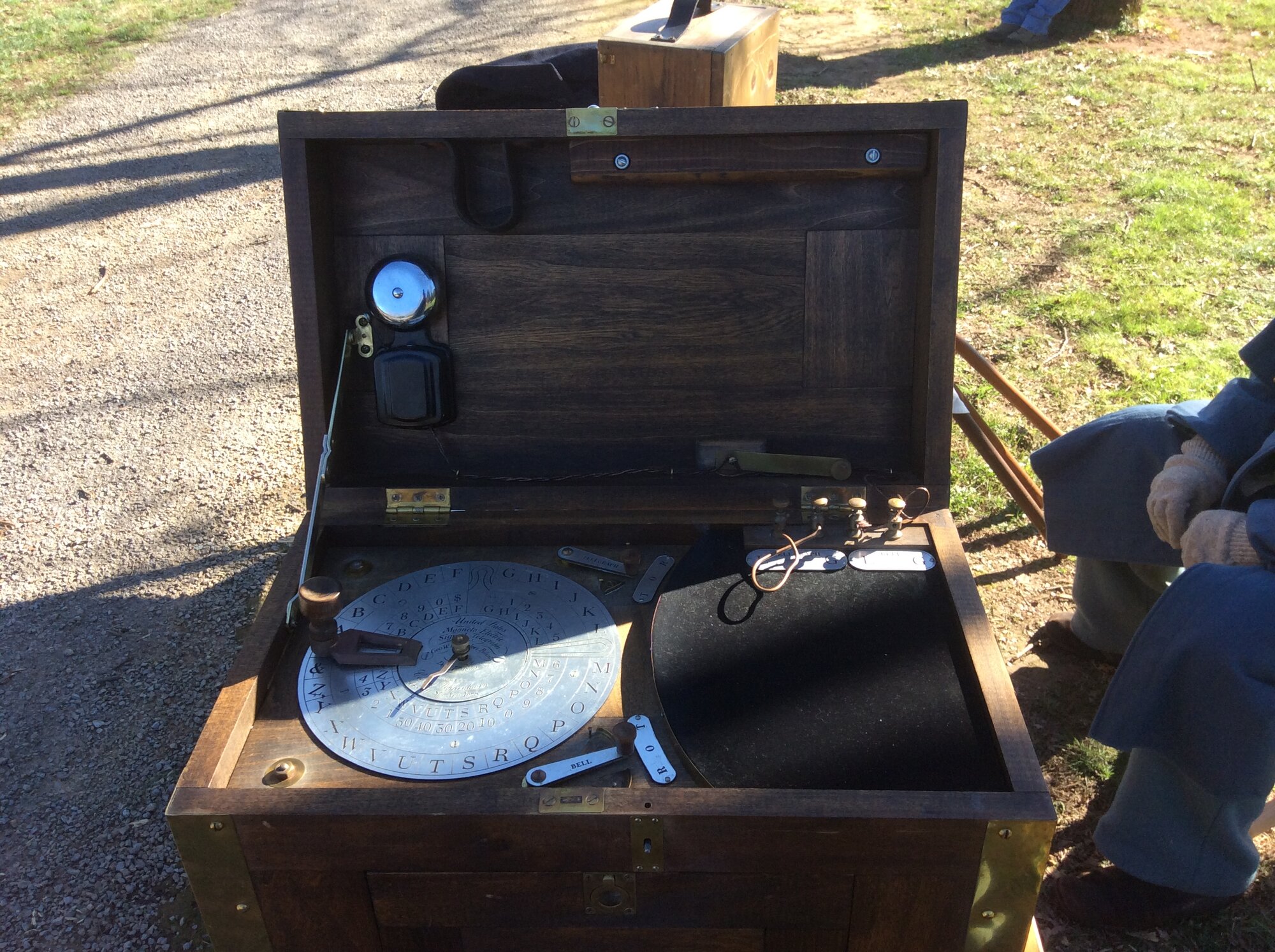
The delay, as you put it, was for an essential element off the plan. A few days before the 23rd of June jump off a fully worked up Beardslee Repeating Telegraph unit arrived on Murfreesboro. It had been stood up in the East. Along with the convoy came the officer appointed as the Army of the Cumberland's Communications officer.
The Army of the Cumberland had fully embraced the nascent Signal Corps & Telegraph's potential. The Beardslee added another element to that multilayered synergy.
In the morning of June 23, 1863 Wilder's mounted infantry brigade & its organic artillery batteries blitzed the waterlogged defenders to Hoover's Gap.
The gap is one of only three passageways onto the high ground of the Cumberland Plateau. A attention 500 year rain ( RE: TVA ) had set in & did not let up. The defenders of the stockade blocking the very narrow one lane wagon road had soggy powder for their muzzleloaders.
In their baptism of fire, the waterproof Spencers drove the defenders into a full blown feet's don't fail me now stampede up the hillsides.
Refusing orders based on how things should have happened, Wilder held the gap open until supporting infantry arrived. It was a dark & stormy night, also under the old rules, it would have been sometime the next day that Rosecrans would have been advised of the surprise breakthrough. It would have been even longer for Rosecrans to react & issue orders for a change of orders. That was yesterday's inevitable chain of events.
In what was without a doubt its finest deployment, the Beardslee train had deployed westward to where an army corps was to sweep Bragg's right flank.
From east to west Rosecrans front was 67 miles as the crow flys, (+/-) 87 road miles wide. Because of flooding the exact distance on June 23rd is unknowable.
The corps advancing up the very steep ridge from Bradyville on the left flank was completely bogged down by axil deep mud. From his position in the rear of the mud bound corps, Rosecrans received news from Thomas of the breakthrough at Hoover's Gap.
Grasping the potential of what was expected to take two hard fought days & cost 2,000 lives, Rosecrans ordered Thomas to attack through the middle of Bragg's line. In the morning, Thomas' 14th corps powered its way into Bragg's flank & rear. The gutta percha insulated wire of the Beardslee was the nerve that made the breakthrough possible.
By contrast, due in part to Wheeler's incompetence as an army cavalry commander, it was 48 hours before Bragg learned that his right flank did not exist anymore. His only hope to avoid envelopment was a precipitous retreat across the Tennessee River. Only the flooded streams & knee deep mud saved him.
On July 4th the lead elements of the Army of the Cumberland surmounted the heights of Monteagle & passed through the 2,000 foot long tunnel through the mountain.

en.m.wikipedia.org
Arrayed along a 70 mile front from the Sequache Valley in the east to Shellmound in the west, the A of the C confronted Bragg at Chattanooga. Military conventional thinking made an advance via the valley inevitable.
Because Rosecrans could send a message & receive a reply from one end of the flank to the other via visual signals in 45 minutes, he was able to coordinate a diversion that caught Bragg looking the other way.
The innovative pontoon design allowed his newly invented combat engineers to construct the longes pontoon bridge ever across the Tennessee. Rosecrans also made that most precarious of maneuvers confident that Bragg had no clue what he was up to. Again, precipitant flight was his only option.
In all candor I can't help but shake my head at the twaddle that is written about Rosecrans' "refusal" to advance. As this source details, the logistical system that Rosecrans was creating made all that happened after June 23 possible.
I realize that many of our friends believe that charging of unsupported into Pennsylvania tilting at windmills of the destruction of Union morale is an example of great generalship. Rosecrans not only captured Middle TN & existential Chattanooga, he held it.
Note: On the right flank, Wheeler's cavalry suffered one of the most lopsided defeats of the war. Once again only (+/-) 40% of his rain soaked muskets could fire. Mitney's sabers, breechloading carbines & Spencer rifles scattered Wheeler's men in every direction. Due to Rosecrans encouragement of innovation, the A of the C did something no other army would or could have done.


 Bringing the