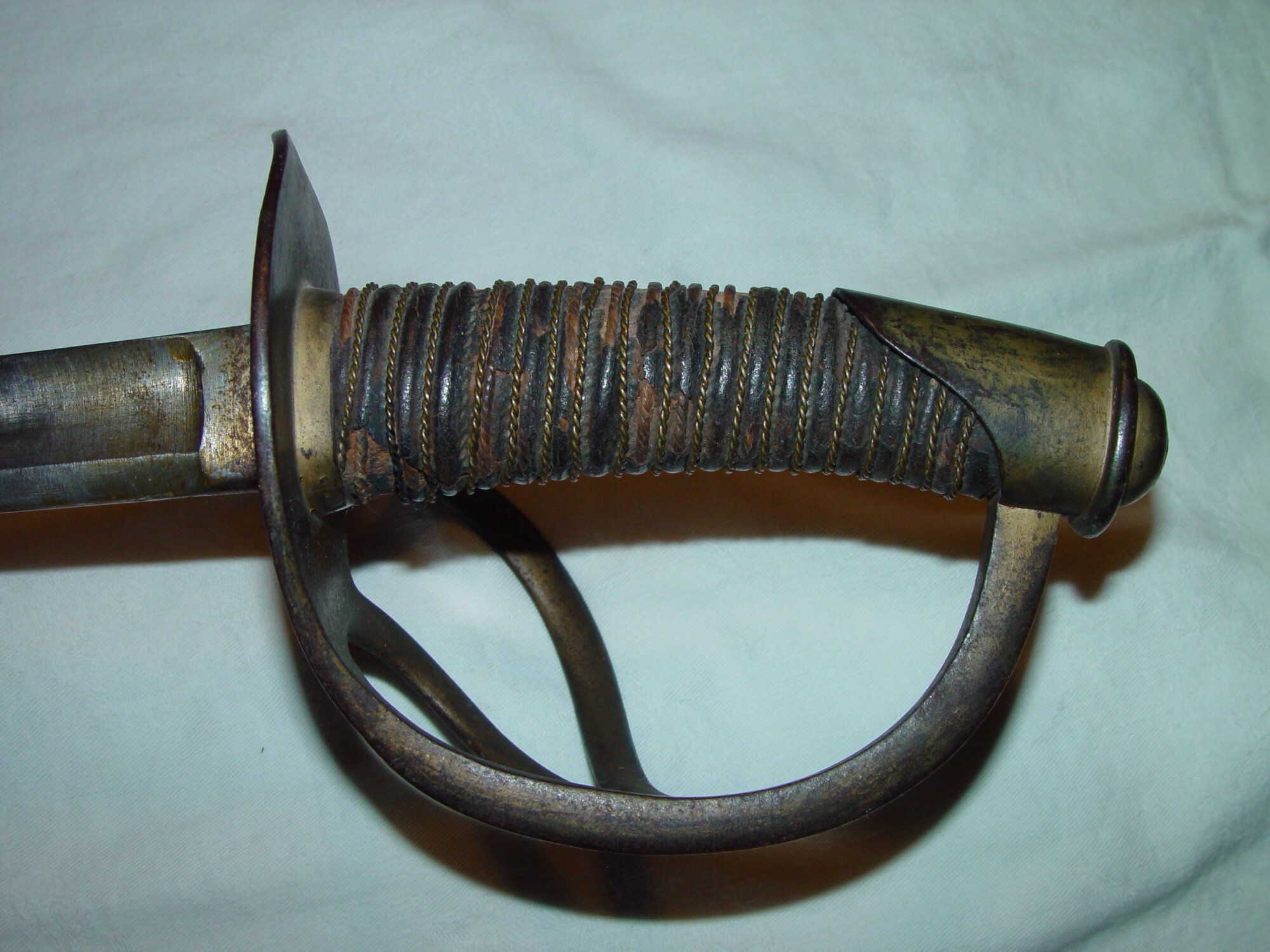
What is this sword? Possible replica?

Wraith_3

Private
Joined
Mar 24, 2021
My dad has this sword, but it has absolutely no markings whatsoever. He had it down below where his other swords were on the wall, which seems like a spot of dishonor lol. I know he bought this early on, so because of those two things and that it has no markings I'm guessing it might be a replica. It's 40 3/4" long overall, and the blade is 34 5/8" long. I'm not too worried if it is, I'll just leave it hanging on the wall. I'd appreciate if you guys could take a look and let me know.

DSC04380.JPG

DSC04382.JPG

DSC04383.JPG

DSC04385.JPG

DSC04389.JPG

DSC04391.JPG

DSC04392.JPG
 
It is does not look like a replica - it has been used - look at the wear of the leather on the handle and the displacement of the wire wrap, the aging of the leather below the guard at the top of the blade and the rust on the ricasso (flat bit at the top of the blade). It LOOKS like a cavalry saber (M1860?) and the maker's name SHOULD be on the ricasso, but some are marked on the spine. Not all were made in the USA Try https://www.angelfire.com/wa/swordcollector/marks/page1.html BTW - a replica would almost certainly have a US name on the ricasso.
 
It is does not look like a replica - it has been used - look at the wear of the leather on the handle and the displacement of the wire wrap, the aging of the leather below the guard at the top of the blade and the rust on the ricasso (flat bit at the top of the blade). It LOOKS like a cavalry saber (M1860?) and the maker's name SHOULD be on the ricasso, but some are marked on the spine. Not all were made in the USA Try https://www.angelfire.com/wa/swordcollector/marks/page1.html BTW - a replica would almost certainly have a US name on the ricasso.
One way to tell an 1840 from the 1860 is the 1840 has a flat spine, the back of the 1860 is rounded. @Glen_C is spot on here.
 
It definitely has a flat spine. I've looked multiple times and no marks of any kind.

Edit: I checked my dad's notes again and he mentioned Roman numerals and sure enough, if you look at the fifth picture above, just under the pommel, you can just see what looks like "IIV" on the guard. I'll have to get a better picture, but the sword is at my parent's house.
 
So what would be the best way to list it, just as a M1840 (which I found my dad had in his notes) or as you said a Prussian made French M1840?
 
I'm going to go out on a limb and say that the hilt is iron and that this sword was made by PDL and sold to Tiffany & Co. of New York.
Nah that hilt looks like brass that is dirty and needs to be shined/cleaned. There would be Tiffany New York markings on the blade. Plus most Tiffany grips had brown leather not black.
 
The side of the knuckle bow facing the fingers is broad and flat. No other model 1840 cavalry sword hilt has a knuckle bow like this. The branches are wide and flat. The surface of the guard facing the blade is flat, there is no rim around the edge. Where the grip meets the guard there is a raised piece that is similar to a ferrule. The rim around the pommel cap is thin. The quillon is somewhat pointed. The grip itself is cord wrapped in the style of those of the sword makers of Solingin.

As for the blade being absent of markings, I have seen numbers of blades with marking in various states of being polished away. I have seen swords with no blade markings but markings on the hilt identifying sword with no signs that the blade has been re-hilted.

I have seen swords painted with silver and gold paint that used to hang in GAR halls. Have someone check the knuckle bow with a magnet. If the hilt on this sword is brass it is a new variation of a PDL sword that has not yet been identified,( based on what I read in Thillmann's cavalry sword book.)
 
The side of the knuckle bow facing the fingers is broad and flat. No other model 1840 cavalry sword hilt has a knuckle bow like this. The branches are wide and flat. The surface of the guard facing the blade is flat, there is no rim around the edge. Where the grip meets the guard there is a raised piece that is similar to a ferrule. The rim around the pommel cap is thin. The quillon is somewhat pointed. The grip itself is cord wrapped in the style of those of the sword makers of Solingin.

As for the blade being absent of markings, I have seen numbers of blades with marking in various states of being polished away. I have seen swords with no blade markings but markings on the hilt identifying sword with no signs that the blade has been re-hilted.

I have seen swords painted with silver and gold paint that used to hang in GAR halls. Have someone check the knuckle bow with a magnet. If the hilt on this sword is brass it is a new variation of a PDL sword that has not yet been identified,( based on what I read in Thillmann's cavalry sword book.)
Um yeah still doubt it's a Tiffany also they stamped the blade deeply (deeper that AMES) so you would really have to polish the heck out of that blade to remove those markings.
 
It's true a magnet will tell you what the hilt/guard is made of. In the interim, it looks like the scabbard does not have rivets at the throat that a PDL/Tiffany scabbard should have per Thillmann. Also, the blade is almost an inch shorter than the measurement he gives for a PDL/Tiffany blade.
 
Thillmann does say at the bottom of page 418, "This model 1840 P.D.L. saber also will show variances in its dimensions in the overall group. While the profiles are the same, the blade widths and lengths will vary slightly." Of course his shortest example has a blade over an inch longer but it does have a very similar appearance. On page 420 he states, "These sabers are forged with considerable hand finishing, so it must be remembered that dimensions will vary." One possibility for a large difference would be that a hilt has been married to a different blade than it started life with. Off hand, I don't seen things that would make me suspect that this sword has been re-hilted. I don't see damage to the pommel cap or tool marks on the blade from being held in a vise. On page 420 he also states, "It has also been observed that there are letters stamped on the drag. An E, Q, P and an I have been noted on the drag bottom." Is there anything on the drag for this one?
 
I don't know how you guys got to bringing PDL into the discussion. While my generic did have the look of crusty steel in the dealer photos, it was simply sooty crusty brass before I cleaned it some. I bought it because the blade was excellent and the grip mostly intact. I did post before, during and after shots.

Off hand, I don't seen things that would make me suspect that this sword has been re-hilted.


Which sword are you regarding?

S524.jpg


There are no marks on the drag of mine and just the numbers shown.

1840 cln 002.jpg


I'm going to go out on a limb and say that the hilt is iron and that this sword was made by PDL and sold to Tiffany & Co. of New York.
That is a pretty short limb ;)

Cheers
GC
 
My discussion has been about the identification of the sword presented by Wraith_3. His is the sword that has the PDL/Tiffany - looking hilt. I do like the color of the greenish-plum looking hilt on that one example sword. It looks like the grip is wood with grooves cut into it rather than wood wrapped with cord, but I can't be sure. If it is an American style grip you would think that pointed quillon and the structure of the knuckle bow with that square in cross section addition to the side of the bow that expands out into the two branches would narrow down the identity. It does have a similar appearance to a PDL brass hilted model 1840 illustrated in Thillmann's book.
 
Yes the grip looks to be wood wrapped with something and wire. I'm not sure what the wrap is, but it's definitely not ray/shark skin like some other swords. It almost looks like very thin leather or fabric.
 

Learn About Us
About CivilWarTalk
Contact the Webmaster
Meet the Staff
Link to CivilWarTalk
Join Our Community
Register
Browse Forums
View Today's Discussions
Search the Forum
Get Help
FAQ
Student Guide
Forum Rules & Etiquette
Copyright / DMCA

     Contact Us CivilwarTalk on Facebook CivilWarTalk on YouTube CivilWarTalk on Twitter RSS Feed

Bringing the American Civil War and More to Life.
© 1999 - , CIVILWARTALK, LLC - Site Version 10.0

SlaveryTalk.com - SecessionTalk.com - CivilWarTalk.com - ReconstructionTalk.com
Back
Top