Need Help w/ Info About This Gun

Joined
Nov 11, 2024
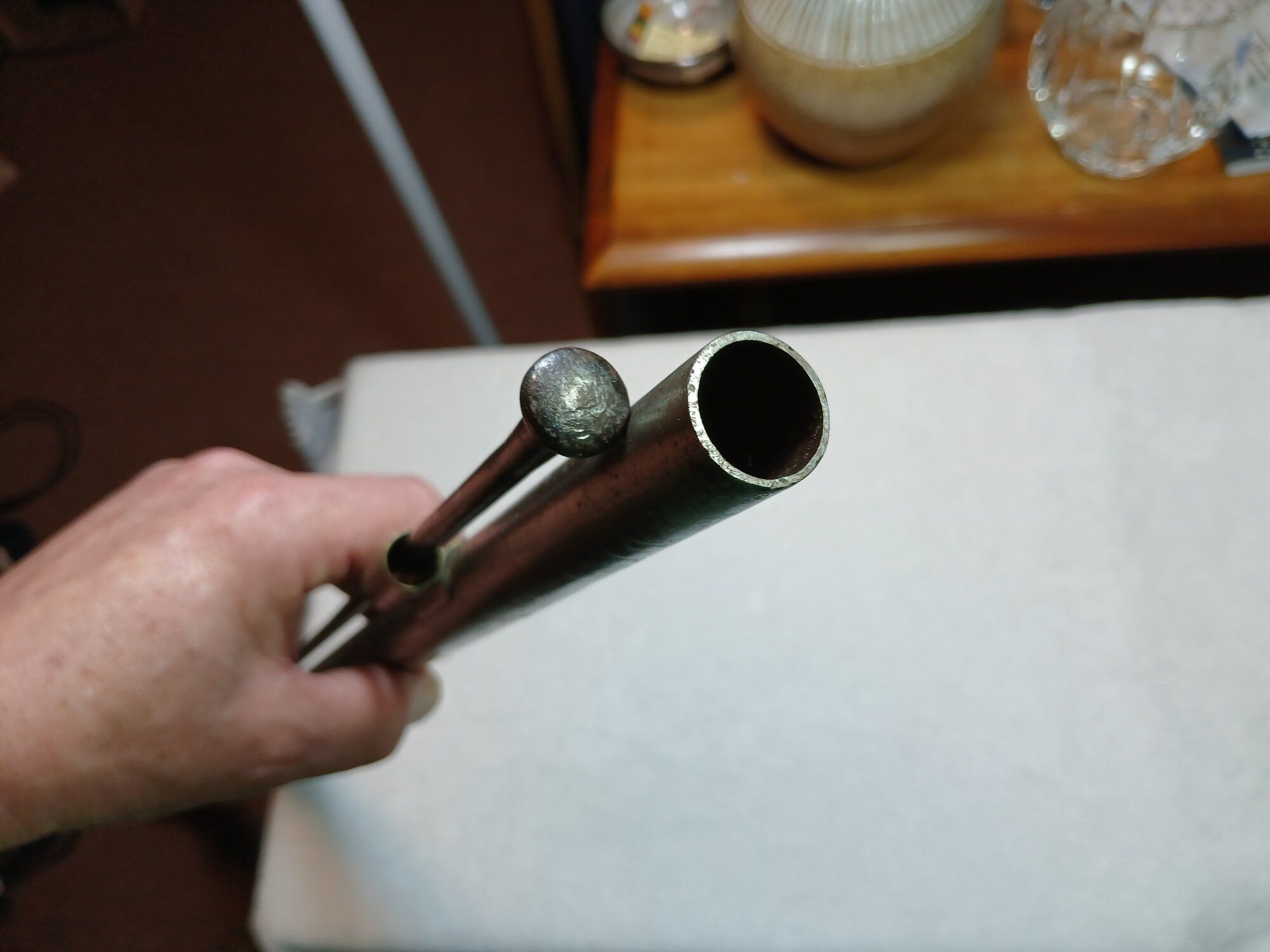
Hi all, I've only posted on this site once to find out more about a Civil War swords I bought so forgive me if this post doesn't belong here or if I make any posting mistakes. I'm also a fairly new antique gun person so may ask questions that seem obvious to more knowledgeable folks. I bought this SHARPE long gun and want to know more about it. I found the Birmingham stamp (though not sure exactly what date it or the other stamps, indicates it is was made) but I can't pin down the other two stamps. One problem has been, Sharpe was only in business from 1800 to 1840 so there aren't many out there, and since the name is so close to Sharps, info about those rifles flood the results. It's 54.25" long overall, with a 40" barrel. The barrel diameter is (as close as I can measure with my equipment) 3/4" with the bore being 5/8". I assume it's a shotgun with size of the bore and thinness of the barrel walls. So, I'd like to know is it a shotgun, caliber, what it was likely used for, e.g. hunting, battle etc. and anything interesting about Sharpe as a gun maker and their quality. I added an enhanced close up of the stamps. If you need additional pics please ask. Thanks so much.

1 Sharpe was in business 1800 to 1840.jpg


Hammer w SHARPE (1).jpg


20250518_135231.jpg


20250518_135353.jpg


20250518_135404.jpg


20250518_135521.jpg


20250518_135153.jpg


20250518_135707.jpg


20250518_135722.jpg


20250518_135735.jpg


Bore.jpg


X 20250522_123059 - Best Close Up Enhansed.jpg


STAMPS (1).jpg
 
Last edited:
My guess is it's what's referred to as a New England Militia musket. These were guns made from a variety of imported and American made parts, assembled so men should have muskets for required militia service. These would also serve as the mans hunting arm if need be.

Yours has had its stock shortened and the forward pipes soldered on to create more of a fowler or shotgun in modern parlance. It probably would have had a full stock originally. I think it would have been flintlock originally as well, and has been converted to percussion. The hammer screw and washer might not be original. IMHO.
 
Please tell us you did not spend alot of $ on that! The Sharpe you mentioned only made flintlock and percussion pistols. That lockplate looks to large for a pistol. You ask me some character added that SHARPE later to try to link it with that TV show Sharpe's Rifles. Otherwise it's a parts gun bored out to be a 1 shot shotgun for a Farmer to shoot varmints.
 
I agree the stock has been cut ad the hammer screw has been replaced. I do not think it was ever a flintlock. I do not see any evidence of alteration on the lock. Someone who knows more then I will be along.
 
First thanks' everyone. I paid $100 so I knew I wasn't risking much and the person I bought it from didn't know anything about guns. He got it from a family member who passed away. My expertise is artwork, primarily antique oil and pastel paintings, which are often altered and faked so I'm good at researching, reasoning and questioning what's in front of me. But not many of those specifics transfer to this and I already have someone more knowledgeable than I am (though as I said, that's not saying too much) very anxious to buy it and his first offer was $400 but he'll go higher. Which was one reason I decided to see what you guys thought. So my questions regarding your answers. Conquerordie, when you say forward pipes (plural) soldered on, I assume you mean the ones that hold the ramrod in place? Because unless you're talking about the barrel, I'm unsure how that by itself, made it more of a shotgun? Bayonet, you think someone added the name Sharpe. That I wouldn't know one way or the other but if so, your reasoning is the best answer so far. Any thoughts on why there are no other makers marks? Unless those were removed on purpose or just occurred as result of the alterations you've all mentioned. Thanks. We'll see what others have to add.
 
Last edited:
Cookie Monster,
Fowlers or shotguns of the 19th century properly had a metal rib soldered to the bottom of the barrel, and the pipes were attached to that. Sometimes on New England guns you see a wood under rib attached. Another way to do it, and it was a less expensive way, was to solder the pipes directly to the barrel. You even see this on civil war muskets that were converted to shotguns after the war. So the pipes soldered to the barrel do not make it a shotgun per se, just a characteristic if a 19th century shotgun. Your gun went from a militia musket, which was a smoothbore, to what collectors would call a Fowler or shotgun, based on its appearance now.

I agree the stock has been cut ad the hammer screw has been replaced. I do not think it was ever a flintlock. I do not see any evidence of alteration on the lock. Someone who knows more then I will be along.

Plymouthrifle,

I think it was converted because you can see the remainder of the fence behind what would have been the pan. Plus the whole countour of the plate around the bolster is not right. The engraving also stops there, if it was percussion in its original form, it would have been engraved all the way around, or a continuous border. If it was flint originally, that area would have been the pan and frizzen, hence no engraving. That's how it appears to me.

It's a neat piece, $100 is a fair price, turning it around for $400 is better.
 
The shape of the lock bolt plate and the martial engravings on the trigger guard and butt tang suggest a New England militia musket to me, so it probably started life as a military weapon that was later replaced by something more modern. You might be able to get more than $400.00 but that seems a respectable amount and perhaps more in line with what it would bring at auction. Plus you have a ready buyer. You shouldn't have to do a background check but some states are starting to get a little more strict so you might want to double check your state's laws on that.

Finally, I'm not an expert on firearms or anything else, just sayin'.
 
One in Fowler configuration like yours sold at auction for 75.00. one in a military configuration sold for 425 in 2021. Id probably take the money and sprint away
 
As a further aside I think this was made my a John Sharpe of Birmingham here's a couple little bits of information


Conquerordie, thank you for keeping in mind my well stated beginner's knowledge, in your explication. That makes sense. Now on them converting these ball/bullet bores to shotgun sized bores. One thing that fascinates me is old tech and what they were able to accomplish with the limited tech, tools and recourses they they had at the different times. So I have to ask, with that in mind, I'm surprised they had the ability to enlarge these heavy walled flintlock barrels, to such thin walled shotgun barrels, without accidentally thinning it out too much in one spot making it unsafe to use. Obviously shotgun's put less pressure stress on the barrel but still. Plymouthrifle, thank you as well, though did you mean to say "the fence" in your description? If so, what is the fence? I spent 45 minutes Googling it every way possible and a Fence doesn't seem to have been part of a flintlock. Is it a slang term gun people use?

20250522_215634[1].jpg
 
As a further aside I think this was made my a John Sharpe of Birmingham here's a couple little bits of information


THANK YOU Jack. I looked and looked but couldn't find another rifle by John Sharpe so I was right. Made my day. I knew it had the Birmingham stamp (unless it was added/faked along with the name Sharpe as was mentioned as a possibility) but can you identify the other two stamps? Can anyone? Also, does this look like the original ramrod that came with the gun when it was a flintlock?
 
Last edited:
The barrel is Birmingham proofed (before 1850) so a civilian product. The lock is an early 19th century civil style and does not appear to have been a flintlick when produced as there is no sign of fixings for the pan spring. The mainspring is not screwed to the lock plate either. The original hammer screw would have been much larger that the current one but since the hammer and lockplate seem to match, it may be (?) a replacement for a damaged screw during restoration. The quality of engraving on the lock and hammer is not high and not in the same style and quality as the brass work engraving. Both barrel and lock may have been replaced during conversion It was almost certainly full-stocked originally, in the style of the British India Pattern musket (?) and cut down during conversion? The usual British way was was to solder a shaped iron strip under the barrel with the ramrod tubes attached to it, not the barrel. The ramrod would be wood with brass head and clearing screw and cover at the other end.

Sorry for all the (?)s but all I have to go on is the photos above. There are many more marks that are hidden from view that would help. 'London' on any piece gave it a higher value, whether it was made in London, or not. If it was NOT imported, it MAY be a captured India pattern musket from 1812 (hence all the flags, shields, etc on the brass), ugraded locally with an imported barrel and lock which was quite common apparently.
 
As a further aside I think this was made my a John Sharpe of Birmingham here's a couple little bits of information


Well you found more on that name than me. So much for Merwyn Carey "English, Irish, and Scottish Firearms Makers". If Cookie Monster is an Art expert & collector as he states he should translate that to weapons also. I wouldn't spend $5 on that monkeyed with pile of new & old parts. Here at ACW CivilWarTalk there is nothing ACW about that, as far as collecting value.
 
So I have to ask, with that in mind, I'm surprised they had the ability to enlarge these heavy walled flintlock barrels, to such thin walled shotgun barrels

On the contrary, 18th century gun barrels were not generally heavy walled pieces of pipe. While handmade gun barrels did exist in the 18th century, it was much more common to be made by makers that might specialize in barrels, or have a section of their business around barrels. These were made on machines that had water driven hammers and such. They were only as thick as they had to be. So a musket barrel might have been thicker than a Fowler barrel. A rifle barrel generally was thicker than all of them. Cast barrels might have thicker walls than forged barrels. If you ever get a chance to look at a New England Long Fowler, or some of the Hudson Valley Long Fowlers, extremely long, but handle beautifully. They had no excess weight. Same with native trade gun barrels. They had very thin walls, nobody wanted to carry the extra weight . Our reproduction barrels today are generally heavier than original barrels. Some think it's because companies don't want to face lawsuits when some schmuck blows themselves up. So they make them thicker than need be.

Boring the barrel was the same. Industry in the 18th century and especially in the 19th century has all sorts of machine to accomplish it.

I'm guessing your barrel didn't change from when it was considered a musket barrel, to what you see today converted to a shotgun. The bore is probably the same.

As to the fence on a flintlock, look at the picture of your lock, and go directly up from the letter H in Sharpe, you'll see that piece of metal sticking up from the edge of the lock plate. That fence was directly behind the pan on a flintlock. You generally don't see them on percussion guns, they as the bolster usually had a similar piece on a percussion barrel not on the lock itself. To me that's one of the vestiges of it being a flintlock originally.
 
Well you found more on that name than me. So much for Merwyn Carey "English, Irish, and Scottish Firearms Makers". If Cookie Monster is an Art expert & collector as he states he should translate that to weapons also. I wouldn't spend $5 on that monkeyed with pile of new & old parts. Here at ACW CivilWarTalk there is nothing ACW about that, as far as collecting value.
There's always one in every group.
 
Now I went back to your first post on this website back in November. There again like here you purchased 2 swords without knowing anything about them. Guess you like throwing money around this one in the group would not. Now everyone in this group have said over & over buy the research books before you buy anything. You stated your an Art expert and good at doing "research" so I'm scratching my head at your poor or no research in buying ACW weapons without knowing anything before hand. Now go enjoy a Cookie there Cookie Monster, my favorite is Chocolate Chip🍪😋🤪:hungry:
 

Learn About Us
About CivilWarTalk
Contact the Webmaster
Meet the Staff
Link to CivilWarTalk
Join Our Community
Register
Browse Forums
View Today's Discussions
Search the Forum
Get Help
FAQ
Student Guide
Forum Rules & Etiquette
Copyright / DMCA

     Contact Us CivilwarTalk on Facebook CivilWarTalk on YouTube CivilWarTalk on Twitter RSS Feed

Bringing the American Civil War and More to Life.
© 1999 - , CIVILWARTALK, LLC - Site Version 10.0

SlaveryTalk.com - SecessionTalk.com - CivilWarTalk.com - ReconstructionTalk.com
Back
Top