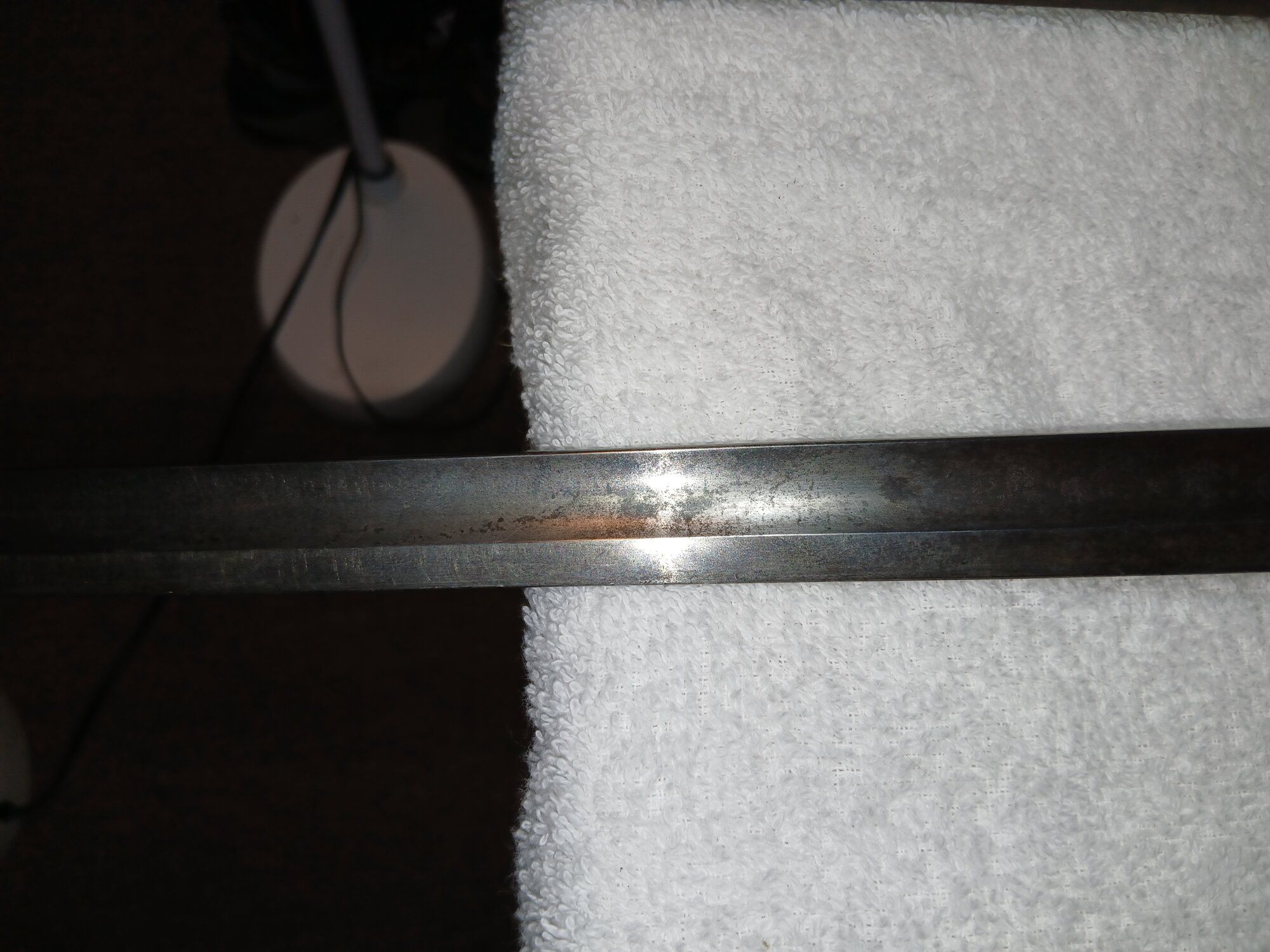
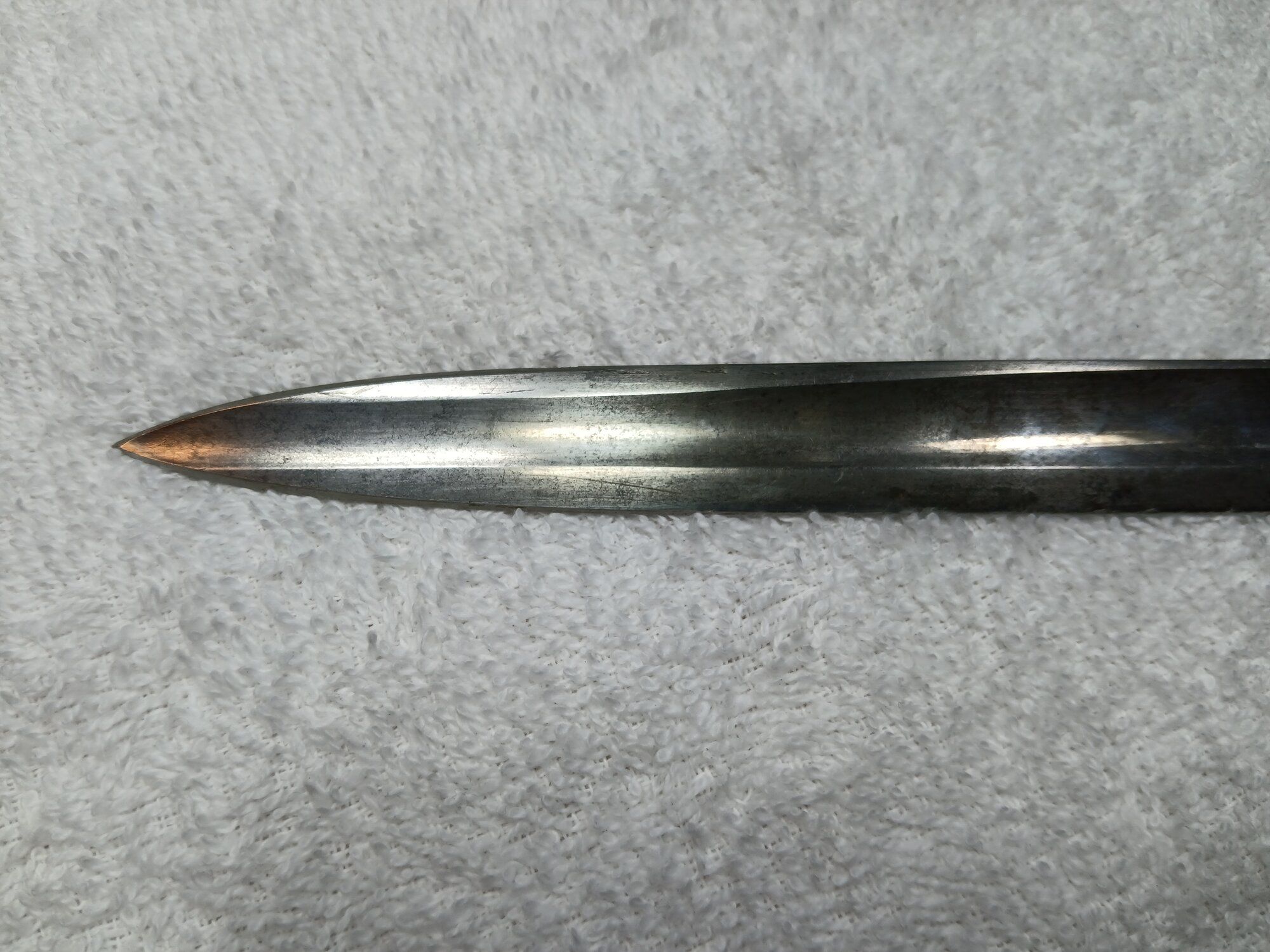
What is this? Need help identifying this sword

Joined
Nov 11, 2024
Hello everyone, this is my first post here so please forgive any incorrect terminology and any other faux pas. I'm retired from TV production and now collect vintage and antique historical items though my specialty is oil paintings. I also love old technology, phones, cash registers, typewriters, nautical instruments etc.. During my travels I run into almost everything and recently I've purchased my first two, what I believe are, Civil War swords. However, not knowing much about those in particular, I need your help identifying them. I'll start with the second one I found first, because it's the one I'm having the most trouble with. After much comparison on line, it appears to be a US Model 1840 NCO sword (with scabbard), manufactured by the Ames Company. The age, wear and patina seem correct to me, granted with my limited knowledge, but my problem is that it lacks the stamps my research tells me it should have. I know where they're normally marked and I've inspected every inch of it closely under magnification to see if any were simply warn down, but the only marks I've found is the number "14" in two places which one site says stands for it being an NCO's sword. So, what I'm trying to find out is, is this a Civil War era sword? Is it an Ames? Is it a model 1840 NCO sword? If so, any reasons it wouldn't have been marked? If anyone needs additional measurements or pics please ask. Blade length is now 29.5", sword length is 36", including scabbard 39.5". I said now, because it appears that at some point the sword's tip was broken off and someone filed/ground it back to as close to the original shape as they could. Was that common. How much does that hurt the value? If there's any other important or interesting info you think I'd want to know about this sword, please let me know. Thanks all.

1.jpg


2.jpg


3.jpg


4.jpg


5.jpg


6.jpg


7.jpg


8.jpg


9.jpg


13.jpg
 
Last edited:
The sword looks like an original Model 1840 NCO sword. To me, the number 14 stamps mean the brass hilt was separated from its blade at one time and the parts of the hilt were stamped to keep them together. That suggests that the blade is original to the sword and was separated from the hilt for cleaning and repair or it is a different blade to replace a damaged one. I would suspect this was done during its service life which could have lasted up to the 20th century. I don't see an image that compares the blade with the length of the scabbard. The blade from the hilt to the tip should be, on average, between 31.75 and 32.25 inches long (based on a number of blades I measured a few minutes ago). If your scabbard is too short for a 32 inch blade, your sword may have been shortened to fit the scabbard. There is a good chance that makers marks and acceptance marks were polished off of the blade and hilt before they were reassembled into a complete sword.

Now about the scabbard. This scabbard does not go with this sword. The scabbard for the NCO sword and the similar musicians' sword was (in general) black leather with a brass throat and brass drag. It did not have suspension rings but instead had a hook on the throat that fit through a leather frog connected to a belt slung over the shoulder. The belt usually had a circular brass stamped plate with the design of an eagle on the front and filled with lead on the back. There was one maker, Emerson and Silver, who, instead of furnishing a leather scabbard, furnished a metal scabbard with brass throat and drag. As stated before, your scabbard does not go with your sword. That is because your scabbard appears to belong to a British infantry officer or NCO from the late 19th century (say, about 1890) or later. I don't remember what their cavalry swords looked like between about 1880 and 1908 but if the blade that goes into the scabbard isn't around 35 inches, it's probably not for a cavalry sword. Hints that the scabbard is British are the screws on the leading and trailing edges of the scabbard holding the typically British throat in place. Also, that loop on the suspension ring mount (which suggests British or German.)

Now, having written all this, I must say that I am not an expert. It would be good to independently verify my comments. An excellent reference source (really THE reference source) is Thillmann's book on Civil War army swords. He also wrote THE reference source on cavalry and light artillery swords too but it is out of print. I think the asking price for the cavalry sword book may have dropped back down to the $350.00 range in some cases but you'll probably have to hunt around. The Army sword book may still be in print.
 
The sword looks like an original Model 1840 NCO sword. To me, the number 14 stamps mean the brass hilt was separated from its blade at one time and the parts of the hilt were stamped to keep them together. That suggests that the blade is original to the sword and was separated from the hilt for cleaning and repair or it is a different blade to replace a damaged one. I would suspect this was done during its service life which could have lasted up to the 20th century. I don't see an image that compares the blade with the length of the scabbard. The blade from the hilt to the tip should be, on average, between 31.75 and 32.25 inches long (based on a number of blades I measured a few minutes ago). If your scabbard is too short for a 32 inch blade, your sword may have been shortened to fit the scabbard. There is a good chance that makers marks and acceptance marks were polished off of the blade and hilt before they were reassembled into a complete sword.

Now about the scabbard. This scabbard does not go with this sword. The scabbard for the NCO sword and the similar musicians' sword was (in general) black leather with a brass throat and brass drag. It did not have suspension rings but instead had a hook on the throat that fit through a leather frog connected to a belt slung over the shoulder. The belt usually had a circular brass stamped plate with the design of an eagle on the front and filled with lead on the back. There was one maker, Emerson and Silver, who, instead of furnishing a leather scabbard, furnished a metal scabbard with brass throat and drag. As stated before, your scabbard does not go with your sword. That is because your scabbard appears to belong to a British infantry officer or NCO from the late 19th century (say, about 1890) or later. I don't remember what their cavalry swords looked like between about 1880 and 1908 but if the blade that goes into the scabbard isn't around 35 inches, it's probably not for a cavalry sword. Hints that the scabbard is British are the screws on the leading and trailing edges of the scabbard holding the typically British throat in place. Also, that loop on the suspension ring mount (which suggests British or German.)

Now, having written all this, I must say that I am not an expert. It would be good to independently verify my comments. An excellent reference source (really THE reference source) is Thillmann's book on Civil War army swords. He also wrote THE reference source on cavalry and light artillery swords too but it is out of print. I think the asking price for the cavalry sword book may have dropped back down to the $350.00 range in some cases but you'll probably have to hunt around. The Army sword book may still be in print.
That was my first impression too that the scabbard was metal not leather. Thillmann's book on Army Swords can be had for $89. Hoping they do a reprint on his Cavalry Swords Book.
 
Thank you everyone. Great information. First, of course I'm disappointed to hear the scabbard isn't original to the sword but that's why I'm here. I always want to know what I have, especially if I end up selling it, I want to represent it accurately. I've added some pictures in response to things you've brought and to help answer my first question, why it isn't marked, I've shown the part of the blade they're normally marked. I've compared the length of the sword to the scabbard, and shown a feature that may be the hook that R. Porter mentioned.

First, being a model 1840 NCO sword. with no makers mark, does anyone know, or is there a way to tell, who made this sword? I've Googled how to tell but without marks I can't get a definitive answer. Which leads into my other question, why it isn't marked? Any ideas? R. Porter though the 14 stamps may indicate the sword was separated from the hilt, for repair/cleaning of the original blade, or to replace the blade entirely. Could either account for this blade having no marks?

So, since the scabbard that's with it now, appears easily long enough to have fit the original length of the blade, that doesn't seem to be the reason the sword was shorted at the tip. Therefor, would it be safe to assume that the most likely reason the sword was shortened at the tip, would be that at some point the tip was broken off and was filed or ground down to approximately the original shape so it could be used as intended?
Thanks again everyone.

X.jpg


Z.jpg


20241118_155952.jpg


A.jpg


B.jpg
 
Assuming the blade belongs to the hilt, the easiest way to try to determine the sword maker would be to look at the ferrules on either end of the grip. The tang dome is also helpful.

The lower ferrule on your sword has two plain thin solid lines, a thick, rounded solid line and two more thin solid lines. This seems to fit Ames, some Collins, some Emerson & Silver, Frederich Horster, some Horstmann, F. Poter, Roby, S & K, and Walschied. We can eliminate S & K because their grip was wire wrapped wood, not a solid piece of metal with a faux wire wrap design like every other model 1840 NCO sword.

Looking at the upper ferrule on your sword we see a thin circular band on the bottom with a thick circular band above it where, going up, it swells out and then contracts to a diameter smaller than its base. Above that is a ring and above that is a conic section whose diameter expands as you approach the pommel. This would fit Ames, Collins, some Emerson and Silver, Frederich Horster, some Horstmann, and Roby. The image in Thillmann's book makes the quillon on a Roby look longer and thinner so we might reject that also.

It probably comes down to very small differences. Below is an image of three swords, an Ames 184?, a Collins separate date 1862 and a Collins integral date 1862. I'm not sure what order the two Collins swords are in but they are the middle and bottom sword. Notice the guard has been removed from one and it has been shortened to make it a musician's sword. It started life as an NCO sword and that is immediately apparent by the form of the quillon. This form appears only on the NCO sword except for the very first musicians' swords made by S &K. Comparing the upper ferrule of the two Collins swords shows slight differences and this must be kept in mind when trying to identify an unmarked sword. The top sword is the Ames and it seems closest
IMG_7698.jpeg
 
Assuming the blade belongs to the hilt, the easiest way to try to determine the sword maker would be to look at the ferrules on either end of the grip. The tang dome is also helpful.

The lower ferrule on your sword has two plain thin solid lines, a thick, rounded solid line and two more thin solid lines. This seems to fit Ames, some Collins, some Emerson & Silver, Frederich Horster, some Horstmann, F. Poter, Roby, S & K, and Walschied. We can eliminate S & K because their grip was wire wrapped wood, not a solid piece of metal with a faux wire wrap design like every other model 1840 NCO sword.

Looking at the upper ferrule on your sword we see a thin circular band on the bottom with a thick circular band above it where, going up, it swells out and then contracts to a diameter smaller than its base. Above that is a ring and above that is a conic section whose diameter expands as you approach the pommel. This would fit Ames, Collins, some Emerson and Silver, Frederich Horster, some Horstmann, and Roby. The image in Thillmann's book makes the quillon on a Roby look longer and thinner so we might reject that also.

It probably comes down to very small differences. Below is an image of three swords, an Ames 184?, a Collins separate date 1862 and a Collins integral date 1862. I'm not sure what order the two Collins swords are in but they are the middle and bottom sword. Notice the guard has been removed from one and it has been shortened to make it a musician's sword. It started life as an NCO sword and that is immediately apparent by the form of the quillon. This form appears only on the NCO sword except for the very first musicians' swords made by S &K. Comparing the upper ferrule of the two Collins swords shows slight differences and this must be kept in mind when trying to identify an unmarked sword. The top sword is the Ames and it seems closestView attachment 529316
I don't think the rear counterguard of the Ames sword was removed; it was cast that way. Ames made this pattern during the CW as well, as did Roby and a couple German firm. Some say they were made for Marine musicians; I don't know.
1734137336171.png
 
I don't think the rear counterguard of the Ames sword was removed; it was cast that way. Ames made this pattern during the CW as well, as did Roby and a couple German firm. Some say they were made for Marine musicians; I don't know.View attachment 532061
I don't disagree with what you have stated, however of the three NCO swords I've illustrated, the counter guards were removed from a Collins sword, not an Ames. I think counter guards were removed from some NCO swords by the Army late in the 19th or early in the 20th century, I'll have to dig up the reference. The earliest NCO sword I have with a vestigial counter guard like the one on the Ames you show, I believe dates from the 1840's.
 
The sword looks like an original Model 1840 NCO sword. To me, the number 14 stamps mean the brass hilt was separated from its blade at one time and the parts of the hilt were stamped to keep them together. That suggests that the blade is original to the sword and was separated from the hilt for cleaning and repair or it is a different blade to replace a damaged one. I would suspect this was done during its service life which could have lasted up to the 20th century. I don't see an image that compares the blade with the length of the scabbard. The blade from the hilt to the tip should be, on average, between 31.75 and 32.25 inches long (based on a number of blades I measured a few minutes ago). If your scabbard is too short for a 32 inch blade, your sword may have been shortened to fit the scabbard. There is a good chance that makers marks and acceptance marks were polished off of the blade and hilt before they were reassembled into a complete sword.

Now about the scabbard. This scabbard does not go with this sword. The scabbard for the NCO sword and the similar musicians' sword was (in general) black leather with a brass throat and brass drag. It did not have suspension rings but instead had a hook on the throat that fit through a leather frog connected to a belt slung over the shoulder. The belt usually had a circular brass stamped plate with the design of an eagle on the front and filled with lead on the back. There was one maker, Emerson and Silver, who, instead of furnishing a leather scabbard, furnished a metal scabbard with brass throat and drag. As stated before, your scabbard does not go with your sword. That is because your scabbard appears to belong to a British infantry officer or NCO from the late 19th century (say, about 1890) or later. I don't remember what their cavalry swords looked like between about 1880 and 1908 but if the blade that goes into the scabbard isn't around 35 inches, it's probably not for a cavalry sword. Hints that the scabbard is British are the screws on the leading and trailing edges of the scabbard holding the typically British throat in place. Also, that loop on the suspension ring mount (which suggests British or German.)

Now, having written all this, I must say that I am not an expert. It would be good to independently verify my comments. An excellent reference source (really THE reference source) is Thillmann's book on Civil War army swords. He also wrote THE reference source on cavalry and light artillery swords too but it is out of print. I think the asking price for the cavalry sword book may have dropped back down to the $350.00 range in some cases but you'll probably have to hunt around. The Army sword book may still be in print.
You, @RPorter, may not consider yourself an expert, but you certainly display an in-depth knowledge of the issue. Good post by you!
 

Learn About Us
About CivilWarTalk
Contact the Webmaster
Meet the Staff
Link to CivilWarTalk
Join Our Community
Register
Browse Forums
View Today's Discussions
Search the Forum
Get Help
FAQ
Student Guide
Forum Rules & Etiquette
Copyright / DMCA

     Contact Us CivilwarTalk on Facebook CivilWarTalk on YouTube CivilWarTalk on Twitter RSS Feed

Bringing the American Civil War and More to Life.
© 1999 - , CIVILWARTALK, LLC - Site Version 10.0

SlaveryTalk.com - SecessionTalk.com - CivilWarTalk.com - ReconstructionTalk.com
Back
Top