
Rhea Cole
Colonel
- Joined
- Nov 2, 2019
- Location
- Murfreesboro, Tennessee
I find that when it comes to explaining the difference between a limber & a caisson that a picture really is worth a thousands words.

Living history volunteers from Stones River N.B. & Eli Lilly's 18th Indiana Light Artillery demonstrate how a limber & six horses were used to pull a six pdr cannon.
It is useful to think of the limber as a pickup truck. It could be hitched to the cannon, caisson, battery wagon & traveling forge of the battery. You will notice that the crew are walking. In illustrations, cannoneers are often depicted riding on the ammunition box atop the limber. That was only done in emergencies. The men walked & often had to push on the wheels to help the horses. Also, it is hard as heck to stay on the limber box. At Chickamauga, Lilly's battery crossed the "Ditch of Death" (no kidding) to support the Lightening Brigade during a living history program. The two men sitting on the limber chest were flung into the air, literally doing a summersault, by an unexpected hump in the field. It was a 911 situation, both went off in an ambulance.

Gibbon's Battery shows how each gun was pulled by a limber with an ammunition chest mounted on it.
Following each gun is limber with a chest & pulling a caisson. If the limber is the pickup truck, the caisson is a utility trailer. When deployed, a battery's footprint was about the size of a football field. The caisson has two ammunition chests mounted on it. In the reserve was a loaded caisson that could be exchanged for one with empty chests as needed. Each gun only had 200 (+/-) rounds on hand. For that reason, careful fire control & management of the caissons was a battery commander's constant preoccupation.

A limber & ammunition chest in front of the Visitor Center at Stones River National Battlefield, Murfreesboro, Tennessee.
At Stone River Battlefield, we have a section of 1841 model six pdr cannons. The cemetery in the background contains the graves of 7,000 Union soldiers. Union artillery was ranged almost wheel to wheel along that rise of ground during the battle on Dec. 31, 1862. Behind the cemetery (east) is a big bend of Stones River where high stone bluffs secured the 14th Army Corps reserve ammunition trains. For that reason, Parson's Battery was able to hold their ground & fire almost 2,000 rounds. That battery, in conjunction with Hazen's Brigade, secured the left of Rosecrans' line & frustrate Brag's attempt to break Rosecrans' communication with Nashville. It also meant that batteries that fell back from the fighting on the right flank were able to go into battery & be resupplied. 52 cannon met repeated attempts to cross the cotton field in the top photo with withering fire & saved the day.
The bucket beneath the limber contains grease for lubricating the axils.
The hand carved rook is our private symbol at STRI.

This limber & caisson is on the west side of the Stones River Visitor Center.
The limber & caisson is sited where the Chicago Board of Trade Battery was positioned along side the Pioneer Corps on December 31, 1862. Besides the two ammunition chests, the caisson has a spare limber pole slung underneath & a spare wheel. The ammunition chests have copper tops to prevent flying debris from setting the box on fire. Each chest is held by a clip that allows the boxes to be slid off & replaced.
During action, ammunition would be taken from the caisson assigned to one of the guns of a section (two cannon). That way, when one caisson's chests were emptied, it could be replaced from the reserve. Otherwise, both guns would run out of ammunition at the same time. The second caisson would be held out of danger, as much as was possible. That meant that in case of the destruction of the ready caisson, the second could be brought up & the guns served. Unfortunately, our firing demonstrations don't come close to depicting the highly choreographed movements necessary for keeping the ammunition flowing to the guns.
The caisson could be used as a sort of utility trailer when the ammo chests were removed. Rations, hay, you name it could be piled on & hauled at need. Flag covered caskets are placed on caissons for formal military funerals.
The limber box for the traveling forge contained tools & iron stock for making repairs. The same was true of the limber assigned to the battery wagon. Every chest & wagon had a very specific packing list & everything had its particular place. The minutia of managing the limbers & caissons is endless.
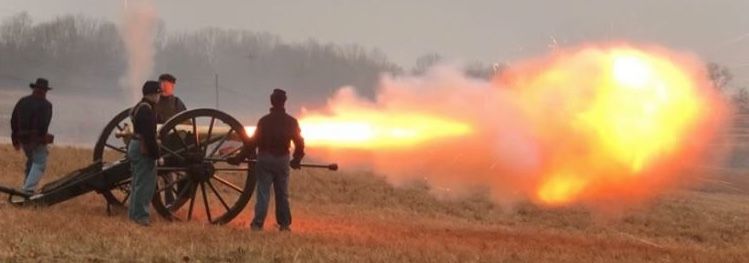
Of course, this is what all this bother is about in the end.
Note:
I think that these two books will be helpful to you.
At <civilwarartillary.com> the complete text is available online.
Artillerist's Manual, Compiled From Various Sources, & Adapted to The Service of The United States.
(by the John Gibbon in the photo above)
Brig.-Gen. John Gibbon, U.S. Vols.,
Captain Fourth Artillery, U.S. army.
Second Edition, Revised & Enlarged.
It is my go-to for all things Civil War artillery. Gibbon's manual is a comprehensive do it yourself guide. You want to make your own friction primers or quit primers, Gibbon has a detailed how to. I keep the spiral bound sections of the manual that deal with smoothbore cannon, friction primers & ammunition in my haversack. It is an invaluable reference when training new crew members & answering visitor questions. The illustrations are very well done. It is not an in the weeds place your feet just so manual, you will have to go elsewhere for that kind of detail.
I recommend The Artillery Service in the War of the Rebellion 1861-65 by John C. Tidball. General Tidball commanded the artillery school at Fort Monroe after the war. He wrote an analysis of artillery practice in all the major battles of the war. It is an overview written by a man who was there & had time to make a professional judgement after years of study.
Artillery horses were 16 hand Morgan or equivalent breeds. At the average of $140 each, a battery would have $200,000 (+/-) worth of horses assigned to it. That is $8,000,000 in 2020 dollars. The horses consumed about 3,120 pounds of feed per day. The soft iron horseshoes had to be replaced constantly. After a route march on the McAdamised pike between Nashville & Murfreesboro, half the hoses in the battery would have to be re-shod. The iron tires of the wheels wore out regularly, as well. The harness would have to be attended to constantly. A Civil War battery's artificers made it a sort of traveling live stock & crafts fair at every halt.
With the exception of the Gibbon photo from the Library of Congress, all photos are by the author.
Living history volunteers from Stones River N.B. & Eli Lilly's 18th Indiana Light Artillery demonstrate how a limber & six horses were used to pull a six pdr cannon.
It is useful to think of the limber as a pickup truck. It could be hitched to the cannon, caisson, battery wagon & traveling forge of the battery. You will notice that the crew are walking. In illustrations, cannoneers are often depicted riding on the ammunition box atop the limber. That was only done in emergencies. The men walked & often had to push on the wheels to help the horses. Also, it is hard as heck to stay on the limber box. At Chickamauga, Lilly's battery crossed the "Ditch of Death" (no kidding) to support the Lightening Brigade during a living history program. The two men sitting on the limber chest were flung into the air, literally doing a summersault, by an unexpected hump in the field. It was a 911 situation, both went off in an ambulance.
Gibbon's Battery shows how each gun was pulled by a limber with an ammunition chest mounted on it.
Following each gun is limber with a chest & pulling a caisson. If the limber is the pickup truck, the caisson is a utility trailer. When deployed, a battery's footprint was about the size of a football field. The caisson has two ammunition chests mounted on it. In the reserve was a loaded caisson that could be exchanged for one with empty chests as needed. Each gun only had 200 (+/-) rounds on hand. For that reason, careful fire control & management of the caissons was a battery commander's constant preoccupation.
A limber & ammunition chest in front of the Visitor Center at Stones River National Battlefield, Murfreesboro, Tennessee.
At Stone River Battlefield, we have a section of 1841 model six pdr cannons. The cemetery in the background contains the graves of 7,000 Union soldiers. Union artillery was ranged almost wheel to wheel along that rise of ground during the battle on Dec. 31, 1862. Behind the cemetery (east) is a big bend of Stones River where high stone bluffs secured the 14th Army Corps reserve ammunition trains. For that reason, Parson's Battery was able to hold their ground & fire almost 2,000 rounds. That battery, in conjunction with Hazen's Brigade, secured the left of Rosecrans' line & frustrate Brag's attempt to break Rosecrans' communication with Nashville. It also meant that batteries that fell back from the fighting on the right flank were able to go into battery & be resupplied. 52 cannon met repeated attempts to cross the cotton field in the top photo with withering fire & saved the day.
The bucket beneath the limber contains grease for lubricating the axils.
The hand carved rook is our private symbol at STRI.
This limber & caisson is on the west side of the Stones River Visitor Center.
The limber & caisson is sited where the Chicago Board of Trade Battery was positioned along side the Pioneer Corps on December 31, 1862. Besides the two ammunition chests, the caisson has a spare limber pole slung underneath & a spare wheel. The ammunition chests have copper tops to prevent flying debris from setting the box on fire. Each chest is held by a clip that allows the boxes to be slid off & replaced.
During action, ammunition would be taken from the caisson assigned to one of the guns of a section (two cannon). That way, when one caisson's chests were emptied, it could be replaced from the reserve. Otherwise, both guns would run out of ammunition at the same time. The second caisson would be held out of danger, as much as was possible. That meant that in case of the destruction of the ready caisson, the second could be brought up & the guns served. Unfortunately, our firing demonstrations don't come close to depicting the highly choreographed movements necessary for keeping the ammunition flowing to the guns.
The caisson could be used as a sort of utility trailer when the ammo chests were removed. Rations, hay, you name it could be piled on & hauled at need. Flag covered caskets are placed on caissons for formal military funerals.
The limber box for the traveling forge contained tools & iron stock for making repairs. The same was true of the limber assigned to the battery wagon. Every chest & wagon had a very specific packing list & everything had its particular place. The minutia of managing the limbers & caissons is endless.
Of course, this is what all this bother is about in the end.
Note:
I think that these two books will be helpful to you.
At <civilwarartillary.com> the complete text is available online.
Artillerist's Manual, Compiled From Various Sources, & Adapted to The Service of The United States.
(by the John Gibbon in the photo above)
Brig.-Gen. John Gibbon, U.S. Vols.,
Captain Fourth Artillery, U.S. army.
Second Edition, Revised & Enlarged.
It is my go-to for all things Civil War artillery. Gibbon's manual is a comprehensive do it yourself guide. You want to make your own friction primers or quit primers, Gibbon has a detailed how to. I keep the spiral bound sections of the manual that deal with smoothbore cannon, friction primers & ammunition in my haversack. It is an invaluable reference when training new crew members & answering visitor questions. The illustrations are very well done. It is not an in the weeds place your feet just so manual, you will have to go elsewhere for that kind of detail.
I recommend The Artillery Service in the War of the Rebellion 1861-65 by John C. Tidball. General Tidball commanded the artillery school at Fort Monroe after the war. He wrote an analysis of artillery practice in all the major battles of the war. It is an overview written by a man who was there & had time to make a professional judgement after years of study.
Artillery horses were 16 hand Morgan or equivalent breeds. At the average of $140 each, a battery would have $200,000 (+/-) worth of horses assigned to it. That is $8,000,000 in 2020 dollars. The horses consumed about 3,120 pounds of feed per day. The soft iron horseshoes had to be replaced constantly. After a route march on the McAdamised pike between Nashville & Murfreesboro, half the hoses in the battery would have to be re-shod. The iron tires of the wheels wore out regularly, as well. The harness would have to be attended to constantly. A Civil War battery's artificers made it a sort of traveling live stock & crafts fair at every halt.
With the exception of the Gibbon photo from the Library of Congress, all photos are by the author.
Last edited:


 Bringing the