-
Welcome to CivilWarTalk, a forum about the American Civil War! - Join today! It's fast, simple, and FREE!
You are using an out of date browser. It may not display this or other websites correctly.
You should upgrade or use an alternative browser.
You should upgrade or use an alternative browser.
Unmarked Whitneys
- Thread starter BBurkett
- Start date

Well, it seems your quote of "a market to sell these ...as late as 1864" seems incorrect according to Fuller seeing all these subcontractor made '61's dated '64 and one '65.You must have the market cornered on these, whatever they are.
Here are the clues that I think lead to the theory that these are post-war put-togethers from condemned and spare parts:
Whitney in New Haven Connecticut did put together all sorts of arms using spare and condemned parts, but I can't imagine even Whitney had a market to sell these to any state or professional troops so late as 1864.
- The hand filed crosshatching on the hammer shown is crude and amateurish.
- shockingly poor work installing that buttplate shown
- The US was producing all the first quality Model 1861 rifle-muskets needed for federal and state troops by 1864, the date on the lock.
- As you say, the parts show they are condemned
- the rear sights vary, one of the hammers looks nicely checkered, in other words, the parts used do not match
- That crude cross hatching on the hammer is the worst possible place to have such crappy work, so noticeable to any potential buyer (sort of like a facial mole with black hair growing out of it - just the wrong place to have an ugly blemish), and even Whitney wouldn't expect to this to be accepted by even the most lackadaisical state buyer.
My Theory:
I suspect that Larry, his brother Darryl and his other brother Darryl came down from the Vermont woods one autumn to New Haven, loaded up their wagon with surplus condemned parts bought at scrap iron prices, and spent the Vermont winter putting these together as they waited for the spring maple sap rising.

- Joined
- Jul 28, 2015
Which actually defeats your argument, these are legitimate to spec arms, why would anyone purchase a 2nd or 3rd rate arm from Whitney when the market was flooded with contract arms? Most of these arms are in excellent condition and never saw use, ending up with Bannerman.Well, it seems your quote of "a market to sell these ...as late as 1864" seems incorrect according to Fuller seeing all these subcontractor made '61's dated '64 and one '65.
View attachment 414231
View attachment 414232
View attachment 414233
View attachment 414234
View attachment 414235
View attachment 414236
Simple. They were 15-20% less expensive to purchase.Which actually defeats your argument, these are legitimate to spec arms, why would anyone purchase a 2nd or 3rd rate arm from Whitney when the market was flooded with contract arms? Most of these arms are in excellent condition and never saw use, ending up with Bannerman.
- Joined
- Jul 28, 2015
And you have proof of this? Whitney was selling an approved spec musket in 1863 for $16 ea., but could not secure direct contracts and had to go through brokers. Amoskeag after fulfilling his federal contracts, ended up selling surplus muskets, to MA with implements for $8.33 ea. and was desperate to unload more than 1,500 more muskets. Same with virtually every 1861 Special Contract supplier. Colt (12,000) literally was in a position that he could not give them away and tried London, Cuba and Central America for buyers.......Simple. They were 15-20% less expensive to purchase.
Colt already had state contracts with NY, NJ, CT & MA
Just talked with Harry Waugh, long time collector and researcher of all Whitney firearms. He said the one decisive identification that's verifiable is that Whitney used band springs on some of these unmarked 1864 Whitney's that came from his purchase of the lot of parts he bought from the creditors of the Robbins&Lawrence contract of their P53 Type II in bankruptcy. These band springs are 2 5/16" long as opposed to the standard Federal US M1861 pattern 2" length. Also, esteemed collector Claude Fuller did a writeup in ARMAX , Volume 2, No 1 on Whitney and he mentions these as being Whitney produced. These were NOT Daryl and Daryl produced as some above speculate.


Jeff in Ohio
Sergeant Major
- Joined
- Oct 17, 2015
I always appreciate research and investigation, and I have enjoyed reading (and contributing) to this thread.
My comment about the first one you pictured looking like it was put together by "Larry and his brother Darryl and his other brother Darryl" still applies in the sense that the quality of the work on at least your first pictured rifle-musket was amazingly substandard - look back again to how badly the butt plate was inletted into the stock, and the childish crosshatching on the hammer - the Richmond hammers are badly done, but none so badly as in your photo.
My comment was and is that it seems this work was so deficient for Whitney to have done.
I am not a Whitney scholar - but I know amateur work when I see it, and that buttplate inletting and hammer crosshatching is bad, bad, bad work. Maybe it was done by Whitney - I don't know. But it is worthy of Darryl and the other brother Darryl. Maybe Whitney hired those three brothers for a time.
My comment about the first one you pictured looking like it was put together by "Larry and his brother Darryl and his other brother Darryl" still applies in the sense that the quality of the work on at least your first pictured rifle-musket was amazingly substandard - look back again to how badly the butt plate was inletted into the stock, and the childish crosshatching on the hammer - the Richmond hammers are badly done, but none so badly as in your photo.
My comment was and is that it seems this work was so deficient for Whitney to have done.
I am not a Whitney scholar - but I know amateur work when I see it, and that buttplate inletting and hammer crosshatching is bad, bad, bad work. Maybe it was done by Whitney - I don't know. But it is worthy of Darryl and the other brother Darryl. Maybe Whitney hired those three brothers for a time.
Last edited:
This is a Whitney Direct Vent Type 2, fully documented in Moller's "American Military Shoulder Arms", page 503. Here is the butt plate on IT for comparisonI always appreciate research and investigation, and I have enjoyed reading (and contributing) to this thread.
My comment about the first one you pictured looking like it was put together by "Larry and his brother Darryl and his other brother Darryl" still applies in the sense that the quality of the work on at least your first pictured rifle-musket was amazingly substandard - look back again to how badly the butt plate was inletted into the stock, and the childish crosshatching on the hammer - the Richmond hammers are badly done, but none so badly as in your photo.
My comment was and is that it seems too badly done even for Whitney to have done.
I am not a Whitney scholar - but I know amateur work when I see it, and that buttplate inletting and hammer crosshatching is bad, bad, bad work. Maybe it was done by Whitney - I don't know. But it is worthy of Darryl and the other brother Darryl.
Jeff in Ohio
Sergeant Major
- Joined
- Oct 17, 2015
I always appreciate research and investigation, and I have enjoyed reading (and contributing) to this thread.
My comment about the first rifle-musket you pictured looking like it was put together by "Larry and his brother Darryl and his other brother Darryl" still applies in the sense that the quality of the work on at least your first pictured rifle-musket was amazingly substandard - look back again to how badly the butt plate was inletted into the stock (looks like this was done with a pocket knife, not a woodworking tool), and the childish crosshatching on the hammer - the Richmond hammers are badly done, but none so badly as in your photo.
My comment was that this work is too deficient for factory work.
I am not a Whitney scholar - but I know amateur work when I see it, and that buttplate inletting and hammer crosshatching is bad, bad, bad work. Maybe it was done by Whitney - I don't know. But it is worthy of Darryl and the other brother Darryl. Maybe Whitney hired those three brothers for a time when skilled labor was in short supply.

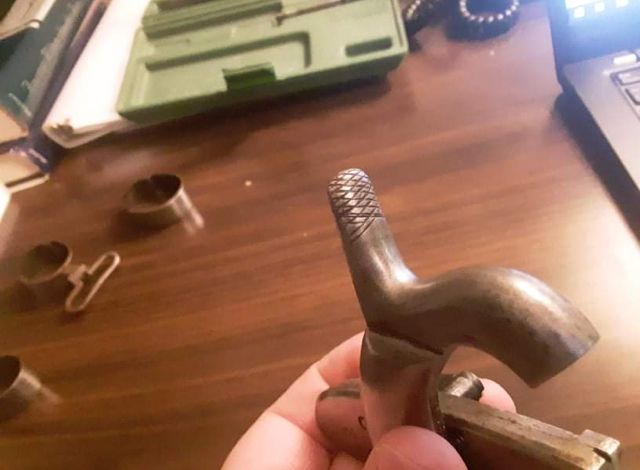
My comment is limited to the point that the quality of this work should not have been accepted from a ten-year-old apprentice, and it seems too crude to be factory work.
My comment about the first rifle-musket you pictured looking like it was put together by "Larry and his brother Darryl and his other brother Darryl" still applies in the sense that the quality of the work on at least your first pictured rifle-musket was amazingly substandard - look back again to how badly the butt plate was inletted into the stock (looks like this was done with a pocket knife, not a woodworking tool), and the childish crosshatching on the hammer - the Richmond hammers are badly done, but none so badly as in your photo.
My comment was that this work is too deficient for factory work.
I am not a Whitney scholar - but I know amateur work when I see it, and that buttplate inletting and hammer crosshatching is bad, bad, bad work. Maybe it was done by Whitney - I don't know. But it is worthy of Darryl and the other brother Darryl. Maybe Whitney hired those three brothers for a time when skilled labor was in short supply.
My comment is limited to the point that the quality of this work should not have been accepted from a ten-year-old apprentice, and it seems too crude to be factory work.
Last edited:
I just noticed something. The hammer in the above pic ONLY fits the Plymouth Rifle or Whitney's Direct Vent Type 2 musket. And being how rare those hammers are, I doubt it was a later replacement. The direct vent hammer is offset to contact the cone properly . Just an observation.Be careful, that piece appears to have been enhanced, the hammer does not appear to be original to the piece and severely cleaned. Hard to tell, but the pitting on the hammer does not match that of the breech.
- Joined
- Jul 28, 2015
You should also note that all known contract Whitney's have the Whitney name in some fashion on the piece. According to the "esteemed" collector and scholar Norm Flayderman, Whitney's quality became so bad that he took to disguising his M1861 under the Manton moniker and even these could not be sold direct to states and went through brokers. The quality of these were extremely suspect and as I recall over 190 were sent back as failing inspection.A friend sent me pics of his captured & collected 1855 Whitney "high hump". Only 350 made AND it went through a refurb and reissue to Confederate troops. These were given to Conn state troops. I quickly noticed the butt plate..
View attachment 442157
View attachment 442158
View attachment 442159
View attachment 442160
I suspect that since the Mantons had such a bad reputation he soon went with no markings on the Plymouth lock plate and since there are no records of contracts for the unmarked pieces, they went again through brokers.
The majority of known Whitney contract pieces are identifiable by stamping and or inspection markings/cartouches.
Again I suspect that your pieces are Manton rejects with the unmarked Plymouth lock plate, he certainly couldn't put his name on them or sell them direct to a state. They were either acquired by Fitch or sold as surplus to Bannerman, since they are in very good shape, reminiscent of the Remington 1863, (which ironically also ended up at Bannerman) I suspect the latter.
Once more, I encourage you to contact Yale for the contract records, I was actually in New Haven last week and didn't even think to stop by.

Lanyard Puller
First Sergeant
- Joined
- Nov 29, 2017
- Location
- South Carolina
The "Z" stamp in the stock could also indicate a Richmond rebuild.
{ref} "Captured and Collected
Confederate Reissued Firearms" by Steven W. Knott
There's even a "Z" marked gun on the cover. {with a small "c" condemned stamp on the trigger guard}

{ref} "Captured and Collected
Confederate Reissued Firearms" by Steven W. Knott
There's even a "Z" marked gun on the cover. {with a small "c" condemned stamp on the trigger guard}
- Joined
- Jul 28, 2015
And now that Zimmerman has those stamps..............The "Z" stamp in the stock could also indicate a Richmond rebuild.
{ref} "Captured and Collected
Confederate Reissued Firearms" by Steven W. Knott
There's even a "Z" marked gun on the cover. {with a small "c" condemned stamp on the trigger guard}
View attachment 442319
Jeff in Ohio
Sergeant Major
- Joined
- Oct 17, 2015
As always, a careful collector needs to be careful.And now that Zimmerman has those stamps..............
But that stamp is ancient, and not put on recently.
- Joined
- Jul 28, 2015
Jeff, that is obvious, I was referring to what we heard at the Baltimore show, the Puller know what I was inferring, everyone needs to take extra care. One can take a newly made stamp, hit the piece with it, iron it with a wet wash cloth to pull the stamping back up rub a bit of graphite and voila!As always, a careful collector needs to be careful.
But that stamp is ancient, and not put on recently.
I aquired an "X" marked P53 years ago which was a stamp virtually unheard of with only one or two other known examples known at the time. A very good friend of mine, major collector and longtime respected poster on this forum picked up a like stamped "X" P53 from a gentleman who had purchased it in 1958 before joining the Marines. It has sat out of public view since then so there is no chance this was stamped recently. There ARE other C&R inspector/depot letters out there, this being one. Two different P53's. Same X font.
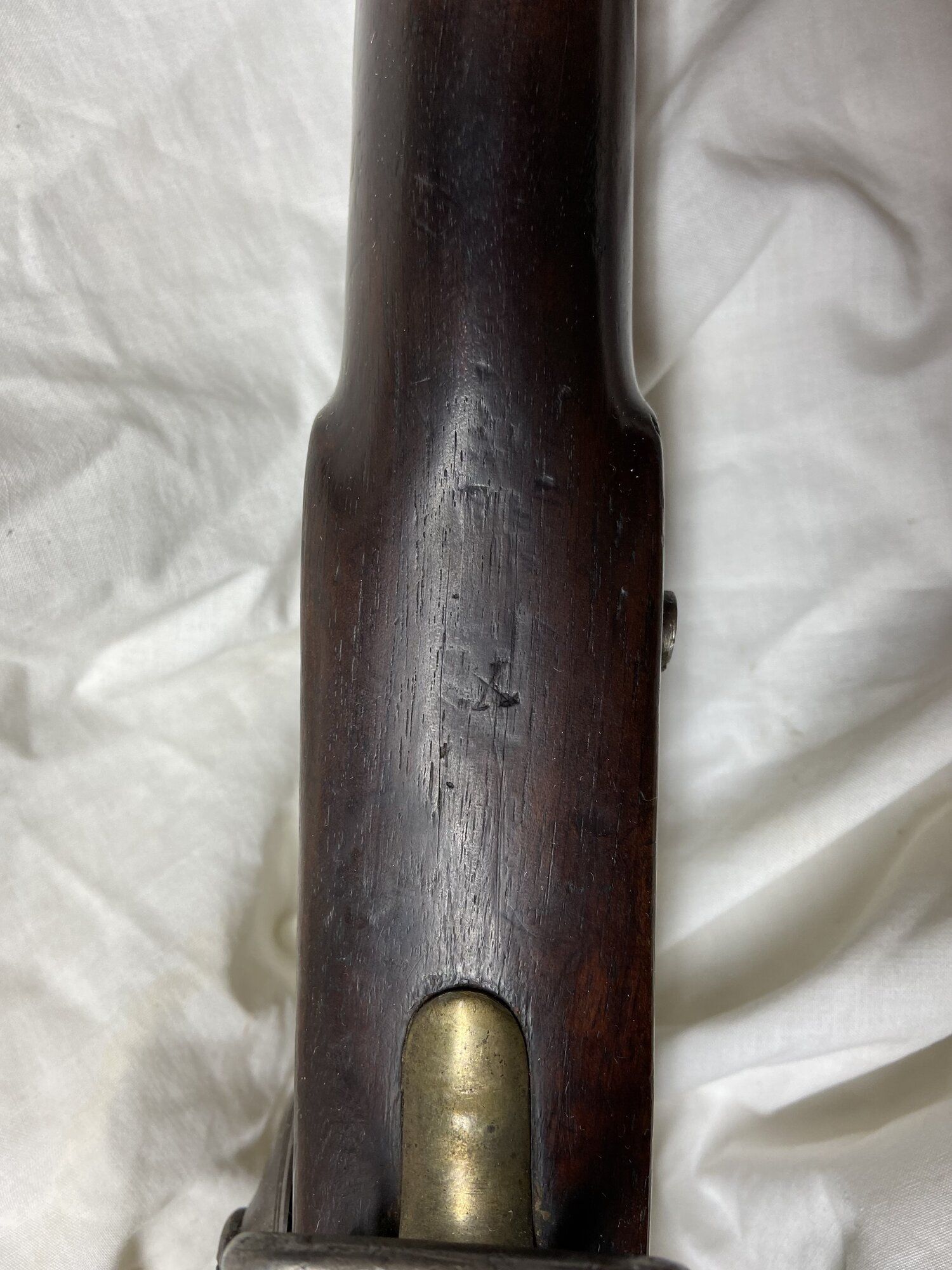

Oh, I agree there's a very distinct possibility these 4 I have and the 3 other examples from my collecting friends are part of those 109 rejected by Fitch & Waldo. If any of you are attending the Richmond relic show in July, I'll be set up alongside Tim Prince's display.You should also note that all known contract Whitney's have the Whitney name in some fashion on the piece. According to the "esteemed" collector and scholar Norm Flayderman, Whitney's quality became so bad that he took to disguising his M1861 under the Manton moniker and even these could not be sold direct to states and went through brokers. The quality of these were extremely suspect and as I recall over 190 were sent back as failing inspection.
I suspect that since the Mantons had such a bad reputation he soon went with no markings on the Plymouth lock plate and since there are no records of contracts for the unmarked pieces, they went again through brokers.
The majority of known Whitney contract pieces are identifiable by stamping and or inspection markings/cartouches.
Again I suspect that your pieces are Manton rejects with the unmarked Plymouth lock plate, he certainly couldn't put his name on them or sell them direct to a state. They were either acquired by Fitch or sold as surplus to Bannerman, since they are in very good shape, reminiscent of the Remington 1863, (which ironically also ended up at Bannerman) I suspect the latter.
Once more, I encourage you to contact Yale for the contract records, I was actually in New Haven last week and didn't even think to stop by.
Similar threads


- Replies
- 8
- Views
- 3K

- Replies
- 4
- Views
- 503
- Replies
- 17
- Views
- 3K
- Replies
- 10
- Views
- 2K
- Learn About Us
- ►About CivilWarTalk
- ►Contact the Webmaster
- ►Meet the Staff
- ►Link to CivilWarTalk
- Join Our Community
- ►Register
- ►Browse Forums
- ►View Today's Discussions
- ►Search the Forum
- Get Help
- ►FAQ
- ►Student Guide
- ►Forum Rules & Etiquette
- ►Copyright / DMCA
 Bringing the