★ ★  Sumner, Edwin V.

Edwin Vose Sumner Sr.

Born: January 30, 1797
Sumner.jpg


Birthplace: Boston, Massachusetts

Father: Elisha Sumner 1760 – 1839
(Buried: Old Burial Ground, Rutland, Massachusetts)​

Mother: Nancy Vose 1765 – 1848
(Buried: Old Burial Ground, Rutland, Massachusetts)​

Wife: Hannah Wickersham Foster 1805 – 1880
(Buried: Oakwood Cemetery, Syracuse, New York)​

Children:

Nancy Sumner Jenkins 1823 – 1911​
(Buried: Oakwood Cemetery, Syracuse, New York)​
Margaret Foster Sumner McLean 1828 – 1905​
(Buried: Oakwood Cemetery, Syracuse, New York)​
Sarah Sumner Teall 1831 – 1928​
(Buried: Oakwood Cemetery, Syracuse, New York)​
Brevet Brig. General Edwin Vose Sumner Jr. 1835 – 1912​
(Buried: U.S. Military Academy Post Cemetery, West Point, New York)​
Mary Heron Sumner Long 1837 – 1900​
(Buried: Maplewood Cemetery, Charlottesville, Virginia)​
Major General Samuel Storrow Sumner 1842 – 1937​
(Buried: Arlington National Cemetery, Arlington, Virginia)​

Occupation before War:

1819 – 1825: 2nd Lt. United States Army, 2nd Infantry Regiment
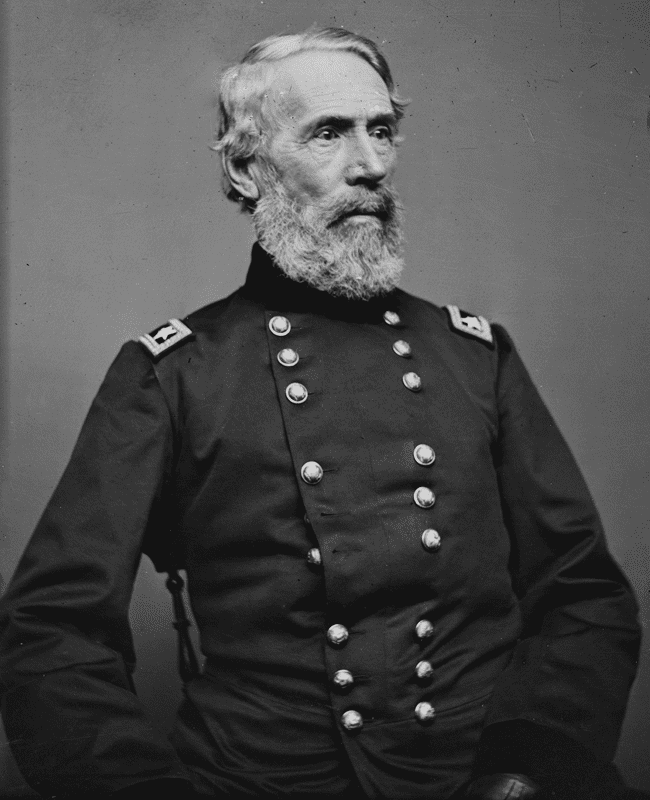
Sumner 1.png
1825 – 1833: 1st Lt. United States Army, 2nd Infantry Regiment​
1833 – 1846: Captain United States Army, 1st Dragoons Regiment​
1838: Commander of Cavalry School at Carlisle Barracks in Pennsylvania​
1842 – 1845: Commander of Fort Atkinson, Iowa Territory​
1846 – 1848: Major United States Army, 2nd Dragoons Regiment​
Brevetted Lt. Colonel for Gallantry at Battle of Cerro Gordo, Mexico​
Received the nickname bullhead at the Battle of Cerro Gordo​
Brevetted Colonel for Gallantry at the Battle of Molino del Rey​
1848 – 1855: Lt. Colonel United States Army, 1st Dragoons​
1851 – 1853: Military Governor of New Mexico Territory​
1855 – 1861: Colonel United States Army, 1st Cavalry Regiment​
Led an expedition against the Cheyenne Natives​
1856: Commander of Fort Leavenworth, Kansas​
1857: Served in the crisis known as Bleeding Kansas​
1858: Commander of U.S. Army, Department of the West​
1861: Wrote President Elect Lincoln advising him to carry a weapon​
1861: Senior officer to accompany Lincoln from Illinois to Washington​

Civil War Career:

1861 – 1863: Brigadier General, United States Army Infantry​
1861: Commander of U.S. Army, Department of California​
His son – in – law Armistead Long resigned his commission in Army
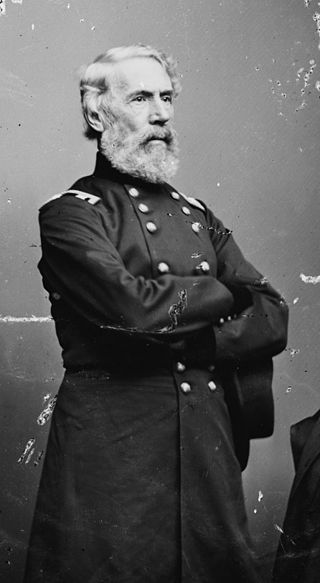
Sumner 2.jpg
1861: His horse threw him forward in Alexandria, Virginia in December​
1862: Commander of the 2nd Army Corps, Army of the Potomac​
1862: Led his troops during the Peninsula Campaign​
1862: Led his troops during the Sevens Days Battles​
1862: Served in the Battle of Williamsburg, Virginia​
1862: Brevetted Major General U.S. Army for Gallantry at Seven Pines​
1862: Wounded in the arm and hand at Battle of Glendale, Virginia​
1862 – 1863: Major General Union Army Volunteers Infantry​
1862: Corps Commander at Battle of Antietam, Maryland​
1862: McClellan recommended Sumner being relieved of duty​
1862: Commander of Right Grand Division, Battle of Fredericksburg​
1863: Relieved of command of his troops at his own request​
1863: Reassigned as Commander Department of the Ohio​

Died:
March 21, 1863

Place of Death: Syracuse, New York

Cause of Death: Congestion of the lungs and fever

Age at time of Death:
66 years old

Burial Place:
Oakwood Cemetery, Syracuse, New York
 
Last edited by a moderator:
Sumner may have had some serious flaws as a corps commander, but I can't help admiring him. A couple of quotes about him:

O. O. Howard: "He was remarkable for two military virtues: an exact obedience to orders and a rigid enforcement of discipline. If two methods were presented, one direct and the other indirect, he always chose the direct; if two courses opened, the one doubtful and leading to safety, the other dangerous and heroic, he was sure to choose the heroic at whatever cost."

Charles Wainwright: "But the old soldier was as honest as the day, and as simple as a child. The fault was not so much his, as of those who put him and kept him in such a place, while the glorious way in which he pushed across the half-gone bridges to the relief of Keyes at Fair Oaks suffices to cover all his faults."

George McClellan: "He was an old and tried officer; perfectly honest; as brave as a man could be; conscientious and laborious. In many respects he was a model soldier. He was a man for whom I had a very high regard, and for the memory I have the greatest respect. He was a very valuable man, his soldier's example was of the highest value in a new army. A nation is fortunate who possesses many such soldiers as was Edwin V. Sumner."

Francis Walker: "If the Second Corps had a touch above the common; if in the terrible ordeals of flame and death, through which, in three years of almost continuous fighting, they were called to pass these two divisions showed a courage and tenacity that made them observed among the bravest; if they learned to drop their thousands upon the field as often as they were summoned to the conflict, but on no account to leave a color in the hands of the enemy, it was very largely through the inspiration derived from the gallant old chieftain who first organized them and led them into battle.... It is easy to criticize Sumner's dispositions at Antietam -- the dangerous massing of Sedgwick's brigades, the exposure of the flank of the charging column, the failure of the commander to supervise and direct, from some Central point, all the operations of the corps; yet no one who saw him there, hat in hand, his white hair streaming in the wind, riding abreast of the field officers of the foremost line, close up against the rocky ledges bursting with the deadly flame of Jackson's volleys, could ever fail to thereafter to understand the furious thrust with which a column of the Second Corps always struck the enemy, or the splendid intrepidity with which it's brigade and division commanders were wont to ride through the thickest of the fight as calmly as on parade."
 
I question how much of the responsibility for Marye's Heights was Sumner's. The following extracts are taken from Ambrose Burnside's official report (OR, Vol. XXI, pages 90 & 94). My impression is that Sumner was given little discretion in the preparation and execution of his attack. As should have been expected, Sumner gave it his all.

Page 90.
It was after midnight when I returned from visiting the different commands, and before daylight of the 13th I prepared the following orders:
Headquarters Army of the Potomac,​
December 13, 1862—6 a. m.​
Maj. Gen. E. V. Sumner,​
Commanding Right Grand Division, Army of the Potomac:​
The general commanding directs that you extend the left of your command to Deep Run, connecting with General Franklin, extending your right as far as your judgment may dictate. He also directs that you push a column of a division or more along the Plank and Telegraph roads, with a view to seizing the heights in the rear of the town. The latter movement should be well covered by skirmishers, and supported so as to keep its line of retreat open. Copy of instructions given to General Franklin will be sent to you very soon. You will please await them at your present headquarters, where he (the general commanding) will meet you. Great care should be taken to prevent a collision of our own forces during the fog. The watchword for the day will be " Scott." The column for a movement up the Telegraph and Plank roads will be got in readiness to move, but will not move till the general commanding communicates with you.​
I have the honor to be, general, very respectfully, your obedient servant,​
JNO. G. PARKE,​
Chief of Staff.​
.......​
Page 94
General Sumner's corps was held in position until after 11 o'clock, in the hope that Franklin would make such an impression upon the enemy as would enable him (Sumner) to carry the enemy's line near the Telegraph and Plank roads. Feeling the importance of haste, I now directed General Sumner to commence his attack. He had already issued his orders, but had, in accordance with my instructions, directed his troops to be held in readiness for the attack, but not to move without further orders from him.​
The enemy was strongly posted along the crest in his front, covered by rifle-pits and batteries, which gave him a commanding sweep of the ground over which our troops had to pass. I supposed when I ordered General Sumner to attack that General Franklin's attack on the left would have been made before General Sumner's men would be engaged, and would have caused the enemy to weaken his forces in front of Sumner, and I therefore hoped to break through their lines at this point. It subsequently appeared that this attack had not been made at the time General Sumner moved, and, when it was finally made, proved to be in such small force as to have had no permanent effect upon the enemy's line.​
General Sumner's order directed the troops of General Couch's corps to commence the attack. French's division led, supported by Hancock's and finally by Howard's. Two divisions of Willcox's corps (Sturgis' and Getty's) participated in the attack. Never did men fight more persistently than this brave grand division of General Sumner. The officers and men seemed to be inspired with the lofty courage and determined spirit of their noble commander, but the position was too strong for them.​
 

Learn About Us
About CivilWarTalk
Contact the Webmaster
Meet the Staff
Link to CivilWarTalk
Join Our Community
Register
Browse Forums
View Today's Discussions
Search the Forum
Get Help
FAQ
Student Guide
Forum Rules & Etiquette
Copyright / DMCA

     Contact Us CivilwarTalk on Facebook CivilWarTalk on YouTube CivilWarTalk on Twitter RSS Feed

Bringing the American Civil War and More to Life.
© 1999 - , CIVILWARTALK, LLC - Site Version 10.0

SlaveryTalk.com - SecessionTalk.com - CivilWarTalk.com - ReconstructionTalk.com
Back
Top