Southern Hardtack

Southern troops were primarily issued cornmeal, and they had to mix it and fry or bake it themselves.
Issuing cornmeal to troops in the field would have been much more practical than issuing cornbread. From my limited experience baking cornbread, I would assume that any cornbread issued to troops would have ended up as a haversack full of crumbs very quickly.
 
Oats are very rarely mentioned in the shipping documents and discussions. My assumption is that oat production was low and other items were used in its place (poorly).
Would it be correct to say that it was difficult for the South to produce the needed food crops when the land was primarily a battleground and that with Sherman's invasion that what land was available was destroyed along with the means to deliver the goods.The North had the means to supply the goods where and when needed.The invasions by Lee and the carveries did not go far into the farm lands to do any damage to this.Would it again be correct to state that the army at times survived off of the supplies that the Raiders and Calvary would borrow/take from, the Union armies supply trains?Did the food supply come mostly from the Bread Basket of the West and the South's food supply was from a far more limited area? That was the major reason for Lee's invasion to the North was to draw the Union forces out of Virginia so that the farmers could grow needed crops and animals.At the end the South was on the verge of starvation due to the successful carrying out of this destruction,read the letters from home as the end of the war approached and the desertion rate.
 
As the blockade became more effective, less food would have came in as well. After the Mississippi River fell into Union hands, food from the Western Confederate states to the Eastern Confederate statrs would have nearly stopped. Also food stuffs transportation requires rail or ship transportation.
 
This is a very interesting question @major bill. From all of the readings I have done in my life on Confederate soldiers, I don't think I have ever encountered anything about eating hardtack. Maybe at times, but food talk is always something involving corn. I know they could have and probably gotten hardtack from dead union soldiers, I always had the feeling they were eating some kind of corn meal or mixture involving corn.
 
Last edited:
would rather have corn mush then hardtack anyday

Its funny all the old timers knew it when growing up, but I'd hardly ever see it fixed, guess during the depression they ate corn mush and cornbread so much they grew sick of it, but its excellent, I can eat it for breakfast or supper

Its mush in the Midwest, in the south I think its called johnnycake or hoecake
 
Last edited:
I would think that any well supplied regt./brigade/division with enough corn meal wouldn't have any problem making enough corn dodgers to fill every soldier's ditty or possibles bag. I've made them before. Easy, lots of fat/grease and corn meal fried up proper. They stay good for weeks and are real jaw breakers. Kinda like hardtack minus the weevils
 
Last edited by a moderator:
would rather have corn mush then hardtack anyday

Its funny all the old timers knew it when growing up, but I'd hardly ever see it fixed, guess during the depression they ate corn mush and cornbread so much they grew sick of it, but its excellent, I can eat it for breakfast or supper

Its mush in the Midwest, in the south I think its called johnnycake or hoecake
What about the meats? The solider would could create replacements for bread but as to the four legged there could be no substitute.There was plenty of cows in the West aka Texas but not enough in the East to supply the Southern forces.There was a famous Calvary raid to gather some cows near the end of the war,it may have been done by Hampton?
 
Would think meat as far as rationed would be scare in the field, also dependent on how active the campaign is, would have to be immobile for some time for much distribution to occur, salted pork or bacon probably when available if supply train is near, would assume that's why both sides foraged in the field, hogs and chickens seem to be universal as far as geographically to forage
 
Last edited:
As far as meat when in the field, seen a lot of sources mention meat foraged from civilians (livestock) but haven't ever seen wild game mentioned much............wouldn't deer/rabbit/ squirrels/turkey encountered have found their way to supper?

Also I've always wondered wasn't there a battle in the east, that when it started several CSA officers were at a shad bake., however other then that don't know if I've seen any other references to fish in diet
 
Last edited:
What about the meats?

Surdam wrote at length in 'Northern Naval Superiority and the Economics of the American Civil War' about the surplus, (to regional needs - some surpluses greater than others), of cattle and swine in Texas, Arkansas, Tennessee, and Florida. The overriding issue was not production but of location and transportation. And availability of salt.

Cheers,
USS ALASKA
 
So...you are losing all that added protein. Another Confederate supply deficiency to overcome... :wink:

Cheers,
USS ALASKA
Indeed!!! But wasn't all the rotten/ moldy bread consumed a rudimentary form of penicillin? Or was it LSD back in the Salem witch trial days??? Historians have a field day with that subject.....
 
The Army of Tennessee lived mostly on fresh beef; the ANV got some fresh beef, but lived mostly on bacon. Active campaigning was a relative short part of the year for any one unit and slaughtering beef and issuing it only required staying in one place one entire day, so fresh beef during a campaign was not too difficult.
 
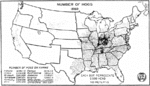
158.gif

United States Production of Hogs, 1860

A map of the United States from the U. S. Department of Agriculture (1923) showing the numbers and location of hogs produced in the United States in 1860. "In the Mississippi Valley production continued to increase between 1850 and 1860 and expanded westward into Iowa, Nebraska, and Kansas. The areas of densest production were not far from Cincinnati, which was still the great packing center. Hogs had now become numerous in California." — United States Department of Agriculture Yearbook, 1923.

http://etc.usf.edu/maps/pages/100/158/158.htm

Cheers,
USS ALASKA
 
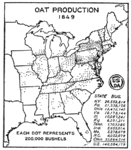
View attachment 179966

Oat Production in the US, 1849

A map of the eastern United States from the U. S. Department of Agriculture (1922) showing oat production in 1849, given in bushels. Each dot represents 200,000 bushels. The total yield of oats for the United States in 1849 was 146,584,179 bushels.

http://etc.usf.edu/maps/pages/200/246/246.htm

Cheers,
USS ALASKA
Never hear a lot of about rice rations, but perhaps it was used too? 90,000 tons of a foodstuff that only required water

http://etc.usf.edu/maps/pages/200/280/280.htm
 
Last edited:

Learn About Us
About CivilWarTalk
Contact the Webmaster
Meet the Staff
Link to CivilWarTalk
Join Our Community
Register
Browse Forums
View Today's Discussions
Search the Forum
Get Help
FAQ
Student Guide
Forum Rules & Etiquette
Copyright / DMCA

     Contact Us CivilwarTalk on Facebook CivilWarTalk on YouTube CivilWarTalk on Twitter RSS Feed

Bringing the American Civil War and More to Life.
© 1999 - , CIVILWARTALK, LLC - Site Version 10.0

SlaveryTalk.com - SecessionTalk.com - CivilWarTalk.com - ReconstructionTalk.com
Back
Top