personalized Weapons

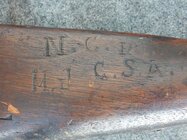
This Smith carbine has the markings "C.H. Duba" , on three areas of the stock. Years ago, I engaged the research people at "The Horse Soldier" in Gettysburg to look into the question.
It is on record that Smith Carbines were issued to the 12th Illinois cavalry, and the results of the research shows a John Duba was mustered into "E" Co. Il. 12th Cavalry 1/24/1862,
and mustered out on 12/31/1865.
Duba, is an an unusual name ,... but C.H Duba is not John Duba.
I guess,.. close is good in horse shoes,,,,but no cigar here????
However,.... it does allow one's imagination to wander???

DSC03802.jpg


DSC03796.jpg


DSC03785.jpg


This Smith carbine.

DSC08759.jpg


DSC08763.jpg


ResizedCroppedCopyofSerialnumberSmi.jpg
 
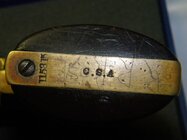
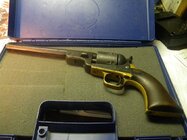
The carved stocks are awesome as they were done by the owner, the inscribed pistols are very unique in the fact that someone or a group of someones thought enough to have them inscribed and presented, This is one from my personnel collection. The back-strap on this 1860 Colt is inscribed Capt R Smith 4th Ala Cav Co B. With the serial # and the fact that Colt "never" shipped guns South leaves me to believe that this one was captured, inscribed and presented to Capt Smith.

colt-1.jpg
 
[QUOTE="ucvrelics.com, the fact that Colt "never" shipped guns South leaves me to believe that this one was captured, inscribed and presented to Capt Smith.[/QUOTE]

Your fluted Army is a great example. Colt can provide a letter on a lot of the early 1860 Armies, and you should give them a call to check yours. Col. Colt was shipping these things to many southern states as late as later April 1861 as well as Colt Navies. .... Richmond dealers received at least 350 Armies, some to Charleston, New Orleans, etc...etc...
Is it 7 1/2 barrel ?? A photo of the engraving would be a real treat.
 
This Smith carbine has the markings "C.H. Duba" , on three areas of the stock. Years ago, I engaged the research people at "The Horse Soldier" in Gettysburg to look into the question.
It is on record that Smith Carbines were issued to the 12th Illinois cavalry, and the results of the research shows a John Duba was mustered into "E" Co. Il. 12th Cavalry 1/24/1862,
and mustered out on 12/31/1865.
Duba, is an an unusual name ,... but C.H Duba is not John Duba.
I guess,.. close is good in horse shoes,,,,but no cigar here????
However,.... it does allow one's imagination to wander???

DSC03802.jpg


DSC03796.jpg


DSC03785.jpg


This Smith carbine.

DSC08759.jpg


DSC08763.jpg


ResizedCroppedCopyofSerialnumberSmi.jpg

That "CH DUBA" stamp is just that, a stamp used for more than just 1 firearm and not a personal id so it could be any sort of guess as to what it means, like you say. My guess is a dealer in arms. Did you have a SN search done ?
 
Last edited:
Fred---the moderator on the Spencer Shooting Society provided me with this.

The SRS books don't have many Smith serial #s listed - closest serial # to your 21198 I found is - 20097, a Smith Carbine issued to Company C, 11th Illinois Volunteer Cavalry on July 27, 1864.

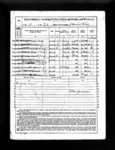
The results of the research done by the research lady at the Horse Soldier shows a John Duba was mustered into "E" Co. Il. 12th Cavalry 1/24/1862, and mustered out on 12/31/1865.
 
This is the letter that I received from the research person at The Horse Soldier.

2001%20letter%20from%20the%20research%20person%20at%20The%20Horse%20Soldier_zpsmkufmgy5.jpg


Back then as I had been communicating with Joe Bilby (the author) on some other stuff I asked him if he had seen these types of markings on other guns of that period.
Joe's response.
As a matter of fact, yes - Fenians had a tendency, if two of the conversion muskets are an indication, to mark guns like this. One that a friend of mine owns has "Sgt. Noonan" stamped into the wood.
-------------------------------------------------------

In 1866, the so called Fenians, a group of over 5000 mainly former Irish soldiers of the Union Army, invaded Canada from the United States and brought a good many Smith Carbines with them. At the time, they were cheap and obtainable.

Could C.H. Duba have been the son of John Duba the CW vet that brought this Smith carbine to Canada as a Fenian invader?-----I have no idea.
 
Jump ahead to December 20 2017---I guess I still had the Fenians on my mind---I purchased a Needham conversion of a 1863 Bridesburg musket to .58 cal. centerfire cartridge that the Fenians used in August 1870 during their invasion into Canada.
The stock is marked 'IN' for Irish Nationalists.

The middle musket in this photo.

DSC07450_zpstbrd5gyz.jpg


Breech%20open_zpsnlbyeccl.jpg


Stock marking 'IN'.

DSC07440_zpsmhiyjrjw.jpg
 
Jump ahead to December 20 2017---I guess I still had the Fenians on my mind---I purchased a Needham conversion of a 1863 Bridesburg musket to .58 cal. centerfire cartridge that the Fenians used in August 1870 during their invasion into Canada.
The stock is marked 'IN' for Irish Nationalists.

The middle musket in this photo.

DSC07450_zpstbrd5gyz.jpg


Breech%20open_zpsnlbyeccl.jpg


Stock marking 'IN'.

DSC07440_zpsmhiyjrjw.jpg

Beautiful pieces; but in my jaundiced view, it's too bad they "ruined" a perfectly good M.1861 Bridesburg contract rifle!
 
A comment by Joe Bilby.
Having written a book on the Irish Brigade, and being of Irish American heritage myself, I am very familiar with the Fenians, as well as the perpetual bungling that characterized their efforts. :-)
The 1866 invasion was actually tactically successful, if I recall, but the victorious Fenians suffered the usual leadership lapse after the Battle of Ridgeway. At that point most Fenian troops were CW vets.

By 1870, the vets had better things to do, and the Fenian force that crossed into Canada with weird looking conversions of CW muskets (designed by a Brit and made in a factory in Trenton NJ by a firm that had a Fenian leader as secret partner) were a lot of unemployed kids swept up off the streets of NYC -- of course the Canadians had no way of knowing that.
--------------------------------------------------------------
A few purchases made today at the local gun show.
Two C.W. pouches.

DSC07708_zpshdpgfza5.jpg


DSC07712_zps8orlt5lx.jpg

Three cartridges that I needed –left to right--.58 cal. centerfire cartridge for the Needham conversion musket---a Smith carbine cartridge---a .52 cal. Sharps linen cartridge.

DSC07715_zpsugqrwfyx.jpg
 
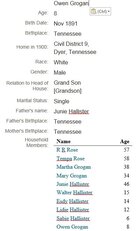
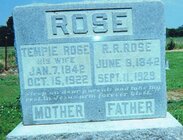
Here's one that I've kept. Owned by Rose's Grandson who lived with the Rebel while a youngster on Grandpa's farm. This gun was under Colonel Grogran's bed when he passed. The widow who he married late in life did not know he had it and did not want any gun in the house.

Obit
Colonel Owen R. Grogran was born in Dyersburg, Tennessee on February 15, 1920. He entered the military service as an enlisted man in January 1943, attended Engineer OCS and was commissioned a 2nd Lieutenant in May 1943. While in Southeast Asia he did demolition and bomb disposal duty at Middleburg Island. He served in the Airborne Engineer Unit in the Southwest Pacific Area as a platoon leader, CO Ex and company commander. Next he served 3 years in the 82nd Airborne Division. During the Korean conflict he was a rifle company commander from 1950 to 1951. He did duty with the Marines at the Chosin Reservoir. In 1953-56, he was Assistant Professor of Military Science at the University of California, Davis, California. He served in Panama as EX Officer of the Jungle Warfare Training Center and as an operations officer of the 20th Infantry Battle Group. In 1960, he saw duty with the Airborne Department Infantry School.
During Vietnam, 1965-66, he served two tours as the theatre logistics officer from the Army Materiel Command and project manager, first air CAV-(non standard items). In 1969-71, he saw duty in Europe as first commander of the Equipment Support Group and later a second command assigned commanding the Combat Equipment Group.
In 1971-73, he was Dean of School of Assets Management, U.S. Army Logistics Center, Fort Lee, VA. In 1973-76, he was commander of the first DSA Overseas, Defense General Supply Center, Richmond, VA.
He was awarded a BS degree from Florida State University and is a graduate of the command and General Staff College, Fort Leavenworth, Kansas.
From 1978 to 1994 he was the Special Investigator in over 100 discrimination cases.
Other acknowledgments include Aeronautical Rating as a single engineer pilot; Hall of Fame, Corps of Engineers; Congressional recognition from Representative Cantor in 2003; 18 service medals and decorations; 10 Battle Stars; 66 months in combat. He also holds the rating as a Master Parachuter and combat infantry bade with Star and Thai Parachute Badge.
Decorations include: Silver Star, 2 Bronze Stars, 3 Legion of Merits and Defense Meritorious Service. Also was invited to speak at the Korean Army Ceremony for Veterans who supported Korea in 1950.
DFF and Army Commendations: Purple Heart, Korean Distinguished Medal with Silver St
 

Attachments

  • post-5718-0-25666300-1462369370.jpg
    post-5718-0-25666300-1462369370.jpg
    76.1 KB · Views: 113
  • post-5718-0-48921900-1462368148.jpg
    post-5718-0-48921900-1462368148.jpg
    152 KB · Views: 140
  • post-29885-0-34595700-1462372148.jpg
    post-29885-0-34595700-1462372148.jpg
    133.2 KB · Views: 171
  • post-29885-0-51274400-1462372277.jpg
    post-29885-0-51274400-1462372277.jpg
    63.3 KB · Views: 122
  • post-29885-0-47771300-1462371551.jpg
    post-29885-0-47771300-1462371551.jpg
    35.2 KB · Views: 126
  • post-29885-0-97032300-1462372371.jpg
    post-29885-0-97032300-1462372371.jpg
    127.5 KB · Views: 128
Companies during the war would have daily roll call and then a routine called "inspection arms"...personalization would be quickly noticed and punished (US Army)

"Would have" is too strong a claim. Let's balance that with the understanding that, in the ACW, we're talking mostly volunteer regiments, so regular army manual, drill book and procedure aside, there was wide variance. In other words let's be citing official government parlance as a strong indication, but never as a proof of anything.

In this case, how many soldiers can we suppose were flogged or jailed for making a few chicken scratches in their equipment? There was actually a war going on,* and the typical volunteer could give a heck about what might affect his career in a post-war army.


- - - - - - - - - - - - - - - - -
*Of the two original Napoleans of known provenance that we use in my reenactment unit both are cleary inscribed with the female names given them. I'm sure that was hardly sanctioned at the time -- oh maybe an "aversion of glance" from the C.O.
 
Last edited:
Not exactly "would have" after all. Let's balance that with the understanding that, in the ACW, we're talking mostly volunteer regiments. Regular army manual, drill book and procedure aside, there was wide variance. In other words official government parlance is at most a strong indication, but never a proof of anything.

In this case, how many volunteer soldiers can we suppose were flogged or jailed for making a few chicken scratches in their equipment? There was actually a war going on, and the typical volunteer could give a heck about what might affect his career in a post-war army. (Of the two original Napoleans of known provenace that we use in my reenactment unit both are cleary inscribed with the female names given them. Hardly sanctioned I'm sure -- oh maybe an "aversion of glance" from the C.O. at the time.
In the collecting world, it is very rare to find US accouterments with names scratched on facing surfaces, they are under flaps or in the case of belts they are on the interior. Where they are on the outside they are very faint and incredibly small, the volunteer army was actually more strict from most accounts, due to the naivety of the officers who turned to the regulations for answers. Conversely, Confederate pieces are freely marked and again in the collector world, large initialed pieces are given more leeway as possibly captured and utilized by southern units.

I had this exact same discussion this past weekend with the members of the Antiques Roadshow crew at the Baltimore Antiques Arms Show. Many markings on federal equipment came after the war, showing ownership of a purchased piece.

The soldiers would be charged for destruction of property and it was taken out of their pay, they didn't need to be flogged.....Soldiers constantly complained about being charged for items that were requisitioned from the QM. You had basic issues and if you lost an item or defaced it, it came out of your pay.

There are the usual places where collectors look for ID on various pieces of US field gear, underside of buckles scratched in the lead, under the flap of a cartridge box or strap, underside of belt, canteen spout, sewn corner of blanket, underneath the handguard of a sword or saber, obverse of the cartridge box or cap box. Underneath the sweatband of a slouch or forage cap, or under the brim. I have examples of all of the above in my collection, but have rarely seen abject defacing of federal property with initials on the exterior.
 
... I had this exact same discussion this past weekend with the members of the Antiques Roadshow crew at the Baltimore Antiques Arms Show. Many markings on federal equipment came after the war, showing ownership of a purchased piece.

The soldiers would be charged for destruction of property and it was taken out of their pay, they didn't need to be flogged.....Soldiers constantly complained about being charged for items that were requisitioned from the QM. You had basic issues and if you lost an item or defaced it, it came out of your pay.

Not to mention that - contrary to the scene in Glory we knew was wrong at the time! - in the U. S. Army corporal punishment had been abolished by the time of the Civil War.

There are the usual places where collectors look for ID on various pieces of US field gear, underside of buckles scratched in the lead, under the flap of a cartridge box or strap, underside of belt, canteen spout, sewn corner of blanket, underneath the handguard of a sword or saber, obverse of the cartridge box or cap box. Underneath the sweatband of a slouch or forage cap, or under the brim. I have examples of all of the above in my collection, but have rarely seen abject defacing of federal property with initials on the exterior.

Thank you for reminding me of another "personalized" item in my collection, this Federal cartridge box plate with the faintly scratched initials J L S in the lead on the back:

DSC01272.JPG
 
BYF 44 rig and 1834 Springfield Musket 024.JPG
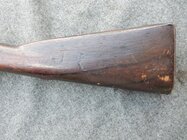
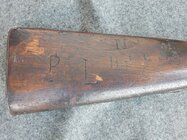
Here's my 1834 Springfield that has two sets of personalized initials. The oldest is the JR on the left side of the butt stock and then more recent on the flip side. I wish it could talk. I had the stock repaired at the wrist. The gun was in otherwise good condition when I bought it.
 

Attachments

  • BYF 44 rig and 1834 Springfield Musket 027.JPG
    BYF 44 rig and 1834 Springfield Musket 027.JPG
    203.5 KB · Views: 127
  • BYF 44 rig and 1834 Springfield Musket 038.JPG
    BYF 44 rig and 1834 Springfield Musket 038.JPG
    182.6 KB · Views: 142
  • BYF 44 rig and 1834 Springfield Musket 036.JPG
    BYF 44 rig and 1834 Springfield Musket 036.JPG
    162.4 KB · Views: 127
View attachment 180720 Here's my 1834 Springfield that has two sets of personalized initials. The oldest is the JR on the left side of the butt stock and then more recent on the flip side. I wish it could talk. I had the stock repaired at the wrist. The gun was in otherwise good condition when I bought it.
Thank you for sharing, what a wonderful piece and the initials can certainly tell a tale, what an historic regiment it is associated!
 
...Many markings on federal equipment came after the war, showing ownership of a purchased piece...

Of course that's something that could only be claimed by someone who witnessed every instance. At best we can only claim there are some indications on some particular artifacts that likely were made post-war. To go from that to "many" is to project, which is ok if stated that way and not as a fact.

...I have examples of all of the above in my collection, but have rarely seen abject defacing of federal property with initials on the exterior.

Well, that's one guy with one collection. There's a few thousand more collectors and collections to consider before even making a projection. By "abject defacement of federal property" I'm guessing you just mean marks. Historians don't make value judgements.
 
Last edited:
Article 82-Soldiers are not permitted to take their arms to pieces except in the presence of an officer, nor under any circumstances to deface the metallic or wooden parts, by attempts to beautify or change the finish of the exterior. The equipment's furnished each man under the direction of an officer and after fitting he is allowed to make no change, by cutting straps or punching holes.

Further-a certified statement giving the date when the loss or damage occurred, the name of the soldier, the articles charged, their total value and the date of the muster and payroll on which the charges are entered is made in duplicate.

The officer was made responsible for the condition of the accouterments and weapons, if they are defaced, he is responsible until the soldier is docked his pay.

Inspections were held by the first sergeant daily, the company commander weekly, the regimental commander/staff monthly.
 
Article 1426-Every officer commanding a regiment, corps, garrison or detachment, shall make at the end of February, April, June, August, October and December a report to the chief of ordinance stating all damages to arms, equipment and implements belonging to his command noting those occasioned by negligence or abuse and naming the officer or soldier by whose negligence or abuse the said damages were occasioned.
 

Learn About Us
About CivilWarTalk
Contact the Webmaster
Meet the Staff
Link to CivilWarTalk
Join Our Community
Register
Browse Forums
View Today's Discussions
Search the Forum
Get Help
FAQ
Student Guide
Forum Rules & Etiquette
Copyright / DMCA

     Contact Us CivilwarTalk on Facebook CivilWarTalk on YouTube CivilWarTalk on Twitter RSS Feed

Bringing the American Civil War and More to Life.
© 1999 - , CIVILWARTALK, LLC - Site Version 10.0

SlaveryTalk.com - SecessionTalk.com - CivilWarTalk.com - ReconstructionTalk.com
Back
Top