Palmetto Armory

Legion Para

Captain
Retired Moderator
Joined
Jul 12, 2015
http://www.scencyclopedia.org/sce/entries/palmetto-armory/

In 1850, following Governor Whitemarsh B. Seabrook's recommendation, the General Assembly created a Board of Ordnance and appropriated $350,000 for weapons and munitions.
?CISOROOT=p16817coll17&CISOPTR=1444&action=2&DMSCALE=0&DMWIDTH=10000&DMHEIGHT=10000.jpg

The Palmetto Armory was a short-lived effort to establish a weapons-manufacturing capability in South Carolina during the secession crisis of 1849–1852. Northern attempts to block the spread of slavery into the newly acquired southwestern territories led many South Carolinians to consider secession. In 1850, following Governor Whitemarsh B. Seabrook's recommendation, the General Assembly created a Board of Ordnance and appropriated $350,000 for weapons and munitions. A consortium of William Glaze, Benjamin Flagg, and James Boatwright received a contract in 1851 to produce muskets, rifles, pistols, cavalry sabers, and artillery sabers, all of which were to be of the current federal pattern and were to be manufactured wholly within the state.

The Palmetto Armory obtained some equipment through Flagg's contacts with northern manufacturers, particularly Asa Waters. But, although Glaze and his company were supposed to manufacture all weapons in South Carolina, there is convincing evidence that most of the components for the firearms and all of the edged weapons were produced elsewhere and merely assembled in South Carolina. Production ceased in May 1853 when the contract was terminated by the state for lack of funds. By this time Glaze had delivered 6,020 muskets, 1,000 rifles, 1,000 dragoon pistols, 2,000 cavalry sabers, and 526 artillery sabers. With no further contracts forthcoming, Glaze converted the Palmetto Armory into the Palmetto Iron Works. Although he attempted to obtain contracts for weapons at the beginning of the Civil War, Glaze was unsuccessful and produced only a few artillery projectiles.

Meyer, Jack Allen. William Glaze and the Palmetto Armory. 2d ed. Columbia: South Carolina State Museum, 1994.

Originally a Museum Bulletin.
41tWy0M47uL._SL500_SY373_BO1,204,203,200_~2.jpg


s-l640 (4).jpg
 
Palmetto Arsenal made all types of weapons from muskets and pistols to bayonets and swords. They also did a LOT of repair and conversion work as well. Below is a photo of the arsenal after Sherman got thru and below is what it looked like in its hey day.

p11937.png

p11938.png
 
I always found it interesting that there were still 500 of the 1,000 Wm. Glaze M-1841 Rifles produced still in storage in Charleston when it was captured. This is a classic example of the States holding State owned arms in reserve. Sadly for us collectors, the remaining 500 Rifles were destroyed by burning. The survival rate of the other 500 that were issued is quite small at best.
J.
 
Jobe, is quite correct concerning the survival rate of the Palmetto rifles.

The muskets are hard to find, but you'll see a few every year or so at the bigger antique gun shows. Muskets with brass furniture command a premium over the iron mounted examples.

There is a major problem with FAKE Palmettos' of every type; especially the 1842 model pistols and the cav. sabers.

a few photos of an identified rifle, showing a correct lock and muzzle alterations for an 1816 type bayonet.
20180928_091300_resized (2).jpg
20180928_091125_resized (2).jpg

20180928_091514_resized (2).jpg
 
Last edited:
http://www.scencyclopedia.org/sce/entries/palmetto-armory/

In 1850, following Governor Whitemarsh B. Seabrook's recommendation, the General Assembly created a Board of Ordnance and appropriated $350,000 for weapons and munitions.
?CISOROOT=p16817coll17&CISOPTR=1444&action=2&DMSCALE=0&DMWIDTH=10000&DMHEIGHT=10000.jpg

The Palmetto Armory was a short-lived effort to establish a weapons-manufacturing capability in South Carolina during the secession crisis of 1849–1852. Northern attempts to block the spread of slavery into the newly acquired southwestern territories led many South Carolinians to consider secession. In 1850, following Governor Whitemarsh B. Seabrook's recommendation, the General Assembly created a Board of Ordnance and appropriated $350,000 for weapons and munitions. A consortium of William Glaze, Benjamin Flagg, and James Boatwright received a contract in 1851 to produce muskets, rifles, pistols, cavalry sabers, and artillery sabers, all of which were to be of the current federal pattern and were to be manufactured wholly within the state.

The Palmetto Armory obtained some equipment through Flagg's contacts with northern manufacturers, particularly Asa Waters. But, although Glaze and his company were supposed to manufacture all weapons in South Carolina, there is convincing evidence that most of the components for the firearms and all of the edged weapons were produced elsewhere and merely assembled in South Carolina. Production ceased in May 1853 when the contract was terminated by the state for lack of funds. By this time Glaze had delivered 6,020 muskets, 1,000 rifles, 1,000 dragoon pistols, 2,000 cavalry sabers, and 526 artillery sabers. With no further contracts forthcoming, Glaze converted the Palmetto Armory into the Palmetto Iron Works. Although he attempted to obtain contracts for weapons at the beginning of the Civil War, Glaze was unsuccessful and produced only a few artillery projectiles.

Meyer, Jack Allen. William Glaze and the Palmetto Armory. 2d ed. Columbia: South Carolina State Museum, 1994.

Originally a Museum Bulletin.
View attachment 205051

View attachment 205052
Not being a weapons guy, I had never heard of the Palmetto Armory or musket. Cool thread and photos.
 
http://www.oldsouthantiques.com/os6244p1.htm


os6244p1.jpg


os6244p2.jpg


os6244p3.jpg


os6244p4.jpg


os6244p5.jpg


os6244p6.jpg


os6244p7.jpg


os6244p8.jpg


"The Palmetto pistol is made on the U.S. model 1842 pattern. It has a .54 smoothbore barrel. The barrel is deeply marked Wm Glaze & Co on the left barrel flat. The breech is clearly stamped with a Palmetto tree and a "V". The lock plate is stamped Columbia SC forward of the hammer and 1852 is deeply stamped behind the hammer.


The pistol is in excellent, original condition. The bore is in very good condition. The wood is extremely nice, having very sharp edges. The tang date is obliterated, but the Wm Glaze & Co, date and Palmetto Armory stamping are unusually crisp and deep, the stock's edges are also remarkably sharp. The pistol is in remarkably good condition, and it would be naturally assumed that it saw little use, but the pocking around the breech shows that it was fired many times. The owner must have prized it highly considering how well he cared for it and he carved his initials "JG" into the reverse stock face.

These pistols are so easily faked that I am very skeptical of them. Because of this, I seldom sell one, but this pistol came from Dr. Fred Novy's collection so there is no doubt of its authenticity. Therefore, I am glad to have it. For those who do not know Dr. Novy, let me introduce him. Dr. Novy has spent more than a decade collecting and studying the Palmetto Armory products. He no doubt knows more about them than anyone living, and it is he that settles all questions of authenticity relative to Palmetto Armory products presented to him by the collecting/dealer community. The pistol comes with his detailed examination report, a copy of which is shown with the images."
 
http://www.oldsouthantiques.com/os6244p1.htm


os6244p1.jpg


os6244p2.jpg


os6244p3.jpg


os6244p4.jpg


os6244p5.jpg


os6244p6.jpg


os6244p7.jpg


os6244p8.jpg


"The Palmetto pistol is made on the U.S. model 1842 pattern. It has a .54 smoothbore barrel. The barrel is deeply marked Wm Glaze & Co on the left barrel flat. The breech is clearly stamped with a Palmetto tree and a "V". The lock plate is stamped Columbia SC forward of the hammer and 1852 is deeply stamped behind the hammer.


The pistol is in excellent, original condition. The bore is in very good condition. The wood is extremely nice, having very sharp edges. The tang date is obliterated, but the Wm Glaze & Co, date and Palmetto Armory stamping are unusually crisp and deep, the stock's edges are also remarkably sharp. The pistol is in remarkably good condition, and it would be naturally assumed that it saw little use, but the pocking around the breech shows that it was fired many times. The owner must have prized it highly considering how well he cared for it and he carved his initials "JG" into the reverse stock face.

These pistols are so easily faked that I am very skeptical of them. Because of this, I seldom sell one, but this pistol came from Dr. Fred Novy's collection so there is no doubt of its authenticity. Therefore, I am glad to have it. For those who do not know Dr. Novy, let me introduce him. Dr. Novy has spent more than a decade collecting and studying the Palmetto Armory products. He no doubt knows more about them than anyone living, and it is he that settles all questions of authenticity relative to Palmetto Armory products presented to him by the collecting/dealer community. The pistol comes with his detailed examination report, a copy of which is shown with the images."
Very cool.
 
Last but never least is one of the 3720 rifled and sighted 1842 style muskets.
Glaze reported to the state that these were the last of the muskets in storage and were "brass mounted".

Use caution in buying Palmetto weapons. If you don't know what to look for seek expert advise first. Fakes are unfortunately common across the range of Glaze products.

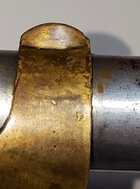
Alterations to the top band for the sights;
20180928_092903_resized (3).jpg the front sight was brazed on to the band and filed out to be smooth..
20180928_092715_resized (2).jpg

The rear sight. {note the range marks... most were correct}. Some condemned US parts some locally made.
20180928_092531_resized (2).jpg

20180928_092618_resized (2).jpg

Barrel proofs and butt plate. Not all will have the S.C. on the barrel

20180928_092437_resized (2).jpg


20180928_092123_resized (2).jpg
 

Learn About Us
About CivilWarTalk
Contact the Webmaster
Meet the Staff
Link to CivilWarTalk
Join Our Community
Register
Browse Forums
View Today's Discussions
Search the Forum
Get Help
FAQ
Student Guide
Forum Rules & Etiquette
Copyright / DMCA

     Contact Us CivilwarTalk on Facebook CivilWarTalk on YouTube CivilWarTalk on Twitter RSS Feed

Bringing the American Civil War and More to Life.
© 1999 - , CIVILWARTALK, LLC - Site Version 10.0

SlaveryTalk.com - SecessionTalk.com - CivilWarTalk.com - ReconstructionTalk.com
Back
Top