
 Forum Host
- Joined
- Aug 26, 2021
- Location
- North Carolina
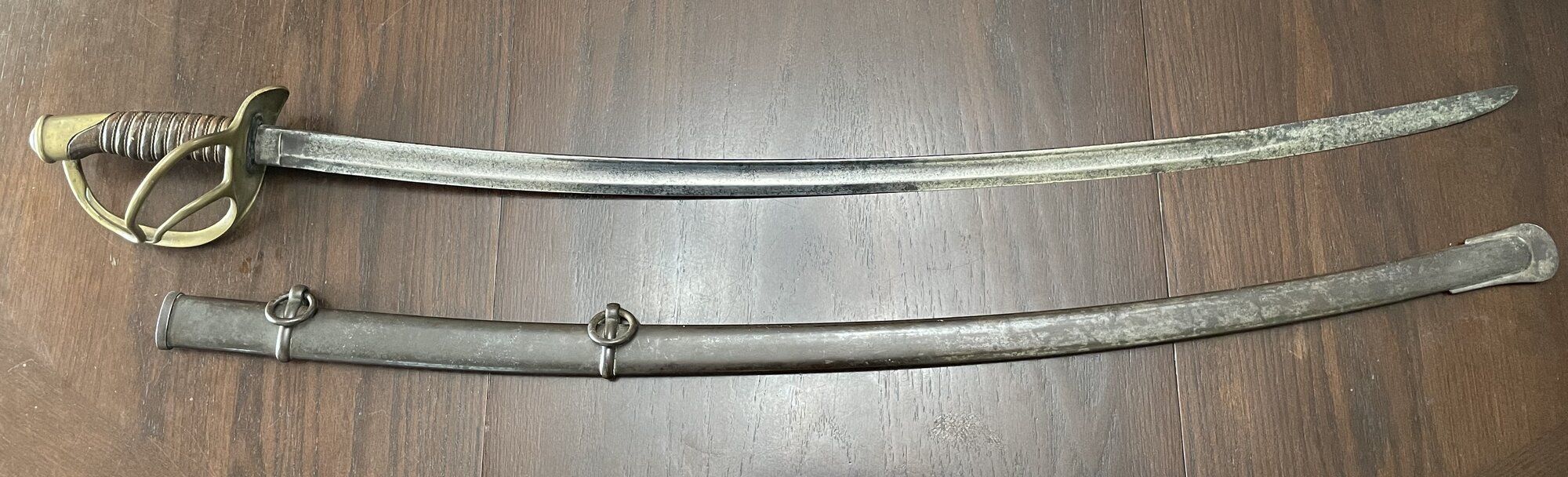
After much internal debate and with the recommendation of some members here, I elected to purchase an Ames Model 1860 Cavalry Saber that was manufactured in 1858 as my next sword/saber purchase (and passing on...for now...a N Starr Model 1818 saber). This saber is more in keeping with my meager Civil War collection and will fit in nicely with the saber timeline (Model 1833 Dragoon, Model 1840, and now Model 1860).
Despite the model name (Model 1860), Ames was manufacturing the "light cavalry saber" starting in 1857. From Thillmann's Civil War Cavalry and Artillery Sabers, in 1857 Ames was requested to send sample patterns of a new light cavalry saber made after the French model of 1822. The Ordnance Department referred to this saber as the "new pattern" in correspondence.
Troops in the field were unhappy with the Model 1840 saber as it was heavy. So heavy in fact it acquired the nickname "Old Wrist Breaker." There was demand for a lighter and more maneuverable saber and so the Model 1860 came to be. The "new pattern" saber had a blade that was slightly shorter, not as thick or wide, and had a scabbard that was scaled down to fit the new blade. The center of balance was moved back more toward the hilt make it easier to wield.
The initial order of 1,000 "new pattern" sabers was delivered by Ames on August 26, 1857. The Ordnance Department paid $8.50 per saber. There were problems with the initial order of 1,000 sabers. Initial inspection revealed that the workmanship of the blades, scabbards and grips was "inferior to that of other sabers from the same manufacturer." Many of the sabers produced in 1857 had faults with their blades. Some blades had visible cracks while others had too high a temper resulting in blades breaking, or too low a temper resulting in blades bending. Of the initial 1,000 sabers produced, 491 were rejected and Ames had to manufacture more sabers to make up for the rejected ones.
The next order for cavalry sabers was dated April 14, 1858. That order requested 800 "new pattern" sabers. These new pattern sabers were delivered on October 18, 1858. In total, 1800 Model 1860 sabers were ordered by the Ordnance Department in 1858, but it's unclear whether all were delivered that year. I tend to think that the original order for 800 and perhaps a few more from the second order that year of 1,000 were dated 1858.
It is interesting to note that the "new pattern" sabers produced in 1857 are not dated. The first date added to the new pattern cavalry sabers was 1858. In total approximately 7,800 "new pattern" sabers were ordered from Ames in the years 1857, 1858 and 1859 (1,000, 1,800, and 5,000 respectively) and were produced through 1860. However, once the war started, 74,500 Model 1860 sabers were ordered from and delivered by Ames from 1861 through 1865.
This saber is one of the 1,800 ordered from Ames by the Ordnance Department in 1858 (and one of 800 or so that were delivered that year). It was inspected by "JH" which can be found on the blade as well as on the pommel cap. JH is thought to beJames Hawkins Joseph Hannis, an armory sub inspector from 1848 to 1859. The blade is slightly discolored and the tip slightly rounded, but overall the saber is in very good shape. I am proud to one of the more scarce versions of this classic cavalry saber.



Despite the model name (Model 1860), Ames was manufacturing the "light cavalry saber" starting in 1857. From Thillmann's Civil War Cavalry and Artillery Sabers, in 1857 Ames was requested to send sample patterns of a new light cavalry saber made after the French model of 1822. The Ordnance Department referred to this saber as the "new pattern" in correspondence.
Troops in the field were unhappy with the Model 1840 saber as it was heavy. So heavy in fact it acquired the nickname "Old Wrist Breaker." There was demand for a lighter and more maneuverable saber and so the Model 1860 came to be. The "new pattern" saber had a blade that was slightly shorter, not as thick or wide, and had a scabbard that was scaled down to fit the new blade. The center of balance was moved back more toward the hilt make it easier to wield.
The initial order of 1,000 "new pattern" sabers was delivered by Ames on August 26, 1857. The Ordnance Department paid $8.50 per saber. There were problems with the initial order of 1,000 sabers. Initial inspection revealed that the workmanship of the blades, scabbards and grips was "inferior to that of other sabers from the same manufacturer." Many of the sabers produced in 1857 had faults with their blades. Some blades had visible cracks while others had too high a temper resulting in blades breaking, or too low a temper resulting in blades bending. Of the initial 1,000 sabers produced, 491 were rejected and Ames had to manufacture more sabers to make up for the rejected ones.
The next order for cavalry sabers was dated April 14, 1858. That order requested 800 "new pattern" sabers. These new pattern sabers were delivered on October 18, 1858. In total, 1800 Model 1860 sabers were ordered by the Ordnance Department in 1858, but it's unclear whether all were delivered that year. I tend to think that the original order for 800 and perhaps a few more from the second order that year of 1,000 were dated 1858.
It is interesting to note that the "new pattern" sabers produced in 1857 are not dated. The first date added to the new pattern cavalry sabers was 1858. In total approximately 7,800 "new pattern" sabers were ordered from Ames in the years 1857, 1858 and 1859 (1,000, 1,800, and 5,000 respectively) and were produced through 1860. However, once the war started, 74,500 Model 1860 sabers were ordered from and delivered by Ames from 1861 through 1865.
This saber is one of the 1,800 ordered from Ames by the Ordnance Department in 1858 (and one of 800 or so that were delivered that year). It was inspected by "JH" which can be found on the blade as well as on the pommel cap. JH is thought to be
Last edited:


 Bringing the