
 Forum Host
- Joined
- Aug 26, 2021
- Location
- North Carolina
I'd been looking for a nice Dragoon saber for a while now, and while I'd found some online the price seemed either too high for the condition of the saber or just too high for my blood in general. Placing a "wanted" plea to a member here, he came through as he has for many others in the past. Many thanks to @ucvrelics for his dogged determination in birddogging this wonderful saber for me. Thanks Richard!
From Thillman's Civil War Cavalry & Artillery Sabers, in 1833 Congress authorized the War Department to establish a mounted arm of dragoons that could fight on foot or horseback. Their role was to principally protect the frontier and settlers from Indian depredations. While the infantry would also provide protection, the dragoons could get to any point of conflict faster and follow up with pursuit if necessary.
The Model 1833 dragoon saber adopted by the Ordnance Department was a close copy of the British pattern 1821 light cavalry saber but with a brass hilt and slightly shorter blade. The US Government contracted with Ames for 6,100 sabers in the 5-year period 1834-1839.
Inspection of sabers was conducted by sub-inspectors who were Springfield Armory employees, with the ordnance officers conducting the final inspection and accepting the finished saber for the government. In addition to their initials, they often used a stamp "ORD" on the hilt and scabbard drag. This saber has the initials WS which was William Smith. The final inspection was performed by MajorMann Page Lomax Henry Knox Craig
The dragoon sabers have two blade inscriptions: UNITED STATES DRAGOONS" and "UNITED STATES" (it is thought that the United States Dragoons was inscribed on sabers made in 1834 and 1835 with United States on sabers after 1835, although Thillman's book refers to at least 1 1839 saber with "dragoons" included in the United States inscription). The blade etching on enlisted sabers was applied with a dry needle as opposed to acid etching found on officer's sabers. This etching did not produce a deep inscription and often normal wear or excessive cleaning destroyed the inscription. Thankfully the UNITED STATES etching on this example remains in very good condition.
The British had objected to their light cavalry saber for at least 10 years before the US adopted the Model 1833, and soon it was found that the same objections existed here. The objections included the saber being too light, the scabbard was easily dented/damaged, and the blade was not suitable for thrusting. At some point Ames increased the gauge of steel used for the scabbards as in 1835 the weight of the scabbard was 13.5 ounces and in 1839 it was 19.5 ounces. These complaints/issues resulted in a new order from the government for a heavier cavalry saber, the Model 1840, which would not be produced in the US until 1845 (although initial orders from overseas were made initially)
The Model 1833 Dragoon saber was also produced for several states including South Carolina, North Carolina and Massachusetts. The Republic of Texas also had Dragoon sabers produced for their use.
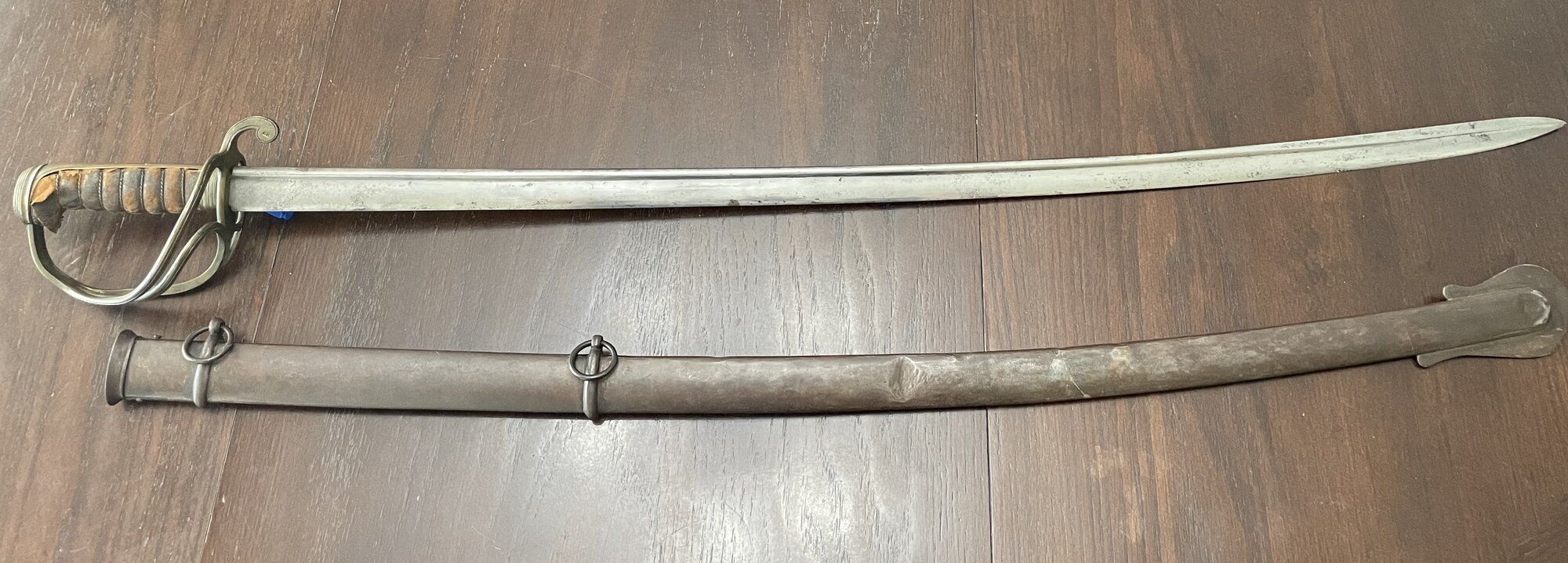
All that said, here is the latest addition to my very meager collection - a 1839 Model 1833 "Dragoon" saber:




From Thillman's Civil War Cavalry & Artillery Sabers, in 1833 Congress authorized the War Department to establish a mounted arm of dragoons that could fight on foot or horseback. Their role was to principally protect the frontier and settlers from Indian depredations. While the infantry would also provide protection, the dragoons could get to any point of conflict faster and follow up with pursuit if necessary.
The Model 1833 dragoon saber adopted by the Ordnance Department was a close copy of the British pattern 1821 light cavalry saber but with a brass hilt and slightly shorter blade. The US Government contracted with Ames for 6,100 sabers in the 5-year period 1834-1839.
Inspection of sabers was conducted by sub-inspectors who were Springfield Armory employees, with the ordnance officers conducting the final inspection and accepting the finished saber for the government. In addition to their initials, they often used a stamp "ORD" on the hilt and scabbard drag. This saber has the initials WS which was William Smith. The final inspection was performed by Major
The dragoon sabers have two blade inscriptions: UNITED STATES DRAGOONS" and "UNITED STATES" (it is thought that the United States Dragoons was inscribed on sabers made in 1834 and 1835 with United States on sabers after 1835, although Thillman's book refers to at least 1 1839 saber with "dragoons" included in the United States inscription). The blade etching on enlisted sabers was applied with a dry needle as opposed to acid etching found on officer's sabers. This etching did not produce a deep inscription and often normal wear or excessive cleaning destroyed the inscription. Thankfully the UNITED STATES etching on this example remains in very good condition.
The British had objected to their light cavalry saber for at least 10 years before the US adopted the Model 1833, and soon it was found that the same objections existed here. The objections included the saber being too light, the scabbard was easily dented/damaged, and the blade was not suitable for thrusting. At some point Ames increased the gauge of steel used for the scabbards as in 1835 the weight of the scabbard was 13.5 ounces and in 1839 it was 19.5 ounces. These complaints/issues resulted in a new order from the government for a heavier cavalry saber, the Model 1840, which would not be produced in the US until 1845 (although initial orders from overseas were made initially)
The Model 1833 Dragoon saber was also produced for several states including South Carolina, North Carolina and Massachusetts. The Republic of Texas also had Dragoon sabers produced for their use.
All that said, here is the latest addition to my very meager collection - a 1839 Model 1833 "Dragoon" saber:
Last edited:


 Bringing the