
DaveBrt
1st Lieutenant
- Joined
- Mar 6, 2010
- Location
- Charlotte, NC


View attachment 89934
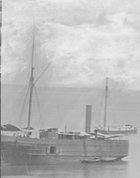
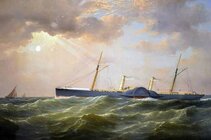
This is a full-resolution copy of the detail image that the author of the linked website in the OP says is "fairly sure" is U.S.S. Banshee, a former blockade runner captured in November 1863 and taken into the U.S. Navy. That may very well be the case, as the vessel shown closely resembles an 1864 painting of that ship by Samuel Walters, which is now in the collection of the Merseyside Maritime Museum in the UK:
View attachment 247749
Update on this one, and I should have posted it sooner. The vessel identified as Banshee cannot be Banshee. Phil Ireson, who runs Spithead Miniatures and is an expert on British-built blockade runners, assured me she was NOT the Banshee. Phil laid out his case and I agree with him:This is extremely interesting to me, because I have tried to document every warship which made it to City Point or further up the James on my Petersburg site. Looking at the various list of vessels different for points of time, I had not been able to confirm the Banshee had made it to City Point. Now I need to add a page for the Banshee at my site. I do still need to go through ththe ORNs, volumes 10-12, page by page, to find the stragglers. This just gives me a head start!
Hi , the vessel pictures is the Hope not the Banshee . If you want to discuss why this is then please fell free to contact me. The Liverpool Maritime museum have done a great disservice in wrongly attributing that painting as Banshee.
I was hoping you would contact me. With a name like Spithead Miniatures, I figured you had done original research on British Blockade runners. I wondered about that painting because the painting looks like the ship pictures.
I'm always open to new assertions. My goal now is to try to figure out a few things:
1. Try to find a reference in the newspapers to the Hope (renamed Savannah on January 11, 1865) departing from or heading for City Point.
2. Try to find out when Hope was sold at auction. I would assume on or close to Janaury 11, 1865. Also try to find out to which port she was taken after capture.
3. Ask you for what other Jones Quiggins vessels could have been captured and used by the Union Army at the Siege of Petersburg.
4. Try to identify other dates on which the Library of Congress image could have been taken. If that ship is the Hope, then that image could not have been taken in early December 1864 as has been claimed. That's okay though. It is not uncommon for dates to be wrong in American Civil War images.
5. I noticed there were two Banshees. Are you positive the model you referenced is Banshee I? That's the ship which was made into a US warship and was definitely on the James River at City Point as part of the North Atlantic Bloackading Squadron. If you can show me through the model what she looked like, I can go actively look for her in the existing images of the James River.
Anything you can give me helping with the above, links to the models you referenced, and just how you came to the conclusion the painting is not of Banshee, all would help me.
Brett Schulte
Hi Brett , I have laid out some answers for you regarding Hope and Banshee in this attachment as it also contains several useful pictures.� Both Hope and Banshee 1 served in the Union Navy but Banshee 2 remained uncaptured so is not the subject of you picture for this reason . Attachment:
Hi Brett , I run a small casting company making models ships but I also have a keen interest in British built blockade runners , I have been researching them for 30 years and have a large library of books on the subject. https://www.facebook.com/spitheadminiatures/
I'm afraid I cannot help you with anything related to her service after blockade running as I focus on this primarily. I have not had to use information on Hope post war as the vessels form is well known although she was later used as an avisio in the Spanish navy under the name Curruco.
The first vessel that the Merseyside company Jones Quiggin constructed to run the blockade was the 120HP Banshee 1 (not to be confused with the later Banshee 2 built on Clydeside). Banshee herself was an unremarkable design as many similar vessels could be seen during this period, what made her special was the use of steel in her construction, this was a brave move on the part of her builders as no ship had been built using this material before. It was done to save weight and gain speed but the theoretical strength of the new material did not match up to its practical application. It was found that the relatively thin steel plates used in her construction tended to buckle in a heavy seaway and although Banshee was the first steel vessel to sail across the Atlantic she needed some strengthening after her launch to make her seaworthy. Banshee was registered on the 14th February 1863 and ran the blockade from the 13th of May. She was captured on the 21st November 1863, she measured 214' x 20' x 8', 325gt, 217rt, 533bt.
The picture below was taken at Liverpool's Maritime Museum, I have also included two pictures of her, the first made post war and the second painted while she was coaling in Ireland before leaving British waters.
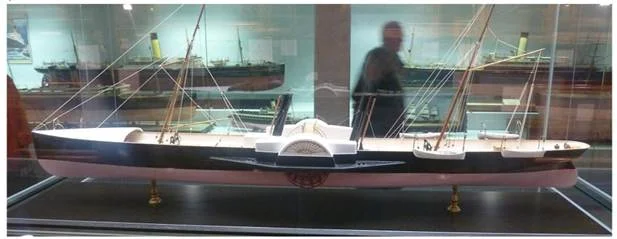
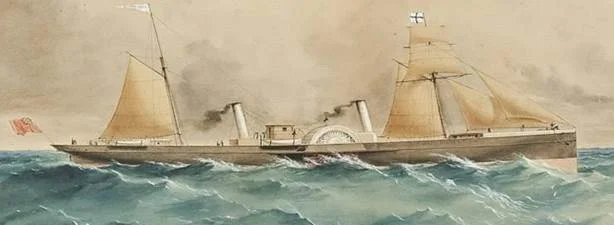
Take a look at the model of PS Hope above from the Liverpool Museum and compare this to the Painting by Samuel Walters (also above) and you will see that the vessels are identical in form. Look at the double fret paddlebox, a design only used by Quiggins, look at the rounded guards either side of the paddle box, again a feature unique to late war Quiggins vessels . Rounded guards can also be seen on other Quiggen's ships like Bat, Dream. Lamb, and Rosine , they were a signature of late 1864 Quiggins designs.
Banshee 2 looked just like her sister ship Susan Beirne, (pictured below) she was identical in size 252.2ft x 31ft and was built alongside Banshee 2 by Aitkin Mansell, Glasgow in 1864, she had a straight bow , had a ship rigged forward topmast, no fore deckhouse , a wheelhouse aft of her paddles and a plain sunburst paddle box pattern. I don't know why the painting (shown above) was labelled Banshee 2 other than to confuse federal agents but the artist Samuel Walters own biographer A S Davidson is also confused as he states "She (Banshee) was built by Jones Quiggins of Liverpool" then he goes onto say that she was the second vessel of that name built in 1864 and was 252 feet long. So here we have the biographer of the artist stating unequivocally that Quiggens also built Banshee 2 which we know to be untrue and presumably this was the art expert that told the Maritime museum to label the painting Banshee when in fact she was PS Hope. For over twenty years now people have been taken in by this mistake, I will grant you that Mr Davidson knows a lot about art but he doesn't know a lot about blockade runners.
Hi Brett , this is getting more interesting now we have ruled out the Banshee as what you say regarding Bat is valid . Again I have written my comparisons down on an attachment for ease and I look forward to your further findings .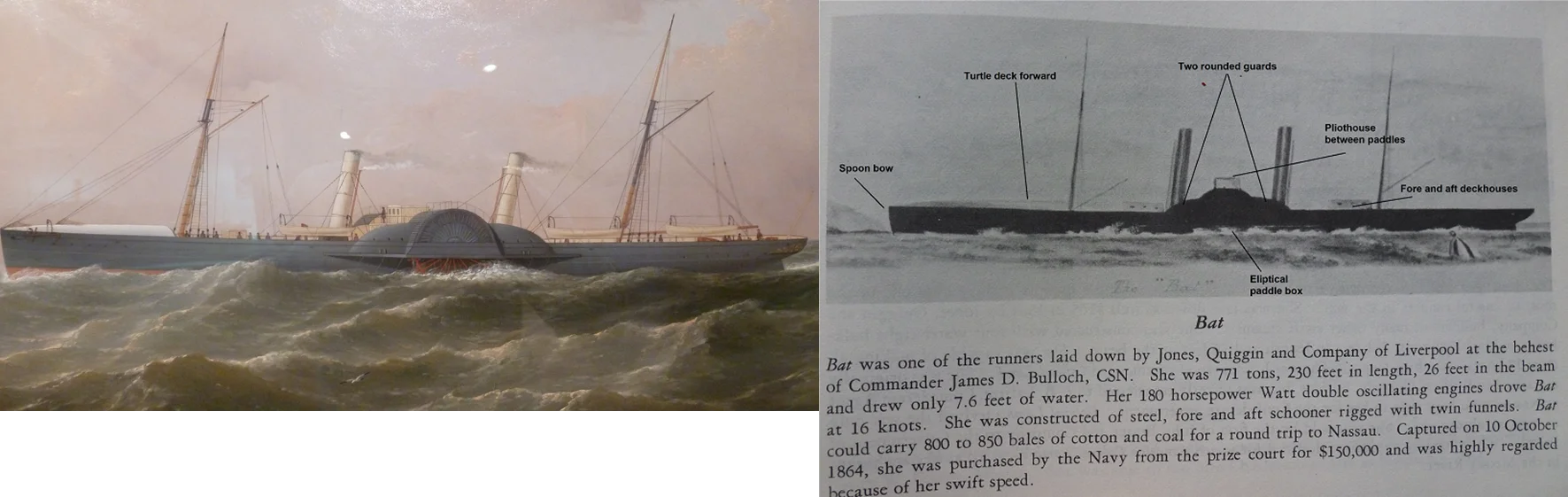
Hi Brett you are correct in thinking that the Bat would look like the Hope as they had many Quiggin's design features in common. Here is a picture of her made in Ireland on her way out. She has the spoon bow, the rounded paddle guards and like several of her Quiggin's predecessors she has a small pilothouse mounted high up between the paddle wheels. What you cannot see here is the double fret paddle box design as she was painted black to fool Union agents. Please note the distance between the forward deckhouse and the fore mast and more importantly the height and small size of her pilot house when compared to Hopes lower and longer pilot house that is slightly forward of the wheels
The picture below shows the Bat as the post war vessel Teaser, you will note that she still has one of her rounded guards in place but her paddle boxes have been replaced during a refit . Please note the smaller distinctive pilot house which was part of her build in line with her paddle wheels. The forward deckhouse has been removed to gain better access to her hold but the aft one is still in place. She looks very small here but don't be fooled as the next picture shows her sistership the Stag in the post war guise of Secret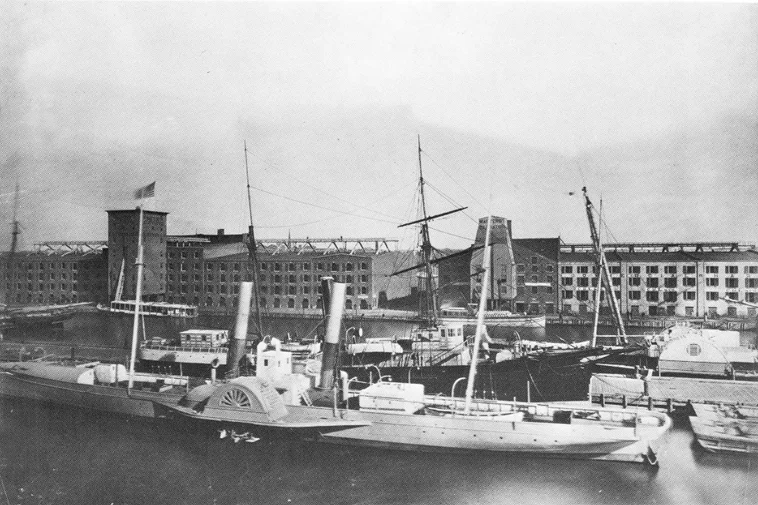
Here is a picture taken post war of Bats sister the Stag when she was called Secret. You will note that this vessel had another deck added but she still retains the Quiggin's double fret paddle box design that Bat would have had during the war, gone are the other features like the deckhouses guards and pilot house
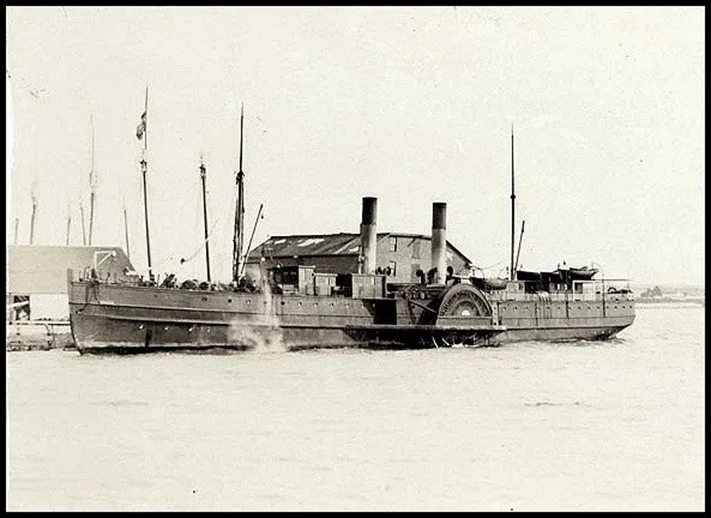
Although The Stag/Secret was the sister of Bat /Teaser , she looks bigger in the picture above. Here is a sketch of her post war with her name still painted on her side
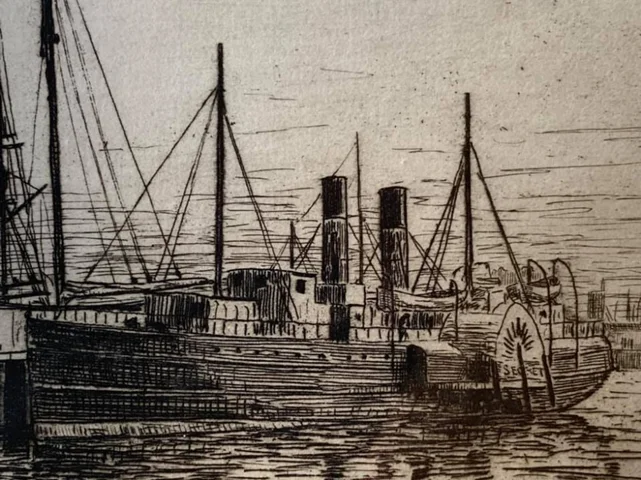
Apart from the difference in size between Hope 281ft and Bat 230ft the main feature of note is that the picture taken of her during the war shows a low pilothouse slightly forward of the paddle boxes.
I have always been certain that the picture below was the Hope but what you say is interesting because I am no longer as sure as I was. She might well be the Bat or even the Stag , the only thing I can say is she is definitely not the Banshee and this vessel was certainly built by Quiggins. I look forward to your findings with interest as they could be key to identifying the name of this ship.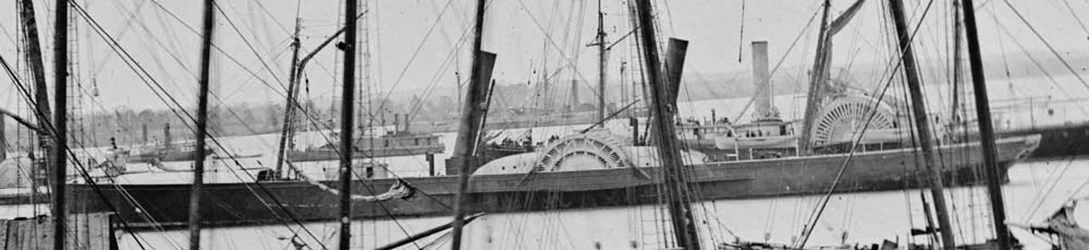
All I can go off is my gut instinct and the overall impression of her size and the fact that the portholes in the guards match the Samuels painting plus the Bat class seemed to have a line of portholes aft of the paddle boxes which are not apparent on the photo below
I am going out on a limb here and backing this vessel to be PS Hope over USS Bat and here are my reasons .
No guns are evident.
The paddle box centre patterns are slightly different to Stag (Zenobia) and Secret which were both smaller vessels.
The ratio of funnel spacing to mast spacing is different when compared to the Bat class (this does not depend on the angle of the photographed ship as the ratio will stay the same)
The ratio of funnel spacing to paddlebox diameter does not match either the Bat class or Secret.
There is no evidence of stern decoration on both Bat class vessels but they appear in the picture at City Point and on the Samuel's painting of Hope .
The strakes on the sides do not match the Bat class or the Secret .
The ratio of the documented length of Hopes lifeboats and the waterline length of the City Point vessel match within 2% of accuracy.
I would have expected to see a Naval ensign on any US Navy ship, she doesnt even appear to have a jackstaff .
Nothing conclusive I admit, but it all stacks up. There are only six possibilites given that she was definately built by Quiggin's, these are Hope, the four Bat class vessels , Bat, Stag , Deer, Owl , and the Secret. We know little about Deer other than she was later sold on and named Palmyra and nothing about the Owl apart from rumours that she was in the Gulf at the very end of the war.
The only book in my collection I would recommend to you is Stephan R Wise's "Lifeline of the Confederacy" as it has potted histories of each runner . I would also recommend any of Silverstones books .
cheers Phil.

Yes, good point. The warship USS Savannah was never at City Point during the Siege, or if she was, it would have been brief, at least according to the Navy ORs and my other independent research.The Savannah / Hope ( good name for a blockade runner that ) was an auxiliary vessel not a commissioned gunboat.
View attachment 586273
The commissioned USS Savannah was very different.
Navsource Photo Index
For details read more here.
Link

True, but we know in this instance the Hope was the vessel's name when it was captured as a blockade runner, and only after it was sold at auction did the name change to Savannah.Documenting blockade runners can be problematic.
View attachment 586274
Capture of blockade runner Savannah.
Link
True, but we know in this instance the Hope was the vessel's name when it was captured as a blockade runner, and only after it was sold at auction did the name change to Savannah.




 Bringing the