OpnCoronet
Lt. Colonel
- Joined
- Feb 23, 2010
The history of the relationship between Amer-Indians and Europeans, would indicate that no matter which side they chose to support, the Indians would still get the short end of the stick, either way.

You probably have these already, but thought I post them anyways:I just started a conversation so we could talk in more detail about this unit without tying up the post. Look forward to hearing from you.
I looked around and can't find a date for this photo, but I think your right about it though; the buckle appears to have a backwards CS ... the image is reversed it seems ...Picture of Colonel McIntosh is wartime photo? Belt, belt buckle and trousers seem military items

This may be a silly question, Diane, but how can you be Karuk if all your ancestors are Choctaw and Chickasaw and Cherokee?
The rules change? I am Norwegian, although there is a rumored Scot somewhere in there.
It is a given that Swedes and Danes share the Skandinavian umbrella, we are not exactly the same. Or so it is claimed.
The Lakota were Native Americans and didn't get along with the Pawnee and Absarokas who were also Native Americans. They did get along with the Cheyenne.
What am I missing?
I looked around and can't find a date for this photo, but I think your right about it though; the buckle appears to have a backwards CS ... the image is reversed it seems ...
Here is another pic of him with others, (last guy from l. to r., from: http://www.paulridenour.com/mcintosh.htm) Daniel N. McIntosh was born in 1822.McIntosh in 1861 was a 39 year old man. Seem that Mcintosh in this photo is older than 39

Hi Robfer,
I guess I should define effectiveness better. Has we know the CW was a conventional war however with a big caveat in that there was quite a bit of guerrillia/insurgent/bushwacking /bandit what ever term you want to use warfare conducted by both sides. Indians served has insurgents for the CSA and counter-insurgents for the Union. A guerillia can only win against a conventional force if the conventional force leaves a territory or gives up its political goal because they get tired of fighting the guerrillia. That of course did not happen the Union forces fought the guerrillias to the very end.
Of the 12k Indians that you mention that fought for the CSA how many fought has in conventional units? If they did so how well did they do vs other CSA units? From what I gather from CSA Todays post the Hampton Legion had 400 Indians how many Indians total fought for the CSA and the Union in conventional units? Perhaps we will never know.
It has been said that most Indians did not want to fight in a conventional unit because it was not to their liking. I can understand that it sure was a fun way to fight. Obviously in later wars plenty of Indians fought in the US and Canadian Army and did just fine but I can see that it may of taken a while to adopt to a new cultures way of war.
The way I would judge effectiveness is did any CSA guerrilla band have the same effect more or less as that of say Mosby's ranger? Did an all Indian conventional unit serve say two years and they did has well has a white ( on both sides) or a USCT unit? I am not arguing that Indians did not fight has bravely has anybody else far from it but to be effective in the long run men must fight has a conventional unit . An example would be Brig Gen. Stan Waite. Yes he had some success in the IT but did he really help out Price when he invaded Mo in Sept 1864? It has been said that the war in the IT was side show of a side show. Is that a fair assessment?
Thanks
Leftyhunter
Hi Rober,
Here is a good example of effectiveness from"The Civil war in the American West" by Alvin Josephy Associate editor of Time Magazine and Chairmen of the Board of Trustees of the Smithsonian Institution National Museum of the American Indian. On pages 342 and 343 during the battle of Pea Ridge Pikes men (mostly Indians but also 200 Texans) bravely charged five companies of Union Cavalry and sent them fleeing and captured Union Artillery. All well and good but despite Pikes orders they don't continue the assault but hang around the captured artillery wooping it up. Unfortunately for them they gave Col. Osterhaus time to reorganize his forces and they fired artillery at the Indians who then fled into the trees and stayed there. Maybe there are other battles where Indians did better in conventional fighting excluding the Hampton Legion. My question is on the whole where Indians better at light cavalry hit and run vs heavy conventional fighting? Again I am not saying that Indians did not have guts just that maybe during the CW they played a somewhat minor role since they did not fight in the main has conventional troops. I really don't know that answer.
Thanks
Leftyhunter

Well Done Sir! I believe we are both on the right track that history is by no means a study of black vs white but shades of grey or put another way history is not has simple has it appears.That is a good assessment about the general features of the "Indian as participant in the Civil War." I have read, although I can't remember the source, that Indians thought it quite "foolish" just to stand in line to be wounded or killed. (What we like to understand as Old World warfare) That mode of warfare wasn't to the American Indians liking at all. Apparently Confederate General Albert Pike knew this "foolishness" as well. Annie Heloise Abel wrote in her three volume series The Slaveholding Indian: "Indians, as Pike well knew, could never be induced to face shells in the open." (It's now a common feature of modern warfare never to "face shells" in the open.) The War was an oddly unique creature. It was a mixture of the old and new—what was going to be deprecated and what will be part of the future. Certainly the Indian's role was the old way, but that doesn't mean Indian knowledge was ALL useless. The Redman's ancient warfare way/tactics/systems was about to be replaced with modernity; however, some of its ways did survive. In a way, the new and the old melded into a new way of fighting. What worked survived and what didn't died. Take, for example, World War I. The Old World warfare systems manifested itself as trench warfare—dig a trench, charge the enemy line when ordered, and fail. As new technologies emerged, new ways to survive emerged—this, long before WW I, is what happened during the Civil War. ("Experience-wise" my military unit was taught, at basic training, to keep low to the ground and crawl while under fire. Seems to me it's the old and new: conceal and cover rather than "face shells" (the old or American Indian way) while arming yourself with a machine gun (M16A2-the Modern or American way).) I wouldn't state the Indians had a minor role rather, more accurately, an ignored role during the War.
Many bands, irregular and regular, did a quality job as Mosby's rangers. In regards to Indians, only Watie's group comes to mind. Watie, with 800 other Indians, captured a supply train of 250 wagons and netted "$1.5 million worth of foods, clothing and goods." (War on the Frontier, The Trans-Mississippi West, Time-Life Books, pg. 156) I don't know all the exploits of John Singleton Mosby, but I doubt he ever netted such a huge financial 'fish.' At one point Mosby confiscated a Union payroll of around $170,000. (Spies, Scouts, and Raiders, Irregular Operations, Time-Life Books, pg. 131) That daring Indian exploit is probably the only real case of Indian Confederate effectiveness, and I would say that was highly effective. But I'm still aggregating unit info.
I cannot say if any confederate conventional units served many years as I am, as I stated earlier, still aggregating such data about units …
(I am not arguing that Indians did not fight has bravely has anybody else far from it but to be effective in the long run men must fight has a conventional unit.) For the War, that is probably a true statement. Unfortunately, the Confederates, at all levels, were not that well organized, had logistical problems, and … the list goes on and on I'm sure you know well. I know that the Confederates were first opposed to guerilla campaigns, but as the fighting went on, they approved such tactics. Maybe if the Confederates were more industrialized, then guerillas warfare may have had a significant impact on the outcome of the War.
Sterling Price, a former governor was more of a politician than a military leader, had a long supply train … I imagine Watie helped, in a sense, Price's campaign into Missouri by indirectly, or possibly directly, supplying Price from that Cabin Creek capture Watie did ... Interesting point.
There were a number of "side shows of side shows" during the War (that's what I love about Civil War history) … I guess the closer you are to Washington D. C. or Richmond then you're the "main attraction" at that point. Battle of Pea Ridge was one of the earliest battles of the War and must have been a 'main attraction' for a short while. Certainly the death of William Clark's grandson, a 19 year old confederate, was an interestingly sad feature that was read in newspapers en masse in the bigger cities back east. The Indian aspect of that particular battle made it unique, naturally. For the most part many people, both North and South, probably didn't care what happened in far off lands across the mighty Mississippi. This particular sentiment must have reigned true on the Eastern seaboard cities.
(Of the 12k Indians that you mention that fought for the CSA how many fought has in conventional units? If they did so how well did they do vs other CSA units? From what I gather from CSA Todays post the Hampton Legion had 400 Indians how many Indians total fought for the CSA and the Union in conventional units?) Great points that I'm hoping time will reveal as I gather my sources.
You brought up some interesting points that I'll keep as a reminder as I research more. I even had to do some Civil War reading on my part to understand the questions more ... this past week I spend some time at the state archives reading up on some of the local Indian units that have been sporadically covered in some books thru the 'ages.' Well, I hope this answered some of your questions.
Regards,
Rob
 Just a comment on the discipline and so forth - many officers found that commanding Indians was a lot like herding cats. Some tribes went more naturally into the European/American style of armies, having military societies themselves, but most had the seemingly unorganized and unsporting ideas of warfare. Most tribes weren't into annihilation or total victory - the concept was quite different. (There were notable exceptions, of course.) I have some accounts of the Catawba auxiliaries under Washington, who gave up on them and let them do it their way. My gggrandfather was captain of a unit but it operated on its own though in concert with white units - they were very effectual. Washington grudgingly said success in South Carolina couldn't have been had without Indian help. However, he also grumbled that they tended to disappear when things looked too dicey! It was simple - why fight if you're almost certainly going to be killed? Duty and all that were nice but there was no survival value in being gentlemanly or sportsmanlike. And, they had a habit of demanding cash on the barrel head BEFORE they went to fight - Washington thought that was insulting but the Catawbas had seen white troops not get paid, starving, ill-clothed - nope, George, we wants our money right now! But by the time of the CW, most eastern tribes were well acculturated to white ways, and expectations. The discipline problems most commented on seemed to have been about the people who had quite recently been sent off from lands in the South to lands in Oklahoma. Takes more than one generation to adjust - and that hasn't happened yet in some quarters. The members of my family who fought with the ANV were Catawbas from South Carolina, and their position was uncomfortable to say the least. Their treaties were with the United States but their reservation was in South Carolina. They viewed the war as 'the white man's fight over the black man' and wished to just stay out of it, but neutrality wasn't an option.

I'm a member of the Mississippi Choctaw. Not aware of any Choctaw, who sided with the confederacy, kin who was part of the War. Mississippi Native American records are sparse between 1860-1900 roughly. I do have plenty from my paternal side though: William Milo Ferguson; John, David, Daniel, & Jesse Boles (Bowles), Hiram Hogan Boles, Robert Cochran, and James Ward Harris.
I'm what the old-timers called a half-breed.
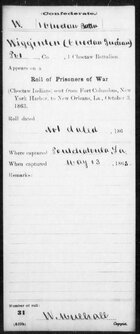
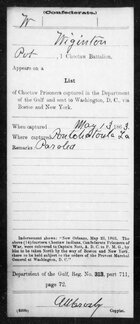
Can you refresh my memory on the 10th NY vs the Chotcaws?At last, found the culprits who caught some of the Choctaw Native American Confederates in Louisiana back in 1863: THE 177th NEW YORK VOLUNTEER INFANTRY (Tenth Regiment). Curse them.View attachment 34177
All I know about the Chotcaws is no Chotcaws equals no Elvis no Elvis then where would we be?I've just started to try to nail down one of my ancestors, a Choctow woman who married a white man sometime in the 1800's (probably around 1830). Any idea what sources I could access to find out more?


 Bringing the