-
Welcome to CivilWarTalk, a forum about the American Civil War! - Join today! It's fast, simple, and FREE!
You are using an out of date browser. It may not display this or other websites correctly.
You should upgrade or use an alternative browser.
You should upgrade or use an alternative browser.
Native Americans and the War
- Thread starter RobertBruceFerguson
- Start date


7th Mississippi Infantry
Brev. Brig. Gen'l
- Joined
- Sep 28, 2013
- Location
- Southwest Mississippi
Here are a few links that provide a good overview,I'm truly serious about studying up on Native American Confederates.gotta go for now.
http://alexandriava.gov/historic/fortward/default.aspx?id=40164
http://www.civilwar.org/battlefields/pearidge/pea-ridge-history-articles/cherokeespearidgehess.html
http://digital.library.okstate.edu/encyclopedia/entries/c/ci011.html
http://www.civilwarhome.com/nativeamericans.htm
diane
Retired User
- Joined
- Jan 23, 2010
- Location
- State of Jefferson
Here are a few links that provide a good overview,
http://alexandriava.gov/historic/fortward/default.aspx?id=40164
http://www.civilwar.org/battlefields/pearidge/pea-ridge-history-articles/cherokeespearidgehess.html
http://digital.library.okstate.edu/encyclopedia/entries/c/ci011.html
http://www.civilwarhome.com/nativeamericans.htm
Those are interesting links. The one about Pea Ridge - they say they don't know why the Cherokees scalped anybody. Well, there is a sad reason and it isn't nice. Some who were recruited from Indian Territory just wanted the chance to kill some white people. Plain and simple. It had only been a couple decades or so since Removal and there many who vividly remembered it.

- Joined
- Feb 20, 2005
- Location
- Near Kankakee
Totally lost me here. It's much simpler to be Norwegian.Oh, not all of them were! The whole list is Quesemegan, Seecock, Semack, Narragansett, Cherokee, Pamunkey, Catawba, Choctaw, Chickasaw, Etaw, Cheraw - that's dad's. Mom's is Konomihu, Okwanuchu, Shasta, Applegate Shasta, Takelma, Shoshone, Karuk, Yurok and possibly a stray Rogue River but we're not sure about him. The BIA wants you to prove blood degree back to your great-grandparents but all those tribes meant droplets except for the Karuk. Happened to have the blood degree for them. The eastern tribes did a lot of moving and getting moved and I guess my ancestors believed in being neighborly!That blood degree thingie by the government is how you get four by four Indians like me who can't join a tribe, and people who would lose their Indian blood with a paper cut as tribal members. It's a weird system!
p s
Oops...forgot the Huron and the Abnaki...


leftyhunter
Brev. Brig. Gen'l
- Joined
- May 27, 2011
- Location
- los angeles ca
Nothing wrong with a thread on CSA Indians. At the same time we should keep in mind quite a few fought for the Union and per the books "The South Bitterly Divided" and "Civil War in the West" CSA Indians did plenty of wrong to Indians that did not want to fight for the CSA. Also many Indians defected to the Union an example is the Indians who joined the 3rd Indian Home guard. It is not a simple story. Also we should keep in mind that in no way did the CW keep both CSA forces and Union forces from killing Indians that they considered hostile.
Leftyhunter "
Leftyhunter "
 Forum Host
- Joined
- Aug 25, 2012
I find it difficult to understand why Indians would have fought for either side.

Union soldiers wounded during the Battle of the Wilderness being cared for beneath a tree at Brompton, Fredericksburg, 1864. Among them are Native American soldiers possibly from the 1st Regiment Michigan Volunteer Sharpshooters. Animated stereoview.

- Joined
- May 12, 2010
- Location
- Now Florida but always a Kentuckian
This is a very interesting thread and will be checking each time I am on forum.

- Joined
- May 3, 2013
- Location
- Pennsylvania
Opothle Yohola (1798 - 1863)
Muscogee Creek chief who survived the Red Stick War and the Indian Removals of the 1820's and 1830's. Refusing to align with the Confederacy he led a fighting retreat of his people and allied followers from the Indian Territory to Kansas in November and December, 1861. They suffered heavy losses in the retreat and more when promised assistance from the Federal government was late in arriving and inadequate when it finally got there. He died and is buried in Fort Belmont KS.

http://skyways.lib.ks.us/genweb/woodson/Yahola.txt
http://digital.library.okstate.edu/chronicles/v009/v009p439.html
http://en.wikipedia.org/wiki/Opothleyahola
Muscogee Creek chief who survived the Red Stick War and the Indian Removals of the 1820's and 1830's. Refusing to align with the Confederacy he led a fighting retreat of his people and allied followers from the Indian Territory to Kansas in November and December, 1861. They suffered heavy losses in the retreat and more when promised assistance from the Federal government was late in arriving and inadequate when it finally got there. He died and is buried in Fort Belmont KS.
http://skyways.lib.ks.us/genweb/woodson/Yahola.txt
http://digital.library.okstate.edu/chronicles/v009/v009p439.html
http://en.wikipedia.org/wiki/Opothleyahola

RobertBruceFerguson
Private
- Joined
- Mar 15, 2014
- Location
- Central Mississippi
Nothing wrong with a thread on CSA Indians. At the same time we should keep in mind quite a few fought for the Union and per the books "The South Bitterly Divided" and "Civil War in the West" CSA Indians did plenty of wrong to Indians that did not want to fight for the CSA. Also many Indians defected to the Union an example is the Indians who joined the 3rd Indian Home guard. It is not a simple story. Also we should keep in mind that in no way did the CW keep both CSA forces and Union forces from killing Indians that they considered hostile.
Leftyhunter "
In I.T., Native Americans considered the evacuation of Union forces from I.T. as abandonment--a violation of treaty terms. "Policywise", the Union did nothing to entice Native American nations/tribes/bands (https://archive.org/details/chickasawnations00malo) ... on the other hand, and to the credit of the C.S.A., the Confederacy did, as policy, encourage Native American cooperation. March 12, 1861, President Davis established a Bureau of Indian Affairs to establish official relations with Indians (http://avalon.law.yale.edu/19th_century/csa_m031261.asp). In early 1861, Davis chose Albert Pike as a delegate to the tribes East of the Mississippi River. One particular treaty, with the Choctaw & Chickasaw, offered the opportunity for an entitled representative in the House of Representatives of the Confederate States of America. This was just one term, out of 64, of that particular treaty. Another interesting term would allow an Indian Nation to become a Confederated state-- if they voluntarily chose to. (http://en.wikipedia.org/wiki/Treaty_with_Choctaws_and_Chickasaws) Many Native Americans, mostly from the Five Civilized Tribes, had mixed ancestry ... which means they would have family ties to non-Indian families of the South rather than the North. Consider all these factor, out of much more that needs to be detailed, it is easy to see why the Indians mostly chose to fight on the side of the Confederacy.
In the southwest, Confederates & Apaches were in conflict, but that's not saying much when the Apaches were in conflict with all outside influences--including other tribes in that area. The Union, however, did commit one of the worse atrocities during the Civil War--the massacre at Sand Creek, Colorado Territory in '64. Black Kettle's Indian group was pro-Union, in a manner of speaking, but members were still murdered by the forces of U. S. Colonel John Chivington. I have yet to undercover U.S. policy about Indians during the Civil War but it seems the country had designed plans against the Indian (West of the Mississippi) right before the outbreak of the War--based on materials I have read.
A good number of Indians also fought for the Union--probably the best known was Ely S. Parker. I have read that roughly between 3000-6,000, more or less, served the Union ... around 12,000 or more for the Confederacy. (I am currently counting all individual Native American Civil War records found on fold3.com)
Native Americans on both sides, and the unfortunate neutrals who were caught in the middle, did commit atrocities--or had atrocities occurred against them. The story of Opothleyahola's neutral group is a sad case, but it appears in August 1861 that Opothleyahola's group sided with the Union--the Confederacy would consider it an act of war.
Yes, it is certainly true that its not a simple story ... one I'm willing to figure out the details, even if it takes years. New information is bound to show-up and shed light on this little told story of the War.
Last edited:
RobertBruceFerguson
Private
- Joined
- Mar 15, 2014
- Location
- Central Mississippi
diane
Retired User
- Joined
- Jan 23, 2010
- Location
- State of Jefferson
The war being the primary concern, I think Lincoln's administration was more concerned about settling the West and opening transcontinental railroads. The Homestead Act, for instance. Kit Carson was busy in Canyon de Chelly getting the Navajos moved to Bosque Redondo - there were plans for a railroad to go through their country. After that was scrapped, Sherman let them return to their homeland but Indian policy after the war was to clear the west of Indians for white settlement. Sherman was always involved in the railroads, and he had a strong interest in them after the war. As a banker in California he'd lent money to Thomas Bragg, Braxton Bragg's brother. Thomas Bragg was improving railroads in North Carolina at the time and had plans, if the Confederacy survived, to improve Southern lines, including westward ones.
For California Indians, the removal of the US army for the CW was disastrous - many tribes and bands relied on the forts for protection from the miners and ranchers as per treaties made in the 50s. They were also almost dependent on the army for clothes and food, which disappeared as well. The Federal withdrawal left such protection up to the state militias and volunteer groups - which were not exactly into protecting Indians!
For California Indians, the removal of the US army for the CW was disastrous - many tribes and bands relied on the forts for protection from the miners and ranchers as per treaties made in the 50s. They were also almost dependent on the army for clothes and food, which disappeared as well. The Federal withdrawal left such protection up to the state militias and volunteer groups - which were not exactly into protecting Indians!
RobertBruceFerguson
Private
- Joined
- Mar 15, 2014
- Location
- Central Mississippi
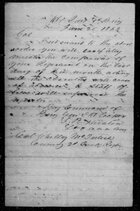
Example of the legibility an old C.S.A. letter (Chilly McIntosh) ...
Last edited:
- Joined
- May 3, 2013
- Location
- Pennsylvania
Manuelito (1818 - 1893) and Barboncito (1821 - 1871)
Leaders of the Diné (Navajo) of the Four Corners area of the Southwest.

Manuelito and wife, Juanita.

Barboncito.
Relations between the Diné and neighboring Ute, Apache, Pueblo and local Spanish / Mexican peoples had been back and forth periods of trading and cultural exchanges intermixed with periods of endemic warfare for centuries before the U.S. acquired the territory at the end of the Mexican-American War in 1848. For the most part the American presence did not change much in that regard and the Diné were not pleased with the establishment of U.S. military outposts on their lands or with the murder of their chief, Narbona, en-route to a peace treaty in 1849.
Manuelito, Narbona's son-in-law then made it his life's work to drive the 'Anglos' from Diné lands. Raids, murders and kidnappings went of sporadically for years, but events came to a head American troops destroyed Diné livestock herds in the vicinity of Fort Defiance (now Arizona). Follow-up attacks by the Army destroyed crops and homes of Manuelito and his followers and all out war broke out. Barboncito, who until this time had pursued a more peaceful path, united with Manuelito and the two were able to field over a 1000 warriors.
In 1862 the new commander of the Department of New Mexico, Brigadier General James Carleton decided to put an end to the 'Indian problems' in his command area. He decided on a scorched earth policy to be implemented by his primary field commander, a reluctant Colonel Christopher (Kit) Carson. The policy gradually worked, the Navajo lands devastated, Diné captives herded into the Bosque Redondo compound near Fort Sumner, New Mexico, and their long suffering neighboring tribes piled on as well. The final straw was the invasion of the Canyon de Chelly in 1863. Barboncito held out until 1864, escaped in June, 1865, and returned to the Bosque in November, 1866. Manuelito held out until the Utes attacked his camp and made off with his bands herds. He surrendered in September, 1866. Manuelito, Barboncito and some followers left the reservation in September, 1867, but returned shortly thereafter realizing their cause was hopeless.

Canyon de Chelly.
Conditions at Bosque Redondo were horrible. The government could no longer afford to feed that many people. Many concerned Anglos actually advocated for the Navajos, saying that the Bosque Redondo reservation had met with disastrous failure. In 1868 Barboncito and other Navajo leaders traveled to Washington D.C. to meet with President Andrew Johnson to determine their future. A peace commission led by William Tecumseh Sherman went to Bosque Redondo to finalize the details. Barboncito spoke for the Diné and a treaty was signed allowing them to return home. Difficult days followed as they tried to reestablish their lives among the devestation. His health broken, Barboncito died in 1871, two years after returning.
Manuelito lived up to the terms of the treaty and spent the remainder of his life working for his people. He served as a tribal policeman, returning stolen property to its owners, but not arresting the perpatrators. Manuelito strongly encouraged education. "My grandchild, the whites have many things which we Navajos need. But we cannot get them. It is as though the whites were in a grassy canyon and there they have wagons, plows, and plenty of food. We Navajos are up on a dry mesa. We can hear them talking but we cannot get to them. My grandchild, education is the ladder. Tell our people to take it." He voluntarily sent three of his children to the Carlisle Indian School where they unfortunately died of tuberculosis. He regretted sending them the rest of his life, but still encouraged education. Alcohol also became an issue in later life. He died in 1893 of complications from measles.
Leaders of the Diné (Navajo) of the Four Corners area of the Southwest.
Manuelito and wife, Juanita.
Barboncito.
Relations between the Diné and neighboring Ute, Apache, Pueblo and local Spanish / Mexican peoples had been back and forth periods of trading and cultural exchanges intermixed with periods of endemic warfare for centuries before the U.S. acquired the territory at the end of the Mexican-American War in 1848. For the most part the American presence did not change much in that regard and the Diné were not pleased with the establishment of U.S. military outposts on their lands or with the murder of their chief, Narbona, en-route to a peace treaty in 1849.
Manuelito, Narbona's son-in-law then made it his life's work to drive the 'Anglos' from Diné lands. Raids, murders and kidnappings went of sporadically for years, but events came to a head American troops destroyed Diné livestock herds in the vicinity of Fort Defiance (now Arizona). Follow-up attacks by the Army destroyed crops and homes of Manuelito and his followers and all out war broke out. Barboncito, who until this time had pursued a more peaceful path, united with Manuelito and the two were able to field over a 1000 warriors.
In 1862 the new commander of the Department of New Mexico, Brigadier General James Carleton decided to put an end to the 'Indian problems' in his command area. He decided on a scorched earth policy to be implemented by his primary field commander, a reluctant Colonel Christopher (Kit) Carson. The policy gradually worked, the Navajo lands devastated, Diné captives herded into the Bosque Redondo compound near Fort Sumner, New Mexico, and their long suffering neighboring tribes piled on as well. The final straw was the invasion of the Canyon de Chelly in 1863. Barboncito held out until 1864, escaped in June, 1865, and returned to the Bosque in November, 1866. Manuelito held out until the Utes attacked his camp and made off with his bands herds. He surrendered in September, 1866. Manuelito, Barboncito and some followers left the reservation in September, 1867, but returned shortly thereafter realizing their cause was hopeless.
Canyon de Chelly.
Conditions at Bosque Redondo were horrible. The government could no longer afford to feed that many people. Many concerned Anglos actually advocated for the Navajos, saying that the Bosque Redondo reservation had met with disastrous failure. In 1868 Barboncito and other Navajo leaders traveled to Washington D.C. to meet with President Andrew Johnson to determine their future. A peace commission led by William Tecumseh Sherman went to Bosque Redondo to finalize the details. Barboncito spoke for the Diné and a treaty was signed allowing them to return home. Difficult days followed as they tried to reestablish their lives among the devestation. His health broken, Barboncito died in 1871, two years after returning.
Manuelito lived up to the terms of the treaty and spent the remainder of his life working for his people. He served as a tribal policeman, returning stolen property to its owners, but not arresting the perpatrators. Manuelito strongly encouraged education. "My grandchild, the whites have many things which we Navajos need. But we cannot get them. It is as though the whites were in a grassy canyon and there they have wagons, plows, and plenty of food. We Navajos are up on a dry mesa. We can hear them talking but we cannot get to them. My grandchild, education is the ladder. Tell our people to take it." He voluntarily sent three of his children to the Carlisle Indian School where they unfortunately died of tuberculosis. He regretted sending them the rest of his life, but still encouraged education. Alcohol also became an issue in later life. He died in 1893 of complications from measles.
Last edited:
leftyhunter
Brev. Brig. Gen'l
- Joined
- May 27, 2011
- Location
- los angeles ca
Good points. Just to muddy the waters up even more Of the 12k Indians who fought for the CSA how active where they? It has been said that the pro-CSA Indians in the IT where more of a nuisance and were inactive a great deal of the time. How effective where the Indians has conventional infantry? I don't know but at Pea Ridge they may of inspired the Union troops to fight harder. On the other hand CSA Hampton's Legion seems to of done well. We forgot to mention the Lumby Indians of Nc who where conscripted to build coastal fortifications and then fought during and after the CW against the local whites. I will try to do some research this weekend. This week I have a lot of work but no doubt it is has we both agree a far from simple story about Indians and the CW.In I.T., Native Americans considered the evacuation of Union forces from I.T. as abandonment--a violation of treaty terms. "Policywise", the Union did nothing to entice Native American nations/tribes/bands (https://archive.org/details/chickasawnations00malo) ... on the other hand, and to the credit of the C.S.A., the Confederacy did, as policy, encourage Native American cooperation. Marcy 12, 1861, President Davis established a Bureau of Indian Affairs to establish official relations with Indians (http://avalon.law.yale.edu/19th_century/csa_m031261.asp). In early 1861, Davis chose Albert Pike as a delegate to the tribes East of the Mississippi River. One particular treaty, with the Choctaw & Chickasaw, offered the opportunity for an entitled representative in the House of Representatives of the Confederate States of America. This was just one term, out of 64, of that particular treaty. Another interesting term would allow an Indian Nation to become a Confederated state-- if they voluntarily chose to. (http://en.wikipedia.org/wiki/Treaty_with_Choctaws_and_Chickasaws) Many Native Americans, mostly from the Five Civilized Tribes, had mixed ancestry ... which means they would have family ties to non-Indian families of the South rather than the North. Consider all these factor, out of much more that needs to be detailed, it is easy to see why the Indians mostly chose to fight on the side of the Confederacy.
In the southwest, Confederates & Apaches were in conflict, but that's not saying much when the Apaches were in conflict with all outside influences--including other tribes in that area. The Union, however, did commit one of the worse atrocities during the Civil War--the massacre at Sand Creek, Colorado Territory in '64. Black Kettle's Indian group was pro-Union, in a manner of speaking, but members were still murdered by the forces of U. S. Colonel John Chivington. I have yet to undercover U.S. policy about Indians during the Civil War but it seems the country had designed plans against the Indian (West of the Mississippi) right before the outbreak of the War--based on materials I have read.
A good number of Indians also fought for the Union--probably the best known was Ely S. Parker. I have read that roughly between 3000-6,000, more or less, served the Union ... around 12,000 or more for the Confederacy. (I am currently counting all individual Native American Civil War records found on fold3.com)
Native Americans on both sides, and the unfortunate neutrals who were caught in the middle, did commit atrocities--or had atrocities occurred against them. The story of Opothleyahola's neutral group is a sad case, but it appearts in August 1861 that Opothleyahola's group sided with the Union--the Confederacy would consider it an act of war.
Yes, it is certainly true that its not a simple story ... one I'm willing to figure out the details, even if it takes years. New information is bound to show-up and shed light on this little told story of the War.
Leftyhunter

East Tennessee Roots
Major
- Joined
- Dec 31, 2010
- Location
- Kingsport, Tennessee
A general thread for Native Americans during the Civil War ...
The Thomas Legion ( Confederate 69th NC ) Made up of Cherokees and Whites from the western North Carolina & eastern Tennessee mountains
http://history-sites.com/cherokee/thomasle.html
http://www.archive.org/stream/historiesofsever03clar#page/n853/mode/2up
James R. Love
Residence Jackson County NC; 27 years old.
Enlisted on 4/27/1861 as a 3rd Lieut.
On 4/27/1861 he was commissioned into "A" Co. NC 16th Infantry
He was transferred out on 10/5/1862
On 10/5/1862 he transferred into "A" Co. NC Thomas's Legion
(date and method of discharge not given)
He was listed as:
* Wounded 5/31/1862 Seven Pines, VA
Promotions:
* 1st Lieut 4/25/1862
* Capt 6/30/1862
Sources used by Historical Data Systems, Inc.:
- North Carolina Troops 1861-65, A Roster
(c) Historical Data Systems, Inc. @ www.civilwardata.com
diane
Retired User
- Joined
- Jan 23, 2010
- Location
- State of Jefferson
The Thomas Legion ( Confederate 69th NC ) Made up of Cherokees and Whites from the western North Carolina & eastern Tennessee mountains
http://history-sites.com/cherokee/thomasle.html
http://www.archive.org/stream/historiesofsever03clar#page/n853/mode/2up
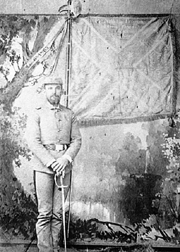
James R. Love
Residence Jackson County NC; 27 years old.
Enlisted on 4/27/1861 as a 3rd Lieut.
On 4/27/1861 he was commissioned into "A" Co. NC 16th Infantry
He was transferred out on 10/5/1862
On 10/5/1862 he transferred into "A" Co. NC Thomas's Legion
(date and method of discharge not given)
He was listed as:
* Wounded 5/31/1862 Seven Pines, VA
Promotions:
* 1st Lieut 4/25/1862
* Capt 6/30/1862
Sources used by Historical Data Systems, Inc.:
- North Carolina Troops 1861-65, A Roster
(c) Historical Data Systems, Inc. @ www.civilwardata.com
That area is where my gggrandfather was given property for being a Catawba ranger with Washington in the Revolution. Tarleton had messed up the place in SC anyway! It's always interested me that Indians were pioneers and settlers, too - something very few notice. It's been a few years but I believe his place was around Cowan.

- Joined
- Dec 3, 2011
- Location
- Laurinburg NC
Ah, this is nice! Love these pictures. You don't often see them.
I'm a full blood but my ancestors hit all 500 nations! I'm a member of the Karuk tribe of California. My grandfather was born in 1849, Choctaw mother, in Kentucky. Around 1864 he signed on with Forrest - his five brothers were already in his escort. They were not tribal but were wealthy horse breeders, which is how Forrest came to know the family. Some Chickasaw relations had a cotton plantation somewhere outside Memphis - some of them came on, too. There were two Oklahoma Choctaw cousins as well, who were US marshals. They'd been Choctaw Light Horse. I know the Mississippi Choctaw require you to be half to join - I inquired several years ago when I found my great-grandmother was Choctaw. I believe they also require you to speak the language? I'm always interested in that as I teach three river languages here.
Diane,
I'm glad you are doing your part to save the languages. The Eastern band of Cherokees are apparently interested in doing the same for their language.
http://visitcherokeenc.com/language/
- Joined
- May 12, 2010
- Location
- Now Florida but always a Kentuckian
The February 2014 issue of the United Daughters of the Confederacy has article, "The Final Fracture, The Cherokee Nation During the War Between the State". It talks about the different tribes that joined the Confederacy, with emphasis on the Cherokees. There was a split in Cherokee Nation, but more joined the Confederacy. The article states there were about 5000 Cherokees of which 3500 joined the Confederacy. The article goes on to state: "Because the majority of the Cherokees fought for the Confederacy, their treaties with the U.S. Government were broken, and the Cherokee people never regained the unity or the prosperity they enjoyed before the war. The fracture within the Cherokee Nation never healed, and these two tribes of the Cherokees operate independently to this day."
From "UDC Magazine", February, 2014, "The Final Fracture", by Donna Bailey, pages 30-32.
From "UDC Magazine", February, 2014, "The Final Fracture", by Donna Bailey, pages 30-32.
RobertBruceFerguson
Private
- Joined
- Mar 15, 2014
- Location
- Central Mississippi
The Thomas Legion ( Confederate 69th NC ) Made up of Cherokees and Whites from the western North Carolina & eastern Tennessee mountains
http://history-sites.com/cherokee/thomasle.html
http://www.archive.org/stream/historiesofsever03clar#page/n853/mode/2up
I wondered who and where these Native American Confederates came from ... North Carolina Native American Confederates (Thomas' Legion): "Indian Volunteers, enlisted in Jackson and Cherokee Counties for the local defense of the Carolinas, East Tennessee, Southwestern Virginia, and the Cumberland Mountains in Kentucky." (Photo taken at the New Orleans Confederate Convention in 1903.)
Similar threads

- Replies
- 16
- Views
- 320
- Replies
- 12
- Views
- 348
- Replies
- 0
- Views
- 88

- Replies
- 0
- Views
- 59
- Replies
- 1
- Views
- 134
Similar threads

- Replies
- 5
- Views
- 127
- Replies
- 16
- Views
- 320
- Learn About Us
- ►About CivilWarTalk
- ►Contact the Webmaster
- ►Meet the Staff
- ►Link to CivilWarTalk
- Join Our Community
- ►Register
- ►Browse Forums
- ►View Today's Discussions
- ►Search the Forum
- Get Help
- ►FAQ
- ►Student Guide
- ►Forum Rules & Etiquette
- ►Copyright / DMCA
 Bringing the