Here is more info, lengthy, but complete:
THE INDIAN ENFIELD
by DE WITT BAILEY II
BY THE close of 1856 the British War Department had pretty well sorted out the small arms problems of the various branches of the services. The line infantry had the P.53 rifle- musket; the Royal Artillery had the P.53 Artillery Carbine; the Royal Engineers had the Lancaster oval-bore Carbine; and the cavalry was still enjoying that state of indecision with regard to arms which seems to have been its status quo, being variously armed with experimental breech-loading carbines, revolvers, pistols and various edged weapons. A carbine patterned on the basic Enfield design was approved on paper but not yet in production, and was designed only as in interim weapon pending the selection of suitable breech-loading arms. The Royal Navy was still equipped with arms of an older pattern, but would shortly set the pace for all improvements made under the Enfield system, with the P.58 Naval Rifle. All of the Enfield pattern arms employed an identical calibre and bullet, the cartridges for the Artillery and Cavalry Carbines only being loaded with a half-dram less powder than the others. Individual susceptibilities in the design of arms for special purposes were confined to variations on a basic theme which was quite closely kept. A remarkable degree of uniformity had thus been achieved for the first time in British Ordnance history.
At this time the largest body of British troops outside of England was located in India, partly under the control of the Government but mainly under the orders of the East India Company. It was envisaged that arms for these troops would closely follow the P.53 pattern weapons, and that this rifle- musket would form the standard arm for Indian as well as Royal infantry. Modifications for particular parts of the service were planned.
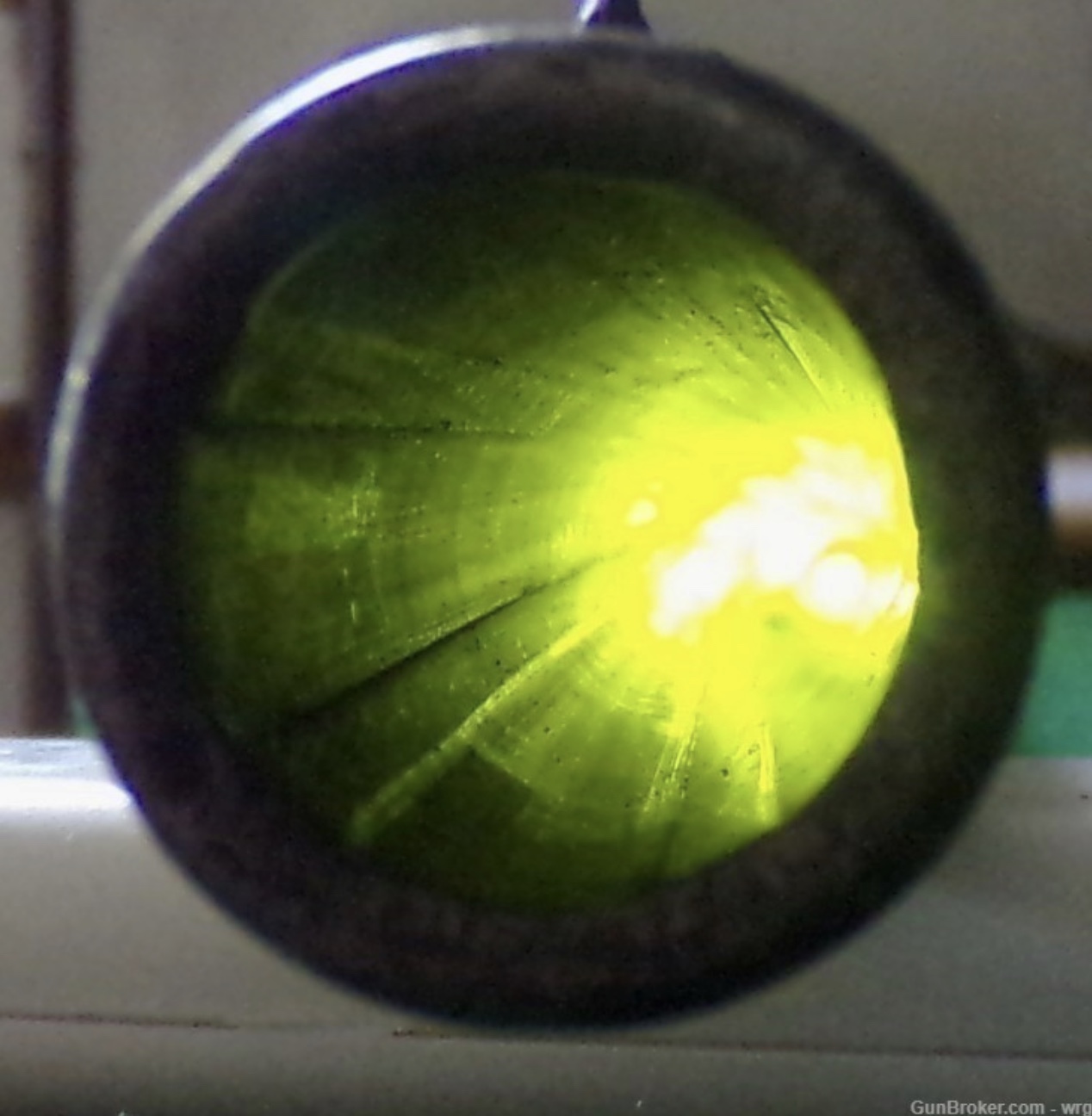
In August, 1856, the first three of these Indian-service Enfield designs were approved by the Secretary of State for War, having been previously approved by the Court of Directors at India House. The first of these was what came to be called the "EIC Government or P.56 Cavalry Carbine". The two other arms for which the Superintendent of the Royal Small Arms Factory at Enfield had submitted patterns were an East India Sappers' Carbine and a Sergeants Fusil. All three were .577 calibre, rifled with three grooves having a turn of 1 in 78 inches—in other words identical with the P.53 system. The East India Company were not quite as experimentally minded as the Government at this point in time and therefore declined the use of Lancaster's oval-bore rifling in their Sappers' (Engineer's) Carbine—which would also have entailed paying certain fees to Charles Lancaster for its use.
The Cavalry Carbine is in fact the "standard" Enfield cavalry carbine, known as the P56. Subsequent political events making the issue of this weapon impractical in India, and the design being already in production—contracts having been let in June, 1857—it was adopted entirely into Government service. Many of them did subsequently see service in India in the hands of Royal cavalry troopers, but the point here is that they were not issued, as originally intended, to East India Government troopers.
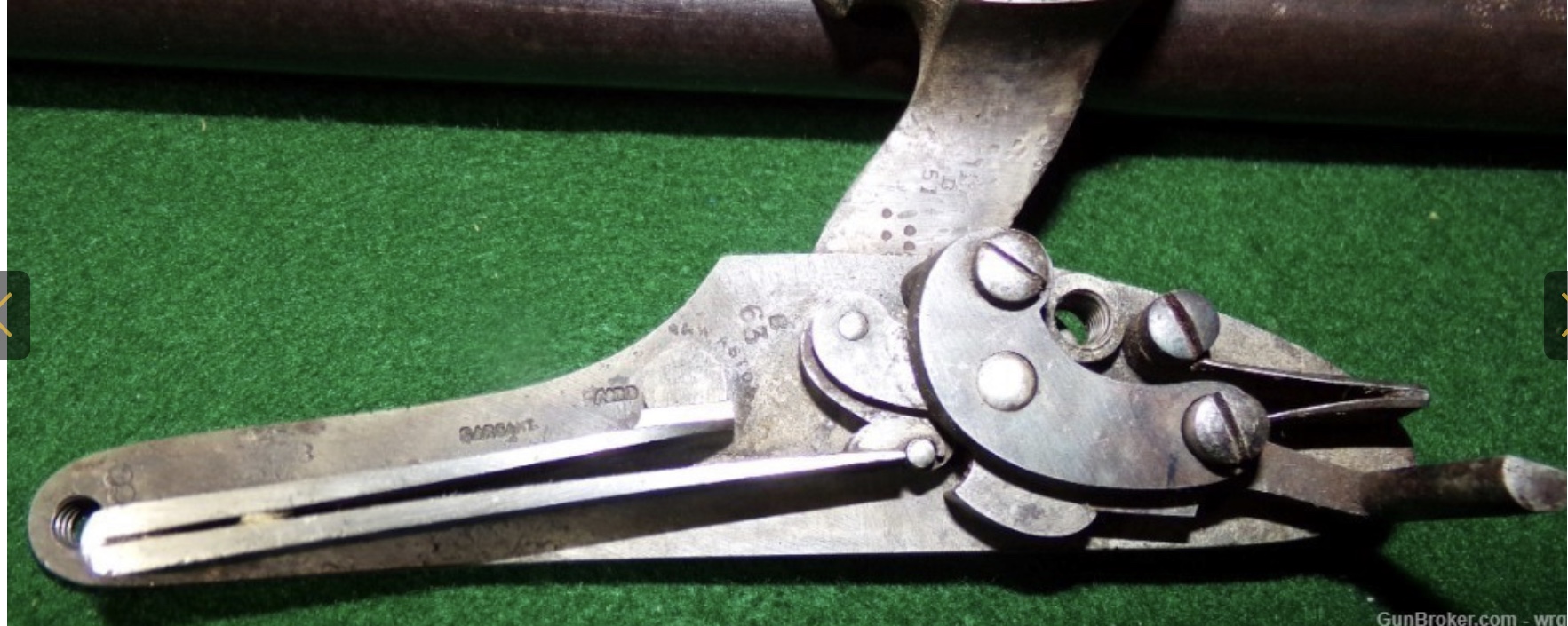
The ETC Sapper's Carbine (Figure 1) externally is identical with the Government Lancaster version, even to the backsight being mounted in reverse to its usual position, that is, with the sight cap nearest the shooter's eye, a feature typical of Lancaster- Enfield rifles. In every respect it followed the pattern and specifications of the Government Carbine except that the rifling was of the three-groove P.53 type. Both this rifle and the Cavalry Carbine were approved by the Secretary of State for War, General Peel, on
August 11th, 1856, having been previously approved by the Court of Directors of the East India Company. It was officially known as the Engineer's Rifled Carbine, Pattern 1857.
The ETC Fusil, or Sergeants' Fusil, Rifled, Pattern 1856 (Figure 2) was again a close copy of the P.56 Short Rifle, but this time with several important differences. In the first place, this weapon was designed to use the P.53 socket bayonet rather than the sword bayonet of the Short Rifle, and the muzzle of the barrel and length of stock at the muzzle are so designed. Secondly, this rifle is brass mounted rather than iron mounted as are the Short Rifles, and the butt swivel is attached to the front of the trigger-guard bow on many of this type, instead of through the rear of the guard strap as on the Short Rifle. This was presumably so that normal P.53 brass mounts could be used in its construction throughout, these being cheaper than iron mounts and the normal thing on service weapons.
The Mutiny
History is often made not on the basis of facts being correctly (or incorrectly) interpreted and acted upon, but upon appearances being accepted as facts. Into such a definition falls the story about the Enfield cartridge and its introduction to break the
FIGURE I: The Pattern 1856 Rifled Sapper's Carbine is identical to the Lancaster oval bore Carbine (Royal Sappers & Miners Carbine) in outward appearance, even to the reverse-mounted backsight typical of Lancaster rifles. But the bore is the normal .577 three-groove rifling with I turn in 78 in. The East India Company did not wish to pay for the use of Lancaster's rifling.
FIGURE 2 Pattern 1857 Rifled Sergeant's Fusil. Similar in appearance to the Pattern 1856 Short Rifle, except for its brass rather than iron furniture, and the provision for the P.53 socket bayonet instead of the P.56 sword bayonet. The rear sling swivel, missing in this
example, screws directly into the stock to the rear of the guard strap. (NOTE: Most examples of the rifled fusil have the lower swivel mounted on the trigger guard bow. WA)
caste system amongst the Indian troops or sepoys. That the "greased cartridge" was a factor in the fermenting of unrest cannot be doubted, even as it cannot be doubted that the
"fat" referred to with such horror was in actual fact neither the fat of the Hindu's sacred cow nor of the Moslem's despised pig, but rather a mixture of beeswax and mutton tallow. This fact was quite beside the point, however, even had British officers on the spot been aware of it and been able to advertise it sufficiently. The mere fact of having to bite a "greased" cartridge was all too easily interpolated into the general view of the attempts of the British to overthrow the social order and modernise the country willy- nilly.
The 'Mutiny Enfields'
Just how many P.53 Enfields were in the hands of the sepoys at the outbreak of the
mutiny is difficult to determine; certainly, any in the hands of mutineers would have been providentially, thrown down in horror and disgust. Troops whose loyalty was considered as beyond question mutinied all over the affected area of India and it quickly became clear that native troops could not be entrusted with weapons of the same degree of efficiency as those in the hands of British troops. The result was a group of weapons which, for want of a better collective term, may be called the "Mutiny Enfields". All but one of them were based completely on the P.53 and P.56 arms then coming into the hands of British troops and it was the avowed policy of the Government to make these special arms as little different in external appearance from the Government weapons as was possible to accomplish their purpose. The illustrations indicate how nearly this object was achieved.
There were, in total, nine smooth-bore weapons designed especially for the use of native Indian troops, of which all but the Constabulary Carbine closely followed their rifled Enfield counterparts. In addition to these arms, and equally as the result of the mutiny, Brunswick Rifles were brought out of store and issued to the Sikh regiments which had remained loyal, as a compromise between the completely inferior smoothbore and the highly effective .577 Enfield. When the store of original Brunswicks gave out (they had been retired from Regular service at the end of 1852 and many re-issued to militia regiments), a new pattern was introduced in 1864, which featured a P.53 lock, and these will be found with dates as late as 1874. There was no attempt, other than the lock which was clearly a matter of convenience, to modernise or improve the later Brunswick rifles. The nine Indian smooth-bore Enfields have a common calibre of .656-inch and a common form of backsight (Figure 3), which are in many cases the only distinctions between them and the rifled weapon of similar design.
In order of their dates of Government approval, the "Mutiny Enfields" include: Designation Date of Final Approval
Musket, P.58 for Native Infantry August, 1858
Constabulary Carbine, "Irish Police but
afterwards sent to India", P.58 14th October, 1858
Carbine, Mounted Police, P.58 17th December, 1858 Sapper's Carbine, for native sappers, P.58 17th December, 1858 Sergeant's Fusils P.58 17th December, 1858
Carbine, Native Foot Police, P.58 Musket, P.59 for Native Infantry Carbine, Bengal Native Cavalry Carbine 1870
17th December, 1858 7th May, 1859
22nd February, 1867
All of these smooth bored Enfields were approved after the transfer of authority in India from the East India Company to the Crown, which occurred on August 2nd, 1858. It is obvious that the "Mutiny" Enfield series was one of the very first steps
FIGURE 3: 'Mutiny Enfield" Sights. In many instances, as will be seen in the illustrations, these sights represent the only external difference between this class of arm and the rifled Enfield group. The backsight is identical to that used on late- pattern Baker flintlock rifles.
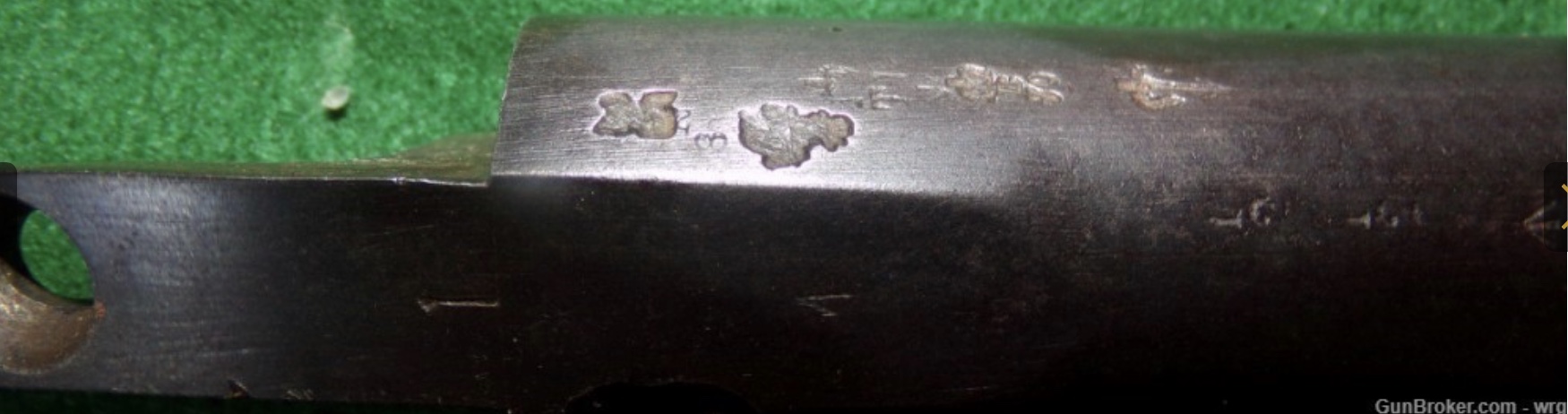
taken by the Crown in the reorganisation of military and civil administration in India. A newly created governmental department known as the East India Government assumed control of the ordering and supplying of weapons for use by Indian troops, and from this time onwards many Enfield pattern weapons—generally of somewhat inferior finish— will be found bearing the marks of the FIG rather than the Crowned VR of regular issue weapons. There were of course many weapons not so marked which went to India, and indeed many of the "Mutiny Enfields" bear regulation Enfield markings or Tower contract markings and are of the normal high standard of finish. Indian Enfields are no exception to the rather confusing rules applying to any study of the sources of supply of military weapons in the mid-Nineteenth Century.
The first of the "Mutiny" Enfields to be approved, the P.58 Musket (Figure 4) is in reality no more than a standard P.53 which has been reamed up from .577 to .656 smooth-bore and fitted with the typical Mutiny backsight (Figure 3). The need to get arms into the hands of loyal sepoys being so great, little time was lost in arriving at this expedient. But it is apparent that equally little time was required to discover that even for loyal native troops the weapon was extremely deficient, even dangerous. The reaming up of the barrel made it very thin and weak, liable both to bursting under the careless loading during
battle, and to damage from rough usage—this latter being a problem of great concern to the authorities even with the issue P.53. When it is not possible to weigh the musket to determine the difference of some six ounces in the lighter weight of the P.58, the simplest means of identification is the use of the standard P.53 foresight on this first smooth-bored Enfield as opposed to the typical "Mutiny Enfield" foresight used on the P.59 Musket (Figure 4).
The P.58 Musket is the only one of the Mutiny Enfield series to be equipped with the standard P.53 blade on block foresight. It is doubtful whether a very large number of this model was manufactured between the time of its approval in August, 1858, and its supercession in May, 1859 by the improved pattern.
The Musket for Native Infantry was re-designed early in 1859 to render it a less delicate and less dangerous arm. The result was the Pattern 1859 Musket which differs externally only in having the foresight of the typical Mutiny Enfield. In its construction, however, there are a number of changes from the P.58 Musket which render this an improved arm. The barrel was specially made for this model and is 4 lbs. I oz. in weight as compared to the 4 lbs. 4 ozs. of the regulation P.53 barrel, and 3 lbs. 6 ozs. of the P.58 Musket. Having made this increase in barrel weight with no further alteration from the regulation P.53 would have meant an additional weight of 4 lbs. 11 ozs. for the stock and furniture, and since it was desirable to keep the overall weight somewhat under that of the robust P.53, not only the stock and furniture but the bayonet of the P.59 were somewhat lightened in their construction. It is, however, only when the weapons are actually handled that this difference becomes apparent, as in appearance there is very little difference between the P.58 and P.59 Muskets (Figure 4).
In addition to the Muskets of this model manufactured in the London and Birmingham trade, some 14,000 were made at Enfield and bear standard Enfield markings with dates of 1858 and 1859 on the locks. In addition a capital letter "I" and a broad arrow appear on both lockplate and stock. These Enfield-made P.59 Muskets are of the usual excellent quality and finish found in Enfield rifles and are fully interchangeable in their parts. Patterns of 1858 create confusion for the arms student on two counts: the regulation Short Rifle of that year (or Bar-on-Band pattern) and the P.58 Musket. In both cases the arms turned out to be transitional designs superseded shortly afterwards by improved patterns, and in both cases the exact specifications for production and their implementation by the manufacturers are unknown and can only be conjectural. Again, in both instances, production must have been relatively small. By the end of March, 1859 some 29,700 Muskets had been received into store from both the Birmingham and London trades, and this figure probably represents the bulk of the P58 Muskets produced; the remaining 20,000 Muskets ordered prior to this date may have been either P.58's or the Pattern 1859. The latter remained the service arm for Native Infantry well into the 1870s.
From the several patterns of Short Rifles introduced for use by native troops, none bore the actual title of Short Rifle; they were designated as either "Carbines" or "Fusils" due to their smooth-bores. In some instances this results in confusion for modern collector as with the Lancaster "Carbine" which in appearance is a Short Rifle. With a single exception "Mounted Police" replaces "Cavalry" as a designation for the several actual carbines, and this exception does not occur until 1867, by which time it is probable that the police functions of mounted troops were again becoming subordinated to military duties.
The first of the shorter weapons to be approved for India was, like the P.58 Musket, an expedient to fill a gap. The Constabulary Carbine, "Irish Police but afterwards sent to India" P.58, (Figure 5) was approved in October, 1858 by the Irish administration rather than EIG authorities. It is the one arm which does not generally resemble its Enfield contemporaries, being a strong reminder of the Lovell series of the 1840's with its pin- fastened barrel, ramrod pipes, strangely French-looking ramrod tip with torque hole through it, and absence of any backsight. Its barrel length of 29 inches is also at variance with established Enfield lengths. The breech, lock, trigger assembly and buttplate all conform to P.53 design. Only 4,000 of this type were contracted for, in December, 1858, thus making it the "odd man out" not only in design but production, as regards Mutiny Enfields.
The remaining Mutiny Enfields were mostly approved on the same date, December 17th, 1858, and complete the series of special purpose arms for various parts of the native Indian service. The P.58 Sergeant's Fusil (Figure 6) is almost exactly like its rifled predecessor (Figure 2) except for the sights and its reduced weight. Once again requirements of the service made it advisable to simply ream-up the rifled pattern from .577 to .656 smoothbore, and once again it was found lacking in strength. This time, however, it took longer to remedy the defect, and it was not until April, 1865 that a second pattern was approved with a heavier barrel; by this time some 17,000 of the original pattern had been furnished by the Birmingham and London trades. Like the P.57 Rifled Sergeant's Fusil, it was designed to accept the issue P.53 socket bayonet, and has a 33-inch barrel.
The Sapper's Carbine, Pattern 1858 (Figure 7), once again closely resembles its rifled predecessor, the Pattern 1857 Engineer's Rifled Carbine, which in turn closely resembles its parent arm, the Lancaster oval-bore Carbine of 1856. The Mutiny Enfield version accepts the issue Lancaster brass-mounted sword bayonet, and has a 31-inch barrel which, by being reamed up .656, is somewhat lighter than the rifled version. The
difference in total weight of the two arms is only about 41 ozs. Oddly enough, considering the extra strain put on the barrel by the weight of the sword bayonet, and the trouble encountered with the regulation Short Rifles in this respect, nothing more was ever done about the P.58 Sapper's Carbine Barrel, no attempt being made to strengthen it or to improve in any way upon the original pattern. The only contracts recorded by Dr. Roads for this model were entered into in January, 1859, for a total of 3,300, on the basis of which figures it may be ranked as one of the rarer Mutiny Enfields.
Two of the Police Carbines were approved in October and December 1858, and two additional types at later dates. The Pattern 1858 Native Foot Police Carbine (Figure 8) was approved on October 14th 1858, the same day as the Constabulary Carbine received approval for Irish issue—but the situation in India resulted in the latter also being sent to India. The Native Foot Police Carbine has a 31 1/2 inch barrel and the usual Mutiny Enfield sights. It is fitted for the P.53 socket bayonet and the stock comes to within 3 l/8th inch of the muzzle. It is these two features alone which distinguish it from the Sapper's Carbine (Figure 7).
The Native Mounted Police Carbine (Figure 9) externally is a virtual twin to the P.56 Cavalry Carbine, except for the Mutiny Enfield sights. These were made from used non- interchangeable P.53 Rifle Muskets which had been rendered unserviceable by some damage to the barrel forward of the first 21 inches, or parts taken from such weapons. The barrels have of course been reamed out to .656 smoothbore.
Many of this type of Mutiny Enfield are found today with Indian markings, and it is obvious that many of them were repaired or stored in Indian state armouries; sometimes parts have been replaced or altered, and in most instances the condition in which they have survived indicates long and arduous service.
By 1866 the stock of used "Tower" Enfield P.53's must have become diminished, and conditions in India calling for another issue of smoothbore carbines, the Bengal Light Cavalry Carbine came into existence (Figure 10). These were manufactured both at Enfield and by the trade, and are in general a much superior weapon to that just described. There are two distinctive features in the construction of this Carbine, the first being the use of the rounded Baddeley rear barrel band and the second the two-piece buttplate. This latter is composed of a brass heel plate and a brass toe plate, each held with one wood screw, the heel plate having a very short rounded tang unlike the typical Enfield plate. The wood between the two pieces is deeply cross-hatched. The trade
version of this carbine continues to indicate the use of older locks, with dates from 1857 onwards appearing. Those made at Enfield are of the usual high quality and completely interchangeable.
FIGURE 7 Pattern 1858 Sapper's Carbine for East India Government. The Engineer's Mutiny Enfield, this .656 smoothbore replaced Lancaster's oval bore Carbine and the Pattern 1856 Rifled Sapper's Carbine. The Engineer's bayonet bar with forward extention, and the 311/2 in. barrel are the salient features of the P.58 Sapper's Carbine.
(NOTE: The #7 description is not correct – that is a .577 rifled arm. WA)
Both of these 21-inch barreled Carbines are fitted with a sling bar on the left side of the stock, the bar running between the lock side-nail cups which have been altered to serve as bases for the bar. They also have the standard P.56 swivel ramrod with large flat finely-knurled knob and tip threaded for tools.
Foot Police Carbine
The last in the series of Mutiny Enfields, and incidentally what is perhaps the last muzzle-loading British
service weapon to receive official approval, is the "Foot Police Carbine for Bombay with Sword Bayonet". This "Carbine" appears at first glance to be a smooth-bored Pattern 1858 Short Rifle fitted with Mutiny Enfield sights. but on closer examination there are several small differences. (Figure 10).
This Foot Police Carbine, like its predecessor of 1858 (Figure 8) has a 31 1/2 inch barrel rather than the usual 33-inch barrel of the issue Short Rifle, and it is no doubt this 1 inch difference which qualified it, as well as Lancaster's Oval Bore rifle, for the classification as a "Carbine" Unlike the P.58 Short Rifle, the stock of the Bombay Foot Police Carbine comes to within 2 1/8 inches of the muzzle while the P.58 stock comes to within 1 1/34 inches. The upper band is of identical form, however, on both rifles, and both patterns have the band pin fastened. The sword bayonet for the Bombay Carbine is identical to that of the P.58 Short Rifle.
FIGURE 10 Post-1858-9 Mutiny Enfields. Top Bengal Light Cavalry Carbine introduced in 1866-67 was produced at Enfield and by the London and Birmingham trades, It is of far superior finish to the P.58 Mounted Police Carbine which it externally resembles, and differs in having a two-piece buttplate with the wood between the heel and
toe plates being heavily cross-hatched. Bottom Perhaps the last British muzzle-loading arm to be officially approved, the Bombay Foot Police Carbine was approved in August 1870. Made up from P.53 and P.58 Short Rifle parts they do not exhibit the quality of some of the other Mutiny Enfields. Although in appearance like the P.58 Short Rifle, the muzzle projects somewhat further beyond the stock than in the earlier type.
These Carbines were made up with old parts of P.53 and P.58 weapons and their production was probably not great. The date of approval of this Carbine by the Secretary of State for India is August 8th, 1870!
The Short Rifle shown in Figure 11 illustrates what was perhaps a sign of change in the political and military climate in India by the beginning of the 1870s. it is in construction a Pattern 1861 Short Rifle—the most modern of British service muzzle-loading rifles— with all the improvements of that model, five-groove heavy weight barrel, 1250 yard backsight and Baddeley band. It bears, however, the marks of the East India Government, as represented by a Crowned EIG on the tail of the lockplate and a circular ETG and Broad Arrow stamp on the right of the butt. Lockplate markings include "B.S.A. & M. Co. 1873." The barrel is 31* inches in length, the only non-standard feature of the weapon, and it was probably for issue to Engineers in the Indian service. It is of excellent workmanship and finish throughout and bears the Government's First Class stamp in the butt. If intended for issue to Indian troops it is a sign that a degree of confidence was again felt in at least a portion of the native troops to an extent where they could be trusted with weapons of equal accuracy to those in the hands of British regulars. By this date of course some of the British troops in India would have had the Snider breech-loading rifle, but the accuracy, if not the speed of loading, of the rifle illustrated was fully equal to that of the new Snider.
FIGURE II: A Pattern 1861 Short Rifle made for the East India Government in 1873. Except for its 31inch barrel this rifle represents the most modern pattern of muzzle loading rifle in use in the British Army (the issue pattern having a 33 in barrel) That it was made for Indian service may indicate an easing of the military and political tension sufficient to allow the partial re-arming of local troops with greatly improved weapons— especially as the Snider was then being introduced into the Regular forces in India.
388 Guns Review





 Forum Host


 Bringing the