ExNavyPilot's Ancestors/Relatives

ExNavyPilot

2nd Lieutenant
Joined
Nov 9, 2010
Location
Chesapeake, VA
Here is my list (so far) of ancestors/relatives who served in the Civil War. I think I found all the possible direct ancestors but haven't completed my search for more 1st cousins and husbands of sisters of direct ancestors. I don't think I'll search beyond first cousins as my list would become too unwieldly. In later posts I'll add info on the individual soldiers and their units as available.

Direct Ancestors and Brothers of Direct Ancestors

Illinois
PVT Martin DeBord, Co. A, 37th Illinois Infantry

(paternal ggg-grandfather)
Discharged for disability after 3 months service

PVT John W. DeBord, Co. A, 37th Illinois Infantry
(paternal gg-granduncle; son of Martin DeBord)
Served Aug '61 to May '66 in Trans-Mississippi and Texas

PVT George Washington Debord, Co. I, 45th Illinois Infantry
(paternal ggg-granduncle; brother of Martin DeBord)
Died of typhoid fever after 6 months service

PVT Robert Leeds, Co. I, 126th Illinois Infantry
(paternal gg-granduncle)
Served 3 years in West and Trans-Mississippi

Massachusetts
PVT Benjamin Corliss, Co. H, 13th Massachusetts Infantry

(paternal ggg-granduncle)
Discharged for disability after 1 month, died 2 years later

Maine
PVT Enoch Hall, Co. G, 15th Maine Infantry

(paternal ggg-granduncle)
Discharged by order (reason unknown) after 2 months, just before unit left Maine

New York
PVT Jacob Minnick, Co. A, 142nd New York Infantry

(maternal gg-grandfather)
Last few months of service in Division Pioneer Corps in NC campaign

PVT Simeon Minnick, Battery D, 1st Regiment, New York Light Artillery
(maternal gg-granduncle; brother of Jacob Minnick)
Died of chronic diarrhea after 15 months of service

PVT Peter Sawyer, Battery D, 1st Regiment, New York Light Artillery
(maternal gg-granduncle; brother of Jacob Minnick's wife)
Died of typhoid fever after 11 months of service

PVT Charles Minnick, Company D, 14th New York Heavy Artillery
(maternal gg-granduncle; brother of Jacob Minnick)
Absent, sick for second half of his 13 months of service

PVT Alexander Minnick, Battery L, 1st Regiment, New York Light Artillery
(maternal gg-granduncle; brother of Jacob Minnick)
Enlisted Aug '64, received $1,000 bounty

PVT James Mosher, Co. L, 8th New York Cavalry
(paternal ggg-granduncle)
Deserted post-Fredericksburg period after 5 months of service

Wisconsin
PVT Henry Procter, Co. C, 30th Wisconsin Infantry

(paternal gg-grandfather)
Served in Sully's Northwest Indian Expedition in Dakota Territory against Sioux

PVT Lewis Massuere, 3rd Independent Battery, Wisconsin Light Artillery
(paternal gg-granduncle; brother of Henry Procter's wife)
Driver of gun carriage; his battery lost 5 of 6 guns at Chickamauga

CPL William L. Moshier, Co. E, 12th Wisconsin Infantry
(paternal gg-granduncle)
Slightly wounded at Bald Hill, Atlanta Campaign, then went on Sherman's March to the Sea

1st Cousins and beyond, In-Laws, ancestors/ relatives of spouse, etc.

Illinois
PVT William Debord, Co. G, 47th Illinois Infantry

(paternal 1st cousin 4x removed)
Enlisted Feb '65 for 1 year

Kentucky
PVT George Debord, Co. C, 7th Kentucky Infantry (USA)

(paternal 1st cousin 4x removed)
Died of smallpox after 5 months of service

New Jersey
CPL Francis L. Vanaman, Co. B, 10th New Jersey Infantry

(Wife's paternal 1st cousin 4x removed; brother of Benjamin F.)
Died of fever after 13 months of service

PVT Benjamin F. Vanaman, Co. B, 24th New Jersey Infantry
(Wife's paternal 1st cousin 4x removed; brother of Francis L.)
Died of dysentery after 1 month of service

PVT John C. Vanaman, Co. I, 40th New Jersey Infantry
(Wife's paternal gg-granduncle; cousin of Francis and Benjamin)
Enlisted Mar '65 for 1 year, deserted in Jun '65.

New York
PVT John Nelson Parkinson, Co. D, 16th New York Infantry & Co. B, 18th NY Cavalry

(maternal gg-granduncle[-in-law]; husband of sister of Jacob Minnick. Sons Truman and Winfield also served.)
Discharged for disability from 16th NY Inf after 2 months of service, then enlisted 2.5 years later in 18th NY Cav, discharged for disability after 7 months of service

PVT Adelbert Mosher, Co. K, 17th New York Infantry
(paternal 1st cousin 4x removed)
Absent in hospital last 9 months of 12 months service, then discharged for disability

PVT Willard Stowell, Co. A, 20th New York Cavalry
(maternal gg-granduncle[-in-law]; husband of sister of Jacob Minnick)
Enlisted Aug '64 for 3 years, received $1,000 bounty
 
Here is a table I put together so I could have a chronological listing of all the major actions in which my ancestors participated. This helps me when I am reading up on a battle and I want a reminder of who participated with which unit in the battle. As you'll see, most of my ancestors either were out west or participated in only some of the less "popular" battles in the east; no veterans of Gettysburg, Antietam, Chancellorsville, etc.
 

Attachments

Biography of Jacob F. Minnick (gg-grandfather)
Jacob F. Minnick was born on May 18, 1832 in Fowler, St. Lawrence County, New York to John Elias Minnick (b. 1790 in German Flats, NY) and Rhoda (Prindle/Pringle) Minnick (b. 1796 in VT). Jacob was apparently the ninth of ten children; his siblings were Elizabeth (1813), Bernard Elias (1815), William L (1816), Lorenzo Dow (1819), Alexander Prindle (1822), Lucy Ann (1825), Charles B. (1827), Rhoda (1829), and Simeon B. (1834). His father John was a member of the NY Militia during the war of 1812 and his grandfather Bernhardt, who came to the US from Germany in about 1776 at the age of 26, fought at the battles of Oriskany and German Flats, among others, while serving in the Tryon County (NY) militia and the 3rd Regmt, NY Line in the Revolutionary War. Both his father and grandfather were farmers.
Jacob remained in Fowler throughout his young adult life and became a "builder"/carpenter. Continuing the family record of service to country, Jacob enlisted on Aug 18, 1962 at Pitcairn, NY, as a Private in Company A, 142nd NY Infantry. He was 30 yrs old, 5ft 6 in tall, with dark hair, brown eyes, and a dark complexion. On Sep 29, 1862 he married Hannah Elizabeth Sawyer (b. 1835 in NY) and then, on that same day, mustered into his infantry regiment.
In Oct 1862, Private Jacob Minnick's unit was ordered to serve in the defenses of Washington DC. In Apr 1863, his unit was sent into Tidewater Virginia where it participated in the Siege of Suffolk, and in June was involved in Dix's Peninsula Campaign. After being sent north in pursuit of R. E. Lee after Gettysburg, his unit was sent south in Aug 1863 to serve in the Siege of Charleston (and attacks on Fts Wagner, Gregg and Sumter) and remained in SC until Apr 1864.
In Apr 1864, the 142nd NY Infantry was sent to Virginia to serve in Gen Butler's Army of the James in the Bermuda Hundred campaign, taking part in the battles of Swift Creek, Ft Darling, Drewry's Bluff and Bermuda Hundred. PVT Minnick then went with his regmt as part of the XVIII Corps contingent to Cold Harbor. It missed the main assaults in the Battle of Cold Harbor, as his brigade was kept back to guard the landing and supply depot at White House, but his unit apparently replaced another regiment in the line after the battle and sustained 10 casualties. The 142nd NY Infantry then participated in the Siege of Petersburg, fighting at the Battle of the Crater, Chaffin's Farm, and Fair Oaks.
In Dec 1864, PVT Minnick was sent with his unit to NC, where it played a major role in the capture of Ft Fisher near Wilmington. Being an experienced carpenter/builder, Jacob Minnick was then detailed to the Pioneer Corps of the 2nd Div, XXIV Army Corps, in which he helped build roads, bridges and defenses during the Campaign of the Carolinas. After Gen Joe Johnston, CSA, surrendered his army at Raleigh, NC in April 1865 and the war came to an end, PVT Minnick mustered out with his regiment in June and returned to Pitcairn, NY.
During the war, Jacob's brothers—Alexander, Charles and Simeon—and his wife's brother—Peter Sawyer—also served in the Union Army. Simeon and Peter, who served an artillery unit together (Battery D, 1st Regmt NY Light Artillery), both died of disease in 1862.
Sometime before 1880, Jacob moved his family to Pensaukee, Oconto, WI, where he took up farming. By this time he and Hannah had Elias John (Eli, b. 1863), Viola (1866), Lorenzo D (Daniel, 1867), Eleanor (1869), Barnard (1872), and Byron (1874). Hannah, who apparently had experienced a lingering illness, died on Aug 25, 1884, and was buried at the Brookside Cemetery in Pensaukee.
On July 29, 1890, Jacob married as his second wife Julia (Juley, age 57). Jacob continued farming and apparently earned his neighbors' respect, for in April 1903 he was elected as Pensaukee Town Justice of the Peace. Jacob's second wife, Julia, died on Dec 12, 1914. Jacob lived until age 91, dying in Abrams, WI, on Mar 22, 1924. He is buried in the family plot at Brookside Cemetery, Pensaukee, with his two wives and a couple of his children.
 
Yeah. When I found a Debord who served in Kentucky, I thought he was going to be my first Rebel...but then I noticed the USA instead of CSA. Maybe one day I'll find someone in gray....

I've had the same experience. I was tracing my Sexton line and got all excited because I found a Benjamin H. Sexton who served in a Tennessee unit and thought I'd found a Confederate closer. Well, he was in the 8th Tennessee U.S.A. Just one more Yankee. It's OK, he's still kin. :smile:
 
Biography of Henry Procter (gg-grandfather)

Henry Procter was born October 28, 1841 in Horton, Gisburn Parish, Yorkshire, England. His father owned a farm of 35 acres employing one laborer. According to family lore, Henry's father William lost the title to the farm when an unscrupulous younger brother drugged him and then said William had signed over the farm to him after a drunken card game. In any event, William decided to rebuild his fortune in America and in 1853, 12-yr-old Henry and his family ended up settling on a farm in Arcadia, Wisconsin.

On August 10, 1862, Henry Procter enlisted as a Private in Company C, 30th Wisconsin Infantry at Galesville, Wisconsin for 3 years. He was 20-yrs-old and had blue eyes, light hair, light complexion, and stood 5 ft 6 in tall. His regiment mustered on October 21, 1862 at Camp Randall, Madison, Wisconsin, and remained there until July 1863. Seven companies of the 30th WI were sent to Camp Washburn (Milwaukee) on Nov 20, 1862 to assist with Ozaukee and Washington County draft rioters. These companies returned to Camp Randall soon after, possibly escorting some rioters. In March 1863, by request of Gov. Salomon, General Pope ordered the 30th WI to remain in state to enforce the draft and to handle anticipated Indian problems. Eighteen men of Company C died of disease while in camp.

Company C, led by Capt Arnold, was sent to New Lisbon, WI, responding to Indian disturbances, arriving July 15, 1863. In mid-August, 20 men were sent to Hartford with Lt Chappell to enforce draft. Upon their return, another detachment was sent to Brown County.

On September 10, 1863, some soldiers of Company C got into a fight with a civilian in New Lisbon. This man, one Peter Bellinger, had:

"denounced the administration in unmeasured terms, accused it of unnecessarily making war upon the south, and, by his whole manner conveying the idea that he was much more in sympathy with the rebels than with the government...In the meantime quite a crowd had collected, among which were a number of soldiers of the 30th regiment, who, upon the doctor leaving, took up the conversation quite spiritedly.

Bellinger then become still more excited, and going out in to the street, loaded his piston, saying to the soldiers, "I can whip the whole of Co. C, 30th regiment; and, **** you, if you follow me I'll shoot you."​

During the resulting altercation, Mr. Bellinger shot a couple of the soldiers, and one--PVT Ebrat Olson—was killed. Some of PVT Olson's company-mates became enraged and beat Mr. Bellinger to death. Eight soldiers, including PVT Henry Procter, were arrested and charged with a variety of offenses, including murder, assault and battery, mutiny, and disobedience of lawful commands. Five soldiers were ultimately found guilty of various offenses (except murder) and sentenced to confinement and/or forfeiture of pay, etc. Henry Procter and two others were acquitted of all charges and returned to duty.

Company C returned to Camp Randall (Madison) in mid-September, 1863. In late December, the company moved to Camp Washburn (Milwaukee), and then in March, 1864 moved to Camp Reno (near Milwaukee). At this time, the 30th WI was ordered to join Sully's Northwestern Indian Expedition against the Dakota (Sioux), during which they were to establish and garrison Fort Rice in Dakota Territory. They traveled by train one week from Camp Reno, WI, to St. Louis, Missouri, arriving at Benton Barracks. On April 29, 1864, Company C boarded steamer "Isabell" and started up Missouri River. They arrived at Jefferson City, Missouri, on May 6, 1864, took on 5,000 rounds of cartridges, and then continued up river, arriving at Fort Sully, 400 miles above Sioux City, on June 6, 1864.

Company C, along with Companies A and H, arrived and encamped near the junction of Missouri and Cannonball Rivers, 400 miles above Fort Sully, on July 8, 1864. One week later, they began construction of Fort Rice.

Company C departed Fort Rice on September 11, 1864, to assist an Idaho-bound immigrant wagon train (led by James F. Fisk) that was under Indian attack. Upon the company's arrival on September 20, the Sioux warriors retreated and the company escorted the immigrant train to the Missouri River. Company C then returned to Fort Rice.

In early October, 1864, the regiment was ordered to construct flat boats for their return trip. They departed October 12, covering 50 miles per day, and arrived November 2, 1864, at Sioux City. They continued their journey down river on November 3, with Cpt Arnold reporting on November 10 cakes of ice in the river. (Company H's boat was trapped in ice several miles above St. Joseph; they had to abandon boat and march overland to join other companies.) On November 18, Company C arrived at St. Joseph, Missouri and went into camp.

The 30th Regiment was ordered to Louisville, Kentucky on November 24, 1864. There the regiment was to serve on provost duty and take responsibilities for guarding POWs at the local prison camp and hunting guerillas. They remained in Kentucky until September, 1865.

Meanwhile, Company C had traveled by train via Quincy and Springfield, Illinois and Indianapolis, Indiana, arriving in Louisville November 29, where they went into camp. During trip, the train reportedly crossed two bridges that were on fire due to guerilla activity.

In early December, 1864, Company C was ordered to take 463 prisoners to Camp Douglas near Chicago, then return to Louisville.

The 30th WI was then sent to Bowling Green, Kentucky on December 12 to guard military stores and a bridge over the Barren River. On January 10, 1865, the regiment returned to provost duty in Louisville, where they were assigned duty as guards for the military prison there. In February, 1865, detachment escorted 90 POWs to Fort Delaware.

On March 11, a squad was sent to capture the local guerilla Jerome Clark (aka "Sue Mundy"). Clark was captured March 13 and hanged by a detail led by Company C commander, Cpt Arnold, on March 17.
On June 23, 1865, PVT Henry Procter was placed "on duty at Branch Post Hospital, Louisville, KY...Detailed as cook." He remained on duty there until September.

On September 20, 1865, the regiment was mustered out of service at Louisville, KY and began its return (by train) to Wisconsin, arriving on September 25, 1865, where the men were paid off and disbanded.
Evidently during his early service in the state, Henry was able to get a furlough, for family records indicate he was married on July 16, 1863 to Susan Almira Massuere in Arcadia, WI. (Susan's brother was PVT Lewis Massuere, 3rd Independent Battery, Wisconsin Volunteer Light Artillery.) Henry returned to his wife after the war and took up farming again. His first four children (David, Jennie, Louis, and George) were born in Arcadia. Henry also worked for some time as a foreman at his father-in-law's grist mill (the Massuere Mills).

About 1874, Henry moved the family to Queen's Peak, Texas. Land was cheap in the south and he was desperate to get ahead, so they arrived with high hopes. The successful life they yearned for was not to be. Although the countryside was congenial with wonderful pecan nuts for the taking, and the land was suitable for farming, the local people there probably resented this "carpet bagging" family coming down from the north to "take advantage" of them. Although Henry had little money, the Texans there had less and they made systematic and repeated advances to the family to "borrow." The word was out that the Procters had real wheat flour: "May I borrow a cup of flour?" The word got out they had sugar: "May I borrow a cup of sugar?" The family didn't have the heart to refuse these people and, of course, nothing came back. The family was "borrowed" into near poverty. Deepening their troubles greatly, two of the children, Jennie (age 9) and George (age 4) died in 1878. Henry gave up and the family returned to Wisconsin sometime shortly after the birth of their fifth child, Ella, in May, 1880.

Back in Arcadia, Henry worked at helping out on his in-laws' family enterprises once again, and his and Susan's last child, Alice, was born eight years later. Henry also worked at bringing cattle on the trains from Texas to market places like Chicago, or on the ranch in Devil's Lake, North Dakota, that his in-laws owned. Each shipment of cattle had to be accompanied by someone responsible for them, to ensure they were fed and watered as well as tracked and signed for. It was a responsible job, but spending so much time walking the trains, on top of the cattle cars, or riding in the caboose at the end of the train, would make for a hard job, too.
After about twelve more years at Arcadia, Henry took the family to Oregon. His oldest son, David Henry Procter, may have preceded him there, living in La Grande and later serving as Union Country Assessor from 1920 until his death in 1941. Henry and the rest of his family settled in Eugene. Henry served as the postmaster in Elgin, Oregon from May 19, 1897 until sometime just before February 1911, and lived there probably until just after his daughter, Alice, was married in La Grande, near Elgin, in June, 1912.

Sometime later, Henry and Susan moved to Sawtelle, California, just outside Pasadena, where there was a home for old soldiers called, appropriately, the Soldier's Home. According to family lore, they reportedly had a home of their own there but Henry liked to have dinners at the Soldier's Home so he could visit with other veterans like himself. Home records indicate, however, that Henry was admitted to the home in June 1913. When Henry became ill towards the end of his life, he moved into the hospital at the home and died there in on October 6, 1927, just short of the age of 86 years. He is buried at Los Angeles National Cemetery, Section 33 Row E Site 15,

Henry's wife Susan moved to Enterprise, Oregon to live with her daughter, Alice. Susan died at the age of 90 in 1934.

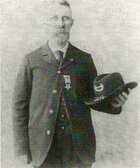
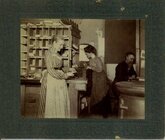
Attached thumbnails show Henry Procter in his GAR regailia and Henry, wife Susan, and daughter Alice running their Post Office in Elgin, Oregon circa 1910.
Henry Proctor, PVT, 30th WIS Infantry-sm.JPG Henry, Susan and Alice Procter in Elgine Post Office ca 1910.jpg
 
Yeah. When I found a Debord who served in Kentucky, I thought he was going to be my first Rebel...but then I noticed the USA instead of CSA. Maybe one day I'll find someone in gray....

Maybe someday you will find that relative in Gray

as for me for every 1 Confederate relative I find, I find a Union relative to counter him

  1. My CSA relatives are from Virginia and North Carolina, My Union relatives are all from Pennsylvania and Kentucky
 
Last edited by a moderator:
My new avatar shows my gg-granduncle, Lewis D. Massuere. He was a Private in the 3rd Wisconsin Battery, serving as a driver for one of the guns. Much as I appreciated having my gg-grandfather Henry Procter's picture as my previous avatar, I figured I'd put this one up to let Lewis share the spotlight and to highlight my deep interest in the history of his battery.
 
I had quite a shock when I learned my g-g-grandfather who resided in Texas (he moved down from Illinois) went back North and joined the yankee cavalry Course he'd only been in Texas since 1854 so I use that as his excuse.
 

Learn About Us
About CivilWarTalk
Contact the Webmaster
Meet the Staff
Link to CivilWarTalk
Join Our Community
Register
Browse Forums
View Today's Discussions
Search the Forum
Get Help
FAQ
Student Guide
Forum Rules & Etiquette
Copyright / DMCA

     Contact Us CivilwarTalk on Facebook CivilWarTalk on YouTube CivilWarTalk on Twitter RSS Feed

Bringing the American Civil War and More to Life.
© 1999 - , CIVILWARTALK, LLC - Site Version 10.0

SlaveryTalk.com - SecessionTalk.com - CivilWarTalk.com - ReconstructionTalk.com
Back
Top