Brandy Station

Waterloo50

Major
Joined
Jul 7, 2015
Location
England
I have just finished watching a documentary about Brandy Station, In the documentary the narrator explains, 'that the 'Federal Cavalry had caught the Confederate unaware and for the first time matched them in battle. The Southern Cavalry were not routed, it was in-fact the federals who withdrew across the Rappahannock river to regroup, the myth of the confederate cavalry was shattered.' The narrator also explained that the Southern Calvary were far superior compared to the Federal Calvary.'

I have a couple of questions about the Confederate cavalry. Why were the Confederate cavalry viewed as being superior? The second part of my question is, When the Federal cavalry caught the Confederate Calvary unaware, why did they withdraw, why didn't they take advantage and press home their surprise attack and then regroup?

Regards

Waterloo
 
I have just finished watching a documentary about Brandy Station, In the documentary the narrator explains, 'that the 'Federal Cavalry had caught the Confederate unaware and for the first time matched them in battle. The Southern Cavalry were not routed, it was in-fact the federals who withdrew across the Rappahannock river to regroup, the myth of the confederate cavalry was shattered.' The narrator also explained that the Southern Calvary were far superior compared to the Federal Calvary.'

I have a couple of questions about the Confederate cavalry. Why were the Confederate cavalry viewed as being superior? The second part of my question is, When the Federal cavalry caught the Confederate Calvary unaware, why did they withdraw, why didn't they take advantage and press home their surprise attack and then regroup?

Regards

Waterloo

Ooo, we have a few folks who can answer those questions for you, at least one of whom is all about Brandy Station and cavalry. Let's see who shows up to answer!:smile:
 
My friend Snooks was there (of course) and the following may or may not be of any interest whatsoever:

In preparation for his own raid, Stuart moved his 9,000 or so troopers plus me into the rolling fields in the vicinity of a railway halt called Brandy Station, a name that promised much and delivered nothing. It was early the next morning after the review in front of Lee that the Yankees crossed the river in two places and surprised Jeb a-bed, as were we all, from front and behind. Stuart had set his headquarters on a hill called Fleetwood and around that eminence and the surrounding fields the blue and grey surged back and forth hour after hour in a deadly tide that left so many men and horses washed up on the shores of battle.

If you've ever been in a cavalry fight you know that it's one of the worst kinds of hell to endure. There is no front line and no rear, no nice files of capable soldiers working their pieces in cool unison to beat off the attack, no relatively safe place to stand and no place to hide. Instead it is a whirl of horsemen in groups and alone, charging and counter charging, clashing and withdrawing, taking each other prisoner and escaping again, shooting and sabreing and shouting the worst kind of language man ever created.

I did a lot of the latter and despite being twice taken prisoner some idiot in grey would insist upon shooting my captor and thus forcing my escape and continued involvement. Frantically I rode from place to place seeking whatever companies or regiments I could find that appeared to be even briefly unengaged in combat and attaching myself behind them striking defiant poses.

It was just my luck that Heros von Borcke caught me at such poltroonery, although I don't think he quite understood the real truth. He rode up to us at a gallop on what was little short of a carthorse, waving that ridiculous flagpole of a sword and pointing it at a group of Yankees who in my opinion would have preferred to be left to their own devices.

"You, colonel!" he cried at me, evidently taking me for the officer in charge of my current human shield. "You will lead these men with me now or I bring charges against you of cowardice! Come now or suffer!" It's possible that in all the blood lust that flooded his eyes he didn't recognise me.

He turned and ordered the charge and I bleated something and the regiment went after him straight at the enemy. I was actually calling for the men to come back, don't waste your lives and so on. It had an effect, much to my surprise. As von Borcke charged ahead at what looked like two entire regiments in blue, his followers began to reassess the situation and decided my idea was the better, turning to come back to a less dangerous spot that I was kind enough to mark out for them. Unfortunately Heros felt unfriended and managed to halt his own charge before reaching the necessity of dying alone.

He wrenched that poor screw around and somehow, although they say fear lends wings and we were indeed flying, he managed to overhaul us and gain a fence that barred our escape route. He blocked the only available gap with his huge body not to mention the horse and once again imposed his will, threatening to shoot any man who attempted to get away or come near him. By now the Yankees were close behind us, no longer solid in their ranks but spread apart and I knew from long experience that if we stayed together as a solid force, we'd carve them up. "Charge!" I cried, "Charge!" and von Borcke joined his voice to mine and off he thundered again, once more alone and leaving the gap now open. I spurred through and didn't bother pausing to see which one of us the men had followed.

When evening began to draw on, the Federals gave way and returned to their side of the river. Stuart claimed a victory for he held the field but others were not convinced. When we got the Richmond papers a few days later, we all read that if General Stuart wanted to be "the ears and eyes of the army, then he should see more and be seen less". Von Borcke did not care for my snickering over that one.

The fact was though, that no matter how Stuart might dismiss such rumbles from home, the boys in blue had got the bulge on him, thrashed him around his own fields for thirteen hours and, while they failed to route him, had returned to their own camps full of fire and spit, congratulating themselves on being bully fighters and hadn't they shown Old Jeb a thing or two? Indeed they had and from now on the Union cavalry began to act like the real thing and to draw to its head leaders who knew what they were about.
 
My friend Snooks was there (of course) and the following may or may not be of any interest whatsoever:

In preparation for his own raid, Stuart moved his 9,000 or so troopers plus me into the rolling fields in the vicinity of a railway halt called Brandy Station, a name that promised much and delivered nothing. It was early the next morning after the review in front of Lee that the Yankees crossed the river in two places and surprised Jeb a-bed, as were we all, from front and behind. Stuart had set his headquarters on a hill called Fleetwood and around that eminence and the surrounding fields the blue and grey surged back and forth hour after hour in a deadly tide that left so many men and horses washed up on the shores of battle.

If you've ever been in a cavalry fight you know that it's one of the worst kinds of hell to endure. There is no front line and no rear, no nice files of capable soldiers working their pieces in cool unison to beat off the attack, no relatively safe place to stand and no place to hide. Instead it is a whirl of horsemen in groups and alone, charging and counter charging, clashing and withdrawing, taking each other prisoner and escaping again, shooting and sabreing and shouting the worst kind of language man ever created.

I did a lot of the latter and despite being twice taken prisoner some idiot in grey would insist upon shooting my captor and thus forcing my escape and continued involvement. Frantically I rode from place to place seeking whatever companies or regiments I could find that appeared to be even briefly unengaged in combat and attaching myself behind them striking defiant poses.

It was just my luck that Heros von Borcke caught me at such poltroonery, although I don't think he quite understood the real truth. He rode up to us at a gallop on what was little short of a carthorse, waving that ridiculous flagpole of a sword and pointing it at a group of Yankees who in my opinion would have preferred to be left to their own devices.

"You, colonel!" he cried at me, evidently taking me for the officer in charge of my current human shield. "You will lead these men with me now or I bring charges against you of cowardice! Come now or suffer!" It's possible that in all the blood lust that flooded his eyes he didn't recognise me.

He turned and ordered the charge and I bleated something and the regiment went after him straight at the enemy. I was actually calling for the men to come back, don't waste your lives and so on. It had an effect, much to my surprise. As von Borcke charged ahead at what looked like two entire regiments in blue, his followers began to reassess the situation and decided my idea was the better, turning to come back to a less dangerous spot that I was kind enough to mark out for them. Unfortunately Heros felt unfriended and managed to halt his own charge before reaching the necessity of dying alone.

He wrenched that poor screw around and somehow, although they say fear lends wings and we were indeed flying, he managed to overhaul us and gain a fence that barred our escape route. He blocked the only available gap with his huge body not to mention the horse and once again imposed his will, threatening to shoot any man who attempted to get away or come near him. By now the Yankees were close behind us, no longer solid in their ranks but spread apart and I knew from long experience that if we stayed together as a solid force, we'd carve them up. "Charge!" I cried, "Charge!" and von Borcke joined his voice to mine and off he thundered again, once more alone and leaving the gap now open. I spurred through and didn't bother pausing to see which one of us the men had followed.

When evening began to draw on, the Federals gave way and returned to their side of the river. Stuart claimed a victory for he held the field but others were not convinced. When we got the Richmond papers a few days later, we all read that if General Stuart wanted to be "the ears and eyes of the army, then he should see more and be seen less". Von Borcke did not care for my snickering over that one.

The fact was though, that no matter how Stuart might dismiss such rumbles from home, the boys in blue had got the bulge on him, thrashed him around his own fields for thirteen hours and, while they failed to route him, had returned to their own camps full of fire and spit, congratulating themselves on being bully fighters and hadn't they shown Old Jeb a thing or two? Indeed they had and from now on the Union cavalry began to act like the real thing and to draw to its head leaders who knew what they were about.

This is brilliant, I assumed that cavalry attacks would be rather messy affairs, I remember reading a description of a cavalry attack at Waterloo, it went into great detail about how an attack becomes a free for all with people slashing at each other with their sabres, I read a description of one man who lost an ear and another who held his hand up to protect his face from a sabre attack, he lost his fingers. I would imagine that cavalry men were to some extent in a worst situation than infantry during an attack. I appreciate that there were many bayonet charges during the ACW but I can't help but feel that for the cavalry it must have been extremely difficult to manoeuvre a horse with one hand and at the same time trying to fight with a sabre/sword. I did read somewhere that a skilled cavalry man could manoeuvre the horse with his knees, this apparently makes the horse turn quicker. From the above description of the battle it would appear that there was a lot of posturing during the battle, it seems that the cavalry would make a charge and then think better of it. I also had a chuckle at the fact that 'It was just my luck that Heros von Borcke caught me at such poltroonery, although I don't think he quite understood the real truth. He rode up to us at a gallop on what was little short of a carthorse, waving that ridiculous flagpole of a sword and pointing it at a group of Yankees who in my opinion would have preferred to be left to their own devices.'

I enjoyed the post MajGenl. Meade Many Thanks

 
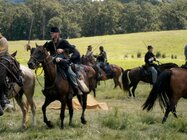
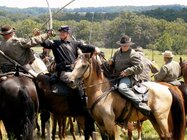
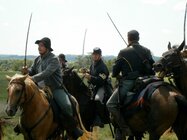
These photos have nothing to do with Brandy Station, but I thought the cavalry reenactment at Gettysburg 2015 might be interesting.
 

Attachments

  • P8081245.JPG
    P8081245.JPG
    305.8 KB · Views: 130
  • P8081248.JPG
    P8081248.JPG
    382.3 KB · Views: 160
  • P8081242.JPG
    P8081242.JPG
    206.9 KB · Views: 155
I have just finished watching a documentary about Brandy Station, In the documentary the narrator explains, 'that the 'Federal Cavalry had caught the Confederate unaware and for the first time matched them in battle.

While it is true that the Federals caught the Confederates by surprise, it is a false statement to say that it was the first time that the Federals matched them in battle. I would say that First Brandy Station, August 20, 1862, was the first time. If not then, then the March 17, 1863 Battle of Kelly's Ford for certain.

The Southern Cavalry were not routed, it was in-fact the federals who withdrew across the Rappahannock river to regroup, the myth of the confederate cavalry was shattered.'

Again, false statement. While the federals withdrew, it was not to regroup. They were fought out, and the commander of the Army of the Potomac's Cavalry Corps, Alfred Pleasonton, decided to break off and withdraw, which he did at a leisurely pace.

The narrator also explained that the Southern Calvary were far superior compared to the Federal Calvary.'

That was probably true early in the war, but certainly not by the summer of 1863, and certainly decidedly false from June 9, 1863 forward.

I have a couple of questions about the Confederate cavalry. Why were the Confederate cavalry viewed as being superior?

I've written an entire 150,000 word book on this subject. This is not a simple or fast answer. Sorry. I don't have time to summarize my 150,000 word book.

The second part of my question is, When the Federal cavalry caught the Confederate Calvary unaware, why did they withdraw, why didn't they take advantage and press home their surprise attack and then regroup?

Because, as pointed out above, they were fought out, they were far behind enemy lines, there was an entire division of Confederate infantry nearby, and Pleasonton was timid.

Eric
 
Hello Eric,

Many thanks for answering my questions, I appreciate that trying to summarise 150,000 words might be a 'tad' time consuming. I will have a look out for your book. Is it available in the UK?

Kind Regards

Waterloo
 
watereloo50 - I think you got it and thanks, but I do want to stress that Snooks stuff is entirely fictitious - although there's good facts in there. Somewhere

Snooks stuff, although fictitious, I think captures what it was like in a cavalry action, complete chaos and an attitude of everyman for himself.
Regards
Waterloo
 
Hello Eric,

Many thanks for answering my questions, I appreciate that trying to summarise 150,000 words might be a 'tad' time consuming. I will have a look out for your book. Is it available in the UK?

Kind Regards

Waterloo

Sadly, it is presently out of print. However, used copies are easy to find. The title is The Union Cavalry Comes of Age: Hartwood Church to Brandy Station 1863. A quick search of www.abebooks.com shows quite a few copies available for sale. I also hope to have it back out in print again some time next year. I've never been pleased that the publisher allowed it to go out of print.
 
Sadly, it is presently out of print. However, used copies are easy to find. The title is The Union Cavalry Comes of Age: Hartwood Church to Brandy Station 1863. A quick search of www.abebooks.com shows quite a few copies available for sale. I also hope to have it back out in print again some time next year. I've never been pleased that the publisher allowed it to go out of print.
Many Thanks Eric,

Your book doesn't appear to be available here in the UK, I have however, managed to find a copy on an auction site, it should be with me in the next few weeks. I have also ordered 'Gettysburg's Forgotten Cavalry Actions', once again many thanks for your help.

Kind Regards

Waterloo
 
My understanding in the difference in Cavalry, North to South, in the first 2 years of the war was that Southerners lived in a different culture where horses were necessary because of distances between towns and plantations and the wealthy engaging in fox hunts and horse racing was common in the South, whereas itwas not in the North to any great degree. This gave the South the upper hand in horsemanship alone. To further that advantage they had great cavalry leader including but not limited to Stuart and Forrest.

Horses, in war, are not long lived. They require enormous quantities of food and water daily. By 1863 the South was having trouble feeding their soldiers, never mind horses. The horses they had were getting long in the tooth with limited means of replacement. In the interim, the North closed the gap in horsemanship, leadership and the ability to buy and support quality horses. By the end, and I know I am going to take a beating for mentioning his name but men like Custer, and Sheridan, closed the leadership gap, IMO.

The US Cavalry were the first to get repeating carbines. Going in to 1864 they had all the advantages.

That is my take based on the authors I have read to date.
 
My understanding in the difference in Cavalry, North to South, in the first 2 years of the war was that Southerners lived in a different culture where horses were necessary because of distances between towns and plantations and the wealthy engaging in fox hunts and horse racing was common in the South, whereas itwas not in the North to any great degree. This gave the South the upper hand in horsemanship alone. To further that advantage they had great cavalry leader including but not limited to Stuart and Forrest.

Horses, in war, are not long lived. They require enormous quantities of food and water daily. By 1863 the South was having trouble feeding their soldiers, never mind horses. The horses they had were getting long in the tooth with limited means of replacement. In the interim, the North closed the gap in horsemanship, leadership and the ability to buy and support quality horses. By the end, and I know I am going to take a beating for mentioning his name but men like Custer, and Sheridan, closed the leadership gap, IMO.

The US Cavalry were the first to get repeating carbines. Going in to 1864 they had all the advantages.

That is my take based on the authors I have read to date.


According to Jack Coggins, one of the reasons for the South having an advantage in Cavalry was the fact that there was a 'considerable class of landed gentry, hard riders all, and it was from this 'horsey set' that many of the excellent Rebel cavalry officers were drawn', Coggins also mentions that 'The Northerner, even if he came from the country, was more likely to be familiar with a horse as a farm animal and beast of burden than as a mount.' another interesting point is that it took time to train Northern Cavalrymen, again according to Coggins 'To jog-trot a conglomeration of such unhappy horsemen within reach of an aggressive enemy was to invite disaster. Yet this happened time and again, and with each reverse the moral ascendancy of the Rebel horsemen became greater.

It appears that the Northerners learnt valuable lessons from their encounters with the Rebel Cavalry but it wasn't until the Northern units of cavalry were formed into corps that an improvement was seen.

Regards

Waterloo
 
The same thing happened to the Germans on the Eastern Front in WW2. They let the war go long enough to teach the other side how to fight.
 

Learn About Us
About CivilWarTalk
Contact the Webmaster
Meet the Staff
Link to CivilWarTalk
Join Our Community
Register
Browse Forums
View Today's Discussions
Search the Forum
Get Help
FAQ
Student Guide
Forum Rules & Etiquette
Copyright / DMCA

     Contact Us CivilwarTalk on Facebook CivilWarTalk on YouTube CivilWarTalk on Twitter RSS Feed

Bringing the American Civil War and More to Life.
© 1999 - , CIVILWARTALK, LLC - Site Version 10.0

SlaveryTalk.com - SecessionTalk.com - CivilWarTalk.com - ReconstructionTalk.com
Back
Top