Blue water navy

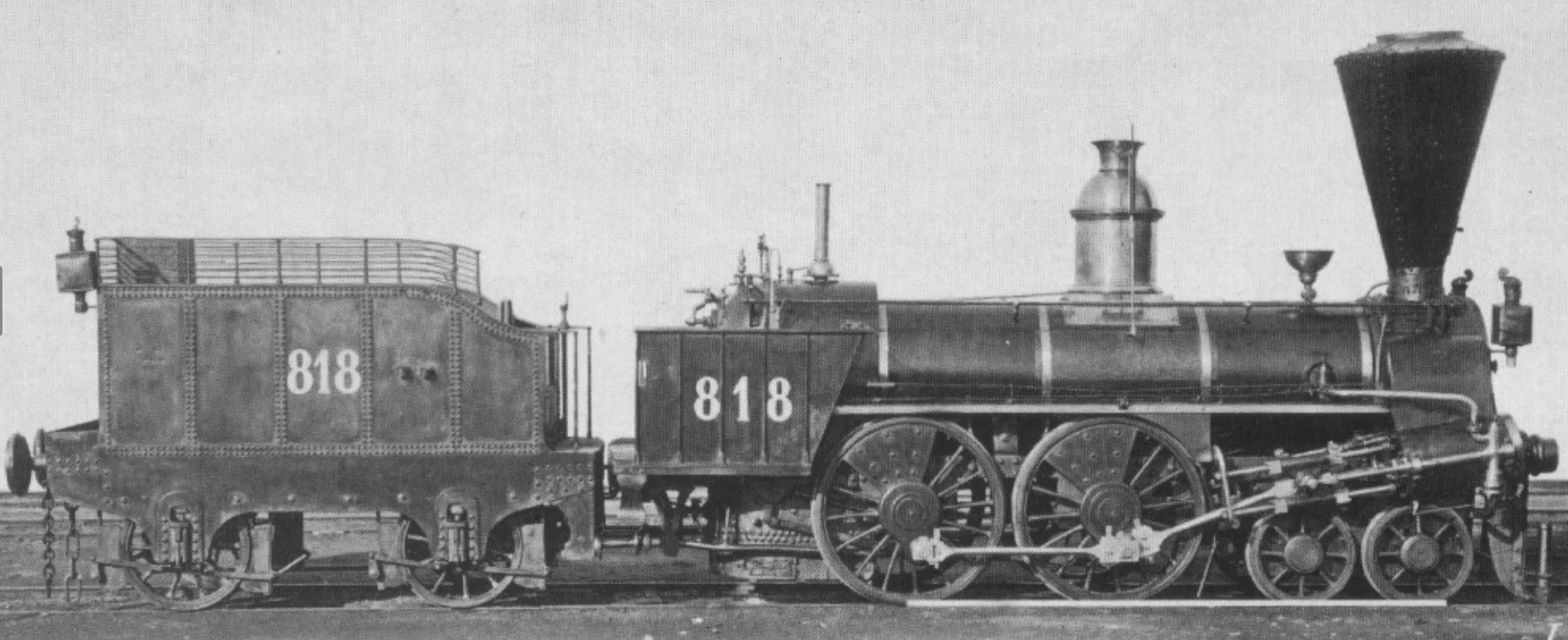
Regarding locomotives the South maybe could have purchased and found useful:

Austrian railroad companies were also always a bit short on cash, their tracks were also only moderately loadable (on the branch lines) and pretty often had to cope with rather steep slopes.
I was a bit perplexed to find some austrian locomotives that looked decidedly un-european and resembled more american locomotives.
Just have a look by yourselves:
IMG_0482.webp

About twenty of these were built by a Viennoise locomotive factory in the 1850s.
This model weighted 22.8 tons (which is rather flimsy when compared to many english locomotives) and could manage rather steep slopes in the Prealps and Alps.

I mean… also austrian rifles were exported to the US….
 
In the 1850's locomotives were shipped from the Northern factories on schooners, usually 2 to the ship. They were on the main deck, crosswise. If this was the method used for British shipments, then the stop in the islands would not have been a problem. The main problem was who would have to stand the loss if the locomotives were lost at sea or were captured?
That was always the problem with any blockade-run items. They are still finding boxes of rifles dumped overboard from runners. Most items were paid for before dispatch, apparently. No money, no dispatch. Trouble is, much of the money was in Confederate $s, hence firms going bust after 1865.
 
Regarding locomotives the South maybe could have purchased and found useful:

Austrian railroad companies were also always a bit short on cash, their tracks were also only moderately loadable (on the branch lines) and pretty often had to cope with rather steep slopes.
I was a bit perplexed to find some austrian locomotives that looked decidedly un-european and resembled more american locomotives.
Just have a look by yourselves: View attachment 579017
About twenty of these were built by a Viennoise locomotive factory in the 1850s.
This model weighted 22.8 tons (which is rather flimsy when compared to many english locomotives) and could manage rather steep slopes in the Prealps and Alps.

I mean… also austrian rifles were exported to the US….
That is a fairly standard European boiler. Dome (steam collector) on the boiler, not the firebox and the safety valve on the firebox. It COULD be a coal-burner adapted for wood - the only external evidence being the spark arrester - BUT - if it is a hill-climber, that may be needed for coal too (it's not called a 'blast pipe' for nothing.! The tender is too small for a woodburner as well and it does not have the American head light or bell either. The cylinder and driving rod is angled too high for US track as well.

Weight-wise, US locos of this time are between 20-30 short tons - no more. US track was not yet steel and lighter weight so could not stand much more and the action was usually almost horizontal to avoid track damage through 'spring jump'. The weight was kept low using bar chassis (like Bury locos) but most European ones were plate chassis. Also there is no 'cab' - they were not liked in Europe, but deemed essential in the USA
1776204012915.webp


1776204240446.webp

Early 1870s - coal-fired. (B&M 55 'Forest City')
 
J Thomas Scharf a former officer in the CSN wrote the history of the confederate states navy, it has plenty of data you might find useful.
Near Richmond, aboard the CSS Patrick Henry, they got lots of on the job training said Midshipman Morgan:

View attachment 579018
View attachment 579019

The report to the confederate congress in 1862 also lists various naval/industrial works established to meet the needs of the navy, everything from rope works to boiler works and so on.
Over 300 officers left the US navy to serve the confederacy the CS Navy secretary was the former chairman of the US senate naval affairs committee.
The US Navy in February of 1861 was small, that is when the provisional confederate congress created the CS navy and it was expedient to simply copy what they knew and go from there.
I am an amateur on here to learn from those more

IMG_4618.webp

The SS Yorktown was captured & re christened the CSS Patrick Henry in September 1861. As an "iron plated" gunboat the Patrick Henry saw active service before becoming a school ship. For more images, history & crew bios, NavSource entry.

Link:

 
Good gracious, you know that trade. Am much impressed.

I choose that model because it also weighted not more than 22.8 tons.
Yes I know my railways, but then I live and was brought up near the first public railway - the Stockton and Darlington. There is a BIG difference between US and British RRs as well, pluses - and minuses for each which is why they were so different. If you think Canadian RRs are all in Canada, think again. The Canadian Pacific is now called the Canadian Pacific Kansas City, since CPR purchased the Kansas City Southern in 2023 and now runs from Nova Scotia to British Columbia and from Edmonton to Mexico City!
1776237821161.webp
 
The only relevant difference between "a fort on a raft" (CSA) and "a cheese on a raft" (USA)
is the revolving turret of the latter (as on the "Monitor") .

The revolving turret did nothing to improve firepower or rate of fire - and was a somewhat cumbersome construction
(that needed teething for quite a while…).

But relevant was indeed that the Union could cast and rifle heavy and heavier ordinance without any problems -

whereas the Confederates were quite restricted -
they could (for quite a while) only rifle the guns they had (mostly 32-pounders) or
(with much effort) cast a few new ones over time.
Also their ammunition was of… well… let´s say moderate quality (see the thread @atlantis started about "Alabama vs. Kearsarge")

Nothing wrong with inclined armour ("fort on a raft") or
revolving turrets ("cheese on a raft") -
both were integrated on all more modern battleship.
The CSN rifled& banded 32pdr and 42pdrs were actually good weapons, even better were the banded and rifled 10"columbiads produced by Easons at Charleston, Although they were a later development at the suggestion of General Beauregard. They certainly rattled the monitors.
At the time of introduction Brooke's 7" MLR were probably the best of their type, later being double and triple banded. it took,some time for UK gun makers to catch up.

following the pattern of the 95 & 110cwt 68pdrs as high velocity shot guns, Tredegar & Selma went on to produce Brooke's 8", 10" & 11" SB as high velocity long bore shot guns, equalled only by the Somerset 100 pdr in the Royal Navy.

It is a matter of regret that these weapons never got the chance tom show what they could do.
 
The CSN Constructors did have designs for seagoing ironclads, but that would need a whole new thread.

Arguably the history of CSS blue water iron hulled rams begins & ends with the Danish Navy's Sphinx.

IMG_0413.webp


The CSS Stonewall is an example of an iron hulled Confederate Navy blue water combatant.

IMG_0414.webp


In dry dock ram made it looked a lot like a 1920's Buck Rogers space ship. The worker bottom center of the image provides a measure for scale.

The narrative of the ram Stonewall's design & construction is a testament to why such vessels could not have been laid down in any Confederate yard. The active service in the Imperial Japanese Navy validates the design & is well worth the read.

These images are from the NavSource Old Navy & Sail Index of USN & CSN [ Danish & Imperial Japanese ] commissioned vessels. Enjoy the story of the CSS Stonewall / Imperial Japanese Navy Kotetsu. Read more here about active service.

Link:

 
Commerce raiders were blue water warships conducting long range combat patrols in oceanic waters. So, I wonder if ditching the ironclad program to focus on max support for commerce raiders would have delivered better results for the confederacy.
 
Commerce raiders were blue water warships conducting long range combat patrols in oceanic waters. So, I wonder if ditching the ironclad program to focus on max support for commerce raiders would have delivered better results for the confederacy.
I do not believe so - searching for information about confederate sea-going ironclads I stumbled upon a verdict of Mallory which I deem fairly convincing
Bildschirmfoto 2026-04-15 um 17.37.16.webp

And as pure harbour-defense vessels the confederate ironclads were seemingly quite successful -
as none of the deep seawater harbours were conquered until very late in the war...
whereas the USN could take N.O. with ease (there was only one ironclad there - and one of very limited size…).

It doesn´t matter if all of that happened because of
- a real effectiveness of ironclads as harbour-defense vessels
or
- because of their psychological effect,
letting USN commanders get cold feet when thinking about attacking one of the relevant confederate harbours…..

I could imagine that without them
Farragut would have tried to do the same trick as he did in N.O. - and he very well could have succeeded there too....

So I do not believe that the South should have skipped the ironclad program.

But maybe they built far too many of them?


On the confederate railroad website of @DaveBrt I read,
that the confederate ironclads ate as much iron as 200 miles of track would have done -
and: additionally made it impossible to re-roll worn-out tracks (because all of the available rolling-mills produced armour plates) .

Maybe a more balanced approach that also considered the needs of the railroads would have been more successful?

But on the other hand: the threat of an amphibious Union attack on an important southern port is a menace nobody can ignore.

Whereas a slow decay of the railroad network is something nobody is much aware of -
until the roads become unserviceable.

(ask someone from Germany - where exactly the same happened with our railroads over the last thirty years…)
 
Last edited:
Commerce raiders were blue water warships conducting long range combat patrols in oceanic waters. So, I wonder if ditching the ironclad program to focus on max support for commerce raiders would have delivered better results for the confederacy.

No.

Great Britain paid a whopping sum to settle damage inflicted by what were British raiders in all but name only. There was a limit to the number of false flag bottoms that could evade the authorities.

As I have suggested, the link to the Danish Sphinx / CSS Stonewall / IJN Kotetsu will render your question moot.
 
Last edited:
This CWT thread has an interesting account of exactly why so many of us have made negative comments about any attempt by the CSSN to create a blue water flotilla.

The Monitor USS Montauk engaged the deep hulled Nashville. In the littoral waters where the Civil War saltwater engagements were fought, the blue water Nashville was at a fatal disadvantage vs the purpose built littoral Monitor.

Link:


NavSource Battleship Index the Passaic Class Monitor USS Montauk, read more here.

Link:

 
Commerce raiders were blue water warships conducting long range combat patrols in oceanic waters. So, I wonder if ditching the ironclad program to focus on max support for commerce raiders would have delivered better results for the confederacy.
No because during the ACW a significant amount of US registered ships were registered under the flags of European nations with large navies.
The most fundamental duty and task of any navy is to protect its nation's coastline. If a navy cant protect its own coastline its not going to win a war.
Leftyhunter
 
This CWT thread has an interesting account of exactly why so many of us have made negative comments about any attempt by the CSSN to create a blue water flotilla.

The Monitor USS Montauk engaged the deep hulled Nashville. In the littoral waters where the Civil War saltwater engagements were fought, the blue water Nashville was at a fatal disadvantage vs the purpose built littoral Monitor.

Link:


NavSource Battleship Index the Passaic Class Monitor USS Montauk, read more here.

Link:

Once again you are just cherrypicking…..
 
British motive equipment by the 1860' s was no longer powerful enough for U.S. mainline service. The terrain & the weight of the drags far exceeded English requirements.

Link:


Rubbish. British locos were just as powerful in 1860-70 but FAR too heavy for a lot of US trackage which was diabolically weak compared to British permanent way. Yes, it did improve, but far more slowly. The main problem was with loading gauges and clearance. Britain's was far more restrictive since most of the main railways were not built around large locomotives. The emphasis and design was more on speed (and good looks) than haulage anyway.
1776283118236.webp

Baldwin Loco 1870 Weight c 25 short tons Tractive effort c 9,523 lbf Top speed c 45mph (on good track)

1776283235688.webp

GNR 'Stirling Single' 1870 - Class A1 express loco. Weight 44-54 short tons Tractive effort 11,130 lbf. Top speed 80mph
 
Last edited:
Arguably the history of CSS blue water iron hulled rams begins & ends with the Danish Navy's Sphinx.

View attachment 579054

The CSS Stonewall is an example of an iron hulled Confederate Navy blue water combatant.

View attachment 579056

In dry dock ram made it looked a lot like a 1920's Buck Rogers space ship. The worker bottom center of the image provides a measure for scale.

The narrative of the ram Stonewall's design & construction is a testament to why such vessels could not have been laid down in any Confederate yard. The active service in the Imperial Japanese Navy validates the design & is well worth the read.

These images are from the NavSource Old Navy & Sail Index of USN & CSN [ Danish & Imperial Japanese ] commissioned vessels. Enjoy the story of the CSS Stonewall / Imperial Japanese Navy Kotetsu. Read more here about active service.

Link:

There were FOUR of them - none of them 'blue water navy' ships. Thet were low freeboard turret rams. The two 'Laird rams' were rebuilt and armed and taken on by the Royal Navy as HMS Scorpion and Wivern. They were never highly rated and both ended up as harbor guards one at Hong Kong and one in Bermuda. Both lasted until the early 1900s.

The two French ships ended up in the Royal Danish Navy and the Prussian Navy. Neither were liked. The Prussian ship was renamed SMS Prinz Adalbert and was also used as harbor guardship and considered 'poorly built'. She was removed from the list in 1870 and stricken in 1878.

The Danish one was named Stærkodder and was also disliked and considered for disposal before being taken on since the Prussia-Denmark war had finished and was no longer needed. She was sold on to the Confederacy as CSS Stonewall in early 1865. She was surrendered at Liverpool and handed over to the USA in Dec 1865. She was sold to Japan as Kotetsu -Japan's first ironclad. After active service, she was declared a 'third class ship' and re-named Azuma in 1870. She was stricken in 1888
 

Learn About Us
About CivilWarTalk
Contact the Webmaster
Meet the Staff
Link to CivilWarTalk
Join Our Community
Register
Browse Forums
View Today's Discussions
Search the Forum
Get Help
FAQ
Student Guide
Forum Rules & Etiquette
Copyright / DMCA

     Contact Us CivilwarTalk on Facebook CivilWarTalk on YouTube CivilWarTalk on Twitter RSS Feed

Bringing the American Civil War and More to Life.
© 1999 - , CIVILWARTALK, LLC - Site Version 10.0

SlaveryTalk.com - SecessionTalk.com - CivilWarTalk.com - ReconstructionTalk.com
Back
Top