Any Thoughts on this Sword?

bobinwmass

First Sergeant
Joined
Jul 14, 2019
Location
Western Massachusetts
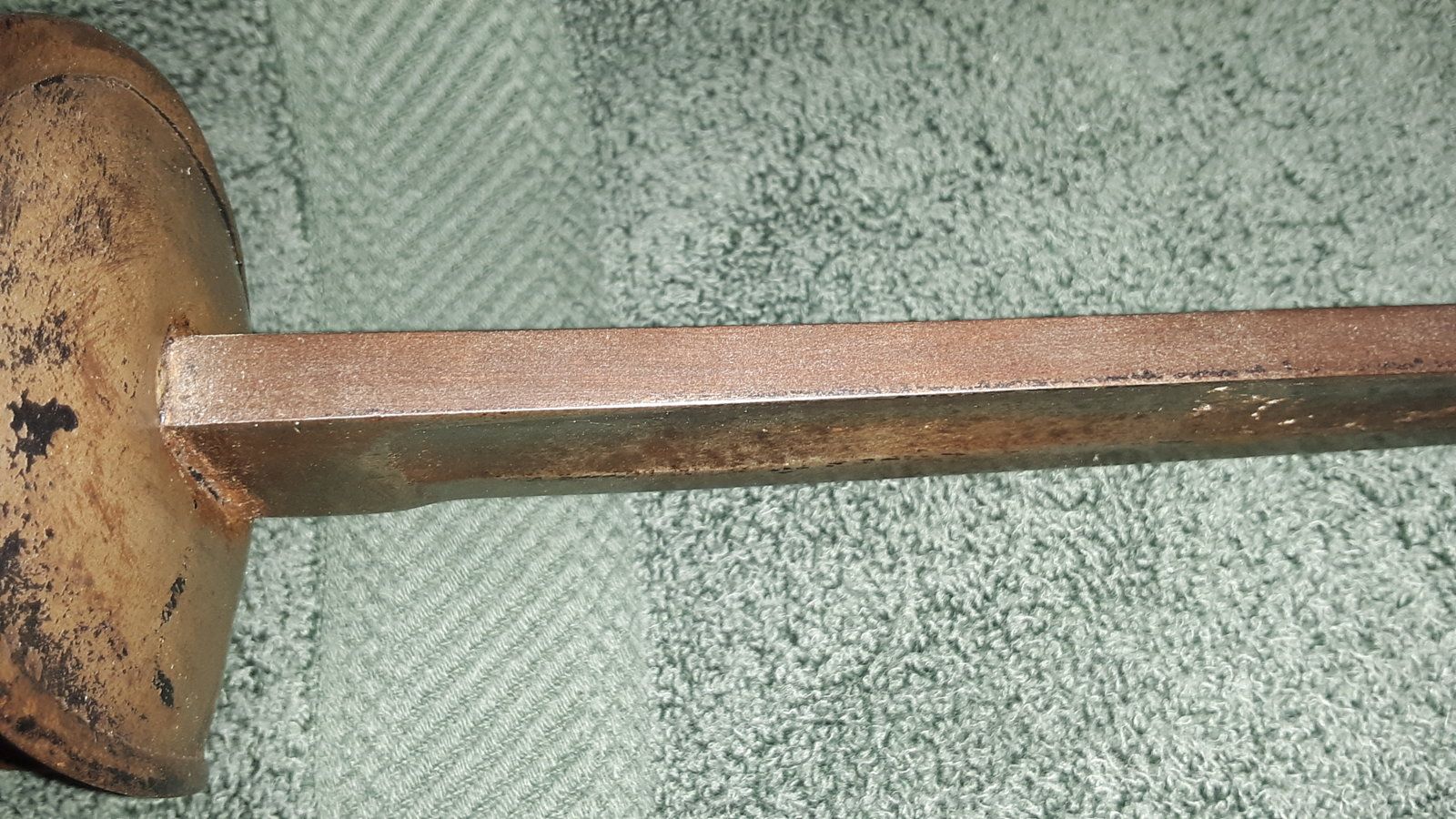
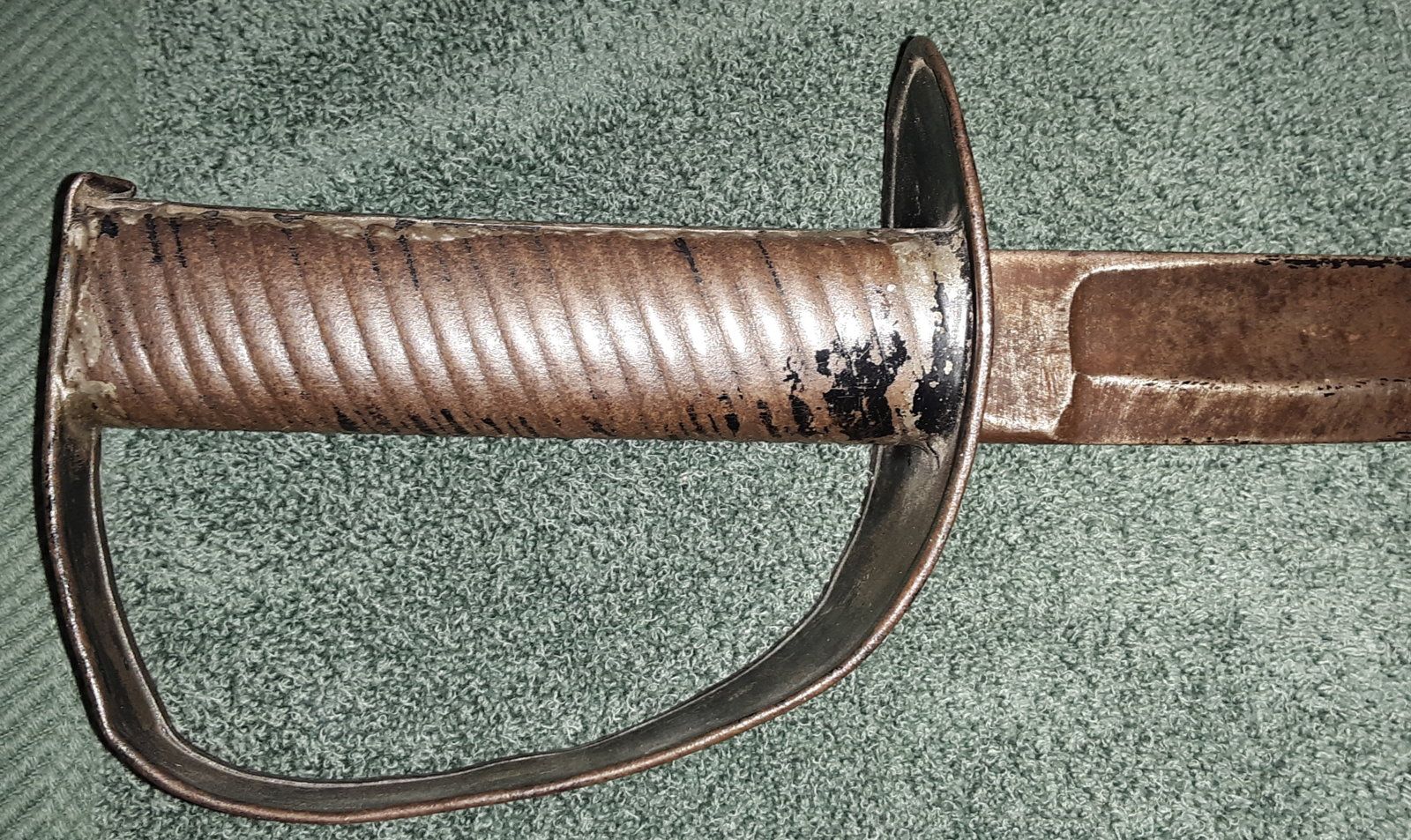
I got this saber as part of a trade over 30 years ago when I first branched out from collecting Civil War uniform buttons. At the time is was described as a "Confederate blacksmith made sword brought home by an Ohio soldier". But we have all heard those stories and attributions before. For all the years since it has hung on a wall with repro and post-Civil War items, never even making it up to the same floor that houses the real Civil War "museum". I'm looking for clues as what it is and when was it made. Obviously the first thing you notice about it is the "home-made" non-regulation hilt. The grip appears to be made of corrugated tin, and it has a tin D-guard with lapped edges. It did take someone with some talent to put this together. The blade is the same style, length, and has the flat spine of a model 1840 cavalry saber. It is tight to the hilt. Unlike most Confederate sabers that I have seen, it has a stopped fuller, but is still crudely made. The blade was sharpened at some time, and there are nicks in the blade. I guess it is possible that someone took an old original blade from a damaged sword and fashioned their own handle, and it was likely done some time after the war. Any thoughts? Does this blade with its rather crude features look familiar to anyone?

saber1.jpg


saber2.jpg


saber3.jpg


saber4.jpg


saber5.jpg


saber6.jpg


saber7.jpg


saber8.jpg


saber9.jpg


saber10.jpg


saber11.jpg


saber12.jpg


saber13.jpg


saber14.jpg
 
Interesting piece. The guard and grip are of a cutlass style and the cav sword blade does have stopped fuller. I'm leaning that the grip and guard are British.
 
Cavalry sabers were not sharpened, but the "sharp" edge of this is not just dull, but actually flat. I suspect this was made as a decoration to hang on the wall, and never a real sword.
Not sure which of the photos you may be misinterpreting but the blade was sharpened and is actually sharper than the 3 model 1860 sabers I have in my collection. While not a common practice, some individuals and units did sharpen their blades. The regimental history of the 1st Massachusetts Cavalry records that their sabers were "ground as sharp as possible" and indeed my 2 Mass. marked 1840 sabers are sharpened.
 
1589508426754.png


The above is the photo that shows the edge is just plain flat on the "supposed to be sharp" edge.

As you say, some users did sharpen their blades, but they were not designed to be used with a sharp edge, and I think (but don't know) that regulations forbade sharpening. I seem to remember that the danger was that a sharp edge could cut into, and get stuck in bone, so that the user could not withdraw it.

I am not enough of a sword collector to add a great deal of knowledge to this thread, but this does look like a decorator of some sort.

One interesting idea - the movie studios owned tens of thousands swords as props, and many were real blades from surplus swords bought for a few bucks each that were put with new made hilts so the result looks like something that fit the movie. The prop men even learned how to bend blades of Model 1860 so they curved like cutlasses and used them, with new hilts, in the pirate movies of the 1920s and 1930s.

The great MGM prop sale offered these by the barrel!
 
View attachment 358636


The above is the photo that shows the edge is just plain flat on the "supposed to be sharp" edge.

As you say, some users did sharpen their blades, but they were not designed to be used with a sharp edge, and I think (but don't know) that regulations forbade sharpening. I seem to remember that the danger was that a sharp edge could cut into, and get stuck in bone, so that the user could not withdraw it.

I am not enough of a sword collector to add a great deal of knowledge to this thread, but this does look like a decorator of some sort.

One interesting idea - the movie studios owned tens of thousands swords as props, and many were real blades from surplus swords bought for a few bucks each that were put with new made hilts so the result looks like something that fit the movie. The prop men even learned how to bend blades of Model 1860 so they curved like cutlasses and used them, with new hilts, in the pirate movies of the 1920s and 1930s.

The great MGM prop sale offered these by the barrel!
I see you are talking about the area near the hilt. The blade starts getting sharper just inches above that. Apparently not uncommon even in regulation swords, as here is picture from an 1860 Roby. The "dull" area is even wider than the sword in question. I do agree this could have been put together for whatever reason at whatever time. Most interested in ideas about where the blade came from.

20200515_051933.jpg
 
Here are a couple photos of one of my sharpened 1840's. As you can see, they started sharpening closer to the hilt. I can see why it may not be a safe idea to have sharpened the sabers- you also would not want to cut yourself, comrades, or horse. This one in particular I handle the blade carefully as I am nervous about cutting myself.

20200515_055205.jpg


20200515_055305.jpg
 
View attachment 358636


The above is the photo that shows the edge is just plain flat on the "supposed to be sharp" edge.

As you say, some users did sharpen their blades, but they were not designed to be used with a sharp edge, and I think (but don't know) that regulations forbade sharpening. I seem to remember that the danger was that a sharp edge could cut into, and get stuck in bone, so that the user could not withdraw it.

I am not enough of a sword collector to add a great deal of knowledge to this thread, but this does look like a decorator of some sort.

One interesting idea - the movie studios owned tens of thousands swords as props, and many were real blades from surplus swords bought for a few bucks each that were put with new made hilts so the result looks like something that fit the movie. The prop men even learned how to bend blades of Model 1860 so they curved like cutlasses and used them, with new hilts, in the pirate movies of the 1920s and 1930s.

The great MGM prop sale offered these by the barrel!
I always did like watching those old black and white movies, especially the Westerns and Civil War movies, trying to figure out how much of the stuff they were using was original. I did have trouble watching supposedly Civil War movies with the soldiers wearing 1872 style crossed infantry rifles on their kepis. Can't remember if "The Red Badge of Courage" was one of those offenders.
 
I don't know enough about sabers to comment on age or authenticity, but I think the blade is extremely elegant in its proportions and the sweep of its curve. I'd display it if it was mine--even if it was always a wall hanger.
 
I always did like watching those old black and white movies, especially the Westerns and Civil War movies, trying to figure out how much of the stuff they were using was original. I did have trouble watching supposedly Civil War movies with the soldiers wearing 1872 style crossed infantry rifles on their kepis. Can't remember if "The Red Badge of Courage" was one of those offenders.

I once had a saved copy of a lengthy article from a sword web site giving some details of composite movie prop swords so that a collector could perhaps see that a supposed rarity was really a movie prop. Swords from the civil war were available at low cost, and the prop department bought them by the thousands!

You'll notice real enfields and springfields in the movie "Red Badge of Courage" and you will also see men using trapdoor Springfield Model 1873s in this Civil War story.
 
I don't know enough about sabers to comment on age or authenticity, but I think the blade is extremely elegant in its proportions and the sweep of its curve. I'd display it if it was mine--even if it was always a wall hanger.
I agree. I think it is an interesting enigma and will stay displayed, even if only on it's current wall of oddball stuff.
 
Yes, I suspect this is the article I had seen years ago. I believe that I've seen photos of some. I know that I some years ago corresponded with a west coast collector who had attended that the great MGM action and had the chance to see the barrels of these swords.
I know I once owned a MGM prop Enfield that had on it not only the MGM mark, but the rare Confederate inspection mark of SHC for Sinclair Hamilton on not only the wood, but on the metal of the barrel; photos of this Enfield are in the fine recent book "The English Connection" without any explanation of that the MGM stamping meant!
 

Learn About Us
About CivilWarTalk
Contact the Webmaster
Meet the Staff
Link to CivilWarTalk
Join Our Community
Register
Browse Forums
View Today's Discussions
Search the Forum
Get Help
FAQ
Student Guide
Forum Rules & Etiquette
Copyright / DMCA

     Contact Us CivilwarTalk on Facebook CivilWarTalk on YouTube CivilWarTalk on Twitter RSS Feed

Bringing the American Civil War and More to Life.
© 1999 - , CIVILWARTALK, LLC - Site Version 10.0

SlaveryTalk.com - SecessionTalk.com - CivilWarTalk.com - ReconstructionTalk.com
Back
Top