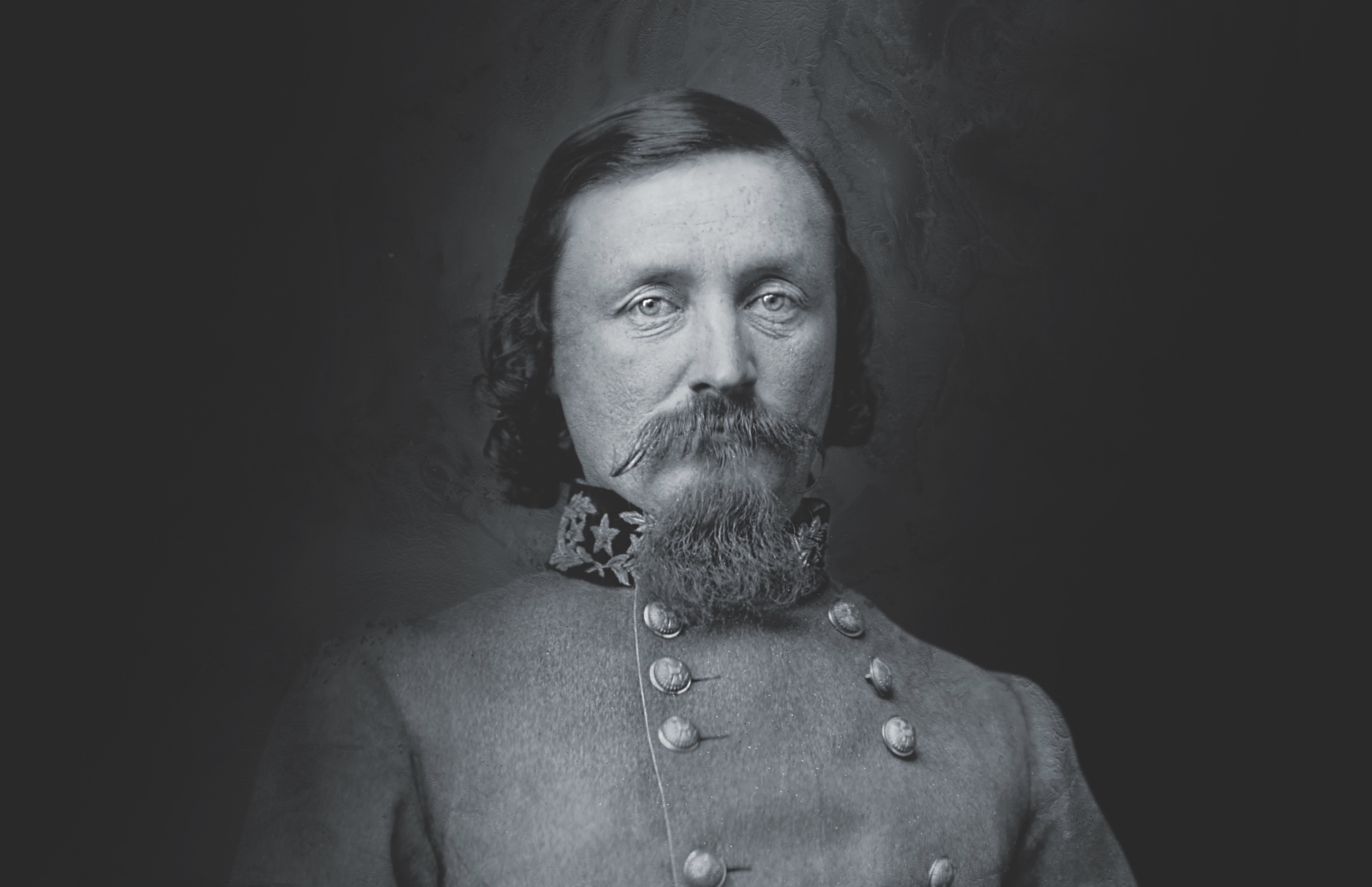
A prolonged Civil War?

I respectfully beg to differ at least slightly. Forrest (together with Walthall's rearguard) put up spirited defenses at Anthony Hill and Sugar Creek, taking advantage of the overextended pursuers under Wilson and stopping the Federals in their tracks. In my opinion this (not to speak of the later performance during the Battle of Bentonville) shows, that the Army of Tennessee had not yet fully lost its fighting spirit. Also, the disintegration of the army after Nashville seems to me to be somewhat of a myth. Hood entered the Battle of Nashville with around 18,900 effective infantry (including the command detached to Murfreesboro). On 20 January 1865, there were still more than 16,500 effective infantry in the ranks (without a doubt including many slightly wounded having returned).

The goal is not to have the Confederates succeed in winning the war, but simply to prolong it as long as reasonably possible.


Did Wilson's men have their repeaters during the Franklin-Nashville-Campaign already? Forrest seemed to be able to confront them just fine during that period.
I got that part of it. I just don't see the survivors of Franklin and Nashville putting up a spirited fight after what they'd suffered both from battle casualties and weather conditions at the army level. Walthall was able to pull together an ad hoc command, but most of the army was very much in bad shape while Thomas would've put a large number of troops against him in much better condition. Keep mind Hood lost a huge percentage of his artillery and large amounts of ordnance and other supplies. His officer corps was also devastated in some of his best divisions. Walthall surviving Franklin was a big reason his troops performed so well with Forrest.

If Hood had managed to pull together his forces, which I find highly unlikely, it would have been a repeat of Nashville. The condition of his army as a whole was just too bad. If he'd thought it possible, I have no doubt Hood would have tried to make a stand to salvage something. Just the fact that he didn't says a lot.
 
Have you heard of the December 5-7 1864 3rd Battle of Murfreesboro / Battle of the Cedars? Forrest & Bate were soundly beaten. They came close to being captured or killed themselves.

How, exactly was the Battle of Selma a Confederate victory in anyway whatsoever?

Bentonville was a case of criminal negligence on the part of the same deadwood that had lost every single battle the Army of Tennessee ever fought.

You are making these events out to be something they certainly were not.
The Murfreesboro fiasco provides a good example of the general poor state of Reb infantry that had experienced Franklin. They'd just suffered too many losses in both men and leaders.

I think he was saying the fighting spirit of the AoT was still present as shown an Bentonville. The failure to support their efforts can't be argued. Totally agree their last attack wasn't supported properly.
 
I honestly don't know how you come up with a scenario where the war continues past 1865 as anything other than a guerrilla war. The Confederacy was just absolutely out of resources to supply a proper army.
Correct And then the remaining Confederates are hunted down and executed. There might have been some show trials, but not many.
 
Correct And then the remaining Confederates are hunted down and executed. There might have been some show trials, but not many.
There would've had to be a very specific set of circumstances for it to happen. A much more intact AoT has to either destroy Schofield and defeat Thomas or defeat Schofield and return to northern Alabama/Mississippi (maybe Georgia) after a drawn fight with Thomas. Mobile has to be held by some portion of that army. Wilmington can't fall. A combination of 2 AoT corps and troops in the Carolinas damage Sherman in his Carolina campaign sufficient to stop him and make him retire to Charleston or some coastal enclave. Lee somehow stymies Grant somehow whether at Richmond or elsewhere.

In other words, they'd have to draw four royal flushes in a row blindfolded. A prolonged war would've only taken place if events had been altered much earlier than late 64.
 
The Murfreesboro fiasco provides a good example of the general poor state of Reb infantry that had experienced Franklin. They'd just suffered too many losses in both men and leaders.

I think he was saying the fighting spirit of the AoT was still present as shown an Bentonville. The failure to support their efforts can't be argued. Totally agree their last attack wasn't supported properly.

The soul shattering misery inflicted on families who lost their loved ones pointlessly so late in the war is the only spirit that matters about Bentonville.
 
I got that part of it. I just don't see the survivors of Franklin and Nashville putting up a spirited fight after what they'd suffered both from battle casualties and weather conditions at the army level. Walthall was able to pull together an ad hoc command, but most of the army was very much in bad shape while Thomas would've put a large number of troops against him in much better condition. Keep mind Hood lost a huge percentage of his artillery and large amounts of ordnance and other supplies. His officer corps was also devastated in some of his best divisions. Walthall surviving Franklin was a big reason his troops performed so well with Forrest.

If Hood had managed to pull together his forces, which I find highly unlikely, it would have been a repeat of Nashville. The condition of his army as a whole was just too bad. If he'd thought it possible, I have no doubt Hood would have tried to make a stand to salvage something. Just the fact that he didn't says a lot.

You are aware that the Inspector General who surveyed Hood's army after it crossed the Tennessee as "…nothing but a mob of unarmed men…" are you not?
 
If the war had been continued past the point at which Booth murdered President Lincoln I believe it would have become a "no quarter" war.
The nation was very fortunate that it was Lee and Grant controlling the armies. Say whatever you will about either but at the end of the day the odds of the Civil War ending as "well" as it did were slim to none.
 
You are aware that the Inspector General who surveyed Hood's army after it crossed the Tennessee as "…nothing but a mob of unarmed men…" are you not?
Exactly, couldn't remember the exact words earlier, but that's the overriding issue above lost artillery and supplies. His army's entire organization was devastated by lost officers, shattered units, and low morale. There were obviously a lot of dedicated men that stuck with it, but there were probably as many who never returned to the ranks in one way or another.
 
Exactly, couldn't remember the exact words earlier, but that's the overriding issue above lost artillery and supplies. His army's entire organization was devastated by lost officers, shattered units, and low morale. There were obviously a lot of dedicated men that stuck with it, but there were probably as many who never returned to the ranks in one way or another.

From the moment it was announced that Hood had taken command entire companies crossed through the picket lines.
 
If the war had been continued past the point at which Booth murdered President Lincoln I believe it would have become a "no quarter" war.

I agree, & I believe the CSA generals understood that, too. When you consider the murder of Sherman's foraging parties in North Carolina & how that almost devolved into a vengeful campaign of extermination… once the dogs of war were loosed with murderous intent, who knows? The death squads that Milroy sent out to eliminate lists of individuals in Middle Tennessee… The post war was bad enough.

For those who claim it would never come to that, the January 1811 slave revolt in St. John the Baptist & St. Charles Parishes will open your mind. The local militia & regular army fought a desperate battle to keep the rebels from descending onto New Orleans. Severed heads were displayed on spikes up & down the rivers. No militia & a military looking the other way in 1866 is Haiti all over again.

 
Last edited:
I agree, & I believe the CSA generals understood that, too. When you consider the murder of Sherman's foraging parties in North Carolina & how that almost devolved into a vengeful campaign of extermination… once the dogs of war were loosed with murderous intent, who knows? The death squads that Milroy sent out to eliminate lists of individuals in Middle Tennessee… The post war was bad enough.

For those who claim it would never come to that, the January 1811 slave revolt in St. John the Baptist & St. Charles Parishes. The local militia & regular army fought a desperate battle to keep the rebels from descending onto New Orleans. Severed heads were displayed on spikes up & down the rivers. No militia & a military looking the other way in 1866 is Haiti all over again.

The way the war ended was borderline miraculous, particularly given the methods of communication at the time. It's not like they pulled their cellphone out and called people up or posted it on Twitter. That Lee and Grant were able to meet on a parlor and end this thing and then Union supplies immediately started flowing to literally starving newly ex-Confederate soldiers and it was largely just OVER with the shake of hands is pretty wild. Yeah, the western theater continued briefly and there were some largely inconsequential guerrilla efforts but it's about as close to flipping a switch and turning it off as you could hope to expect in that era.
 
Any prolongation of the war after December 1864 would have created an extremely dangerous situation for the remaining Confederates. The US administration could have easily changed its policy and declared the Confederates bandits and criminals no longer entitled to the protection of the law of war.
Wouldn't have happened. Declaring them bandits and criminals would have most likely had the opposite effect to that intended, and put deserters back in the ranks.
 
None of this "hunted down and executed" business would be something the north would ever dream of doing (isolated incidents aside). I doubt Lincoln would have been assassinated if the south had carried on, but Andrew Johnson was born in NC and grew up there and in TN. Grant was a slaveholder at one point. Very few Union Army generals, not to mention the rank and file, would have turned a blind eye to freed slaves killing former slaveholders, mostly because they sympathized very little with the slaves.

If the war had carried on via conventional means, it would have carried on much as it did the preceding 4 years.
 
It would be useful for you to read up on what happened in North Carolina after Gov. Vance did exactly that.
Did exactly what? Cite your sources, give some quotes. I grew up in NC and there were no mass murders of confederates there. Where do I read up?
 
To take a short break from my current timeline, I'd like to revive a scenario I've started pondering on (and abandoned) several times in the near future and put the rough timeline up for debate here: A prolonged Civil War starting with a divergence after the Battle of Nashville. Please feel free to chime in at any point!

-Hood somehow convinces Forrest to attempt a desperate attempt of a stand at Columbia, mainly to "preserve the honor" of the Army of Tennessee (and much more important to himself personally) to safe his legacy.
-During the 2nd Battle of Columbia (21st December, 1864), Hood (leading from the front) is mortally wounded, but the Confederates manage to check Thomas' pursuit, inflicting nearly 3,500 casualties while suffering less than 1,100 losses.
-A. P. Stewart takes over command and orders a disciplined retreat not towards Alabama, but in the direction of Georgia, aiming to reach Augusta and to link up with the forces facing off against Sherman at Savannah. Much less desertions occur and no furloughs are handed out during the retreat.
-The Army of Tennessee reaches Augusta on the 17th of January, 1865 with nearly 22,700 effectives in the ranks (about equal to the historical numbers as of 18th/19th January 1865).
-Hood's death leads Lee and Breckinridge to aggressively push for Johnston to be placed in command of the defenses of the Carolinas. Davis begrudgingly agrees and appoints him in mid-January 1865.
-In the end of January, 1865, the Army of Tennessee is reorganized in Augusta. Many depleted brigades from the western states are sent to Taylor's department (Granbury, Brantley, Deas, Sharp, Gibson, Featherston, Sears, Ector, Cockrell, and Reynolds as well as Forrest's cavalry). Other depleted formations are retained to guard Augusta (Maney, Strahl, Smith, Finley, Cumming, Stovall, Quarles). The remainder of the army, 11,700 effectives in three reorganized divisions under Cheatham, Bate, and Stevenson are sent to Branchville.
-The South Carolina Campaign includes battles at Pocotaligo (16th January), Rivers Bridge (4th February), and Columbia. Sherman is slowed down and finally repelled at the gates of Columbia, suffering total casualties of 13,300 men versus 4,300 on the Confederate side for the whole campaign. The Federals retire to Savannah and Sherman embarks the Army of Georgia in order to reinforce Grant at Petersburg (as Grant originally envisioned).
-The 2nd Battle of Fort Fisher on the 15th January results in a Federal defeat due to Conner's South Carolinians having joined the garrison (and not reinforcing McLaws in South Carolina due to the better shape of the Army of Tennessee). Terry's Provisional Corps is also sent back to Petersburg. Schofield's XXIII Corps is therefore not sent to North Carolina, but also assembles at Petersburg.
-On the 25th March, Grant throws his entire army group of 156,000 men against Lee's 58,400 defenders, breaking the defenses at the cost of more than 31,000 casualties. Lee's forces, having suffered over 9,000 losses, evacuate Richmond and Petersburg and head south to join Johnston. Grant orders the pursuit.
-The Mobile Campaign features the successfull defense of Spanish Fort and Fort Blakeley by a reinforced Confederate garrison. Canby has to abort the siege eventually after the outbreak of diseases.
-Forrest and two divisions of Wilson's corps fight a prolonged battle near Tuscaloosa on the 4th April, resulting in a draw. Meanwhile, Thomas advances with the IV Corps and another division of Wilson's cavalry on Selma.
-Walthall in command of the Selma defenses fights Thomas to a standstill on the 6th April, utilizing six depleted brigades formerly belonging to the Army of Tennessee as well as local militia and cavalry under Roddey.

My goal (if this were to be somewhat realistic) would be a final showdown between Grant/Sherman and Lee/Johnston in North Carolina where Lee's army is split and a large portion is forced to surrender, while Johnston, accompanied by Jefferson Davis, leads the survivors towards the west, ultimately hoping to ferry enough men across the Mississippi River and to prolong the struggle in the Trans-Mississippi-Theater.

Does this sound too ludicrous or might this result in an interesting and at least slightly plausible read?
Given what we know about the state of the AOT after Nashville, the above sounds pretty ridiculous. Are you trying to come up with a plausible scenario for a fictional treatment? If so, I think a more plausible scenario is that Hood does not go to Nashville in the first place and somehow is able to cripple one of Sherman's wings on the March to the Sea.
 
March to the Sea does not occur if Hood remains in GA. Period. Completely impractical for Sherman to feed an Army of 60,000 while pushing back an army that is backpedaling and eating up all the forage in his path, unless he kept repairing that ever-lengthening rail line all the way to Savannah. How much foraging did Sherman do in North Georgia?

If Hood had remained at Palmetto, I think Sherman would detach enough men to allow Canby to take Mobile in the fall of 1864. Hood might counter by sending the "Army of Mississippi" aka Stewart's Corps, which could give the CSA enough force to turn Mobile into a siege. The other 2 corps stay in front of Sherman, who still can't move forward, and who is then forced by Halleck/Grant to detach additional forces for campaigns to take Wilmington.
 
Did exactly what? Cite your sources, give some quotes. I grew up in NC and there were no mass murders of confederates there. Where do I read up?

This should fill in the blanks for you.

Link;


Link;

Link:


Link;


Link:


Link:


Link:


Link:


Learn About Us
About CivilWarTalk
Contact the Webmaster
Meet the Staff
Link to CivilWarTalk
Join Our Community
Register
Browse Forums
View Today's Discussions
Search the Forum
Get Help
FAQ
Student Guide
Forum Rules & Etiquette
Copyright / DMCA

     Contact Us CivilwarTalk on Facebook CivilWarTalk on YouTube CivilWarTalk on Twitter RSS Feed

Bringing the American Civil War and More to Life.
© 1999 - , CIVILWARTALK, LLC - Site Version 10.0

SlaveryTalk.com - SecessionTalk.com - CivilWarTalk.com - ReconstructionTalk.com
Back
Top