USS Camanche question

andy19k10

Private
Joined
Apr 6, 2013
Location
Virginia Beach, Virginia
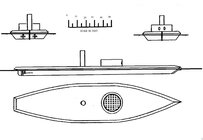
Everything I'v found about Camanche says she was shipped in pieces to San Fransico aboard the ship Aquila (which then sank at the pier). My question is, was the whole ironclad shipped on the one vessel, or were their other ships involved or was local fabrication of some components nessessary?
 
My understanding is that she was completely built, disassembled and shipped on the Aquila. Probably some minor fittings and such were sourced locally, but all of the basic systems and structures were built in New Jersey.

Even though it's an old, old joke, I still enjoy noting that she may be the only ship to sink before she was launched...
 
h55198.jpg

http://www.history.navy.mil/photos/images/h55000/h55198.jpg

http://discerninghistory.com/2013/04/photographs-of-the-uss-camanche/
 
Impressive achievment getting an entire monitor into one ship. Would have been interesting if a Confederate raider had gotten her.
If the Aquila had been taken, the raider would have had to try to get the ship into a Southern Port, which then raises an interesting question - could the CSN have completed her ?
 
If the Aquila had been taken, the raider would have had to try to get the ship into a Southern Port, which then raises an interesting question - could the CSN have completed her ?

I'd think that John M. Brooke and Catesby Jones would have a lot of fun trying. :wink:

I wouldn't rule it out. The Confederate Navy was deficient in heavy industrial support, but that was a matter of degree rather than kind. I think the CSN would have been up to the challenge. I'd be even more interested to see what improvements or changes Brooke or Jones might suggest...
 
I would imagine that if the got her into Mobile or Charlston they wouldnt have had too many problems. They most significant change I could see would be a change of armament. So would it be one 15-inch Dahlgren and one 7-inch Brooke, or two Brookes? Or just mount the two 15 inchers and leave it at that? I wonder what they would have called her?
 
Mark and Andy19K10, my first reaction to my own question was no, so your positive response surprised me.
I think they might have retained the 15" initially, in order to get the ship commissioned , after all it's easier to cast the projectiles for that rather than have to wait until new Brooke rifles, plus carriages designed to fit the turret were available.
As for the USN name, I can't offer an explanation.
What would the CSN have called her, again I don't know. If they had got into Mobile, then possibly CSS Mobile, At Charleston, Well CSS Charleston and, Chicora and Palmetto State already existed, Columbia was being built, Ashley and Cooper had bbeen assigned to the two new ironclads also under construction - doesn't leave a lot !
 
The monitor's name is occasionally spelled Comanche, but the "official" orthography appears to be Camanche.

rebelatsea, I think that the CSN, if given an essentially-complete-but-dissassembled ironclad, wouldn't look a gift horse in the mouth and would complete her. Neither side was averse to using the other's vessels when they became available. (But I still think Brooke or Jones or someone of that ilk would look her over closely and either suggest improvements or use some of her design in their own work-- probably a little of both.)

As to what she would have been named... though it was traditional to retain the name of the captured vessel, it wasn't an invariable rule, and the fact that the vessel was in pieces and hadn't been christened yet leads me to believe they wouldn't necessarily have felt bound by custom... Let's posit her capture in June 1863, shortly after the Aquila left for the West Coast but before she got too far from Confederate shores; and let's figure on her being run into Wilmington NC. (Charleston was too closely menaced by Union naval forces, Savannah was bottled up, and Mobile was a long way away; with a prize like that they'd have wanted to secure her as rapidly as possible.) She might have taken the name Wilmington that was ultimately used for the unfinished twin-casemate design; or, after the recent victory at Chancellorsville, she might have been named that (or after the recently-deceased Stonewall Jackson).

An active Confederate monitor in the Cape Fear River would have been a big problem for the Union, particularly as historically they couldn't get anything heavier than the Camanche's sister ship Montauk into the Cape Fear. Very interesting scenario.
 
There's a town in Iowa called Camanche, on the Mississippi, founded in the 1830s. Haven't been able to find any background on the name; the Comanche Indians do not appear to have been that far east. Here's another oddity, the wiki article on the Comanche includes this 1718 French map which refers to the Padoucahs, also similar to a midwestern place name.

http://en.wikipedia.org/wiki/File:Comanche_1718.jpg
 
There's a town in Iowa called Camanche, on the Mississippi, founded in the 1830s. Haven't been able to find any background on the name; the Comanche Indians do not appear to have been that far east.

Given that Welles and Fox were big on naming vessels after Indian-derived place names, that seems to be a very likely antecedent.

It doesn't necessarily have anything to do with the Comanches, perhaps. I'm reminded that the Miami River in Ohio and the city of Miami in Florida are linguistically unrelated; just a coincidence of similar words at the basis of the names.
 
Last edited:
If the Aquila had been taken, the raider would have had to try to get the ship into a Southern Port, which then raises an interesting question - could the CSN have completed her ?

How often did the Confederate raiders try to send their prizes into port, and how successful were they? That had been common practice in earlier wars, especially for privateers working for prize money, but the Confederates seem mainly to have either burned or bonded and released their prizes. Presumably if they captured something as valuable as a monitor (in kit form ;)) they would try to get it home, but running the blockade in a large sailing ship in 1863 would be a bit problematical.....
 
Yeah, that's why I think they would have tried to get her into Wilmington in that case. If they couldn't get her in to a Southern port, they would have sunk the Aquila, I'm sure.
 
Mark, getting the Aquila into Wilmington makes sense. I'm sure all the big CSN names would have been around the ship like bees round a honeypot. The engineers would have looked the engines, the artillery men the guns ( wonder what Brooke would have done to a 15" Dahlgren sb?), the constructors the hull and so on. I bet James H Warner, renowned for the simplicity of his engines, would have had something to say about that, and of course had ideas and a plan for his own turretship.
The result might just have been CSS Raleigh and the twin citadel ship being altered to a turretship plan.
.
 

Attachments

  • WARNER\'S TURRETSHIP.jpg
    WARNER\'S TURRETSHIP.jpg
    126 KB · Views: 314
I think Raleigh might have been too far along at that point to alter, but the proto-Wilmington might well have been changed up a bit.

As for Brooke and the XV-inchers... maybe he'd have sleeved and rifled them?

While going through some of the appendices to Olmstead, Stark, and Tucker's The Big Guns in response to the thread on pieces captured at Norfolk, I noted that the first six "Brooke rifles" (single-banded) were in fact cast but unbored Dahlgren IX-inch gun blocks; with tube #7, Brooke moved to new castings (with significantly different weights). While the XV-inchers fitted to Camanche were of course already bored out (and had been cast hollow anyway), Brooke definitely seemed to favor rifles over smoothbores... even a number of Brooke smoothbores were originally intended to be rifled, but had failed some portion of their quality control process.
 
Brooke did have on paper a 12.25" chambered rifle, being presented with two 15" sbs might have enabled him to build it.
I wonder how long it would have taken to produce new carriages or modify the existing ones for 2 -7" triple banded rifles, if indeed they would fit .
I think, having just looked it up you are probably right about Raleigh.
 
A Brooke rifle -armed Confederate monitor on the Cape Fear would probably mean that, even if Fort Fisher fell, the fall of Wilmington would have been considerably if not indefinitely delayed. (Same probably goes for if the Wilmington had been completed on something like was scheduled, and even more so with both.) Without Fisher, Wilmington's blockade running days would have been over, but the continued Confederate control of the city would have prevented its use in opening additional communications with Sherman moving into the Carolinas. Very interesting.


Further thought... imagining the U.S. Navy unleashing Cushing on the Confederate monitor... ("You've taken one ironclad out; time to do it again...")
 
Last edited:

Learn About Us
About CivilWarTalk
Contact the Webmaster
Meet the Staff
Link to CivilWarTalk
Join Our Community
Register
Browse Forums
View Today's Discussions
Search the Forum
Get Help
FAQ
Student Guide
Forum Rules & Etiquette
Copyright / DMCA

     Contact Us CivilwarTalk on Facebook CivilWarTalk on YouTube CivilWarTalk on Twitter RSS Feed

Bringing the American Civil War and More to Life.
© 1999 - , CIVILWARTALK, LLC - Site Version 10.0

SlaveryTalk.com - SecessionTalk.com - CivilWarTalk.com - ReconstructionTalk.com
Back
Top