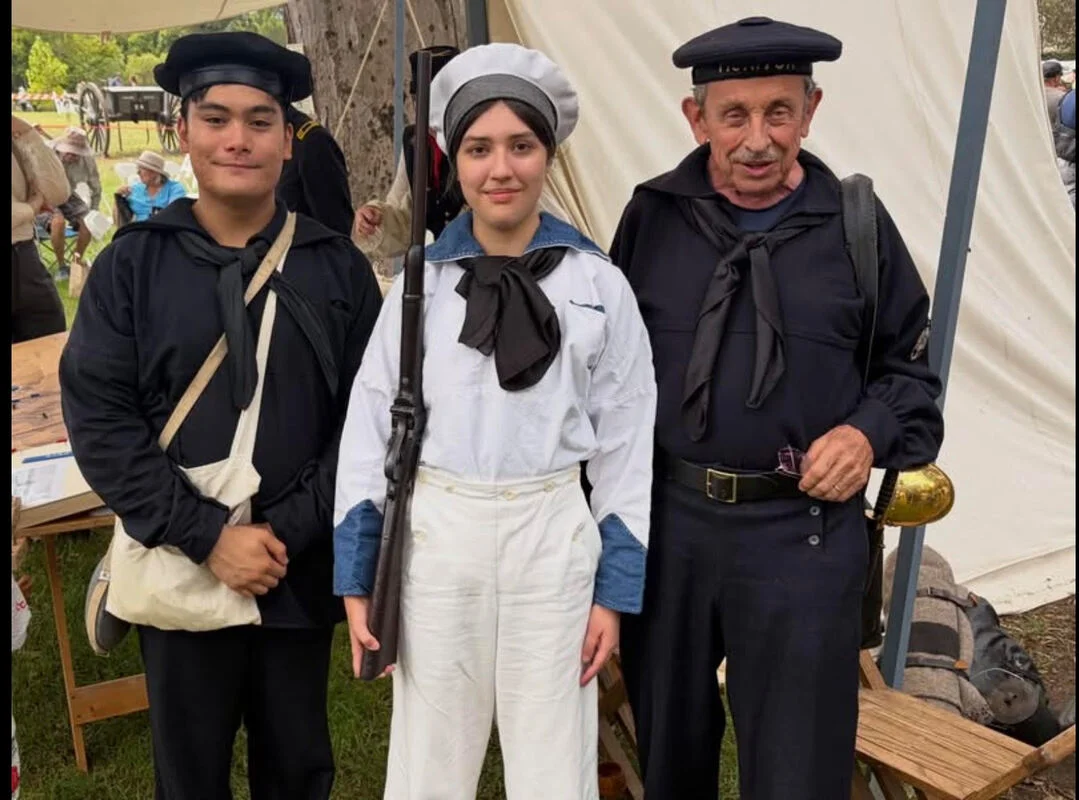
The role of the Union Navy, especially beyond a few high profile actions, is underappreciated by the general public. The blockade wasn't where the glory was at. Thus I'm always happy to see Union Navy living history.
I think it's more accurate to say the Anaconda Plan as specifically proposed by Scott was never the official war policy.
However, many elements of the plan were implemented: the blockade, the seizure of ports, the prioritization of the Mississippi River. However, Scott didn't propose to use the large overland campaigns that were also part of the Union war strategy from early on.
I don't disagree; however, I'd quibble to reemphasize that any elements of Union strategy that resembled Scott's plan were coincidental or already in motion before Scott put pen to paper. This is nitpicky I confess, but I find it interesting and imagine everyone else will, too.
The blockade was already in effect before he made his proposal, though the official Blockade Strategy Board did not convene until June 27, 1861, shortly before the Anaconda Plan was fully put to bed. Throughout July, they recommended specific locations be seized along the Confederate coast to use as bases for the blockade.
While it was hard to miss the importance of the Mississippi River, Scott's plan saw it as the primary and in fact only avenue of Union advance. When Scott was ousted for McClellan, the Western Theater overall was seen as more of a supporting axis rather than a main point of concentration. In fact, in his August 4, 1861 memorandum to President Lincoln, McClellan insisted that, "I propose, with the force which I have requested, not only to drive the enemy out of Virginia and occupy Richmond, but to occupy Charleston, Savannah, Montgomery, Pensacola, Mobile, and New Orleans; in other words, to move into the heart of the enemy's country and crush the rebellion in its very heart."
In other words, Richmond would be occupied first, and then McClellan's army would proceed to march overland, seizing key cities along the way, culminating in New Orleans.
It was only the efforts of the navy that prevented the ports and rivers from being completely ignored. Assistant Secretary of the Navy Gustavus V. Fox proposed an attack be made against New Orleans, which McClellan opposed, arguing that the force necessary for such an attack to succeed would weaken his growing army around Washington DC.
Gustavus Fox, David Dixon Porter, and Gideon Welles met with McClellan and Lincoln on November 14, 1861 to propose an attack on New Orleans, but McClellan refused to send any men to support the plan. That said, if it was a purely naval operation, he would allow it to go forward.
McClellan's reasoning can be seen in his letter to the new Secretary of War Edwin Stanton on January 25, 1862:
The great points from which important operations are to be conducted are, first, the Department of the Potomac, in front of which is posted and strongly intrenched the largest and best-armed body of the insurgents guarding the approach to Richmond; second, the Department of the Ohio, opposed to the next great body of the rebels in Kentucky; third, the Department of the Missouri, has for a prime object the control of the Mississippi River and operations against New Orleans.
....
It would be only a wise and necessary measure to hold in reserve the troops raised, but not yet assigned, to corps d'armee, ready to support and re-enforce in any quarter where they may be required, and which can only be determined by circumstances in the course of active operations. Thus they should not be withdrawn to raise General Butler's expedition to the number (not less than 30,000 men, and it is believed 50,000) which would be required to insure success against New Orleans in a blow to be struck from the Gulf.
...
The part of it now at Ship Island is well placed, and is quite adequate, with the co-operation of the Navy, to hold that important position. The remaining troops of this expedition now at Fort Monroe cannot at present be better disposed of than by adding to the command of Major-General Wool at that post.
Also see LINCOLN'S TRIDENT page 53-55
To protect his pet project, Fox did his best to keep the planning for an expedition against New Orleans under wraps, only informing Stanton on January 28, 1862 when he heard that Stanton was going to send the troops he wanted to Texas. Stanton, thankfully, was in support of the plan, and McClellan claims to have forgotten all about it when he was summoned to discuss the details.
David Glasgow Farragut was chosen to lead the naval component, arriving at Ship Island on February 20, 1862, and McClellan wrote to Butler on February 23 that he was in charge of the land forces, "destined to cooperate with the Navy in the attack on New Orleans."
Instead of the 50,000 McClellan claimed was needed to seize New Orleans, Butler was told he would have "15,255 men" but that "The commanding general of the Department of Key West is authorized to loan you temporarily two regiments. Fort Pickens can probably give you another, which will bring your force to nearly 18,000."
Simultaneously, from the other direction, Governors, Generals, and Admirals in the West did not need to be told from above that the Mississippi River was important in order to focus on it.
Governor Richard Yates of Illinois announced on January 14, 1861, before the war had even begun, that the "people of the West would never permit the Mississippi River to fall into foreign hands." Governor Alexander Randall of Wisconsin echoed this in a letter to Lincoln on May 6, 1861: "It is a matter of absolute necessity not only for the Northern Border States, but for all the North-western States . . . to control the business and commerce of the Ohio River, and the Upper Mississippi, in order to reach a vital point of this rebellion."
On June 3, 1861, Colonel William T. Sherman wrote that, "After all the Mississippi River is the hardest & most important task of the war" and the Union Defense Committee of Chicago stated that, "the true line of military operations is through the Valley of the Mississippi."
Thus, an early focus of the war in the west centered on Kentucky's neutrality and who would control the high bluffs of Columbus, Kentucky overlooking the Mississippi.
The Western theater of the Civil War, rich in agricultural resources and manpower and home to a large number of slaves, stretched 600 miles north to south and 450 miles east to west from the Appalachians to the Mississippi. If the South lost the West, there would be little hope of preserving the...
www.google.com
Page 11-13
I went through this simply to emphasize how strategic decisions that mirrored what Scott proposed were only reached via a circuitous route that did not consider Scott's ideas. In fact, the assault on New Orleans as ultimately carried out differed substantially from that which Scott envisioned, as he saw the navy and the army cooperatively working their way south from Illinois rather than north from the Gulf of Mexico. Even with McClellan's wishes somewhat ignored, the prioritization for the Union remained Virginia. It was the work of the Governors, Generals, and Admirals who were stationed out West that brought victory for the Union in that region even when most eyes were fixed firmly on Richmond.


 Bringing the