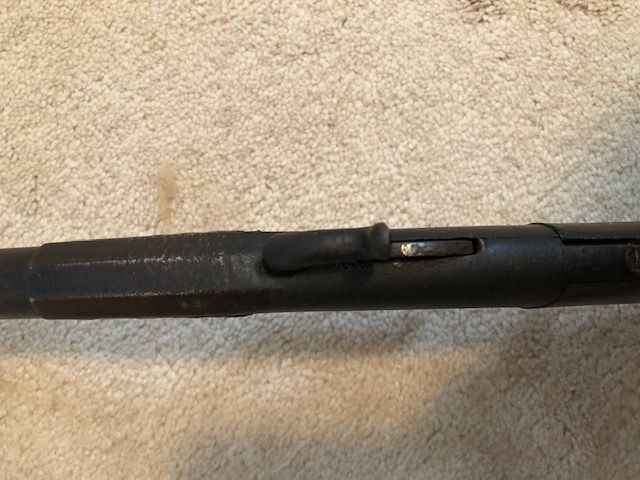
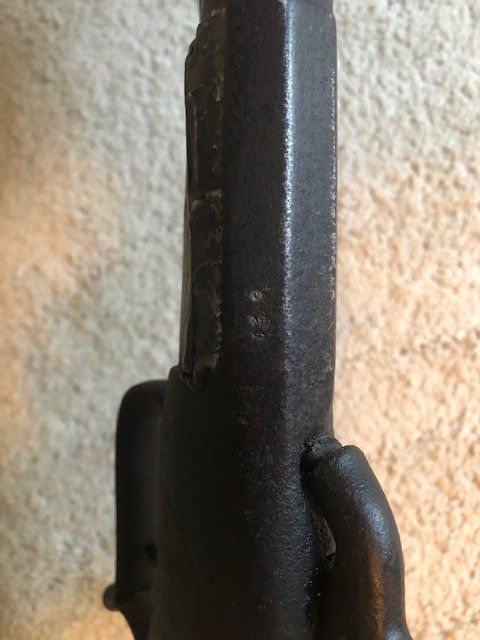
Unknown SmoothBore .54 Carbine?

Deezil33

Cadet
Joined
Jul 27, 2020
I recently acquired this percussion musket of some sort. The overall length is just under 37 inches. The barrel length is 21 inches. The bore appears to be a .54 cal. I haven't cleaned the bore yet, but it looks to be smooth. The barrel and "receiver" is one piece, not threaded together. The only markings on it are the serial numbers "521" on the barrel, inside plate, and the inside of the lock mechanism. I have some pictures below. Any ideas on what this is? Does not appear to be a one off.
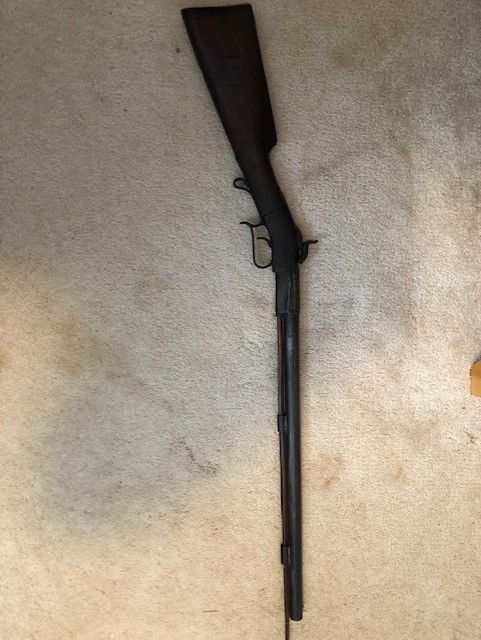
a1.jpg


a2.jpg


a3.jpg


a6.jpg


a7.jpg
 
Interesting weapon. I went thru Flayderman's book aka the bible of American gun collecting and it is not listed so I don't believe it a US gun. Lets see if we can get an answer. paging @johan_steele
 
It might be European of some kind. This might be a stretch, but it kinda makes sense. Is this possibly a whaling gun? The nosecap was soldered heavily. Could have been added later and with the ramrod guides. It looks close to an English Whaling Harpoon gun (pictured below). The dimensions are correct and would explain why the bore is large and smooth. Thoughts?
1595947868317.png
 
It is certainly a German Duchy arm. Oldenburg, I believe. It is NOT the M1848 "Cyclops" but one of their earlier models. I can't tell for certain if it's one of the military models or a civilian model of the centerline hammer. To make matters worse I can't find my reference to other arms with this style lock.
It should be noted that it may be an oval bore instead of smoothbore. But the apparent lack of a rear site makes that unlikely to me. From what I can see it's missing a good bit of it's stock and I'll wager the barrel has been cut down and it's missing the original ramrod. I'm using my phone to view the pics so I may well be in error.
The centerline lock/hammer style action wasn't real common. A couple Duchies in Germany used them but I believe only one adopted them for military use. They're a 1840-1850's arm that was replaced by the needle rifle.
 
I agree that the stock is missing and at some point tubes were soldiered in place to hold a replacement ramrod in place. However, I do no believe it was cut down. It still retains the front sight and it is nicely in place, not added after the fact. I will take a close look to see if the bore is oval or not. Whenever you find your reference, could you post a picture so I can see how the stock would of looked originally? Thanks
 
I just looked at the barrel and I don't see any signs of being an oval. Do you think that this could be a really early Allen & Wheelock?

Looking at the photo of one of these in the FLAYDERMAN'S GUILD TO ANTIQUE AMERICAN ARMS, 9th edition, page 68, the trigger guard is not the same and the buttplate on the gun in the book's photo has a deep curve to it, typical of the guns made in the 1850's.

"Single-Shot Muzzle-Loading Center Hammer Percussion Rifle by Allen & Wheelock. (a.k.a. "No 10 Inside Cock"). Made c. 1850's. Quantity unknown, very limited.
Amde in various calibers and barrel lengths. Also made as a smoothbore shotgun.
Irono mountings; lock-casehardened, the barrel browned. Wooden ramrod beneath barrel.
Walnut buttstock with crescent shaped buttplate; no forestock. Stock sual; earlier production had narrow iron forend.
Serial numbered. Barrel marking: ALLEN & WHEELOCK.
A distinctive feature is the center hung hammer slightly offset to the right to allow for sighting, and the long integral iron frame extending, full length of the wrist. Rare."
 
At first blush I'd say no to it being an Allen & Wheelock... that said I can't say why. I would say it had a forestock at one point. The question becomes was it a military or civilian arm. I'm tempted to lean toward civilian if you don't believe it was cut down.
 
If the front side was crude or attached like the other soldiered pieces, then I would agree it is is cut down but the front sight looks original. (I have some cut down muskets in my collection). If this civilian, then what purpose would a .54 cal smoothbore of this short length would have served? It would be handy for horseback, but that is all I can think of.
 
That my friends is a rather poor Picket rifle.

5.jpg


Bought one a while back that some schmuck had installed a scope to,hard tail.
Compare the "fore end" for instance. In the case of this actual rifle it indeed was a picket rifle,normally shooting sugar loafs. Point here though is that this one at least sported progressive rifling. Ie;it turned faster the closer to the muzzle you got.
Have sold it since.

Rather accurate piece of kit,and as you can see in this case with a set trigger,which wasn´t unusual.

The design is very typical New England and there´s thus nothing Euro about it,at all.

These picket rifles were often used as sharp shooters rifles at the beginning of the war,as far as the story goes. Aka "Wesson rifles",and they could vary quite a bit as far as looks,but not the design per se.

This actual boom stick then of 41 cal. Normally these were around that but it´s not unheard of in larger calibers too.
 
16.jpg


18.jpg


Gives you an idea of the rifling at least.

All said and done i let the scope be (just replaced it) and it turned out this was a rather accurate little rifle digesting PP boolits like it was going out of style.
 
Neat rifle. Unfortunate that a scope like that was attached. I can see the similarities. It makes sense. It could be a "poor" version. So poor that they didn't even rifle the bore of it?
 
No.
I´d beg to differ. On the contrary,the "caliber of choice" at the time was no doubt 58 cal and as long as there´s "meat" enough in the barrel many many rifles were so bored out.
Some rifled some not.

Just compare (google and read up) vs the Austrian Lorenz rifles. These were originally in 54 caliber and LOADS of them were rerifled to 58cal in Belgium (Liege) before leaving for the US.
Some on the other hand were not.. Which IMO led to the notion in the US that the Lorenz was an inherently inaccurate rifle. This is simply not true..

But..leave it at that calibers were changed hi n low to cater to the "standard" 58 caliber musket. Either that or the various 54 caliber rifles and carbines..down to the Smith 515 carbine and in turn the 44 Henry and what not.
Gunsmiths were sure kept busy.

If you want me to i´ll be happy to post more pics of what is most LIKELY a George Foster made rifle (my pics above). No matter,these "picket rifles" were all the rage beginning of the war,and indeed..many of them way more accurate than the average later musket. Thus they were often in the hands of pickets or skirmishers.
 

Learn About Us
About CivilWarTalk
Contact the Webmaster
Meet the Staff
Link to CivilWarTalk
Join Our Community
Register
Browse Forums
View Today's Discussions
Search the Forum
Get Help
FAQ
Student Guide
Forum Rules & Etiquette
Copyright / DMCA

     Contact Us CivilwarTalk on Facebook CivilWarTalk on YouTube CivilWarTalk on Twitter RSS Feed

Bringing the American Civil War and More to Life.
© 1999 - , CIVILWARTALK, LLC - Site Version 10.0

SlaveryTalk.com - SecessionTalk.com - CivilWarTalk.com - ReconstructionTalk.com
Back
Top