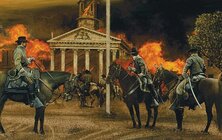
The Black Flag

It appears that General Eleazer A. Paine was an antebellum acquaintance of Lincoln from back in Illinois and that Paine held a command right in the heart of Champ Ferguson and Confederate guerilla territory. From what I've read, Paine was a brutal s.o.b. and despised by the locals but Sherman? had him relieved of command and court-martialed where he was acquitted of all charges except the charge of disrespecting a superior officer. Lincoln's only involvement from what I've been able to find out, was that he received the results of Paine's court martial and wrote a general order reprimanding the general for his conviction on the single charge and Secretary of War, Stanton refused to implement the order. From what I've been able to find through a Google search, there is no evidence of any wrongdoing on Lincoln's part especially one taking it to the level of a violation of the "laws of war."
CMWinkler created a post on him today.

https://civilwartalk.com/threads/eleazer-paine–the-man-the-myth-the-hair.77870/

Seems your not the only one who thinks he was a brutal SOB. A shame he never got the comeuppance he so rightly deserved. :furious::frown:
 
The February 1864, Battle of Olustee in Florida comes pretty close to black-flag affair, at least in regards to the Georgia state troops in their treatment of the USCT's:

HEADQUARTERS DISTRICT OF FLORIDA,
Jacksonville, Fla., September 25, 1864.

Major General E. A. HITCHCOCK,
Commissioner for Exchange of Prisoners:
GENERAL: Soon after the battle of Olustee, in Florida, a list of wounded and prisoners in the hands of the enemy was forwarded to our lines by the commander of the rebel army. The very small number of colored prisoners attracted immediate attention, as it was well known that the number left wounded on the field was large.

It is now known that the most of the wounded colored men were murdered on the field. These outrages were perpetrated, so far as I can ascertain, by the Georgia regulars and the Georgia volunteers in Colquitt's brigade.

As many of these troops are now in our hands as prisoners, an investigation of circumstances might easily be made. All accounts represent the Florida troops as not engaged in the murders.
Very respectfully, your obedient servant,
JNO P. HATCH,
Brigadier-General, Commanding.
O.R. Series 2, Volume VII, part I, pg. 876


"In passing over the field, and the road ran centering through it, my attention was first attracted to the bodies of the yankees, invariably stripped, shoes first and clothing next. Their white bodies looked ghastly enough, but I particularly notice that firing seemed to be going on in every direction, until the reports sounded almost frequent enough to resemble the work of skirmishers.

A young officer was standing in the road in front of me and I asked him, 'What is the meaning of all this firing I hear going on.' His reply to me was, 'Shooting nlggers Sir. I have tried to make the boys desist but I can't control them.' I made some answer in effect that it seemed horrible to kill the wounded devils, and he again answered, 'That's so Sir, but one young fellow over yonder told me the nlggers killed his brother after being wounded, at Fort Billow, and he was twenty three years old, that he had already killed nineteen and needed only four more to make the matter even, so I told him to go ahead and finish the job'. I rode on but the firing continued.

The next morning I had occasion to go over the battle field again quite early, before the burial squads began their work, when the results of the shooting of the previous night became quite apparent. Negroes, and plenty of them, whom I had seen lying all over the field wounded, and as far as I could see, many of them moving around from palace to place, now without a motion, all were dead. If a negro had a shot in the shin another was sure to be in the head."
William Frederick Penniman , 4th Georgia Cavalry
 
The February 1864, Battle of Olustee in Florida comes pretty close to black-flag affair, at least in regards to the Georgia state troops in their treatment of the USCT's:

HEADQUARTERS DISTRICT OF FLORIDA,
Jacksonville, Fla., September 25, 1864.

Major General E. A. HITCHCOCK,
Commissioner for Exchange of Prisoners:
GENERAL: Soon after the battle of Olustee, in Florida, a list of wounded and prisoners in the hands of the enemy was forwarded to our lines by the commander of the rebel army. The very small number of colored prisoners attracted immediate attention, as it was well known that the number left wounded on the field was large.

It is now known that the most of the wounded colored men were murdered on the field. These outrages were perpetrated, so far as I can ascertain, by the Georgia regulars and the Georgia volunteers in Colquitt's brigade.

As many of these troops are now in our hands as prisoners, an investigation of circumstances might easily be made. All accounts represent the Florida troops as not engaged in the murders.
Very respectfully, your obedient servant,
JNO P. HATCH,
Brigadier-General, Commanding.
O.R. Series 2, Volume VII, part I, pg. 876


"In passing over the field, and the road ran centering through it, my attention was first attracted to the bodies of the yankees, invariably stripped, shoes first and clothing next. Their white bodies looked ghastly enough, but I particularly notice that firing seemed to be going on in every direction, until the reports sounded almost frequent enough to resemble the work of skirmishers.

A young officer was standing in the road in front of me and I asked him, 'What is the meaning of all this firing I hear going on.' His reply to me was, 'Shooting nlggers Sir. I have tried to make the boys desist but I can't control them.' I made some answer in effect that it seemed horrible to kill the wounded devils, and he again answered, 'That's so Sir, but one young fellow over yonder told me the nlggers killed his brother after being wounded, at Fort Billow, and he was twenty three years old, that he had already killed nineteen and needed only four more to make the matter even, so I told him to go ahead and finish the job'. I rode on but the firing continued.

The next morning I had occasion to go over the battle field again quite early, before the burial squads began their work, when the results of the shooting of the previous night became quite apparent. Negroes, and plenty of them, whom I had seen lying all over the field wounded, and as far as I could see, many of them moving around from palace to place, now without a motion, all were dead. If a negro had a shot in the shin another was sure to be in the head."
William Frederick Penniman , 4th Georgia Cavalry
That's a hard story to hear, and a shameful one, too. It is much more poignant when expressed in the soldier's own words and allows us to see into the mind of these men and their motivations - the '******s' killed his brother and he only needed to kill four more to make the matter even...motivation: revenge, calculation: 24 negros = 1 white male in value. We can often see where our ancestors went wrong, but their humanity is reflected in all of us...who hasn't at some time wanted revenge? Are there people (any kind) we value less than ourselves? I'd have to answer yes to both these questions, and remind myself that I am no better than them, but will strive to do better... because in them I see a reflection of myself.
 
Came across this today and thought I would add it to the thread:

" That afternoon, Union brigadier general and Danville native Speed F. Fry sent Federal forces in Lebanon an order to'send one detachment through Perryville and one directly to Perryville. Order your men not to take any prisoners if they find them. Tell your men to be very careful, as guerrillas are arrayed in Federal uniform.' Tired of statewide bushwhacker attacks, angered that the guerrillas were so bold as to wear Federal uniforms and sickened by the plundering of his hometown, Fry ordered Union troops to hoist the black flag. As Quantrill's men had offered no mercy, Fry called for no quarter".

"The prospect of catching the routed guerrillas was indeed good; on February 10, a Union captain in Danville reported that troops 'just brought in three of Clarke's men, captured in the woods after Bridgewater's fight.' The following day Federal scouts reported that they had 'captured another of Clarke's men but in bringing him in this morning he attempted to escape, and was shot dead on the spot.' This unnamed guerrilla was probably executed by the Federal scouts. Many remembered General Fry's order to allow no quarter".

"Giving no quarter, Quantrill expected none. From his first murder in Kansas to his last in the Bluegrass State, Quantrill cut a violent swath wherever he went. The sensitive young schoolteacher became one of the most dangerous and despicable figures of the Civil War"

http://www.historynet.com/americas-...m-clarke-quantrills-last-raid-in-kentucky.htm.

Interesting aside from the end of this article: "Upon reaching Louisville, Quantrill was placed in the military prison hospital, where he was nursed by a Catholic priest. He made a full confession, converted to Catholicism and took the sacrament of extreme unction. On June 6, following an operation, William Clarke Quantrill died at the age of 27". Perhaps he was given 'quarter' in the next life...
 
Last edited:
The Battle of Wilson's Wharf or Fort Pocahontas was fought on March 24, 1864. The Federal outpost was situated on the left bank of the James River not farm from President John Tyler's Sherwood Forest Plantation. The fort was defended by 1100 USCT troops under command of BG Edward Wild. 2550 Confederate cavalry commanded by MG Fizhugh Lee attacked the outpost. A link to the site with some quotes from the article follow.
http://www.fortpocahontas.org/battle/

Lee sent a surrender demand under a flag of truce. The terms Lee outlined were should the fort be relinquished, the black captives would be delivered to Richmond as prisoners of war. If they refused, he would take no responsibility for them when he took the fort. The threat was an obvious reference to the massacre at Fort Pillow six weeks earlier, when captured USCT were executed. Angered by Lee's arrogance, Wild replied "Present my compliments to General Fitz Lee and tell him to go to hell."

Private Charles T. Price, 2nd Virginia Cavalry, wrote "the Yankees ran on a high pole a black flag (meaning no quarter). We had orders to kill every man in the fort if we had taken them."
 
On giving "no quarter"---

General Orders #100

Art. 60:

...a commander is permitted to direct his troops to give no quarter, in great straits, when his own salvation makes it impossible to cumber himself with prisoners.


So it is a part of the "Hard War" of the Lieber Code?


Respectfully,
William
Burning Of Chambersburg, Pa.jpg
 
What you're speaking of is the "No quarter!" command, I assume. General Hood gave that command after losing Atlanta, and driving the Army of Tennessee north to Dalton, Georgia, where he came upon a US Colored regiment holding the city. He took the regiment, led by white Federals, and gave the command "No quarter". Hood's men refused to obey. The field officers went back to Hood, and his ordered changed. The Colored regiment was set to work on building fortifications, and the white officers were paroled. This information comes from corroborating more than one diary of soldiers of the 27th, 35th, and 49th Alabama Regiments who were there.
Interesting. Although I am aware of atrocities (Fort Pillow comes to mind), most of the incidents I've come across were individual in nature, not commanded or authorized by a senior officer. After all, captured blacks were generally considered property and returned to their previous owners (if they could be found), loaned to local planters or placed on work details.
As to "No quarter", that was frequently used as a threat, but seldom- if ever- followed through.
You mention corroborating evidence for Hood ordering "No quarter". Can you provide specifically where I can find those allegations?
 
I believe that another instance of "black flag" warfare was the guerrilla war that was carried on by Colonel John Singleton Mosby and his raiders against federal forces under Sheridan in the Shenandoah Valley in 1864, in which retaliatory killings were carried out by both sides.
 
So it is a part of the "Hard War" of the Lieber Code?


Respectfully,
William
View attachment 131366
Yes, it is part of the Lieber Code. Below, I have pasted a number of Sections for anyone who's interested. Quattrill did not qualify for 'quarter' under the code, so I'm not sure why the Order was given in that instance, but perhaps some men were still reluctant to kill arbitrarily unless under ordered to do so.

59. A prisoner of war remains answerable for his crimes
committed against the captor's army or people, committed
before he was captured, and for which he has not been
punished by his own authorities.

All prisoners of war are liable to the infliction of retalia-
tory measures.


60. It is against the usage of modern war to resolve, in
hatred and revenge, to give no quarter. No body of troops
has the right to- declare that it will not give, and therefore
will not expect, quarter ; but a commander is permitted to
direct his troops to give no quarter, in great straits, when
his own salvation makes it impossible to cumber himself
with prisoners.


18 INSTRUCTIONS FOR THE GOVERNMENT

61. Troops that give no quarter have no right to kill
enemies already disabled on the ground, or prisoners cap-
tured by other troops.

62. All troops of the enemy known or discovered to
give no quarter in general, or to any portion of the army,
receive none.

63. Troops who fight in the uniform of their enemies,
without any plain, striking, and uniform mark of distinction
of their own, can expect no quarter.

64. If Americon troops capture a train containing
uniforms of the enemy, and the commander considers it
advisable to distribute them for use among his men, some
striking mark or sign must be adopted to distinguish the
American soldier from the enemy.

65. The use of the enemy's national standard, flag, or
other emblem of nationality, for the purpose of deceiving
the enemy in battle, is an act of perfidy by which they lose
all claim to the protection of the laws of war.

66. Quarter having been given to an enemy by Ameri-
can troops, under a misapprehension of his true character,
he may, nevertheless, be ordered to suffer death if, within
three days after the battle, it be discovered that he belongs
to a corps which gives no quarter.

https://archive.org/details/governarmies00unitrich
 
Last edited:
I believe that another instance of "black flag" warfare was the guerrilla war that was carried on by Colonel John Singleton Mosby and his raiders against federal forces under Sheridan in the Shenandoah Valley in 1864, in which retaliatory killings were carried out by both sides.
Most of the time both sides including Mosby did exchange prisoners. There was a brief period where they did not but after a few retaliatory killings it stoped. I can't get to the source this instant. On the whole Mosby did not fight under the black flag.
Leftyhunter
 
On giving "no quarter"---

General Orders #100

Art. 60:

...a commander is permitted to direct his troops to give no quarter, in great straits, when his own salvation makes it impossible to cumber himself with prisoners.

That's an interesting order, Am I interpreting it correctly, 'If a commander feels that both he and his and his men's survival will be jeopardised by taking prisoners then no quarter needs to be given, in other words its okay to massacre a defeated enemy rather than take them prisoner. It begs the question as to what would happen if the enemy surrendered or a white flag was raised.
 
That's an interesting order, Am I interpreting it correctly, 'If a commander feels that both he and his and his men's survival will be jeopardised by taking prisoners then no quarter needs to be given, in other words its okay to massacre a defeated enemy rather than take them prisoner. It begs the question as to what would happen if the enemy surrendered or a white flag was raised.
I've posted from the Lieber Code above, but here is part of it again in answer to your question:

59. A prisoner of war remains answerable for his crimes
committed against the captor's army or people, committed
before he was captured, and for which he has not been
punished by his own authorities.

All prisoners of war are liable to the infliction of retalia-
tory measures.


60. It is against the usage of modern war to resolve, in
hatred and revenge, to give no quarter. No body of troops
has the right to- declare that it will not give, and therefore
will not expect, quarter ; but a commander is permitted to
direct his troops to give no quarter, in great straits, when
his own salvation makes it impossible to cumber himself
with prisoners.


On studying the code what I have found is that it basically is a rule book that qualifies the breaking of the rules of war. I just found myself going around in circles with it to be honest, and it seems it was pretty much up to the people involved in a situation at any given time to decide how they would respond.
 
Yes, it is part of the Lieber Code. Below, I have pasted a number of Sections for anyone who's interested. Quattrill did not qualify for 'quarter' under the code, so I'm not sure why the Order was given in that instance, but perhaps some men were still reluctant to kill arbitrarily unless under orders to do so.

Hallecks "no quarter order" regarding guerrillas (see post #9 this thred) predates the publishing or issuing of the "Lieber Code." It was around the middle of 1862 when Hallack had met with Lieber and had him write up a brief on the subject which later developed into the code. The no quarter order had been in effect in Missouri since Mch of '62.
 
I've posted from the Lieber Code above, but here is part of it again in answer to your question:

59. A prisoner of war remains answerable for his crimes
committed against the captor's army or people, committed
before he was captured, and for which he has not been
punished by his own authorities.

All prisoners of war are liable to the infliction of retalia-
tory measures.


60. It is against the usage of modern war to resolve, in
hatred and revenge, to give no quarter. No body of troops
has the right to- declare that it will not give, and therefore
will not expect, quarter ; but a commander is permitted to
direct his troops to give no quarter, in great straits, when
his own salvation makes it impossible to cumber himself
with prisoners.


On studying the code what I have found is that it basically is a rule book that qualifies the breaking of the rules of war. I just found myself going around in circles with it to be honest, and it seems it was pretty much up to the people involved in a situation at any given time to decide how they would respond.

That's what I was thinking, it seems that just about every rule is open to interpretation, the no quarter order is a good example of that, it would be easy for any commander to justify the killing of an already beaten enemy by simply stating that to take them prisoner would have put him and his men at great risk. Fascinating stuff, I appreciate you posting it.
 
Hallecks "no quarter order" regarding guerrillas (see post #9 this thred) predates the publishing or issuing of the "Lieber Code." It was around the middle of 1862 when Hallack had met with Lieber and had him write up a brief on the subject which later developed into the code. The no quarter order had been in effect in Missouri since Mch of '62.
Do you know when the Code came into operation? Either way, Quattrill would not have qualified for 'quarter', whether under Halleck's order or the Lieber Code, it seems.
 
That's what I was thinking, it seems that just about every rule is open to interpretation, the no quarter order is a good example of that, it would be easy for any commander to justify the killing of an already beaten enemy by simply stating that to take them prisoner would have put him and his men at great risk. Fascinating stuff, I appreciate you posting it.
I find it fascinating, too. Thanks :)
 
Hallecks "no quarter order" regarding guerrillas (see post #9 this thred) predates the publishing or issuing of the "Lieber Code." It was around the middle of 1862 when Hallack had met with Lieber and had him write up a brief on the subject which later developed into the code. The no quarter order had been in effect in Missouri since Mch of '62.
Are there many examples of the no quarter rule being used?
 
Do you know when the Code came into operation? Either way, Quattrill would not have qualified for 'quarter', whether under Halleck's order or the Lieber Code, it seems.

I believe Lincoln signed off on and had the code issued in early (April?) of 1863, a year after Hallack issued his "no quarter" order. As I said, Hallack had Lieber write up a brief for a code of conduct and that brief was the basic which latter turned into the "Code." I'm no fan of Halleck, and pre-war he had been a lawer, so what's the possibility that the Lieber Code was a cya for Hallacks "no quarter" order?--just some speculation on my part.

Prior to Hallacks "no quarter" order, their had been a limited amount of exchange between guerrillas and fed. Troops, but that stopped after the order was issued. Anytime you read something where "the prisoner was shot while attempting to escape" its just another way of saying, we took no prisoners.

Your post regarding "Black Flag" operations is general in its scope, but you'll find my answers are centered on what occured locally in Missouri, in particular the center and western portions of the state along the Missouri river.
Its where I live, as have 5 generations of my family, so while I find things pertaining to the CW interesting in other parts of the country interesting, I have "refined" my C W interests to what happed locally. The CW in The East was a gentleman's war. Out here, it was ugly and brutal beyond belief. It was a total "black flag" operation.
 
That's an interesting order, Am I interpreting it correctly, 'If a commander feels that both he and his and his men's survival will be jeopardised by taking prisoners then no quarter needs to be given, in other words its okay to massacre a defeated enemy rather than take them prisoner. It begs the question as to what would happen if the enemy surrendered or a white flag was raised.
I believe the classic case was the English victory at Agincourt, fought October 25, 1415. After the battle there were reports of a large French army coming. The English decided to kill all prisoners- even those who would have fetched a nice ransom- to free their forces up for the renewal of battle they anticipated.
It turned out the rumors were false....
 
That's what I was thinking, it seems that just about every rule is open to interpretation, the no quarter order is a good example of that, it would be easy for any commander to justify the killing of an already beaten enemy by simply stating that to take them prisoner would have put him and his men at great risk. Fascinating stuff, I appreciate you posting it.
I had a friend of mine who commanded an infantry company in Vietnam tell me that oldtimers told him before he deployed that sometimes one gets stuck with to many prisoners and oh well you got to do what you got to do.
Leftyhunter
 

Learn About Us
About CivilWarTalk
Contact the Webmaster
Meet the Staff
Link to CivilWarTalk
Join Our Community
Register
Browse Forums
View Today's Discussions
Search the Forum
Get Help
FAQ
Student Guide
Forum Rules & Etiquette
Copyright / DMCA

     Contact Us CivilwarTalk on Facebook CivilWarTalk on YouTube CivilWarTalk on Twitter RSS Feed

Bringing the American Civil War and More to Life.
© 1999 - , CIVILWARTALK, LLC - Site Version 10.0

SlaveryTalk.com - SecessionTalk.com - CivilWarTalk.com - ReconstructionTalk.com
Back
Top