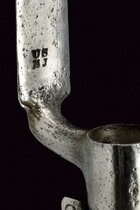
Springfield or... what?

Voltigeur

Cadet
Joined
Feb 5, 2015
Hi all, I'm a new member and I'm a young collector
smile.gif


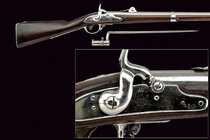
I was looking for my first US rifle (not so easy to find here ) and I've found this one; the seller present it as Springfield but I can't find helpful information on the net.

Could you help me understanding "whatisit" ?
smile.gif


Thank you
G53361_1a.jpg G53361_3.jpg G53361_4.jpg G53361_5.jpg G53361_6.jpg
 
It is a rifled M1816, one of the myriad different contractors. My brain says that is one that Colt did up from surplus parts in the 1850's that were intended to be sold to the beligerants of the Crimea War but I'm not sure off hand. It also appears to have the NJ ownership stamp meaning New Jersey owned it at one point.

What's the price tag on it?
 
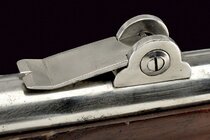
Looks like a 1816 but never saw a rear site like that on one before. Looks like the stock has been refinished and the metal has been polished up bright recently. Not sure if that would help it or hurt it. It depends if you are getting it for a collector or shooter. What is the seller asking for it.
 
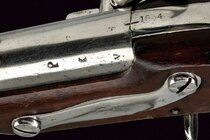
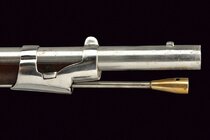
Voltigeur - What you have shown is an incredibly rare and desirable musket! The base pattern is a U.S. Model 1812, Type 2, as evidenced by the "stud band springs". This a difficult to find musket all by itself, much less being altered by Colt. The conversion is, as Johan correctly identified it, done by Colt. Arms entrepreneur George Law contracted with Colt to alter obsolete and condemned U.S. muskets for sale to Russia at the beginning of the Crimean War. The rear sight is correct, as it is a Russian pattern rear sight. The front sight is also correct, because the original brass blade was removed by Colt and replaced with the high iron blade you see in the photograph. The barrel was rifled by Colt using 4 narrow grooves. The original date of the musket would have been probably 1815/16. The date you see on top the breech tang is correct, because Colt polished off the old dates, and re-stamped them with the dates of when the muskets were converted.

An old acquaintance of mine, the late Howie Madaus, classed this Colt converted musket as being so rare that he estimated that there were no more than 10 examples left in existence, and that was in 1981. To the best of my knowledge, this is the ONLY example in existence of a Colt converted Model 1812, Type 2, musket, which was unknown until you shared the photographs. For which, I thank you most sincerely! All of the other known examples are converted U.S. M-1816 or M-1822 muskets.

Yes, it has been over cleaned, but Voltigeuer, if there is any way possible you can add this arm to your collection, just pay the price, it is that rare!
J.
 
What's a "Russian pattern sight?" Is this what the Russians were putting on muskets mid-century?
 
That is rare as hen's teeth, even though it has been way over polished. Yes, it is indeed a M1812 type 2 that appears to have been altered to percussion by Colt to fill an order for the Imperial Russian Arm during the Crimean War. Tim Prince at The College Hill Arsenal recently sold a M1816 with the same conversion. If you are curious look up the listing as he has a very helpful description and history of these muskets. Also, the rear sight is of Belgian design, as it was used on the Russian Luttich carbines (If I recall correctly a copy of the British Baker rifle), that were produced in Belgium during the mid-19th century. Very cool gun. Hope you get it.

Cheers,
Garrett Glover
 
We usually read about the Americans being the ready market for obsolete military junk during the 19th century. Odd to think of us selling our old junk to Europe! I know the mid-century was not a high point for the Russian army. Wasn't that musket one of the ones that was so bad American commanders turned them in? Ironically, the Russians fielded an army largely rifle armed, but taught troops instead to rely on the bayonet. There was a saying in the Russian army: get three recruits. Beat two to death and teach the third. It was a brutal army.
 
Every power involved in the Crimean War was woefully under prepared for the conflict. The French turned to the Belgians for arms, the English and Russians to the Belgians and Americans, and the Turks to the British and French. At the onset of the war the vast majority of the Russian army was armed with smoothbore arms, generally resembling the French M1822. The other belligerents, apart from the British with the adoption of the P1853 (which didn't see service until 1855 at the earliest) were still using large bore muskets and rifles throughout the war. Russian arms were generally .70 caliber, while French arms typically bore somewhere around .71 to .72 (variations of which they continued to produce until the late 1860's). You are correct however in that Russian tactics relied on a massive bayonet charge to break the enemy. The Russian serf army was under trained, under paid, and under equipped. Large portions of their army had never fired their muskets prior to combat, and many arms were unserviceable due to age and lack of care.

The Colt contract would have supplied a very capable and modern arm for any of the warring powers. The muskets (generally M1816's) were converted to percussion via the drum, or French method, rifled with 4 shallow grooves, and sighted. Ramrod heads were replaced with brass ones to prevent damage to the rifling when loading. In fact, the Colt arms would probably have been nearly as reliable as the M1861 Naval Rifle (Plymouth Rifle), that the US Navy Ordered during our Civil War.

Unfortunately for Sam Colt, production didn't get up to speed before the war was over, and he was left holding some 25,000 arms at the conclusion of the Crimean War that nobody wanted. Apparently some were sold to American militia units, probably not more than a couple hundred. It has been speculated that the remainder were sold to Guiseppi Garibaldi during the Italian Civil War. The fact that the one Voltigeur has been so generous to share with us is located in Italy adds substantial credence to this theory. It should be noted though, that the 25,000 offered by Colt may not have been as complete as this example is. It is very possible that the 25,000 figure was applied to all guns that were servicable at the time and examples may be encountered that are not sighted or rifled.

Cheers,
Garrett Glover
 
Also, when the Italian gun maker Pedersoli decided to build a 1816 conversion they copied the Colt alteration, further proof that a number of them did in fact turn up in Italy.
 
Yes, when troops were sent to Crimea in 1854. However, units were rearmed starting in 1855 with newer P1853's. As far as British bore sizes are concerned, the P1839 and P1842 are typically .75 to .76 caliber, while the P1851 is .702 (nearly the same size as Brunswick rifles, although the latter utilizes a winged bullet).
 
Thanks for that explanation. It seems like no major army swings so wildly in quality as the Russian. Beaten at Austerlitz, it is reformed and potent in 1812. Almost incompetent in 1853, refined and competitive again against the Turks in the 1870s. Incompetent again in 1904...
 

Learn About Us
About CivilWarTalk
Contact the Webmaster
Meet the Staff
Link to CivilWarTalk
Join Our Community
Register
Browse Forums
View Today's Discussions
Search the Forum
Get Help
FAQ
Student Guide
Forum Rules & Etiquette
Copyright / DMCA

     Contact Us CivilwarTalk on Facebook CivilWarTalk on YouTube CivilWarTalk on Twitter RSS Feed

Bringing the American Civil War and More to Life.
© 1999 - , CIVILWARTALK, LLC - Site Version 10.0

SlaveryTalk.com - SecessionTalk.com - CivilWarTalk.com - ReconstructionTalk.com
Back
Top