
 Forum Host
- Joined
- Aug 26, 2021
- Location
- North Carolina
Been on the hunt for an Indian War converted Spencer carbine to go with my Springfield Model 1873 carbine. Was fortunate enough to finally acquire this one recently.
From College Hill Arsenal: There is probably no single weapon of the US Civil War that is more representative of the overwhelming force of industry and technology brought to bear by the North against the South than the US Model 1860 Spencer Carbine, more commonly known simply as the Spencer. Various single-shot, breech-loading percussion carbines were the standard issue US cavalry long arms prior to the war, and most of these guns remained in heavy use through the closing days of the war. However, the Spencer firmly established the era of repeating carbines firing metallic cartridges by the end of 1863.
The Spencer was in essence the original assault rifle. For the Confederates it was "that **** Yankee carbine that you load on Sunday and shoot all week!" While the Henry Rifle offered a greater number of cartridges in the magazine, the .44RF Henry round was essentially the ballistic equal to a pistol cartridge. The .52 caliber 56-56 RF Spencer round was much more comparable to a real service rifle load and delivered far greater downrange stopping power.
The Spencer was also very fast to reload. With a 7-round tubular magazine that fed through the buttstock, troopers could reload very quickly. Even though the Spencer shooter did have to manually cock the hammer for each shot, the robust design and powerful cartridge combined to make it the most prized, and most feared, cavalry long arm of the American Civil War.
Roughly 50,000 of these carbines were produced (in the 11,000 to 61,000 serial number range) between 1863 and 1865 and almost all of them saw service during the war. After the war, many were altered and modified at US armories and many remained in service on the frontier through the early 1870s.
Between 1866 and 1874, Springfield Armory refinished approximately 12,000 Spencer carbines for service with Cavalry units on the Western frontier. Changes included drilling out the original 52 caliber bore and putting in a 50 caliber 3-groove sleeve, installing a Stabler magazine cutoff, repairing and refinishing the stock as needed, and repairing and replacing metal parts to include rounding hammer noses and receiver tops to permit easier loading of single cartridges when the cutoff was engaged.
My carbine, serial number 28409, was manufactured in mid-1864 and likely saw service during the Civil War. It was refinished by Springfield Armory as described above and reissued to a Cavalry unit out west for further use.
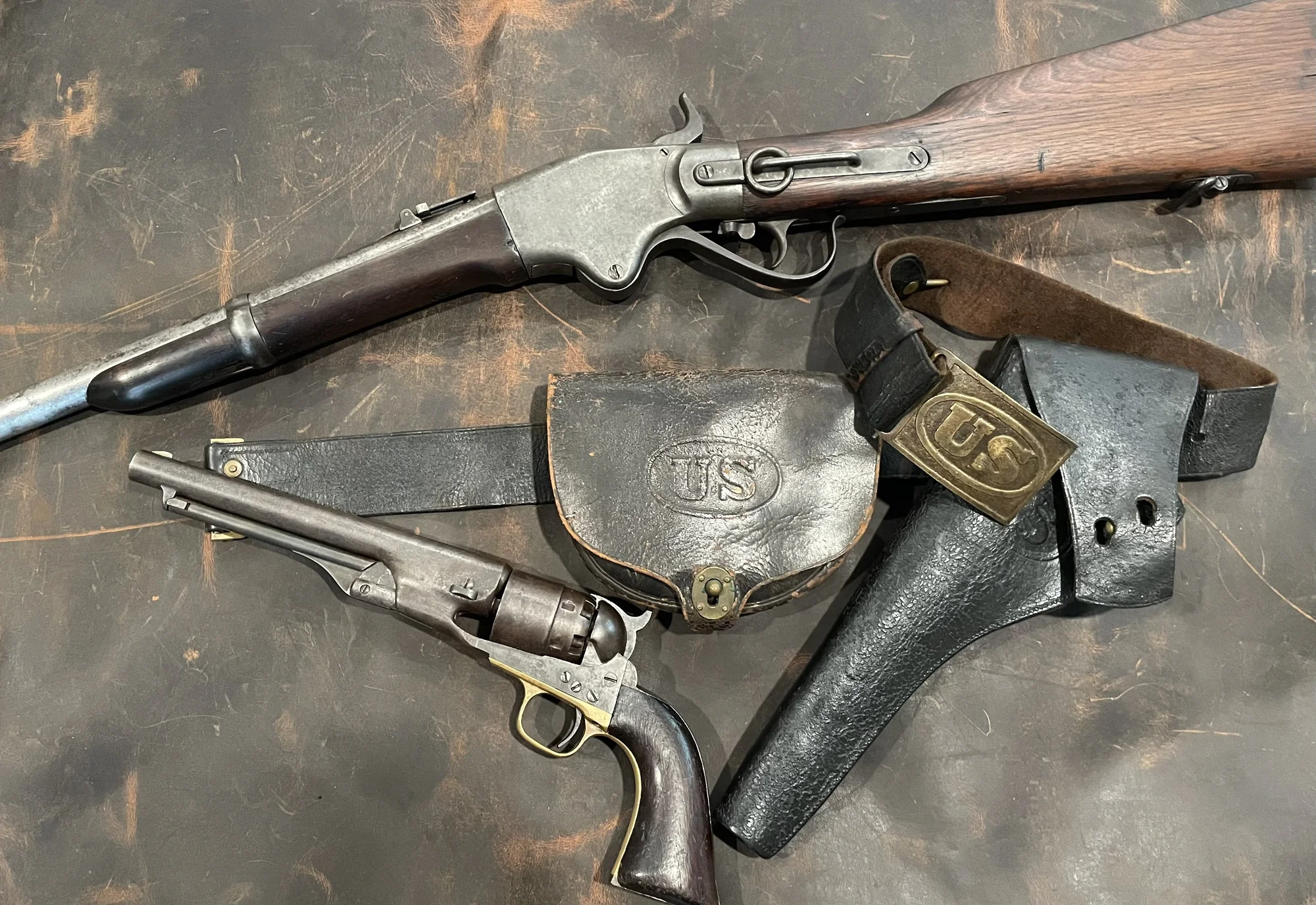
Pictured here is my Spencer Model 1860 carbine with the Colt Model 1860 percussion revolver.
I'm excited to add this wonderful carbine to my Civil War and "Old West" collection.
From College Hill Arsenal: There is probably no single weapon of the US Civil War that is more representative of the overwhelming force of industry and technology brought to bear by the North against the South than the US Model 1860 Spencer Carbine, more commonly known simply as the Spencer. Various single-shot, breech-loading percussion carbines were the standard issue US cavalry long arms prior to the war, and most of these guns remained in heavy use through the closing days of the war. However, the Spencer firmly established the era of repeating carbines firing metallic cartridges by the end of 1863.
The Spencer was in essence the original assault rifle. For the Confederates it was "that **** Yankee carbine that you load on Sunday and shoot all week!" While the Henry Rifle offered a greater number of cartridges in the magazine, the .44RF Henry round was essentially the ballistic equal to a pistol cartridge. The .52 caliber 56-56 RF Spencer round was much more comparable to a real service rifle load and delivered far greater downrange stopping power.
The Spencer was also very fast to reload. With a 7-round tubular magazine that fed through the buttstock, troopers could reload very quickly. Even though the Spencer shooter did have to manually cock the hammer for each shot, the robust design and powerful cartridge combined to make it the most prized, and most feared, cavalry long arm of the American Civil War.
Roughly 50,000 of these carbines were produced (in the 11,000 to 61,000 serial number range) between 1863 and 1865 and almost all of them saw service during the war. After the war, many were altered and modified at US armories and many remained in service on the frontier through the early 1870s.
Between 1866 and 1874, Springfield Armory refinished approximately 12,000 Spencer carbines for service with Cavalry units on the Western frontier. Changes included drilling out the original 52 caliber bore and putting in a 50 caliber 3-groove sleeve, installing a Stabler magazine cutoff, repairing and refinishing the stock as needed, and repairing and replacing metal parts to include rounding hammer noses and receiver tops to permit easier loading of single cartridges when the cutoff was engaged.
My carbine, serial number 28409, was manufactured in mid-1864 and likely saw service during the Civil War. It was refinished by Springfield Armory as described above and reissued to a Cavalry unit out west for further use.
Pictured here is my Spencer Model 1860 carbine with the Colt Model 1860 percussion revolver.
I'm excited to add this wonderful carbine to my Civil War and "Old West" collection.


 Bringing the