I'm not sure if there is a thread on this subject already. My daughter came across the Butterick "Making History" patterns at JoAnn's the other day and we thought we might try our hand at seeing if we could make our dresses. Of the ladies I spoke to at a Civil War event last year, I found some of them had purchased their clothes premade from various places and others had sewed their own by hand and made their own patterns. I'm not talented enough to make my own patterns but I also know that sometimes commercial patterns can be difficult as well. I know historical accuracy is also important in materials used and so forth. Any thoughts or comments to share on commercial patterns versus making your own versus just going ahead and buying your clothing?
-
Welcome to CivilWarTalk, a forum about the American Civil War! - Join today! It's fast, simple, and FREE!
- Home
- Forums
- The War of the Rebellion Forums
- People & Personalities of the Civil War
- Ladies Tea - War from a Feminine Perspective
You are using an out of date browser. It may not display this or other websites correctly.
You should upgrade or use an alternative browser.
You should upgrade or use an alternative browser.
Sewing - dress pattern
- Thread starter AshleyMel
- Start date

NurseErin
Private
- Joined
- Jan 5, 2017
I'm not sure if there is a thread on this subject already. My daughter came across the Butterick "Making History" patterns at JoAnn's the other day and we thought we might try our hand at seeing if we could make our dresses. Of the ladies I spoke to at a Civil War event last year, I found some of them had purchased their clothes premade from various places and others had sewed their own by hand and made their own patterns. I'm not talented enough to make my own patterns but I also know that sometimes commercial patterns can be difficult as well. I know historical accuracy is also important in materials used and so forth. Any thoughts or comments to share on commercial patterns versus making your own versus just going ahead and buying your clothing?
Check out the past patterns company... you can get them off amazon... I found them very simple to make and once you have a basic pattern you can add and change things to make the garments more unique rather than cookie cutter like everyone else.
Oh fun! Whether you guys end up sewing or buying, please do share your progress with us.
@MaryDee might have some thoughts on this too.
ETA: Actual MaryDee thoughts from an earlier thread, "Baby It's (Still) Cold Outside".
@MaryDee might have some thoughts on this too.
ETA: Actual MaryDee thoughts from an earlier thread, "Baby It's (Still) Cold Outside".
Last edited:
- Joined
- Dec 23, 2014
IMHO, the best source on mid-19th century sewing is Elizabeth Stewart Clark's Dressmaker's Guide. It's available through her Sewing Academy website. It includes recommendations for patterns, how to design your own, and how to alter for variations in the basic pattern, such as different bodice, neckline and sleeve styles. I agree with @NurseErin that Past Patterns is one of the best. Past Patterns instructions are often a sewing manual in themselves. I have been told, however, that some of the most recent Past Patterns issues may have problems with fitting because of using computer formulas to mark the sizes. Just because a woman has a larger bust or waist doesn't mean she has a larger neck, for example. It's really important to cut out the pattern in cheap fabric (inexpensive muslin, usually), baste it together, fit it to your own body (with help), and trace the pattern with revisions for your own shape on separate paper (leaving the original pattern intact) before cutting the fashion fabric.
Also, unless you are working with post-Civil War fashions, you don't need a pattern for the skirt, only the bodice. The skirts for 1840-1865 were made from straight panels. Just calculate what is needed, measure, and rip! My own recommendation is to calculate at least three times and measure at least twice, since you can rip only once!
The Dressmaker's Guide also has instructions for sewing all the necessary underpinnings: chemises, drawers, corset, petticoats, and, for 1856 on, hoops. Patterns aren't really needed for these, although for a corsest you may have better luck with authentic corset patterns (Laughing Moon is often recommended for their two corset patterns) than with the methods that Liz Clark uses. (I found that the duct-tape pattern method she desribes works better in theory than in practice, at least for me.)
The problem with the modern pattern company versions of Civil War era dresses are that they do not use 19th century fitting and sewing techniques, so the resulting garments often don't look authentic. A number are designed as stage costumes rather than garments to be worn in the field. A few, however, were designed with the help of true designers of CW reproductions, such as Kay Gnagy.
It's also important to familiarize yourself with the fabrics and prints of the appropriate era. Unless you're really lucky, you won't find those fabrics in a local chain store. Many of us mail-order our fabrics, usually ordering a sample to check out before purchasing the total 7 1/2 yards needed for a dress. There are a number of good sources on 19th century fabrics, from the most recent--and extremely expensive--Wearable Prints 1760-1860 by Susan Greene, to my favorite, Eileen Trestain's Dating Fabrics. I was fortunate to attend a half-day workshop session with Eileen two years ago in which we examined her extensive quilt collection.
You may find workshops being held in your area. Watch for those and be sure to attend! In my own area we also have two different custom seamstresses of 19th century garments who hold classes.
There's nothing wrong with using your sewing machine for garments from 1855 on, when machines sold on the installment plan became quite common. However, remember that the machines of that era did only straight stitch. You do need to master hand-sewn buttonholes. I'm still working on this, but already find that even my rather uneven products are so much more durable than machine-sewn buttonholes. You can avoid the buttonhole issue by using hooks and eyes, and using buttons just as decorations. With this method you can put the hook-and-eye closures closer together at points of stress, while spacing the buttons evenly. This was a common 19th century technique.
Also, unless you are working with post-Civil War fashions, you don't need a pattern for the skirt, only the bodice. The skirts for 1840-1865 were made from straight panels. Just calculate what is needed, measure, and rip! My own recommendation is to calculate at least three times and measure at least twice, since you can rip only once!
The Dressmaker's Guide also has instructions for sewing all the necessary underpinnings: chemises, drawers, corset, petticoats, and, for 1856 on, hoops. Patterns aren't really needed for these, although for a corsest you may have better luck with authentic corset patterns (Laughing Moon is often recommended for their two corset patterns) than with the methods that Liz Clark uses. (I found that the duct-tape pattern method she desribes works better in theory than in practice, at least for me.)
The problem with the modern pattern company versions of Civil War era dresses are that they do not use 19th century fitting and sewing techniques, so the resulting garments often don't look authentic. A number are designed as stage costumes rather than garments to be worn in the field. A few, however, were designed with the help of true designers of CW reproductions, such as Kay Gnagy.
It's also important to familiarize yourself with the fabrics and prints of the appropriate era. Unless you're really lucky, you won't find those fabrics in a local chain store. Many of us mail-order our fabrics, usually ordering a sample to check out before purchasing the total 7 1/2 yards needed for a dress. There are a number of good sources on 19th century fabrics, from the most recent--and extremely expensive--Wearable Prints 1760-1860 by Susan Greene, to my favorite, Eileen Trestain's Dating Fabrics. I was fortunate to attend a half-day workshop session with Eileen two years ago in which we examined her extensive quilt collection.
You may find workshops being held in your area. Watch for those and be sure to attend! In my own area we also have two different custom seamstresses of 19th century garments who hold classes.
There's nothing wrong with using your sewing machine for garments from 1855 on, when machines sold on the installment plan became quite common. However, remember that the machines of that era did only straight stitch. You do need to master hand-sewn buttonholes. I'm still working on this, but already find that even my rather uneven products are so much more durable than machine-sewn buttonholes. You can avoid the buttonhole issue by using hooks and eyes, and using buttons just as decorations. With this method you can put the hook-and-eye closures closer together at points of stress, while spacing the buttons evenly. This was a common 19th century technique.
Wonderful! Thank you all so much for sharing your knowledge. I am so new to all of this and there is so much information to filter through! I was going to try to diary my progress once I figured out a starting point. My daughter and I did purchase two patterns but I do think I might end up modifying them (again, thanks to all your wonderful help) and I will definitely look online for fabric choices. I have a wonderful lady at my church who is a wiz a sewing (she is teaching me to quilt) and I know I can go to her for help if I get too overwhelmed. I also want to research appropriate accessories. Some of the ladies at the reenactment were carrying umbrellas and bags and had lovely hair accessories. I'm hoping to have something finished in time for the September UDC Division meeting as well. We shall see! Wow! What an undertaking this is!
Wonderful! Feel free to create a thread just for this. You'll have a captive audience, I suspect, with me being your first follower.I was going to try to diary my progress once I figured out a starting point.
A lot of us in the crating community document our progress in some way, via blogging, vlogging, or forum threads. It's great for the crafter her/himself in that it gives one time to take a step back and look at ALL the progress made ~ not just the bumpy rides and mistakes made (which so many of us tend to focus on).
Personally, the documentation gives me a space to have a good chuckle over my goofs. Because really, some of them are darn funny. And it's not nearly as much fun when you have no one to share it with. Example:
Me: I tried sketching a design. I can't sketch though. *shows sketch of what I think could be an elegant design for a shawl*
Friend: Well, if you tried sketching a [insert body part here], you nailed it!
Me: OMG!
 I sketched a [body part]!! I can't knit that!!
It's also awesome for the rest of us who love to see what others are doing almost as much as practicing the craft ourselves. Plus the enabling is fabulous.
 I have many online crafting friends to blame for all the stuff I've gotten myself into. And I love them for it!
NurseErin
Private
- Joined
- Jan 5, 2017
The fabric is really important as @MaryDee said... I just got a good deal on fabric.. didn't have time to research it now I have a bad deal on a lot of fabric I can't use... lol good thing I like modern sewing too! I the picture below is of the fabrics I bought without research and only one of them is anywhere near proper... the white cotton is the one I took the loss on...unless anyone has any other opinions?
Attachments
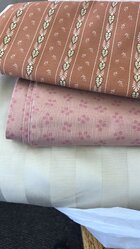
I love those top two!The fabric is really important as @MaryDee said... I just got a good deal on fabric.. didn't have time to research it now I have a bad deal on a lot of fabric I can't use... lol good thing I like modern sewing too! I the picture below is of the fabrics I bought without research and only one of them is anywhere near proper... the white cotton is the one I took the loss on...unless anyone has any other opinions?
NurseErin
Private
- Joined
- Jan 5, 2017
I posted on another site and was told the only appropriate fabric was the top one. Ill use it for something just not anything civil warI love those top two!
NurseErin
Private
- Joined
- Jan 5, 2017
That was just one persons opinion so I have no clue how truthful it is but I believe them lol I'm not very good at fabrics eitherThe top one only? I wouldn't be able to discern the authenticity! They are all lovely! I think I might be in trouble!

- Joined
- Dec 23, 2014
I'd say the top one is fine, assuming the stripes are vertical, but the pink not so much. Use the white (if it's all cotton) for underthings that don't show! Although if it contains polyester, there's a safety issue. Polyester doesn't burn but melts into your flesh, so is not very safe if working around a campfire. Cotton/poly blends also look quite different from 100% cotton, and since there was no polyester in the 1860s. . . .
Don't feel bad, I ended up with the "bargain of the century" being a non-period print for my first dress, too. I'm using it little by little as bodice lining and hem facing, where it won't show. Yes, a lot of fabric from old dresses was recycled that way back in the day!
Don't feel bad, I ended up with the "bargain of the century" being a non-period print for my first dress, too. I'm using it little by little as bodice lining and hem facing, where it won't show. Yes, a lot of fabric from old dresses was recycled that way back in the day!
NurseErin
Private
- Joined
- Jan 5, 2017
I'd say the top one is fine, assuming the stripes are vertical, but the pink not so much. Use the white (if it's all cotton) for underthings that don't show! Although if it contains polyester, there's a safety issue. Polyester doesn't burn but melts into your flesh, so is not very safe if working around a campfire. Cotton/poly blends also look quite different from 100% cotton, and since there was no polyester in the 1860s. . . .
Don't feel bad, I ended up with the "bargain of the century" being a non-period print for my first dress, too. I'm using it little by little as bodice lining and hem facing, where it won't show. Yes, a lot of fabric from old dresses was recycled that way back in the day!
My first dress is most likely not a period correct print due to the similarity to the pink print above lol anyways I'm working to learn and improve. I'm not taking my first dress to Shiloh that's for sure or my hoops for that matter. Mainly camp dresses as I'm trying to develope my nurse impression. My second dress (the green one) turned out a bit bettter. Also forgive my awful bonnet


Hrobin1383
Cadet
- Joined
- Jan 17, 2017
Try RecollectionsI'm not sure if there is a thread on this subject already. My daughter came across the Butterick "Making History" patterns at JoAnn's the other day and we thought we might try our hand at seeing if we could make our dresses. Of the ladies I spoke to at a Civil War event last year, I found some of them had purchased their clothes premade from various places and others had sewed their own by hand and made their own patterns. I'm not talented enough to make my own patterns but I also know that sometimes commercial patterns can be difficult as well. I know historical accuracy is also important in materials used and so forth. Any thoughts or comments to share on commercial patterns versus making your own versus just going ahead and buying your clothing?
Try Recollections websiteI'm not sure if there is a thread on this subject already. My daughter came across the Butterick "Making History" patterns at JoAnn's the other day and we thought we might try our hand at seeing if we could make our dresses. Of the ladies I spoke to at a Civil War event last year, I found some of them had purchased their clothes premade from various places and others had sewed their own by hand and made their own patterns. I'm not talented enough to make my own patterns but I also know that sometimes commercial patterns can be difficult as well. I know historical accuracy is also important in materials used and so forth. Any thoughts or comments to share on commercial patterns versus making your own versus just going ahead and buying your clothing?
- Joined
- Dec 23, 2014
I have the opposite problem--enough gained that I had to unstitch bodice from skirt, let them out, reattach.
BTW, hair needs to be parted in middle--that's important! No bangs ("fringe") in this era--came in in the 1870s.
BTW, hair needs to be parted in middle--that's important! No bangs ("fringe") in this era--came in in the 1870s.
You ladies look beautiful!My first dress is most likely not a period correct print due to the similarity to the pink print above lol anyways I'm working to learn and improve. I'm not taking my first dress to Shiloh that's for sure or my hoops for that matter. Mainly camp dresses as I'm trying to develope my nurse impression. My second dress (the green one) turned out a bit bettter. Also forgive my awful bonnet
How do you manage with those hoops? I'd be knocking stuff over, flattening small children, hiding animals ~ all unintentionally.
Well. Mostly unintentionally.

JPK Huson 1863
Brev. Brig. Gen'l
- Joined
- Feb 14, 2012
- Location
- Central Pennsylvania
60 pounds from where? Did you unstrap ankle weights? I mean, congratulations, that's a lovely achievement but goodness.
We've been missing more of these threads in Ladies Tea, thanks so much! For some reason, POOF, the Fairy Godmother of Good Fortune is bringing us more sewers, knitters, crocheters and people who are seriously following reenacting, too. I've never had a clue beyond quilting so these are fascinating besides valuable here.
You had to know Mary Dee would be able to solve pretty much anything. May have to request a reenacting sticky, for Ladies Tea, with something comprehensive on it, and CWT links. Written by a comprehensively capable reenactor.
We've been missing more of these threads in Ladies Tea, thanks so much! For some reason, POOF, the Fairy Godmother of Good Fortune is bringing us more sewers, knitters, crocheters and people who are seriously following reenacting, too. I've never had a clue beyond quilting so these are fascinating besides valuable here.
You had to know Mary Dee would be able to solve pretty much anything. May have to request a reenacting sticky, for Ladies Tea, with something comprehensive on it, and CWT links. Written by a comprehensively capable reenactor.
NurseErin
Private
- Joined
- Jan 5, 2017
I unfortunately had a pixie cut that was simply unmanageable at the time of these pictures I have since grown it out and managed the fringeI have the opposite problem--enough gained that I had to unstitch bodice from skirt, let them out, reattach.
BTW, hair needs to be parted in middle--that's important! No bangs ("fringe") in this era--came in in the 1870s.
NurseErin
Private
- Joined
- Jan 5, 2017
Let's just say I'm fluffy60 pounds from where? Did you unstrap ankle weights? I mean, congratulations, that's a lovely achievement but goodness.
We've been missing more of these threads in Ladies Tea, thanks so much! For some reason, POOF, the Fairy Godmother of Good Fortune is bringing us more sewers, knitters, crocheters and people who are seriously following reenacting, too. I've never had a clue beyond quilting so these are fascinating besides valuable here.
You had to know Mary Dee would be able to solve pretty much anything. May have to request a reenacting sticky, for Ladies Tea, with something comprehensive on it, and CWT links. Written by a comprehensively capable reenactor.
I have about fifty more to go... I still have a lot of sewing to do. This time I made my corset 3 sizes to small so I could shrink into it lol I hate making corsets with a passion!Similar threads

- Replies
- 2
- Views
- 179
- Replies
- 2
- Views
- 349

- Replies
- 9
- Views
- 2K

- Replies
- 5
- Views
- 686
Similar threads

- Replies
- 9
- Views
- 180
- Replies
- 4
- Views
- 5

- Replies
- 1
- Views
- 80
- Learn About Us
- ►About CivilWarTalk
- ►Contact the Webmaster
- ►Meet the Staff
- ►Link to CivilWarTalk
- Join Our Community
- ►Register
- ►Browse Forums
- ►View Today's Discussions
- ►Search the Forum
- Get Help
- ►FAQ
- ►Student Guide
- ►Forum Rules & Etiquette
- ►Copyright / DMCA
 Bringing the