Saber find

SEHatfield

Private
Joined
Oct 28, 2017
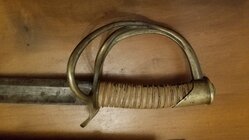
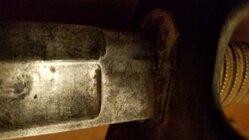
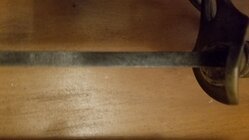
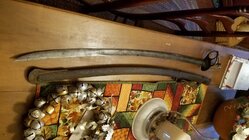
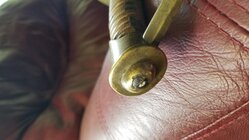
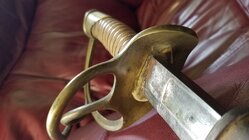
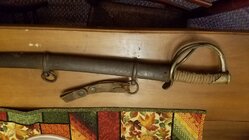
Hello all. I'm from Western North Carolina. I purchased what was presented to me as an M1860 Union Cavalry saber in an antique mall in NW Atlanta. This particular store had very high reviews and somewhat of a reputation. At any rate, the saber was presented to me as a mid 1800's M1860 Cavalry saber. I already now believe that it is in fact an M1840 saber due to it's dimensions, it's handle shape, etc.. While that in and of itself is not a deal breaker (I purchased it as it was supposed to be a cavalry item.) I'm a little concerned about it's value. (I'll be the first to say that "caveat emptor" applies to me, but I trusted the staff there and their reputation. That's on me.) It was represented as having the makers mark obscured. I can find no markings on any part of this saber. I have heard that there were some swords that didn't get marked or had their marks obscured. Can anyone give me an indication as to where this saber might have come from and any other information. Steve
20171028_171954.jpg 20171028_172016.jpg 20171028_172103.jpg 20171028_172644.jpg 20171028_172724.jpg 20171028_172823.jpg 20171028_172751.jpg 20171028_172902.jpg
 
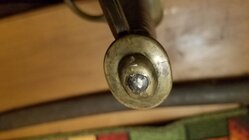
Its is a model 1840 cavalry sword and it does have a cavalryman's bend on the guard. Without markings there is really no way to tell who made it and where it came from. Its hard to tell from the photos but it does appear to have had the handle removed from the blade but with the camera flash's it hard to tell. Hope you aren't to deep in it.
 
I fear I am Richard. I paid $650 for it. Thanks for the info. I may try to upload better pictures.
 
Ouch, In the future if you will ask our opinion before the fact it would be helpful.
 
Just another thought, perhaps someone just attempted to tighten the blade by peening the tang, rather than disassembling the sword? My reason for this is that I don't see where any of the pommel cap has been ground off.
J.
 
20171029_090946.jpg 20171029_090954.jpg 20171029_091004.jpg 20171029_091029.jpg

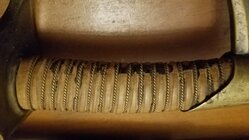
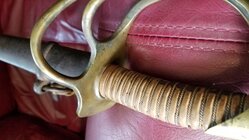
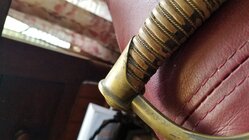
Here are more images of the handle. Thanks to all so far for the info. Is it possible to have an authentic 1840 without any marks whatsoever? Not on the endcap, handle, blade or scabbard? I guess I just wanted to know that it wasn't fake.
 
Last edited:
Hello all. I'm from Western North Carolina. I purchased what was presented to me as an M1860 Union Cavalry saber in an antique mall in NW Atlanta. This particular store had very high reviews and somewhat of a reputation. At any rate, the saber was presented to me as a mid 1800's M1860 Cavalry saber. I already now believe that it is in fact an M1840 saber due to it's dimensions, it's handle shape, etc.. While that in and of itself is not a deal breaker (I purchased it as it was supposed to be a cavalry item.) I'm a little concerned about it's value. (I'll be the first to say that "caveat emptor" applies to me, but I trusted the staff there and their reputation. That's on me.) It was represented as having the makers mark obscured. I can find no markings on any part of this saber. I have heard that there were some swords that didn't get marked or had their marks obscured. Can anyone give me an indication as to where this saber might have come from and any other information. Steve

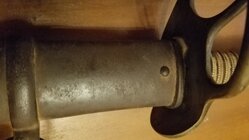
If it was a reputable shop, give them the benefit of the doubt that they were just ignorant, not intentionally dishonest. This is definitely a M1840, not an 1860. You can tell by the grip which is straight and lacks bulge found on the M1860, and the blade has a flat spine whereas the 1860 is rounded. It is probably an import from Solingen. Tens of thousands of these M1840s were imported to both the north and south during the CW. Often they are maker-marked, but are also frequently totally unmarked, which seems to be the case with your sword. In addition to the misidentification, there are also condition issues which detract from the value of your sword, e.g. the loss of leather on the grip, the bend to the guard, etc. What are the chances of getting a refund?
 
If it was a reputable shop, give them the benefit of the doubt that they were just ignorant, not intentionally dishonest. This is definitely a M1840, not an 1860. You can tell by the grip which is straight and lacks bulge found on the M1860, and the blade has a flat spine whereas the 1860 is rounded. It is probably an import from Solingen. Tens of thousands of these M1840s were imported to both the north and south during the CW. Often they are maker-marked, but are also frequently totally unmarked, which seems to be the case with your sword. In addition to the misidentification, there are also condition issues which detract from the value of your sword, e.g. the loss of leather on the grip, the bend to the guard, etc. What are the chances of getting a refund?
Hello Richard. Not sure. I have emailed them and they were receptive enough to offer to let me trade this one in on another one I looked at while I was there. I believe it is an actual 1860 with markings on it. I asked them to send me pictures so I could look up the marks before I made a decision. If I am unable to see what I need to see I'll ask for a full refund. Thanks.
 
the bend to the guard

The bend in the guard is common. We call it a cavalryman's bend. This was done by the trooper and it was done to trap or catch the blade of an incoming sabre blow. Below is one in my collection a CS B Douglas with the bend to the guard.
DSCN7679.JPG
 
Because of the bend in the outer guard loop pointed out by Richard (thanks) and the other information provided, and because it was originally represented as an 1860, I have politely sent pics to the shop asking for a refund. Thanks to all for your help. Time will tell.

Steve
 
The bend in the guard is common. We call it a cavalryman's bend. This was done by the trooper and it was done to trap or catch the blade of an incoming sabre blow. Below is one in my collection a CS B Douglas with the bend to the guard.
View attachment 163550
That wasn't the bend to which I was referring. You are right - the forward bend of the quillon is more common than not and does not detract from the value. The bend I was talking about was the downward bend to the outer band of the knuckle guard.
 
With respect, the "Cavalryman's Bend" is not for catching another sword blade, but rather to protect your hand when slashing with the sword coming to a sudden stop. If the guard is in the original vertical form it will gouge into the webbing of your hand between your thumb and forefinger. When the guard is bent forward you have no problems. This is from personal experience experiments done by a friend and myself many years ago when we were quite interested in why things were the way they were!
J.
 
It looks like a authentic model 1840 wrist breaker CW imported sword . A lot of the imported swords were unmarked so they could be sold to either side.
 
Last edited:
The shop actually agreed to refund my money when I take the sword back. Once that's done I'll be on the hunt for another sword, hopefully I'll be a bit wiser this time. Thanks for the replies and information.
 
That's great. They are undoubtedly a VERY reputable store.
 
Just another thought, perhaps someone just attempted to tighten the blade by peening the tang, rather than disassembling the sword? My reason for this is that I don't see where any of the pommel cap has been ground off.
J.
When you repeatedly smack a round piece of brass with a steel hammer, it tends to flatten out ;)
 
Unless bottom diving (guilty) always buy the best sword you can afford. There is nothing wrong with window shopping and saving up.

Cheers

GC
 

Learn About Us
About CivilWarTalk
Contact the Webmaster
Meet the Staff
Link to CivilWarTalk
Join Our Community
Register
Browse Forums
View Today's Discussions
Search the Forum
Get Help
FAQ
Student Guide
Forum Rules & Etiquette
Copyright / DMCA

     Contact Us CivilwarTalk on Facebook CivilWarTalk on YouTube CivilWarTalk on Twitter RSS Feed

Bringing the American Civil War and More to Life.
© 1999 - , CIVILWARTALK, LLC - Site Version 10.0

SlaveryTalk.com - SecessionTalk.com - CivilWarTalk.com - ReconstructionTalk.com
Back
Top