
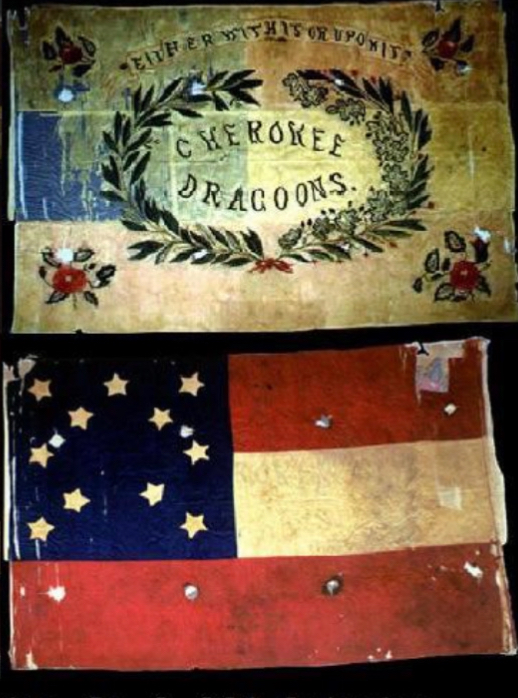
I was looking at my ancestors regimental flag on display in the Kennesaw Mt. battle field Museum in Georgia.It has Cherokee Dragoons on it , The motto on top says "EITHER WITH IT OR UP ON IT". I've been reading about it, it goes way back to Spartan Soldiers saying that they will return with their shield or be carried dead back home upon it. This flag is two sided with the original Confederate flag on the other side. What other mottos were used on other regimental flags and were there many two sided flags.
-
Welcome to CivilWarTalk, a forum about the American Civil War! - Join today! It's fast, simple, and FREE!
You are using an out of date browser. It may not display this or other websites correctly.
You should upgrade or use an alternative browser.
You should upgrade or use an alternative browser.
Regimental Flags
- Thread starter G Low
- Start date
Two sided flags in the South were pretty common actually. If a flag had painted devices, slogans etc., there would be a bleed through to the other side of the paint. Same with embroidered flags. So if you wanted something different on the other side then you had to make a second one sided flag and then sew the two together to make one flag. A number of SC company colors were done like this as well as a couple regimental flags including the 1st South Carolina's state flag variant. Some of these would have First National flags on them like the depicted Cherokee Dragoons but others had other devices. I add here the two sided flag of the 10th Tennessee Infantry, one of two Irish regiments raised in the state. This flag was left in their camps at Fort Henry when the Confederate garrison fell back to Fort Donelson. Now in the collections of the Tennessee State Museum.I was looking at my ancestors regimental flag on display in the Kennesaw Mt. battle field Museum in Georgia.It has Cherokee Dragoons on it , The motto on top says "EITHER WITH IT OR UP ON IT". I've been reading about it, it goes way back to Spartan Soldiers saying that they will return with their shield or be carried dead back home upon it. This flag is two sided with the original Confederate flag on the other side. What other mottos were used on other regimental flags and were there many two sided flags.View attachment 526039
Here's the two sided flag of the 1st South Carolina Infantry (Gregg's). Held by the Relic Room and Museum in Columbia, SC today.Two sided flags in the South were pretty common actually. If a flag had painted devices, slogans etc., there would be a bleed through to the other side of the paint. Same with embroidered flags. So if you wanted something different on the other side then you had to make a second one sided flag and then sew the two together to make one flag. A number of SC company colors were done like this as well as a couple regimental flags including the 1st South Carolina's state flag variant. Some of these would have First National flags on them like the depicted Cherokee Dragoons but others had other devices. I add here the two sided flag of the 10th Tennessee Infantry, one of two Irish regiments raised in the state. This flag was left in their camps at Fort Henry when the Confederate garrison fell back to Fort Donelson. Now in the collections of the Tennessee State Museum.
View attachment 526663
View attachment 526665
The 1st SC flag is embroidered by the way.Here's the two sided flag of the 1st South Carolina Infantry (Gregg's). Held by the Relic Room and Museum in Columbia, SC today.
View attachment 526670
View attachment 526671
Here is the actual flag. Made in Mississippi in late 1862 or early 1863. I will comment on 15 star CS flags below.This is my ggg grandfather and his regimental flag and a little history.View attachment 526077View attachment 526078View attachment 526079View attachment 526080
A lot of people don't know this today but Baltimore was then a heavily secessionist city. I have files of CS flags being flown there in large numbers before the riots versus the Massachusetts troops passing through. After the riots, the county sheriff published a "no flags at all" edict, aka no flags for either side could be flown for 30 days and it was enforced! This cooled things down considerably. Of course Baltimore was "occupied" early on by Federal troops and after that CS flags became a moot point.This may be another reason why Maryland didn't secede.View attachment 526337
This original flag looks like it's in pristine condition. Knowing that my ggg grandfather fought under it gives me chills..Here is the actual flag. Made in Mississippi in late 1862 or early 1863. I will comment on 15 star CS flags below.
View attachment 526672
There are actually a decent number of 15 star CS flags still around and these come in two basic time frames. First, those made in 1861/1862 with hopes that the other slave states would secede and join the Confederacy and those battle flags made in Mississippi in late 1862/early 1863. I have files on six existing 15 star First National flags and there were undoubtedly more made back then but how many we will never know. As for the late 82/early 63 battle flags, these seem to stem from exchanged troops captured at Fort Donelson in February 1862 and paroled from the POW camps later that year. The exchange point was Vicksburg so these former prisoners were shipped there to be reincorporated into the army. They pretty much all stayed in Mississippi to fight in the Vicksburg/Port Hudson campaigns before heading to the Chattanooga area and the Army of Tennessee. Three such flags still exist today for these exchanged units, all made in Mississippi. Those of the 7th Texas Infantry and the 50th Tennessee Infantry were made from the same bolt of cloth, probably by the same maker (whoever that was but there was a flag maker in Jackson). Gen. Lloyd Tilghman's flag came from someone else and is more ornate, along the lines of the depicted 42nd Georgia Infantry's flag above. I will post these flags here. 50th TN, then 7th Texas and Tilghman's flag.Don't see many 15 star flags..
I am not sure how much combat use this one ever saw. Since it was at Champion Hill probably not very much. It is an awesome flag indeed!This original flag looks like it's in pristine condition. Knowing that my ggg grandfather fought under it gives me chills..
The second flag depicted was captured at Mill Springs in January 1862. The one with the shortened canton was taken at Island Number Ten. The last one was taken at Yazoo City, Mississippi in 1863.Here's some 15 star First National flags.
View attachment 526679
View attachment 526680
View attachment 526682
View attachment 526683
View attachment 526684
View attachment 526685
I was wanting to see how many different regimental flags would be put on here. When Southern states seceded they some times created a new sovereign flag.This is the Republic of Georgia flag.This original flag looks like it's in pristine condition. Knowing that my ggg grandfather fought under it gives me chills..
They hid their flags after thisThis is what made confederate supporters hide their Flags.A lot of people don't know this today but Baltimore was then a heavily secessionist city. I have files of CS flags being flown there in large numbers before the riots versus the Massachusetts troops passing through. After the riots, the county sheriff published a "no flags at all" edict, aka no flags for either side could be flown for 30 days and it was enforced! This cooled things down considerably. Of course Baltimore was "occupied" early on by Federal troops and after that CS flags became a moot point.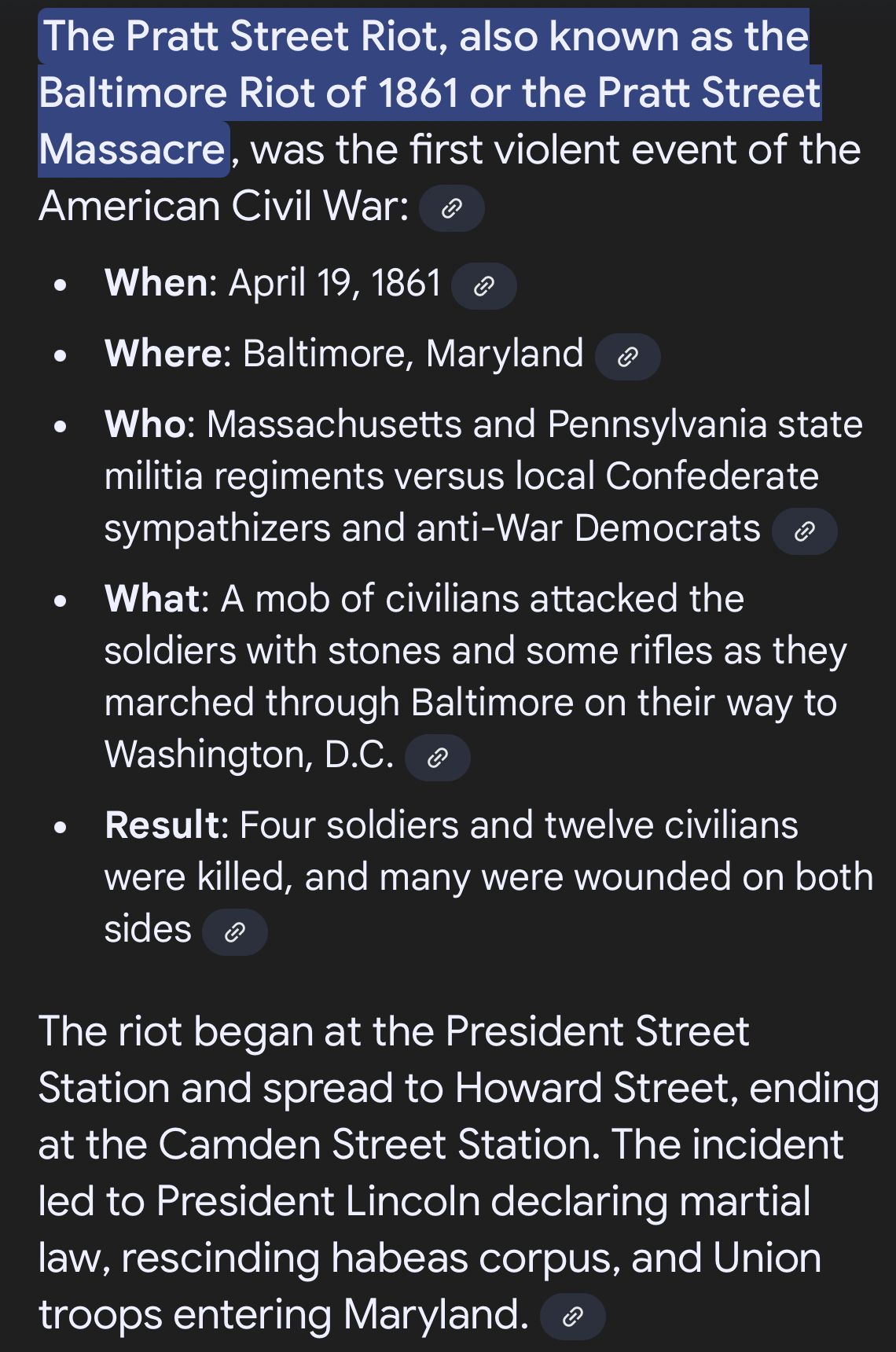
There is even one 17 star First National flag and this one briefly flew in Sacramento, California in 1861 before being taken down. It is in their state museum today and is known as the Biderman Flag. California pre-Civil War, was actually a divided state somewhat (and it remains so today - I lived in LA for 15 years and one learns that northern CA dislikes southern CA a good bit and vice versa) and this was based on the immigration patterns. Southerners who went west to CA did so in pretty much a straight line and so settled in southern California. Northerners did so as well and ended up in northern CA. There are some exceptions to this mainly during the Gold Rush. A large majority of the gold miners in Colorado before the war came there form the gold fields of Georgia and brought their politics with them - same for CA in both parts of the state. The miners caused issues in Colorado in 1860/1861 as well. In the late 1850s, southern CA had a movement to split off from northern CA and become a new state. It came closest in 1859 and the Pico Act would name it the Territory of Colorado but there was also another name with "Pacific" in it (I forget the rest). LA has a Pico Boulevard today named for the state senator sponsor. In 1860 as secession was heating up in the South, it also happened in southern CA. The California state flag today is the "Bear flag" and this has roots with the white settlers seeking to separate from Mexico in the 1840s. It is as much a symbol of rebellion in America as were the lone star flags from the Texas War of Independence and the palmetto flags of 1860/1861 and came back into use in southern CA back then. Newspapers have accounts of Bear flags appearing in eastern LA suburbs in decent numbers. In northern CA I have not found accounts of Bear flags there but this 17 star Confederate First National was hoisted very briefly in Sacramento in 1861 by a guy named Gillis and taken down by a guy named Biderman. We think the two additional stars were for New Mexico Territory (which included the modern states of New Mexico and Arizona), which had southern sympathies, and southern California. This is the only such flag with 17 stars that exists today.


Rhea Cole
Colonel
- Joined
- Nov 2, 2019
- Location
- Murfreesboro, Tennessee
I was wanting to see how many different regimental flags would be put on here. When Southern states seceded they some times created a new sovereign flag.This is the Republic of Georgia flag.View attachment 526678
Curiously, this red star flag is the same as signal flags awarded for valor.
The usual square in the center of the signal flag was replaced by a red or white star.
It was called that but never adopted as such. One was hoisted when the Federal arsenal in Augusta, GA was captured in January 1861 by state troops (irony being the arsenal commander was arnold Elzey, later a CS general). The actual flag is depicted here, held by the Augusta-Richmond County Museum. There were a few other lone star flags hoisted in Georgia at this time with different colored fields but far more flags with the state Coat of Arms on them were made for unit colors carrying on a long militia tradition. Georgia never adopted a state flag in the Civil War but did so afterwards in 1879 which was based on the Confederate First National flag sans stars and designed by Georgia Confederate veterans.I was wanting to see how many different regimental flags would be put on here. When Southern states seceded they some times created a new sovereign flag.This is the Republic of Georgia flag.View attachment 526678

RedRover
Captain
- Joined
- Dec 16, 2019
There were so many "secession flags" but only some of them were ever adopted for some official State or Confederate purpose.
When Florida's secession was announced, this flag, made by the ladies of Duval County, was employed.

During 1861 the following State of Florida flag was adopted, but it is unknown if any were ever actually made or employed.

When Florida's secession was announced, this flag, made by the ladies of Duval County, was employed.
During 1861 the following State of Florida flag was adopted, but it is unknown if any were ever actually made or employed.
Trooper "D"
Sergeant Major
- Joined
- May 20, 2018
Jailing the secessionist state legislature before they could vote on secession probably did the trick.This may be another reason why Maryland didn't secede.View attachment 526337
Trooper "D"
Sergeant Major
- Joined
- May 20, 2018
I always thought Pico Blvd. was named for once of the Pico brothers who were in charge of Mexican California. Out near Whittier there is gone their houses that's a park of some type. State Park probably. Pio and Andreas Pico.There is even one 17 star First National flag and this one briefly flew in Sacramento, California in 1861 before being taken down. It is in their state museum today and is known as the Biderman Flag. California pre-Civil War, was actually a divided state somewhat (and it remains so today - I lived in LA for 15 years and one learns that northern CA dislikes southern CA a good bit and vice versa) and this was based on the immigration patterns. Southerners who went west to CA did so in pretty much a straight line and so settled in southern California. Northerners did so as well and ended up in northern CA. There are some exceptions to this mainly during the Gold Rush. A large majority of the gold miners in Colorado before the war came there form the gold fields of Georgia and brought their politics with them - same for CA in both parts of the state. The miners caused issues in Colorado in 1860/1861 as well. In the late 1850s, southern CA had a movement to split off from northern CA and become a new state. It came closest in 1859 and the Pico Act would name it the Territory of Colorado but there was also another name with "Pacific" in it (I forget the rest). LA has a Pico Boulevard today named for the state senator sponsor. In 1860 as secession was heating up in the South, it also happened in southern CA. The California state flag today is the "Bear flag" and this has roots with the white settlers seeking to separate from Mexico in the 1840s. It is as much a symbol of rebellion in America as were the lone star flags from the Texas War of Independence and the palmetto flags of 1860/1861 and came back into use in southern CA back then. Newspapers have accounts of Bear flags appearing in eastern LA suburbs in decent numbers. In northern CA I have not found accounts of Bear flags there but this 17 star Confederate First National was hoisted very briefly in Sacramento in 1861 by a guy named Gillis and taken down by a guy named Biderman. We think the two additional stars were for New Mexico Territory (which included the modern states of New Mexico and Arizona), which had southern sympathies, and southern California. This is the only such flag with 17 stars that exists today.
View attachment 526689
Mostly what I think of with Pico Blvd. is "Pico and Sepulveda, Pico and Sepulveda...." from Dr. Dimento.

CleburneFanBoy
Cadet
- Joined
- Sep 23, 2010
A nice two-sider, 28th Alabama, it was captured at Orchard Knob. I cannot find an image of the saltire side.
Here is an interesting page with Federal and Confederate descriptions of this fight.
Here is an interesting page with Federal and Confederate descriptions of this fight.
The now retired curator of the Florida Museum of History told me years ago that he had never found a single instance of the adopted state flag ever being used. Nor have I in nearly 40 years of flag research. There was also a lone star flag hoisted in Pensacola and noted by a US Navy officer offshore in his report. It has mistakenly been called a Florida secession flag with the implication that this flew all over the state when the only documented place was Pensacola.There were so many "secession flags" but only some of them were ever adopted for some official State or Confederate purpose.
When Florida's secession was announced, this flag, made by the ladies of Duval County, was employed.
View attachment 526692
During 1861 the following State of Florida flag was adopted, but it is unknown if any were ever actually made or employed.
View attachment 526693
Similar threads


- Question
- Replies
- 13
- Views
- 160

- Replies
- 1
- Views
- 221
- Replies
- 9
- Views
- 275
Similar threads

- Question
- Replies
- 10
- Views
- 180

- Learn About Us
- ►About CivilWarTalk
- ►Contact the Webmaster
- ►Meet the Staff
- ►Link to CivilWarTalk
- Join Our Community
- ►Register
- ►Browse Forums
- ►View Today's Discussions
- ►Search the Forum
- Get Help
- ►FAQ
- ►Student Guide
- ►Forum Rules & Etiquette
- ►Copyright / DMCA
 Bringing the