Period construction

johan_steele

Regimental Armorer
Retired Moderator
Joined
Feb 20, 2005
Location
South of the North 40
Building a structure at the time of the Civil War was a lot more than just going down to the local lumberyard and buying the lumber you needed. The further west you went the more likely the manufacture would be done by hand. Through skillful use of hand tools and careful planning a comfortable home, barn or other building could be built.

The first step was choosing the lumber aka trees, felling them then squaring them. The would be stored and allowed to dry or season before their use.

After the logs were chosen they would be notched with a felling axe.
Notches.JPG


Then the material between the notches would be removed with a broad axe or adze.
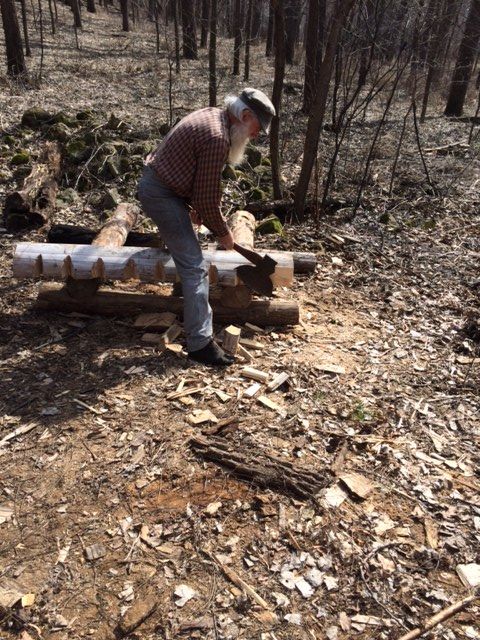
Using a broad axe.JPG

Adze as broadaxe.JPG


Then the log would be smoothed with an Adze.
Adze pro 2.JPG

This process would be repeated for each side that needed to be flat. The end result was a square beam suitable for building.
Log after adz work.JPG


The tools used to make a beam; a felling axe, broad axe and adze. Not shown is a square, chalk line or plane for final finish.
Tools used to turn a log into a beam.JPG
 
A skilled builder could change several logs into beams in a day. In my own experience I watched two skilled artisans change three logs into beams in the time it took me to do just one face.
 
Thanks for posting that. I'm curious about a couple things. You mentioned the logs turned into beams, so I thought this was going to be for a frame building. But then it seemed to be for a log building? Logs for a log building were typically only hewed on two sides and there really wasn't as much need to finish them with an adz, except maybe floor puncheons.

It would be easier to do the mortices and tenons for a frame building if all four sides of the timber were smoothed nicely with an adze, though that would be a lot of work on a big barn and the timbers sometimes look just done with a broadaxe, with only the important parts smooth.

In the photos with the augers, what are they doing? That looks like framing again, cutting a mortice, rather than any sort of typical log cabin notch.
 
Thanks for posting that. I'm curious about a couple things. You mentioned the logs turned into beams, so I thought this was going to be for a frame building. But then it seemed to be for a log building? Logs for a log building were typically only hewed on two sides and there really wasn't as much need to finish them with an adz, except maybe floor puncheons.

It would be easier to do the mortices and tenons for a frame building if all four sides of the timber were smoothed nicely with an adze, though that would be a lot of work on a big barn and the timbers sometimes look just done with a broadaxe, with only the important parts smooth.

In the photos with the augers, what are they doing? That looks like framing again, cutting a mortice, rather than any sort of typical log cabin notch.


I tried to keep it generic as these could be used for a variety of things from a log cabin to structural beams in a church. Most were only adzed on two sides but we made a couple beams that were squared & smoothed
In the case of boring that is for the door frame.

This was done for a museum, Laura Ingles Wilder Museum in Pepin Wi. The plan was to take pictures of tools like what they have in the museum in their intended use and there will be the corner of a log cabin & door jam on display inside the museum so visitors can see how log cabins and other buildings were constructed with just hand tools.
 
Oh, okay. Out of curiosity... Back in the 1980s-1990s when I was into this stuff, there was a general belief that the uninformed public were convinced log cabin logs were smoothed with adzes, but those in the know understood that they were hewed with broadaxes, and adzes were only used for finishing already- hewed wood into a smoother surface if necessary, which wasn't necessary on cabin logs.

Here's a good example: "The most frequent question I am asked is do I use an adze. There is a persistent misconception that most hewing was done with the adze. The reality, however, is that through the Middle Ages to the present hewing has generally been done with the axe." Another example: "The next photo shows an Eric Sloane drawing of the proper use of an adze which was to plane down, or make smooth, a timber that was previously hewn with an axe. It is very, very rare to find an old log cabin where someone has come in with an adze."

Have you heard that? Has it been abandoned now and has evidence come forth that adzes were used interchangeably with broadaxes just as the public used to think?
 
In Cooper County, Missouri there are quite a number of surviving log buildings. Most of them in this area are made of squared logs with dovetailed corner joints. This required a great deal more work to construct than round logs. The objective seemed to be that the building could then be sided with regular weatherboard siding as soon as that material became available. Sawmills often became established not too many years after first settlement. Some log buildings had second stories built with timber frame construction. There's an 1837-vintage house around the corner from me that is made from squared walnut logs with white painted clapboard siding. Conventionally framed rooms were added on to the back with each new child born to the family. The last room is brick. I know of only two round log buildings in this area, but there are probably some others out there.
 
You'll see the froe in use in photo number 7. It is commonly used for splitting short lengths of wood. In this case the builder is splitting thin "splits" from the end of the log to a sawn tenon shoulder. Typically the froe would be used to make shingles and this builder might, indeed, be saving these splits for shingles. The blade is driven part way in with the mallet. Then the handle is levered to one side and a piece of the wood splits free.
 
SAM_0319.JPG
A froe had multiple uses from making shingles as Patrick H mentioned to being used as a riving beak (splitting clapboards). A framing chisel was most often used to remove wood from ends in prep for mortising.
 
Oh, okay. Out of curiosity... Back in the 1980s-1990s when I was into this stuff, there was a general belief that the uninformed public were convinced log cabin logs were smoothed with adzes, but those in the know understood that they were hewed with broadaxes, and adzes were only used for finishing already- hewed wood into a smoother surface if necessary, which wasn't necessary on cabin logs.

Here's a good example: "The most frequent question I am asked is do I use an adze. There is a persistent misconception that most hewing was done with the adze. The reality, however, is that through the Middle Ages to the present hewing has generally been done with the axe." Another example: "The next photo shows an Eric Sloane drawing of the proper use of an adze which was to plane down, or make smooth, a timber that was previously hewn with an axe. It is very, very rare to find an old log cabin where someone has come in with an adze."

Have you heard that? Has it been abandoned now and has evidence come forth that adzes were used interchangeably with broadaxes just as the public used to think?

There is evidence for both the adze and broad axe being used to smooth or level beams and logs. The Adze pictured with the broad axe and felling axe is a RR Adze (1850-1880 vintage) most likely used on railroad ties. What I really learned when working on this stage of the project was how much easier an adze was to use than a broad axe. At least I was able to use more effectively. Adze were also used on flooring to deal w/ uneven beams. Though I wonder how much of that was done with the smaller hand adze. Though my father, certainly more versed in tool use than I, doubts much of that kind of work was done with a hand adze.
 
Last edited:
I tried to keep it generic as these could be used for a variety of things from a log cabin to structural beams in a church. Most were only adzed on two sides but we made a couple beams that were squared & smoothed
In the case of boring that is for the door frame.

This was done for a museum, Laura Ingles Wilder Museum in Pepin Wi. The plan was to take pictures of tools like what they have in the museum in their intended use and there will be the corner of a log cabin & door jam on display inside the museum so visitors can see how log cabins and other buildings were constructed with just hand tools.
I love that museum. It's a real gem.
 
FYI here in Orange County, VA the Willow Grove dates back to Colonial times and looking up from the ground floor you could see that the floor boards from the main (or 2nd floor) were left round on the bottom and were smooth on only the top and sides.
 
FYI here in Orange County, VA the Willow Grove dates back to Colonial times and looking up from the ground floor you could see that the floor boards from the main (or 2nd floor) were left round on the bottom and were smooth on only the top and sides.
You'll see that on rafters too, just the top hewed flat for the roof boards.
 
As a contractor, I love old building and the oldest I have had the privilege to work in dated to 1814. The floor joists were mostly round, planed flat on one side only, guess which one. Rest of the frame was timber frame with pegged joints. I recently worked in an 1840 and the framing of the house was timber framed. Much of the rest of the wood was machined. There were sawmills around at the time and those guys would purchase timbers precut to the right rough dimensions and then do the joinery on site. The clapboards on the 1840 are mostly original, but having examined one that was removed because of damage, it was also machined. Hand tools are cool, but there were mills around during that time that machined wood for the trades.
 
One can see how everything worked together. When roads were poor and trees were abundant, a log cabin made sense, despite the waste of wood, because it was easier to hew it on site than haul it to a mill and back. Timber frame houses were considered nicer, and also had the advantage of saving wood, as wood got more expensive, but required a skilled joiner and also required clear wood to split clapboards or, becoming cheaper and easier, sawn boards from a mill.

Sawmills also saved wood, rather than wasting it in chips, and better transportation meant that the wood could come from Maine or Michigan and be sold farther away. About the time the treeless prairies were settled, men designed balloon frame houses, requiring even less wood than timber frame and dependent on cheaper nails, which were coming down in price due to better nailmaking machinery. Each construction technique fit its time and place.
 
I've seen a variety of buildings in mn & wi as well as iowa dating well into the 1880's with clearly hand hewn beams.

Saw mills were indeed around but getting logs sawn was not free. A man willing to do the work himself could save some coin and coin was quite short in the late 1850's.
 

Learn About Us
About CivilWarTalk
Contact the Webmaster
Meet the Staff
Link to CivilWarTalk
Join Our Community
Register
Browse Forums
View Today's Discussions
Search the Forum
Get Help
FAQ
Student Guide
Forum Rules & Etiquette
Copyright / DMCA

     Contact Us CivilwarTalk on Facebook CivilWarTalk on YouTube CivilWarTalk on Twitter RSS Feed

Bringing the American Civil War and More to Life.
© 1999 - , CIVILWARTALK, LLC - Site Version 10.0

SlaveryTalk.com - SecessionTalk.com - CivilWarTalk.com - ReconstructionTalk.com
Back
Top