Libbie Custer Engraved Presentation Watch

Mike Serpa

Lt. Colonel
Joined
Jan 24, 2013
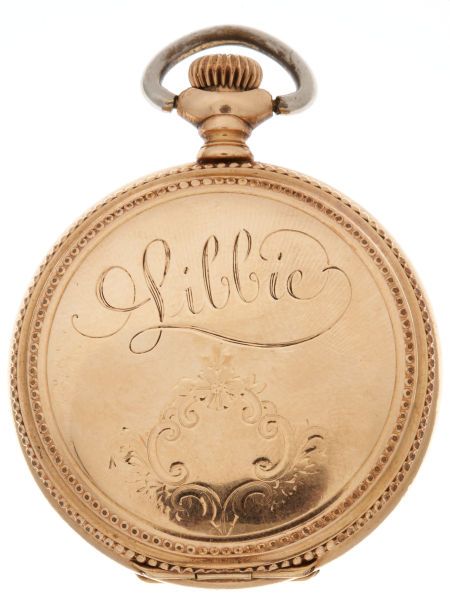
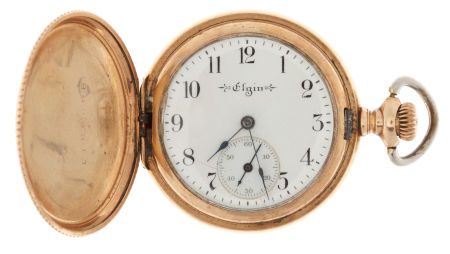
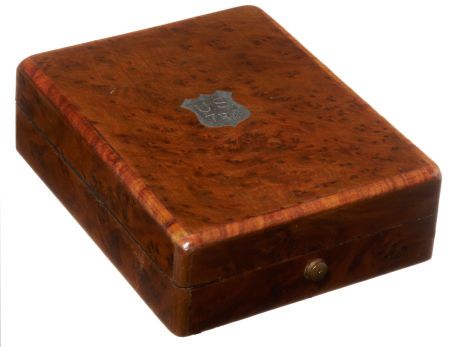
"Libbie" Custer: Engraved Watch Presented to Custer's Beloved Widow by the Veterans of the 7th Cavalry. A 14K gold-filled lady's pocket watch, affectionately inscribed "Libbie" on one side, and "1876 - 1901 'Lest we forget' " on the other. Contained in the original fine maple presentation box, with inset pewter shield inscribed "U.S. 7 Rgt." in center of top of the hinged lid....
lf.jpeg

lf-1.jpeg

lf-2.jpeg

lf-3.jpeg

http://historical.ha.com/itm/milita...he-veterans-of-the-7th-cavalry/a/6035-47324.s
 
Hi, I'd love to see a picture of the movement (i.e., the works), if that would be possible.
The movement wasn't shown.

Here is a link to General Mahone's watch; movement shown -
http://historical.ha.com/itm/milita...ose-cut-diamond-at-the-movement/a/674-72319.s

Here is a link to General Ruggles' watch; movement shown -
http://historical.ha.com/itm/milita...inted-second-national-confeder/a/6098-32085.s

Search the website for civil war pocket watch. A few more are shown.
 
Thank you for bringing these two watches to my attention, Mr. Serpa. I must say that I am much more impressed with the Ruggles watch than the Mahone watch.

The only apparent link between the first watch shown and Gen. Mahone is the undocumented assertion made in the auction listing. Unless I missed it, General Mahone's name does not appear anywhere on the watch. Unless there is other documentation not shown, all we really know about the watch is that it is an English lever movement that was cased and sold in Richmond, VA (not an unusual occurrence at the time). The fact that the case is American made is a mixed blessing. On the one hand, the fact that the name of the Richmond retailer appears on the case is highly consistent with the suggestion that the watch had been carried by a confederate officer. On the other hand, if the watch had been cased in England, the case would have been date marked.

The Ruggles watch, on the other hand, would be a very desirable horological artifact even without an important provenance. It is an early Waltham Model 1859 movement with D. B. Fitts' patented reversing center pinion (which protects the wheel train and the escapement from damage in the event of a reverse impulse, such as often occurs when a mainspring breaks). The Fitts' patent feature, which is inaccurately, and amusingly described in the auction listing, is a scarce and highly desirable technical feature of the watch. Fitts' patent is engraved on the watch plate around the center wheel escutcheon, and part of the invention itself is visible as a disk protruding from the edge of the plate. Also, being an American movement, one can consult the Waltham factory records, which still exist, and know exactly when it was manufactured.
 
Hi, I guess I can understand why some who can might want to pay that much for General Stuart's watch. He was a famous, swashbuckling, arguably even romantic figure. I suppose if I were a multimillionaire I might have been tempted myself. That said, I paid $4,000 for Lt. Colonel John Hodges watch I showed pictures of here, and I can't convince myself that Jeb Stuart's watch is 35 times more interesting or important than that one.
 
Last edited:
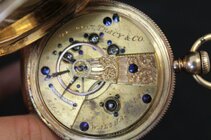
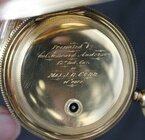
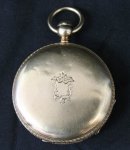
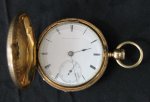
Here is another watch from my own collection. This gold watch was presented to Major Josiah B. Cobb of the 12th Indiana Cavalry by his Colonel, Edward Anderson. Given the production date of the movement, a 15 jewel, "Appleton, Tracy & Company" Grade Model 1857, made by the American Watch Company of Waltham, MA, in October of 1863, I am surmising that Cobb received the watch upon his promotion to major. (The 12th IN Cavalry took the field in March 1864, at which time Cobb, a veteran of the 2nd IN Cav, the first Indiana cavalry unit to serve in the CW, was "elected" a captain of the 12th Cav's Company D. He was promoted to major later that year.) According to his obituary in the Indianapolis Times, Cobb had helped to organize the 12th Cav in the winter of 1863. The 12th Cav saw action in Mississippi, Alabama and Tennessee against N. B. Forrest's guerrillas and the forces of John Bell Hood. They were involved in the battles of Wilkinson's Pike (aka Third Murfreesboro), Overalls Creek, and Fort Blakely, among others. Previously, Cobb had enlisted as a sergeant in the 2nd IN Cav, Company M, in November 1861, in which he would have seen action at the battles of Shiloh, Corinth, Perrysville, and possibly Stones River (aka Second Murfreesboro), before briefly returning to Goshen in late 1862 or early 1863.

Cobb again returned home to Goshen Indiana after the war, where he raised and raced horses, an especially fitting occupation for a retired cavalryman. (He reportedly had a racetrack on his property!) The major was elected Mayor of Goshen in 1884, and served as an Elkhart County Commissioner in 1901. He died on April 14, 1919.

I had high hopes that the Goshen Historical Society would be able to furnish a picture of the man, but no such luck. If anyone else can help me to locate a picture of Major Cobb, I would greatly appreciate it.
 

Attachments

  • JB Cobb AT&Co M57 Movement.jpg
    JB Cobb AT&Co M57 Movement.jpg
    221 KB · Views: 314
  • JB Cobb Cuvette w Inscription.jpg
    JB Cobb Cuvette w Inscription.jpg
    169 KB · Views: 349
  • JB Cobb front case lid.jpg
    JB Cobb front case lid.jpg
    126.7 KB · Views: 299
  • JB Cobb Dial view.jpg
    JB Cobb Dial view.jpg
    154.7 KB · Views: 312
Last edited:
Great thread!

Folks, I was told by a Gettysburg tour guide about time and how it was kept back then. He reminded us that there were no established time zones in 1863 and that those who owned and carried timepieces typically kept them set to local time, at home. And so that is partly why the Battle of Gettysburg is such a confusing mess, in terms of time of day.

Does this make any sense and is there further explanation?
 
Great thread!

Folks, I was told by a Gettysburg tour guide about time and how it was kept back then. He reminded us that there were no established time zones in 1863 and that those who owned and carried timepieces typically kept them set to local time, at home. And so that is partly why the Battle of Gettysburg is such a confusing mess, in terms of time of day.

Does this make any sense and is there further explanation?

Yes, this makes perfect sense. Not until the development of a long-distance railroad network had there been a compelling need to create global time standards. The world-wide time zone system we have today began as an effort by American railroads to coordinate the schedules of different intersecting rail lines, in order to avoid collisions, missed connections and unnecessary delays on busy routes. One could arrive in a railway station at "12:00" according to the reference clock of one railroad line, only to discover that your "12:15" connection on another rail line had already left. While first proposed in 1863, the first time zone system was not adopted until 1883.

It would be interesting to know whether either Meade's or Lee's general staff made any attempt to synchronize watches when they met.
 
Last edited:

Learn About Us
About CivilWarTalk
Contact the Webmaster
Meet the Staff
Link to CivilWarTalk
Join Our Community
Register
Browse Forums
View Today's Discussions
Search the Forum
Get Help
FAQ
Student Guide
Forum Rules & Etiquette
Copyright / DMCA

     Contact Us CivilwarTalk on Facebook CivilWarTalk on YouTube CivilWarTalk on Twitter RSS Feed

Bringing the American Civil War and More to Life.
© 1999 - , CIVILWARTALK, LLC - Site Version 10.0

SlaveryTalk.com - SecessionTalk.com - CivilWarTalk.com - ReconstructionTalk.com
Back
Top