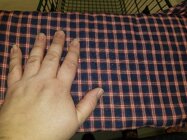
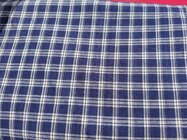
Just need an opinion

I'll have to come back tonight and read this thread more carefully. (As in, not when I'm supposed to be making dinner. Ha.) But this made me laugh:
Edited to correct stupid autocorrect--the correct term for the 19th century cotton fabric used for underthings is "longcloth," not "loincloth"!
All I could think was "Civil War loincloth". If I photoshop something later, it's this thread's fault!

Mary Dee, if there's anything I can do to help you with uploading photos, just PM me. Once you get them on your computer, they should upload on this site just fine. And if you get them on your computer but for some reason can't get them up here, you can try emailing one or two to me, and I'll see if I can do it. (I mess with photos all the time.)
 
So not to freak you out or anything, but from my understanding rats bones are very pliable and as long as their spine fits they can get into a hole the size of a quarter, mice can fit through a space the size of a dime.


Well that's just splendid. One of those things you can pretend you did not know, and enjoy life or, having discovered this factoid, make yourself crazy running amuck with a caulking gun. Cannot bring myself to poison anything. Seems so sneaky of us.
 
Well that's just splendid. One of those things you can pretend you did not know, and enjoy life or, having discovered this factoid, make yourself crazy running amuck with a caulking gun. Cannot bring myself to poison anything. Seems so sneaky of us.
I have tried the poison to no avail. Sealing all possible entrances into your home is the best preventative. I'm just glad I live somewhere it is not a problem.
 
I have tried the poison to no avail. Sealing all possible entrances into your home is the best preventative. I'm just glad I live somewhere it is not a problem.


Best, ever softy story? Son's apartment, necessarily shared with other mammals while counting student pennies. He'd set a Have a Heart trap at night, take the prisoner with him, to a local park on the way to work every morning. Called one morning- transpires he'd caught the rodent, made the usual Aiken's Landing stop, released his furry little roommate, got back in the darn car and ran right over it.

That poor mouse. Last time he forgets his mother's advice on looking both ways before crossing the street.

This has not, one thing to do with your nice thread. So sorry, little easily distracted.
 
Best, ever softy story? Son's apartment, necessarily shared with other mammals while counting student pennies. He'd set a Have a Heart trap at night, take the prisoner with him, to a local park on the way to work every morning. Called one morning- transpires he'd caught the rodent, made the usual Aiken's Landing stop, released his furry little roommate, got back in the darn car and ran right over it.

That poor mouse. Last time he forgets his mother's advice on looking both ways before crossing the street.

This has not, one thing to do with your nice thread. So sorry, little easily distracted.
He sounds like a gentle young man! Poor thing trying to do something good.
 
Do we have a thread on here about fabric and sourcing it? Like how dark is indigo really? Does Navy pass muster? My male guinea pig has requested a blue shirt as I am experimenting with patterns and I don't know where to go with it.
 
Do we have a thread on here about fabric and sourcing it? Like how dark is indigo really? Does Navy pass muster? My male guinea pig has requested a blue shirt as I am experimenting with patterns and I don't know where to go with it.

As I recommended previously, Elizabeth Stewart Clark's Sewing Academy site is excellent. http://www.thesewingacademy.com
Sign up for the "SA Board" and ask your questions there. It may take a week to get answers, but you'll get them!

Plain color cotton was not used back in the day because the dyes tended to fade. If using cotton, you want plaids or patterns. If you see original period garments in plain colors, they are of a fabric other than cotton, probably wool or silk or a blend of those two.

I recommend Eileen Trestain's Dating Fabrics, available from amazon. She is a nationally known quilt expert who works at the National Park Service's Fort Vancouver site, right across the Columbia River from me. You can also view original period fabrics online at various museum sites, including quilt museums. Do note, however, that a lot of mid-19th century dyes tended to fade to brown, so brown was not quite as common as it appears from looking at original garments.
 
Last edited:
Oopps! Sorry! I missed the link the first time. The books are pricey, I have feeling I will need to. Suddenly every one is asking me to make something. It's like I can sew but I am slow and it may take a while. It took me a year to finish that scarf. Though now I am in a better environment it may be better.
It's like I found the fabric website but can't get a grasp of how to navigate it. I have pictures I took from the Ft. Sumter museum but don't know how to tell what was used in clothing.

I would not be surprised if blue was available even during the war in my home state of Ga., as Indigo was produced on Ossabwa Island. Other dyes were produced using things found in the swamps around my home town . Woad was still used for some British textiles and I don't know if they attempted to grow it here, it is still used in vanity projects on the British Isles, is very toxic? It's the same thing Picts painted themselves with in battle to induce an almost hypnotic state. The dye is unusual not just for it's drug like properties, but because the longer the dye is exposed to oxygen the more intense and dark the blue becomes. It's the reason why a lot of medieval tapestries have faded everywhere but where the blue is.
That doesn't surprise me about the brown. There's a dress at either Ripleys in St.Augustine or the Lightner Museum that was originally white from that time frame and it's now green I believe.

I was also trying to say a thread just for Fabrics and sewing would be nice to have a little guide for those starting out. It's confusing and hard to figure out which sites can be trusted for fabric and which sutlers are using authentic, and which ones are just selling make do's. The tiny notions like buttons versus hook and eye. I am afraid I want to learn everything and get impatient when it doesn't come all at once. LOL
 
Of course, there were plenty of colors, many of them richer than modern chemical dyes. The madder reds were an example. Certainly indigo was used. What I'm trying to point out is that solid color cottons were not used in the CW period because of the fading problem. If you see what purports to be a solid color cotton garment of the period, it's definitely not authentic. A plain blue shirt would probably be wool, probably not what you'd want for Florida summers. For cotton, stick with plaids or prints.

Characteristic prints of the period are spaced relatively far apart, not crowded. They often had a geometric feature, almost always vertical. This reproduction fabric (which I got on sale as it was discontinued) is a good example which I used for my first dress. I got it approved by several experts on the Sewing Academy Board before buying it, so I know it's good.
0263_0110.jpg


The best way to learn about period fabrics is to study various museum websites for originals, to get your eye trained. A number will have "swatch books" from the era (most women kept notebooks with little swatches of fabric from everything they sewed). Watch the dates! While some reproduction firms such as Reproduction Fabrics and Two Bees do have some authentic reproductions, not all of those they list as "Civil War" are authentic.

At least get registered for the Sewing Academy Board and ask your questions there. It's free! There is lots of free stuff on that site. If you buy nothing else, get Elizabeth Clark's Dressmaker's Guide. Considering the time and effort you put into CW era clothing, it's worth a little extra money to make sure you are doing it right. There is lots of free stuff on that site. For the Dating Fabrics book I mentioned, check with your local library which may be able to get it on interlibrary loan. There's also a lovely but hideously expensive book, Wearable Prints, 1760-1860 by Susan W. Greene, which you may also be able to get via interlibrary loan. Unfortunately most of the prints are earlier than the Civil War period.

I really don't want to go into detail on mid-19th century sewing techniques, because I'd just be copying Liz Clark's book, which would get me into serious copyright violations.

I wouldn't trust sutlers; even the best sell a lot of junk along with whatever good stuff they offer. I spent a two day reenactment several years ago casing them out. One I would trust is Originals by Kay https://shop.originals-by-kay.com/m...29972508B86317DA1AB369ADCD6CB.p3plqscsfapp002
Kay Gnagy is very well-known, and you'll find her giving lectures on fashion at the big reenactments. At reenactments, her sutler shop goes by the name of P Palmer Dry Goods.
 
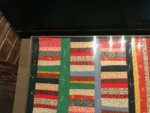
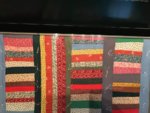
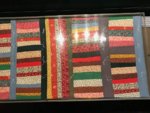
I pulled up the photos I took of the fabric at Ft. Sumter and I am thinking it' not authentic and just examples.
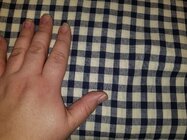
I can' find the photo I took of the display above them. Frustrating. I was looking at some options at Joanns (I really want to paricipate in the next living history weekend at our Ft. And I have a 60% off coupon. I used the 55% off coupon to buy a bolt of muslin for underpinnings. ) they're the bottom two images. Once my laptop loads I'm going to check out some copies of these books online.
I'm thinking about how better to present my impression too. It's leading me to wonder about the women who lived on Amelia Island. They were Southern and largely cut off from the outside world, but the Fort mostly stayed in Union hands through the war. What would it have been like working as a Laundress in the Fort at that time?
 

Attachments

  • FB_IMG_1521172837960.jpg
    FB_IMG_1521172837960.jpg
    76.9 KB · Views: 94
  • FB_IMG_1521172833950.jpg
    FB_IMG_1521172833950.jpg
    83.4 KB · Views: 87
  • FB_IMG_1521172826615.jpg
    FB_IMG_1521172826615.jpg
    89.4 KB · Views: 86
  • 20180315_200335.jpg
    20180315_200335.jpg
    470.1 KB · Views: 84
  • 20180315_200403.jpg
    20180315_200403.jpg
    447.3 KB · Views: 85
Although it isn't as active as it used to be, I've gotten a lot of help from Elizabeth Stewart Clark's "SA Board" on http://www.thesewingacademy.com I'm sure that any questions asked on that Board will be answered within a week or so. There's lots of free info in the "Compendium" section. there, and you can buy her excellent book, The Dressmaker's Guide. Do note that the period covered on her website (and book) is 1840-1865. I've found this helpful because here at the end of the Oregon Trail, and at Fort Vancouver, we have the opportunity to do both the 1840s and 1860s. I just wish I hadn't made my dress with coat sleeves, because coat sleeves are specifically an 1860s fashion item.

I just realized that I haven't bought any dress fabric for the past three years, so my info on fabric vendors is not as current as it could be.

My reenactment group has put on two seminars in the last 5 years, another great source of info, and we have a professional who does 19th century sewing and gives lessons. These, plus Liz' website, has been an enormous help--I started in 2013 knowing absolutely nothing. There's lots of info available at Fort Vancouver NHP (just across the Columbia River from me), too. If you're close to a period museum, you can find help there.

For @Shannon Wolf: Sewing tucks or flounces in the outer petticoat will give it more body, especially if you starch. I love tucks but they are tricky--measure and calculate not just once or twice, but 3 or 4 times! Either is easier than an out-of-date (assuming you're doing the Civil War) corded petticoat.

I have no idea why the mice ignored anything of cotton to snack on the wool! Also, they specifically went for the sontag and ignored my wool shawl!


Thank you for the Sewing Academy link BTW. It's lead me down a rabbit hole of research which will make my Laundress impression much better. Ft. Clinch is not far from where I grew up. Both my home town and our current county seat were plantations before, during, and after the war. Neither existed until 1893 roughly. St. Mary's though was founded by the Spanish, Used as a blockade running point at the start of the war, bombarded by the US Navy during the war, and over taken. It would not have been unheard of for someone from there to end up on nearby Amelia with family. There were roughly 1200 freedman and 200 others on the island during the war. This makes me feel more firmly planted in my home. I have a little more leeway than some for rougher fabrics I think. I can see how being a Laundress in the Fort would be a necessary thing, but hard knowing that most of their husbands and sons were fighting on the other side. The more I read the more curious I become.
 
So they didn' have enough yards of the other fabric. So after looking at tin types and sites till my eyes crossed I choose this one. It's in the dryer now. I have a quick project to start and finish then I'm going to work on my muslin mock up and then go from there. I still haven' tried my corset. That's next.
 

Attachments

  • 20180317_132331.jpg
    20180317_132331.jpg
    724.9 KB · Views: 100
If it's all cotton (no synthetic blends), it'll be perfect! Plaids like this were very popular back in the day! I love the color!

I've heard it both ways--that back in the day plaids were not matched, or that they were matched. Take your pick! Given that you're doing a laundress impression, you would be low-income and therefore could not afford the extra fabric needed to match them--which, IMHO, saves a lot of work!
 
Last edited:
If it's all cotton (no synthetic blends), it'll be perfect! Plaids like this were very popular back in the day! I love the color!

I've heard it both ways--that back in the day plaids were not matched, or that they were matched. Take your pick! Given that you're doing a laundress impression, you would be low-income and therefore could not afford the extra fabric needed to match them--which, IMHO, saves a lot of work!
From what I can gather the laundresses at our fort were the women left behind. The land here wasn't easily farmable for food. Fishing and Shipping were the primary business' in St. Marys, Ga. (My hometown didn't exist until 1893. Kingsland was originally a plantation owned by the King family) and it was abandoned after the Union Navy took over. I've found reference to a Naval Bombardment of the town, but I've not found any evidence and it would be difficult as one edge of the town is bordered by the estuary at the end of the St. Johns river, and the other by a lagoon and barrier island.
A lot of women would have ended up where ever family was close by. Amelia Island where the Fort is, is a simple boat ride across the river from there. Roughly 1200 freed people of colour and 200 townsfolk were left behind. The more I research the more questions I have and the more curious I become. Knowing your menfolk were largely Blockade runners and soldiers on the other side of the conflict. Being Union Occupied through out the war. Supplies being hard to come by as they were already on the Frontier so to speak. Needing supplies and working in the Fort being the best way to acquire them. How hard would it be to go to work for the very group your boys are fighting? They sent 2 women down from New York to teach the Freedman, and "help" the poor on the island. The more I dig into our history the more excited I get.
It's like I've read paste board was used to stiffen slat bonnets, but here and back home was swamp largely. There are natural resources that would have been more readily available and worked better. Makes me wonder if they would've used like palm fronds to stiffen instead.
 
Interesting history!

I never could figure out the pasteboard. Certainly those ladies who walked westward (they didn't ride in the wagon unless really sick or giving birth) on the Oregon and California Trails didn't use pasteboard when it rained every day! I expect that they found a man with a bowie knife to split thin wooden slats! I also have a corded bonnet, but it requires lots of starch--which, like pasteboard, dissolves in the rain!
 
My plan is to use dried palmetto fronds. They were used here frequently for everything from improvised brooms to baskets. I want to do a test though to make sure, if they get wet, 1) If they will soften, 2) If they will bleed colour. There are other plants too. I'm trying to go through my herbal pharmacopeia too for things that I can use.
 

Learn About Us
About CivilWarTalk
Contact the Webmaster
Meet the Staff
Link to CivilWarTalk
Join Our Community
Register
Browse Forums
View Today's Discussions
Search the Forum
Get Help
FAQ
Student Guide
Forum Rules & Etiquette
Copyright / DMCA

     Contact Us CivilwarTalk on Facebook CivilWarTalk on YouTube CivilWarTalk on Twitter RSS Feed

Bringing the American Civil War and More to Life.
© 1999 - , CIVILWARTALK, LLC - Site Version 10.0

SlaveryTalk.com - SecessionTalk.com - CivilWarTalk.com - ReconstructionTalk.com
Back
Top