
JPK Huson 1863
Brev. Brig. Gen'l
- Joined
- Feb 14, 2012
- Location
- Central Pennsylvania
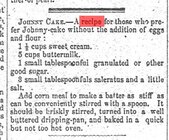
Originally intended to post an era recipe for Johnny Cakes. One ingredient is ' saleratus ' which of course was wildly distracting as in what in the name of all that's unidentifiable on the bottom of my shoe is ' saleratus ' ? Rats. Why is there always something to go look up, track down or run to earth? I am not obsessive, not obsessive, not obsessive.

" Saleratus was a chalk-like powder used as a chemical leavener to produce carbon dioxide gas in dough.
To make it, pearlash had carbonic acid added to it, changing the potassium carbonate in it to potassium bicarbonate. The chemical formula for this is KHCO3.
Strength varied by brand. All brands needed something acidic to react with."
http://www.cooksinfo.com/saleratus
" Per teaspoon of saleratus, 1 1/4 teaspoons of baking soda." Ah!
Literature & Lore
"Saleratus is said to be injurious to the human system, and that it destroys thousands of children and some adults every year. In New Brunswick, contiguous to Maine, the physicians are wont to say that half the children are killed by the use of saleratus. The evil is fast spreading throughout the Union. Families of moderate size already use from ten to twenty-five pounds yearly.
Remarks of the New England Farmer -- Storekeepers who have been engaged in the business for many years, have told us formerly they used to purchase three or four small kegs of saleratus for a year's supply in a country village, but that they now purchase more than as many large cases weighing six or eight hundred pounds each. Large quantities are used in making bread, the most common food, and of which all partake. Milk should take its place there. Many persons are in the habit of adding a little saleratus to most kinds of pastry. We are inclined to believe the remarks quoted above have much truth in them. We do not know how far the powder of saleratus may be neutralized by a mixture of other substances used as food, but it may be known by the chemist, and should be explained to the people.
What is saleratus? Wood burnt to ashes. Ashes are lixiviated -- lye is the result . Lye is evaporated by boiling -- black salts are the residuum. The salts undergo a purification by fire, and the potash of commerce is obtained. By another process, we change the potash into pearlash. Now put this into sacks, and place them over a distillery wash-tub, where the fermentation evolves carbonic acid gas, and the pearlash absorbs and renders it sold, the product being heavier, dryer and whiter than the pearlash. It is now saleratus. How much salts of lye and carbonic acid can a human stomach bear and remain healthy, is a question for the saleratus eaters." -- The Adams Sentinel and General Advertiser. Gettysburg, Pennsylvania. Monday, 15 August 1853. Page 5.
http://www.cooksinfo.com/saleratus
" Saleratus was a chalk-like powder used as a chemical leavener to produce carbon dioxide gas in dough.
To make it, pearlash had carbonic acid added to it, changing the potassium carbonate in it to potassium bicarbonate. The chemical formula for this is KHCO3.
Strength varied by brand. All brands needed something acidic to react with."
http://www.cooksinfo.com/saleratus
" Per teaspoon of saleratus, 1 1/4 teaspoons of baking soda." Ah!
Literature & Lore
"Saleratus is said to be injurious to the human system, and that it destroys thousands of children and some adults every year. In New Brunswick, contiguous to Maine, the physicians are wont to say that half the children are killed by the use of saleratus. The evil is fast spreading throughout the Union. Families of moderate size already use from ten to twenty-five pounds yearly.
Remarks of the New England Farmer -- Storekeepers who have been engaged in the business for many years, have told us formerly they used to purchase three or four small kegs of saleratus for a year's supply in a country village, but that they now purchase more than as many large cases weighing six or eight hundred pounds each. Large quantities are used in making bread, the most common food, and of which all partake. Milk should take its place there. Many persons are in the habit of adding a little saleratus to most kinds of pastry. We are inclined to believe the remarks quoted above have much truth in them. We do not know how far the powder of saleratus may be neutralized by a mixture of other substances used as food, but it may be known by the chemist, and should be explained to the people.
What is saleratus? Wood burnt to ashes. Ashes are lixiviated -- lye is the result . Lye is evaporated by boiling -- black salts are the residuum. The salts undergo a purification by fire, and the potash of commerce is obtained. By another process, we change the potash into pearlash. Now put this into sacks, and place them over a distillery wash-tub, where the fermentation evolves carbonic acid gas, and the pearlash absorbs and renders it sold, the product being heavier, dryer and whiter than the pearlash. It is now saleratus. How much salts of lye and carbonic acid can a human stomach bear and remain healthy, is a question for the saleratus eaters." -- The Adams Sentinel and General Advertiser. Gettysburg, Pennsylvania. Monday, 15 August 1853. Page 5.
http://www.cooksinfo.com/saleratus


 Forum Host


 Bringing the