"Irish" Potatoes

lupaglupa

Lt. Colonel
Forum Host
Joined
Apr 18, 2019
Location
Upstate New York
IrishPotatoes.png

As a child when visiting my grandparents in Mississippi, I helped in the garden. They grew an a variety of potato I'd never heard of, the "arsh" potato. After a bit I realized "arsh" was "Irish" and "arsh potato" was my grandparents term for what I, raised in New York, would just call a potato. To them, Irish was needed to differentiate between white and sweet potatoes, a contrast rarely needed in the North.

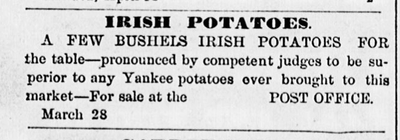
My grandparents weren't unique in this. Irish potato was a common term in the South. A search of Civil War newspapers shows almost every use of the term came in a Southern paper. And the uses outside the South almost always were in articles about the South. The Confederate Congress even used the term in legislation: the law which stipulated the payment of taxes in kind had set asides for families that included sweet and Irish potatoes.

I haven't heard or seen the term in recent years. Has it died out, like so many other regional colloquialisms?
 
The white potato was first introduced into North America in Londonderry, New Hampshire in 1719. The plants had come from Ireland, and so became known as the Irish potato. The plant spread rapidly (Idaho by 1838), and whatever the origin, the term "Irish potato" was widely used throughout the 18th and 19th centuries. In the 1850 and later agricultural schedules of the US Census all potatoes were categorized as either "Irish" or "Sweet". The "Irish" designation has simply gone out of general use.
 
Irish potato - hadn't heard that for a long time. Potatoes were developed in Peru, in great variety as well, and - like corn - it was a food that kept well and had lots of vitamins. Spanish sailors learned to pack potatoes and corn for their food supply! Which is how Francis Drake got credit (likely undeserved) for introducing the potato to Ireland. He could never figure out whether he was a pirate or a patriot but he was never one to let a juicy-looking Spanish galleon pass. He captured one which, instead of being full of gold was full of potatoes. That was a head scratcher! What's up with the taters? he asked the captain. Cap'n said we're eating them and growing them in Spain. They do well in lousy soil - we have a lot of that! So...legend has it Queen Elizabeth I thought it was a good food for poor people and Ireland was full of poor people so here come the potatoes! Irish potatoes were developed to be blight-resistant, and so they were the predominate crop...until a blight came along they weren't resistant to. When you can see the pestilence drifting in from the ocean...you know you're doomed! But the potato famine did give us Patrick Cleburne. The Cleburne tenants couldn't pay their rent, government said pay them anyway, but without the potato crop no can do...I'm headed for America! Stick a fork in it, his Irish potato was done...
 
it was a good food for poor people and Ireland was full of poor people
It became the staple diet of the poor and when their crops failed, they starved. As you say, they couldn't pay rent to their landlords, ended up homeless as well as starving and many took to eating grass as a means to try and survive. Almost half the population of the country was wiped out with emigration being an element of that, while shiploads of edible produce continued to be shipped to England as the Irish population starved. We can definitely be thankful for those who managed to emigrate to the four corners of the earth bringing with them all the good things the Irish had to offer.
 
It became the staple diet of the poor and when their crops failed, they starved. As you say, they couldn't pay rent to their landlords, ended up homeless as well as starving and many took to eating grass as a means to try and survive. Almost half the population of the country was wiped out with emigration being an element of that, while shiploads of edible produce continued to be shipped to England as the Irish population starved. We can definitely be thankful for those who managed to emigrate to the four corners of the earth bringing with them all the good things the Irish had to offer.

The Irish are indeed a remarkable people! Yes, there were more factors in the Irish Famine than potato crop failure, which was plenty. In the case of Cleburne, his family was one of the 'landed gentry' and were supposed to keep collecting taxes from people who couldn't pay them, in addition to paying their own taxes - which they got from the sale of the tenants' crops. When the ship went down, everybody went with it. England didn't need the potatoes but the Irish did - it was a bad deal all around. So...America here we come! "Ireland is gone up," wrote Cleburne to his sister, matter of factly. He got a job and started bringing members of his family over, person by person. Even the upper class was starving.
 
Here's a little bit more on the perspective of the landed gentry in Ireland:

"Still, it's important to note that the bulk of these elected representatives were landowners of British origin and/or their sons. In addition, any Irish who practiced Catholicism—the majority of Ireland's native population—were initially prohibited from owning or leasing land, voting or holding elected office under the so-called Penal Laws.
Although the Penal Laws were largely repealed by 1829, their impact on Ireland's society and governance was still being felt at the time of the Potato Famine's onset. English and Anglo-Irish families owned most of the land, and most Irish Catholics were relegated to work as tenant farmers forced to pay rent to the landowners.
Ironically, less than 100 years before to the Famine's onset, the potato was introduced to Ireland by the landed gentry. However, despite the fact only one variety of the potato was grown in the country (the so-called "Irish Lumper"), it soon became a staple food of the poor, particularly during the cold winter months."

And the aftermath still being felt in the 20th Century:

"Tony Blair, during his time as British Prime Minister, issued a statement in 1997 offering a formal apology to Ireland for the U.K. government's handling of the crisis at the time."

 
The white potato was first introduced into North America in Londonderry, New Hampshire in 1719. The plants had come from Ireland, and so became known as the Irish potato. The plant spread rapidly (Idaho by 1838), and whatever the origin, the term "Irish potato" was widely used throughout the 18th and 19th centuries. In the 1850 and later agricultural schedules of the US Census all potatoes were categorized as either "Irish" or "Sweet". The "Irish" designation has simply gone out of general use.

Interesting that I didn't find it in Northern papers.
 
View attachment 345374

As a child when visiting my grandparents in Mississippi, I helped in the garden. They grew an a variety of potato I'd never heard of, the "arsh" potato. After a bit I realized "arsh" was "Irish" and "arsh potato" was my grandparents term for what I, raised in New York, would just call a potato. To them, Irish was needed to differentiate between white and sweet potatoes, a contrast rarely needed in the North.

My grandparents weren't unique in this. Irish potato was a common term in the South. A search of Civil War newspapers shows almost every use of the term came in a Southern paper. And the uses outside the South almost always were in articles about the South. The Confederate Congress even used the term in legislation: the law which stipulated the payment of taxes in kind had set asides for families that included sweet and Irish potatoes.

I haven't heard or seen the term in recent years. Has it died out, like so many other regional colloquialisms?

I remember my parental grandfather talking about the little red potatoes that he grew in his garden, calling them "ice" potatoes.
My young ears heard that and assumed that red potatoes were called ice potatoes until I got into my teen years.

I still use the term Irish Potato to refer to the smaller potatoes with red skins that are often used in dishes like stews, soups and with pot roast. This term distinguishes them from the white potatoes that are used for french fries and baking and the sweet potato which has a variety of uses. Some people also use the term New Potatoes to describe what I call Irish Potatoes.
 
Last edited:
The Spanish first brought the potato from the Americas, and by the 1560s it had begun to spread to the Hapsburg lands, where it widely replaced turnips and rudabagas. Drake, and others, as @diane pointed out, filched it (it was what they did best) from the Spanish, and brought it to the British Isles. One version gives Sir Walter Raleigh credit for bringing it to Ireland, at Queen Liz' behest, possibly.

The Phytophthora infestans organism, which caused the great potato famine, first appeared in Mexico in the 1820s, and soon after in Vermont and New Hampshire, where it quickly ran its course and then died out. It also showed up sporadically in northern and western Europe before arriving in Ireland, where it "went wild." What made Ireland different was the almost complete dependence of the bulk of the population on this one crop (it was about the only thing they could grow that wasn't taken from them by the "Ascendancy" landlords to pay their rent), and a few cold, wet years in the mid-1840s, that provided the ideal environment for an 'epidemic' growth of the infestation.

In 1841 the Irish population was 8.2 million. By 1851, it was 6.5 million, and would continue to decline well into the 20th century (today it's 6.7 million -- for the entire island).
 
Last edited:
I've heard someone else here refer to an 'Irish potato' in a more modern context and I had never considered potatoes to be 'Irish' per se. Potatoes are just potatoes, and there is a large variety to be sure, but there's definitely a connection to the Irish as the term indicates. There is also an identification in the Irish psyche with potatoes and while my children may still refuse other vegetables from time to time, potato has never been one of them!

Potatoes were developed in Peru, in great variety as well, and - like corn - it was a food that kept well and had lots of vitamins.
And @diane as always you are an endless source of information (in fact I think you are a walking encyclopedia!), so when it comes to vitamins, I'm pretty sure potatoes were also used to prevent scurvy.
 
I've heard someone else here refer to an 'Irish potato' in a more modern context and I had never considered potatoes to be 'Irish' per se. Potatoes are just potatoes, and there is a large variety to be sure, but there's definitely a connection to the Irish as the term indicates. There is also an identification in the Irish psyche with potatoes and while my children may still refuse other vegetables from time to time, potato has never been one of them!


And @diane as always you are an endless source of information (in fact I think you are a walking encyclopedia!), so when it comes to vitamins, I'm pretty sure potatoes were also used to prevent scurvy.

The story of the development of corn and potatoes, which are staples in most of this hemisphere, is very intriguing...and very, very ancient. Mendel wasn't the first to fiddle with nature!

Potatoes and onions were very much sought for prevention of scurvy in the old British navy - they kept better than limes and the sailors would eat them! It was Horatio Nelson who first insisted on onions in particular for scurvy. He got stuck in the mud off the coast of South Carolina during the Revolution with no food - he and his scurvy crew were fixing to be gonners. Finally some loyalists brought out food - no citrus but plenty of onions to go with rice and such. Nelson noticed the onions worked a cure. When he was scolded by the Admiralty for not picking up his limes, he protested he'd picked up onions and potatoes which his men would eat, but they wouldn't take the lime juice unless he put it in their rum. (He may have invented the Mai Tai....!)
 
I didn't know about onions and their use in the prevention of scurvy! I've often always thought citrus fruits as well.

Onions actually have more vitamin C than oranges or limes. Nelson didn't know about that - he just observed his men's teeth stayed in their heads better with onions than with citrus! (He had bad dental problems himself - which started with that little vigil off SC. Got the same thing his crew had!)
 
:bounce:

Since this is the food forum, maybe someone has a recipe for that?

We might have to use vodka, to keep on the potatoes! :laugh: The original Mai Tai was developed by the famous Victor Bergeron - Trader Vic - in the mid-1940s to showcase a Jamaican rum he was promoting. The South Pacific and Caribbean were opening up as exotic tourist spots, so a drink to inspire was always great when you run clubs in that place. Tiki clubs, specifically! Basically, it was rum, lime juice and a nice syrup...now, it's quite the sugar bomb!
 

Learn About Us
About CivilWarTalk
Contact the Webmaster
Meet the Staff
Link to CivilWarTalk
Join Our Community
Register
Browse Forums
View Today's Discussions
Search the Forum
Get Help
FAQ
Student Guide
Forum Rules & Etiquette
Copyright / DMCA

     Contact Us CivilwarTalk on Facebook CivilWarTalk on YouTube CivilWarTalk on Twitter RSS Feed

Bringing the American Civil War and More to Life.
© 1999 - , CIVILWARTALK, LLC - Site Version 10.0

SlaveryTalk.com - SecessionTalk.com - CivilWarTalk.com - ReconstructionTalk.com
Back
Top