Help with Lock ID

Murph58

Cadet
Joined
Feb 25, 2024
Location
Shippensburg, PA
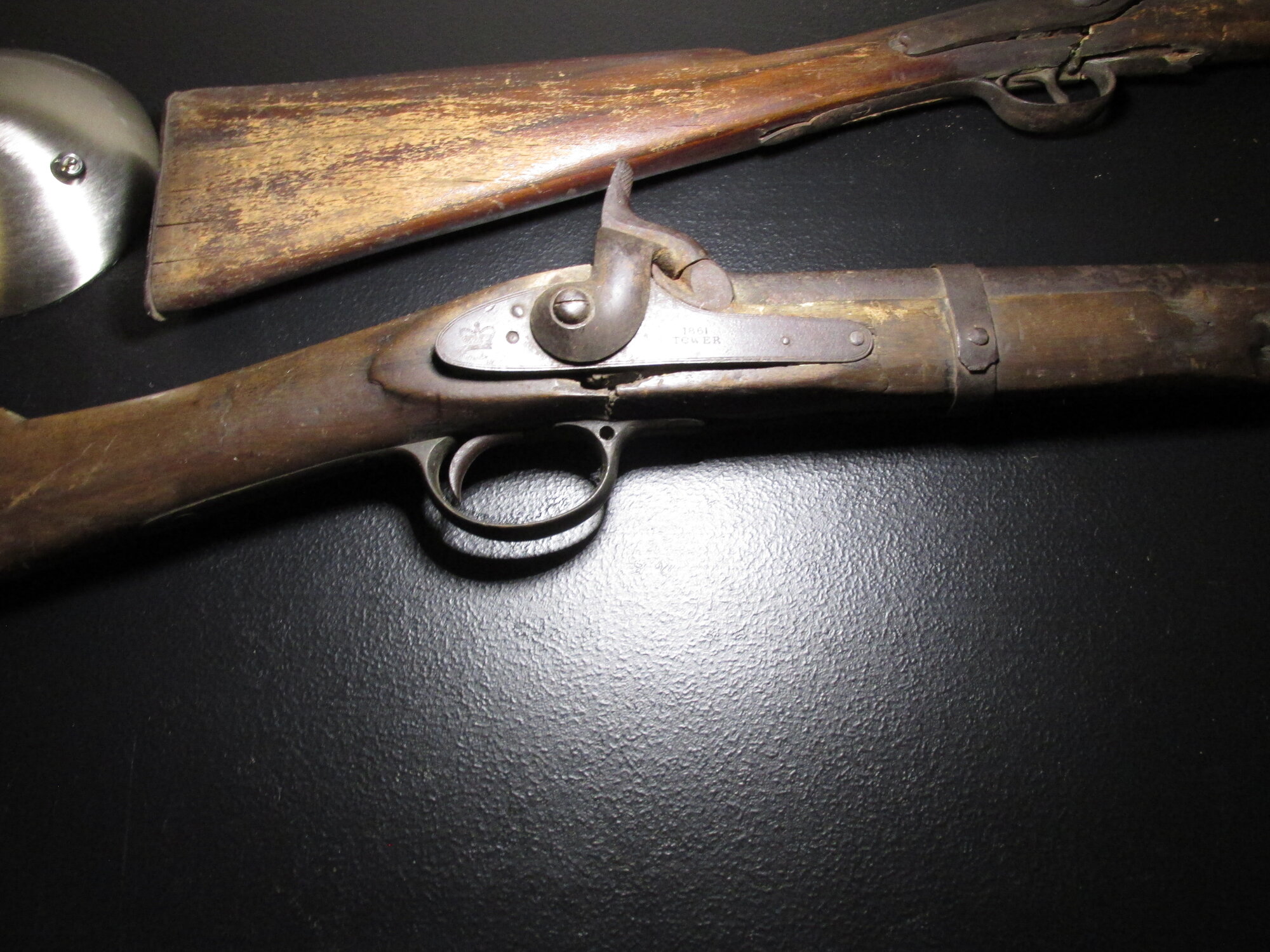
Hello All, I recently purchased two rifles with broken and shortened stocks at an auction held in a home in PA that was constructed in 1789. I did this thinking they may be civil war relics seeing the age of some of the other items from the home, (please excuse my typing since I have one finger bandaged up:). My thinking is either to leave them as is or take them apart and repair the remaining stocks. I'd like to just address one of the rifles at this time. I have done quite a bit of research on what markings I have found but nothing conclusive. From postings on this site, I see there are some knowledgeable people on the subject and hopefully find out if these are truly relics from the Civil War. Here are photos of markings on the lock and barrel. I can find no other markings on the wood other than the initials CH carved in the wood. Many thanks, Jim

pix1.JPG


pix2.JPG


pix3.JPG


pix4.JPG
 
The Enfield was a Birmingham-made civilian P1853 (long rifle) with a 25-bore (.577) caliber. Any confederate acceptance markings would be on the wood behind the trigger guard, but the condition of the stock is rather poor. Given the date, it would be one of the first imports, probably for the Confederates. Any markings on the top strap of the butt plate?
 
Thanks to all. Here are a few more rather poor pictures. The second gun is in the pictures but have not examined it closely yet. So far I can find no markings. Also is the ramrod. the unique thing to me is that the end does not have a screw hole. It appears to be a very hard wood. If someone can tell me the best way to remove the lock I'd appreciate it. If I can remove all the hardware I think I can fix what is left of the stock.

View attachment 499805

View attachment 499806

pix3.JPG


pix4.JPG


pix5.JPG


pix6.JPG


pix7.JPG
 
pS: The lock does function. I can attest to that since it went off unexpectantly and took a small chunk off my index finger. If it hit the center of the finger it would have broken the bone. Lesson learned. Thanks to the forum for allowing all the space for the pix. The other guns size seems to indicate it was made for a youth etc.
 
Welcome from the Fort Sumter and the Fredericksburg forums.

As others have said, one is a Model 1853 Enfield made by Tower in England in 1861. Likely imported early in the war. Check the wood on the bottom of the stock between the butt plate and the trigger guard tang to see if there are any initials or symbols showing.
 
Nothing on the buttplate tang means it ISN'T Second Contract, nor are there any state contract indications. So if (still debateable) it is a Civil War import it is likely to be one of the first import landings in early 1862. As Scooter says - check underneath the butt from buttplate to triggerguard for any marks/stampings
.
 
No I don't see anything for sure between the trigger guard and butt plate that is discernable!. I tried cleaning the wood some and about 1" from the end of the trigger guard there are some very faint scratchings but could be anything. This gun has had a lot of use by the looks of the stock. Not a Holland and Holland production thats for sure. I've never seen a stock so beat up and worn. There is so much wear from the end of the trigger guard to the butt that I don't think much could survive.
 
Okay, many thanks for all the help. I'll move on to the second rifle. In closing I see we do not have any proof remaining that it was used in the Civil War. Is this an accurate description? 1861 Tower Rifle or 1853 Enfield pattern musket
 
1861 Tower Rifle or 1853 Enfield pattern musket
An 1853 Enfield pattern musket, made in 1861 at the Tower Armory. I believe English government produced Enfields did not make it over here, but put those labels in the search bar (upper right corner) and you'll be pleasantly surprised at the number of threads.
 
An 1853 Enfield pattern musket, made in 1861 at the Tower Armory. I believe English government produced Enfields did not make it over here, but put those labels in the search bar (upper right corner) and you'll be pleasantly surprised at the number of threads.
NO. 'Tower' describes a series of consortiums of civilian gunmakers in Birmingham or London. At this time, it had nothing to do with the Tower Armoury (basically just a store of weapons). The date is its production date. Some bear gunmakers company names in place of 'Tower', some have no date, some have neither. Some were also supplied from Liege, Belgium and generally have no name or date and bear Liege/Belgian proof marks and inspectors stamps (* over (letter) externally.

It was not an official government product and, although it is an Enfield Pattern 1853 rifle musket, they are of variable quality and are rarely made with interchangable components. The only 'quality' mark on them are the civilian barrel proofs from the Birmingham or London Proof Houses. This tests the strength of the barrel. It does not mean they shoot straight.
Post-1813-Proof-Marks.jpg


Proof marks at this time - the Birmingham proofs also had the bore; 25 = .577", 24 = .58"

The government weapons were mostly produced at Enfield and are so marked. They carry government barrel proofs and acceptance marks. None were supplied to either side by the War Office or government.
 
Last edited:
Proof marks are there but pretty much unreadable for me. I tried chalk but no luck.

View attachment 499933
The results of long-term corrosion. This is what happens to these old guns when not looked after. It is JUST readable as a 1813-68 Birmingham proof.

The first proof - (crown over BP), provisional Black Powder proof - is usually the lower (nearest breech) with no bore size (but may well be underneath the barrel). After the first boring it is proofed again with bore size followed by - lower (left) (crossed sceptres and V - Viewer) and then, after finishing, the bore size followed by the Final Proof (crossed sceptres and BPC - Birmingham Company Proof). The letters are often unreadable and pistols rarely have the bore size.

25 is the usual bore size for .577" (British military standard) for rifles, but you may see some with 25 and 24, IOW - started as a .577" but was rebored to .58" (Union standard). Here is a more readable one:
1709196716966.png
 
Last edited:
Thank you for taking the time to look. Just wanted to be sure I am understanding correctly. When you say "The results of long-term corrosion. This is what happens to these old guns when not looked after. It is JUST readable as a 1813-68 Birmingham proof." are you referring to my gun or your? If you did manage to read the proof from your attachment what would your final description of my firearm? Thanks
 
Thank you for taking the time to look. Just wanted to be sure I am understanding correctly. When you say "The results of long-term corrosion. This is what happens to these old guns when not looked after. It is JUST readable as a 1813-68 Birmingham proof." are you referring to my gun or your? If you did manage to read the proof from your attachment what would your final description of my firearm? Thanks
The long term corrosion was describing yours.

Description - just what I said before - a British Enfield Pattern 1853 rifle musket of originally .577" caliber from civilian manufacture and dated 1861. We cannot say for certain that was a civil war piece as it has no US or CS acceptance marks visible but it is possible.
 

Learn About Us
About CivilWarTalk
Contact the Webmaster
Meet the Staff
Link to CivilWarTalk
Join Our Community
Register
Browse Forums
View Today's Discussions
Search the Forum
Get Help
FAQ
Student Guide
Forum Rules & Etiquette
Copyright / DMCA

     Contact Us CivilwarTalk on Facebook CivilWarTalk on YouTube CivilWarTalk on Twitter RSS Feed

Bringing the American Civil War and More to Life.
© 1999 - , CIVILWARTALK, LLC - Site Version 10.0

SlaveryTalk.com - SecessionTalk.com - CivilWarTalk.com - ReconstructionTalk.com
Back
Top