Help with Confederate foot locker identification

Franksalot

Cadet
Joined
Apr 25, 2016
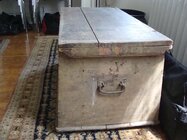
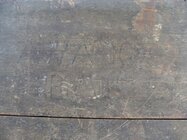
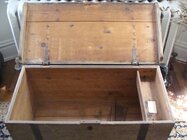
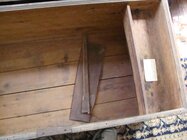
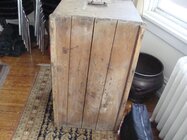
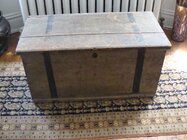
Let me start by saying I dabble in antiques and collectibles but I know very little about civil war history or collecting. I live in Richmond Virginia and last week I bought this foot locker out of a local estate auction. My sense of it when I saw it was that it is civil war and probably belonged to a confederate officer. It's made very well with dovetail joints out of yellow pine which likely makes it southern and it has the original grayish green milk paint finish. There are rails on the bottom that would make it easy to slide onto a buck board wagon. The hinges are old but not original I believe there were originally bigger iron strap hinges. There is some worn away writing on the top. I'd love to be able to figure out what the wring says. My guess is that whoever this belonged to was a man of means and likely went to a cabinet maker to have it made. It was obviously used hard and is still in very solid condition. I'm going to post a bunch of photos. Any help or info from anyone on this forum would be greatly appreciated.
 

Attachments

  • 2016-04-25 12.29.09.jpg
    2016-04-25 12.29.09.jpg
    306.4 KB · Views: 1,354
  • 2016-04-25 12.29.23.jpg
    2016-04-25 12.29.23.jpg
    272.8 KB · Views: 909
  • 2016-04-25 12.29.35.jpg
    2016-04-25 12.29.35.jpg
    297.1 KB · Views: 560
  • 2016-04-25 12.29.53.jpg
    2016-04-25 12.29.53.jpg
    244.8 KB · Views: 902
  • 2016-04-25 12.30.02.jpg
    2016-04-25 12.30.02.jpg
    239.8 KB · Views: 701
  • 2016-04-25 12.30.28.jpg
    2016-04-25 12.30.28.jpg
    258.2 KB · Views: 647
The best way to determine age on an old wooden chest is the type of lock. Check the markings. Also, what kind of nails were used in the construction? This box appears to have the straps painted on, more like a carpenter's tool box than a Confederate officer's trunk.
 
The best way to determine age on an old wooden chest is the type of lock. Check the markings. Also, what kind of nails were used in the construction? This box appears to have the straps painted on, more like a carpenter's tool box than a Confederate officer's trunk.
I'm pretty sure the first four letters in the top line are ANVA....Army of Northern Virginia. The N is mostly worn away but the A ..VA is still pretty easy to see.
 
I'm pretty sure the first four letters in the top line are ANVA....Army of Northern Virginia. The N is mostly worn away but the A ..VA is still pretty easy to see.
If it were an officer's trunk it would more likely be marked with the owner's regiment and/or company, but it's nice to dream.
 
If it were an officer's trunk it would more likely be marked with the owner's regiment and/or company, but it's nice to dream.
Could the top line actually read A VA NORTH and the one below say .. .. RM VALLEY. The regiment number worn away. Would those markings make any sense?
 
Such storage chests are quite common to have been found in homes... clothing or blanket/linen storage usually. The general designs were basic and didn't really alter much over the many decades.... yet differences may be found in those of different regions. Whether it be 1850 or 1890, many really didn't change much... In more rural areas even in use much longer. Construction methods and fasteners used can sometimes give a clue to generalized time frame... but many have also been repaired and altered over the years so would have to closely examine to determine what may be original and what isnt.. Because something might be of the era it would be quite speculative to assume it had some military function.

Military camp chests typically are found to be rather heavily constructed and many times reinforced... Those identified as such with provenance habitually would have the owners name and unit boldly painted on the exterior front or end.

chest-m19047a.jpg

chest-P1020078.jpg
 
Such storage chests are quite common to have been found in homes... clothing or blanket/linen storage usually. The general designs were basic and didn't really alter much over the many decades.... yet differences may be found in those of different regions. Whether it be 1850 or 1890, many really didn't change much... In more rural areas even in use much longer. Construction methods and fasteners used can sometimes give a clue to generalized time frame... but many have also been repaired and altered over the years so would have to closely examine to determine what may be original and what isnt.. Because something might be of the era it would be quite speculative to assume it had some military function.

Military camp chests typically are found to be rather heavily constructed and many times reinforced... Those identified as such with provenance habitually would have the owners name and unit boldly painted on the exterior front or end.

View attachment 98551
View attachment 98552
This is a heavily constructed chest. It has seen a lot of use and is still in very solid condition. I think the writing on the top is the key to knowing whether or not it was used for military use. While it makes more sense to have the owner's name written across the front, it certainly could have been written on the top and would have been visible for quite some time before being worn off. After moving it around for quite some time, everyone in the regiment would have known who's chest it was thus eliminating the need for further markings. This is a fairly unique chest. There would be no mistaking which officer it belonged to. Does this reasoning make sense to you? What do you make of the writing?
 
Hard to tell but: The handle looks pretty original to the trunk (from what I can tell here, based on color and wear.) Unless it is replacement, this was probably made after the 1870s because it is fastened with screws, a highly unlikely thing to occur before 1870 when the automatic lithe started mass producing wood screws. Plus that writing is way too small for the period , too dark (black on red,) and at the wrong place. My guess about the writing is that it was used at some time as a luggage or transport trunk and the marking are identifying marks.

Hard to tell about those things unless they come with a story and a name.
 
Hard to tell but: The handle looks pretty original to the trunk (from what I can tell here, based on color and wear.) Unless it is replacement, this was probably made after the 1870s because it is fastened with screws, a highly unlikely thing to occur before 1870 when the automatic lithe started mass producing wood screws. Plus that writing is way too small for the period , too dark (black on red,) and at the wrong place. My guess about the writing is that it was used at some time as a luggage or transport trunk and the marking are identifying marks.

Hard to tell about those things unless they come with a story and a name.
I think you might have your facts wrong about screws.
http://info.craftechind.com/blog/bid/301958/8-Little-Known-Facts-about-the-History-of-the-Screw
 
But were screws highly unlikely to be used pre-1870?

From http://journalofantiques.com/2002/c...ing-country-and-primitive-furniture-part-one/

bScrews.jpg

"The screw above was handmade. The slot in the top was hand cut by a hacksaw. The screw on the right was machine made. The slot in its head was cut by a machine. There are many differences between a handmade and a machine-made screw. The shank of a handmade screw does not taper. The point of the handmade screw is blunt. By contrast, the shaft of the machine made screw tapers to a point. The threads are cut evenly and they pitch at a different angle than those of the handmade screw. The first machine made screw dates to 1846. The first machine made screw with a machine cut slot in its head dates to 1856."

Those blunt screws show up in house door hinges and door latches pre-1840. I don't know the specifics of trunks, but I would want to see more evidence that they weren't used in such places. Here's an example of a chest in a style similar to the OP, which the dealer dates to the 1850s, with similar screwed-on handles: https://www.harpgallery.com/showroom/item22885.html
 
The bold markings placed upon military camp chests were done so for obvious reasons... when on active campaign extras and excess officer baggage would be placed in storage in the rear... and/or transported via rail if needed... etc... Those detailed to handle such things were usually folks detailed via quartermaster dept managing transport... Besides having probably close to 40 officer chests to deal with just for a given regiment many times... Unlikely the agent receiving request to retrieve Capt such and such belongings would have any clue which was his other than it being properly so marked... thats why they were marked, and it was the normal habit... Many many confirmed originals are noted like that. Ive examined quite a few of them over the decades...

Besides using a blanket chest for this purpose would be a bit of a stretch... since each respective officer was only allotted a given space size and weight limit for their baggage.. This being much larger in size than what was typically allowed...

I do hope this item was not sold with some Confederate officer use story attached to it... Nothing present would give any evidence of such. This is a blanket chest, and the pattern of it is a common one. This particular style usually associated with makers in Pennsylvania and the use of the blind strap hinge that yours once had, and the internal small compartment box. Text book common features of these.. Some had feet, others just runners on the bottom. Still a nice item, but it is what it is...
blanket-bb5.jpg


blanket-DSC_4160.jpg


blanket-fish%20tail.jpg
 
The bold markings placed upon military camp chests were done so for obvious reasons... when on active campaign extras and excess officer baggage would be placed in storage in the rear... and/or transported via rail if needed... etc... Those detailed to handle such things were usually folks detailed via quartermaster dept managing transport... Besides having probably close to 40 officer chests to deal with just for a given regiment many times... Unlikely the agent receiving request to retrieve Capt such and such belongings would have any clue which was his other than it being properly so marked... thats why they were marked, and it was the normal habit... Many many confirmed originals are noted like that. Ive examined quite a few of them over the decades...

Besides using a blanket chest for this purpose would be a bit of a stretch... since each respective officer was only allotted a given space size and weight limit for their baggage.. This being much larger in size than what was typically allowed...

I do hope this item was not sold with some Confederate officer use story attached to it... Nothing present would give any evidence of such. This is a blanket chest, and the pattern of it is a common one. This particular style usually associated with makers in Pennsylvania and the use of the blind strap hinge that yours once had, and the internal small compartment box. Text book common features of these.. Some had feet, others just runners on the bottom. Still a nice item, but it is what it is...
View attachment 98722

View attachment 98723

View attachment 98724
A chest like this made to store blankets in a home would not be painted so plainly like this and then have all of it's paint and lettering worn off through heavy use. This chest was transported frequently at one time and likely had stuff placed and pushed around on top of it. Before I called it a blanket chest, I would call it a workman's chest but then I would be looking for quite a bit of scarring inside from heavy tools. Does anyone hear have any comment on the writing that is mostly worn away....what it might say? Top line A VA NORTH ? bottom line _ _ RM VALLEY? That's what I see.
 
It's an antique chest. I see no evidence to point to it as a CS officers camp chest or even to date it to the ACW. It's too lightly constructed to be a tool chest. It's a storage chest of one sort or another; whether for blankets or clothing I don't know.
 

Learn About Us
About CivilWarTalk
Contact the Webmaster
Meet the Staff
Link to CivilWarTalk
Join Our Community
Register
Browse Forums
View Today's Discussions
Search the Forum
Get Help
FAQ
Student Guide
Forum Rules & Etiquette
Copyright / DMCA

     Contact Us CivilwarTalk on Facebook CivilWarTalk on YouTube CivilWarTalk on Twitter RSS Feed

Bringing the American Civil War and More to Life.
© 1999 - , CIVILWARTALK, LLC - Site Version 10.0

SlaveryTalk.com - SecessionTalk.com - CivilWarTalk.com - ReconstructionTalk.com
Back
Top