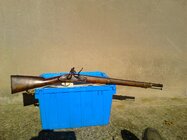
Help on Musket

kevikens

2nd Lieutenant
Joined
Jun 7, 2013
Location
New Jersey
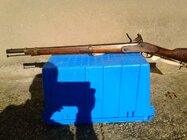
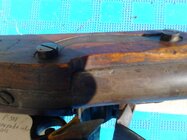
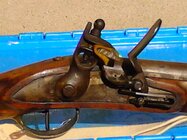
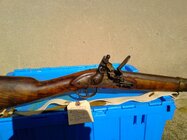
I a looking for information on a musket which is probably a French musket, model 1822 or 1829 in the musketoon barrel length, 25 inches and .71 caliber. Lots of makers or proof marks , crown with arrow and letters TI, crown with arrow on barrel and a Liege (Belgium) proof mark, another tiny crown and a capital C on the otherwise bare lock plate. The gun is a flintlock, not altered to percussion. Most of the furniture is in steel except for the barrel bands which are brass. I ran across a notation that some of these were sold to a Confederate agent and wound up in Confederate hands, though whether or not they had been converted was not stated. Anyway, I am looking for more information on this firearm as, having acquired this rather oddball arm, I want to know more about it and if, indeed, it was issued to any units in the CSA. Thanks for any information you ma be able to provide.
 
Confederate purchases of French and Belgian arms are quite scarce compared to the 150,000 or so bought by the north. I am not aware of any flintlock being purchased by either side. If you post some pictures I will do my best to ID it for you.

G
 
20111127142246_French%20Napoleonic%20Cavalry%20Arms%20006.jpg


Did they look anything like the bottom two? These are part of my collection of French Napoleonic arms. The bottom one dates to the French Revolution and was made in Liege around 1795; the middle one is French-made and newer, dated 1813.
 
Last edited:
Thanks. It looks pretty much like the middle one with the sling attachments in those exact locations, middle band and in the butt stock. But, the pan is iron, not brass and the middle band is brass as well as the front band as on yours. Also the trigger guard is iron (or steel). The barrel length is 25 inches, overall length is 40 inches. How does that compare to yours. On mine the barrel protrudes 3 and 1/3 inches from the front band and there is a small sight on the top of the barrel near the muzzle. I think it is a braised brass sight. There does not seem to be a bayonet lug but there may have been one at one time because underneath the barrel about an inch from the muzzle is a rectangular cut indented into the barrel. The rammer is a button type. I cannot quite see if yours has a bayonet lug and the shape of the rammer tip. I may have the model number wrong. What model is yours? Is your an An IX variant of the 1777? I am thinking low cost Belgian armory knock off some French model. No date anywhere that I can find and nothing legible inside the lock. sorry, I have no idea how to post images.
 
As a rule, neither side purchased or imported flintlocks from Europe. Plenty of percussion conversions from flint, but not arms still in flint. They had plenty of those obsolete arms sitting in armories awaiting conversion to percussion which had to be issued as a stop gap measure.

We also know flintlocks saw service until quite late in the war. The last on the Union side were picked up from the battlefield at Fredericksburg (13 were collected) and on the Confederate side, there is an account from the Trans-Mississippi in 1864 where a soldier mentions getting burned by a flash in the pan from a flintlock his file partner was using which singed his cheek. Some were noted in the AoT in use after Missionary Ridge, where more modern arms were lost and the flintlocks had to be reissued for the defense of Atlanta.
 
Thanks. It looks pretty much like the middle one with the sling attachments in those exact locations, middle band and in the butt stock. But, the pan is iron, not brass and the middle band is brass as well as the front band as on yours. Also the trigger guard is iron (or steel). The barrel length is 25 inches, overall length is 40 inches. How does that compare to yours. On mine the barrel protrudes 3 and 1/3 inches from the front band and there is a small sight on the top of the barrel near the muzzle. I think it is a braised brass sight. There does not seem to be a bayonet lug but there may have been one at one time because underneath the barrel about an inch from the muzzle is a rectangular cut indented into the barrel. The rammer is a button type. I cannot quite see if yours has a bayonet lug and the shape of the rammer tip. I may have the model number wrong. What model is yours? Is your an An IX variant of the 1777? I am thinking low cost Belgian armory knock off some French model. No date anywhere that I can find and nothing legible inside the lock. sorry, I have no idea how to post images.

20111127133131_French%20Arms%20017A.jpg


Bayonets were part of the weaponry carried by French cavalrymen and there are paintings of troopers on guard duty, both mounted and dismounted, with bayonets fixed. Both my musketoons have bayonet lugs and the Hussar musketoon (the one that looks cut down but isn't - it's made that way) had a longer-than-usual bayonet to compensate for the relative shortness of the musketoon. (They're very rare today, so I don't have one!) Brass pans are a feature of the M.1777's that were carried over as long as flintlocks were regulation, but during the Revolution and a couple of times during Napoleon's wars firearms became scarce and "parts guns" were created in the arsenals by cobbling together parts from earlier models. Until 1814, Belgium WAS France, so any regulation arms made there (like the musket at top marked Mfture Imple a' Liege) corresponded to those made in the rest of France.

20111127144248_French%20Napoleonic%20Cavalry%20Arms%20009A.jpg


This is known as Musqueton Mlle. An IX or "Year 9," meaning that many years since the French Revolution - which the French date from 1792 and the abolition of the monarchy rather than the 1789 fall of the Bastille - or in other words 1801; it was in most ways identical to the earlier M.1777 and another intermediate Revolutionary model. The barrel is dated on the tang 1812 and there is a cherrywood plug in the buttstock stamped E F (French Empire) surrounded by a circular stamp with the date 1813. It was made in the Imperial armory at Charleville and is so marked on the lockplate.

20111127145134_French%20Napoleonic%20Cavalry%20Arms%20007.jpg


Originally these were manufactured with a carbine bar and ring to attach them to the cavalryman's over-the-shoulder belt sling and mine is now missing that feature, but it was like the one on the Hussar musketoon below. This is possibly because these were eventually issued to such non-mounted personnel as bandsmen, medics, and even light infantry, especially when regular-length infantry muskets were in short supply. (That's why they were made with the loops for a short sling too.) These were replaced by newer post-Napoleonic models but remained in armories; some were eventually converted to percussion.

20111127144454_French%20Napoleonic%20Cavalry%20Arms%20012A.jpg
 
Last edited:
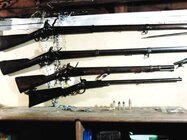
Thanks so much for posting these pictures, even though I have not yet got the hang of taking good ones. I did take some better ones this morning with the available sunlight and hope they will be better, including the two marks of the crowns, initials and arrows. Hopefully these can be posted later. Yes, it is the third from the top. It's hard to see in my lousy picture but it is almost a carbon copy of the US model 1816 (dated 1832) at the very top, except for the shorter barrel and the obvious US markings. The middle one is a model 1795 made by a contractor in 1808, and the bottom one a Gallagher carbine. Any other help would be gratefully appreciated as I like to nail down what I have in my collection. Thanks again.
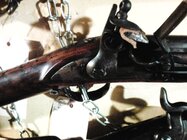
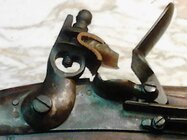
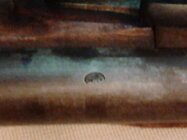
Photos of Kevin's musketoon; I believe it it shown as the third one from the top. View attachment 82243 View attachment 82244 View attachment 82245 View attachment 82246

Cheers,
Garrett
 
@kevikens MEA CULPA!!! I stated the model number of the French musketoon incorrectly - it is in fact denoted as M. An. IX the same as the infantry musket, so 1801, and have changed it accordingly in the OP. I was confounding it with the cavalry pistol which is called An XIII and one I used to have an example of until it was stolen in a smash-n-grab burglary.
 
Photos of Kevin's musketoon; I believe it it shown as the third one from the top. View attachment 82243 View attachment 82244 View attachment 82245 View attachment 82246

Cheers,
Garrett

That certainly looks the same as my M. An IX except of course for the absence of markings. That appears to be a Belgian proof on the barrel too. Belgium became independent in 1814 and kept it through the Waterloo Campaign and afterwards, so the mark makes it appear that this might indeed have been a Belgian copy of the French original, possibly made for France, a former ally of France, or even a former ENEMY of France. This is because victorious countries like Prussia, Austria, and Russia had on hand so many French arms following the Battle of the Nations at Liepzig in 1813 they issued them to their own levies and even adopted modified versions for their own armies. This was especially true for cavalry sabers and infantry short swords.
 
Last edited:
Thanks so much for posting these pictures, even though I have not yet got the hang of taking good ones. I did take some better ones this morning with the available sunlight and hope they will be better, including the two marks of the crowns, initials and arrows. Hopefully these can be posted later. Yes, it is the third from the top. It's hard to see in my lousy picture but it is almost a carbon copy of the US model 1816 (dated 1832) at the very top, except for the shorter barrel and the obvious US markings. The middle one is a model 1795 made by a contractor in 1808, and the bottom one a Gallagher carbine. Any other help would be gratefully appreciated as I like to nail down what I have in my collection. Thanks again.

One of my pictured muskets is something of a mystery too: The one at the top of the rack is marked on the lock Mfture Imple du Liege, but that only means the LOCK was made in the Imperial Lockplate Factory there - there was NO actual French government armory in Belgium despite repeated petitions by the Liege guilds for one to be established there. If I remember right, there is a date 1813 on the barrel, but like on my musketoon, the barrel might've been made well before the finished gun was assembled. There are NO French acceptance marks (the cherry plug and surrounding stamp), so I think it quite possible it was completed to be an arm for the then-new Belgian army. Also, the musket is shorter than regulation for a French infantry musket: note that it's the same length as the fusil beneath it made to arm French dragoons. Before the Revolution there had been a shorter French cavalry musket, but the model was dropped during the Revolution and not restored by the Empire.
 

Learn About Us
About CivilWarTalk
Contact the Webmaster
Meet the Staff
Link to CivilWarTalk
Join Our Community
Register
Browse Forums
View Today's Discussions
Search the Forum
Get Help
FAQ
Student Guide
Forum Rules & Etiquette
Copyright / DMCA

     Contact Us CivilwarTalk on Facebook CivilWarTalk on YouTube CivilWarTalk on Twitter RSS Feed

Bringing the American Civil War and More to Life.
© 1999 - , CIVILWARTALK, LLC - Site Version 10.0

SlaveryTalk.com - SecessionTalk.com - CivilWarTalk.com - ReconstructionTalk.com
Back
Top